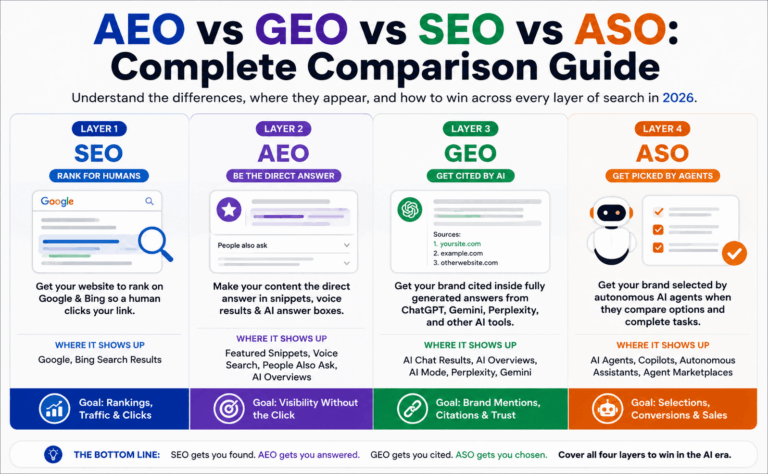
If you searched “AEO vs GEO vs SEO vs ASO,” you’re trying to solve one real problem: search has quietly split into four different games, and most articles online only explain two or three of them. Here’s the direct answer. SEO gets your website ranked on Google so a human clicks it. AEO gets your content chosen as the direct answer inside that search — a featured snippet, a voice reply, the top line of an AI Overview. GEO gets your brand cited inside a fully generated response from ChatGPT, Gemini, or Perplexity, whether or not anyone ever visits your site. And ASO — Agentic Search Optimization — gets your brand shortlisted and selected by an autonomous AI agent that is comparing options and completing a task on someone’s behalf, with no human reading anything at all.
This guide puts all four side by side, shows exactly where each one shows up in the real world, and gives you a practical framework for covering every layer instead of betting everything on just one.
Quick Answer: What Each Term Means
SEO
What Is Search Engine Optimization?
Search Engine Optimization is the original discipline: shaping a website’s content, code, structure, and backlink profile so it ranks organically on Google and Bing. The audience is a human being typing a query and scanning a page of results. Success is measured in ranking position, organic sessions, and the clicks that follow.
In 2026, SEO hasn’t gone away — it has become the floor every other layer stands on. AI systems and AI agents still discover most of their candidate websites through the same search indexes that have always powered SEO. If your site isn’t crawlable, indexed, and structurally sound, nothing above this layer can help you, because nothing above will ever find you in the first place.
- Keyword targeting and matching real search intent
- Technical health — crawlability, site speed, mobile UX, Core Web Vitals
- On-page structure — headings, internal linking, schema markup
- Backlinks and domain authority
- Local signals — Google Business Profile and citations, for local businesses
See how the fundamentals have shifted in our AI SEO vs Traditional SEO breakdown, or go straight to our SEO services if you need the foundation rebuilt properly before layering on the rest.
AEO
What Is Answer Engine Optimization?
Answer Engine Optimization structures your content so it can be lifted out and presented as a direct answer — a Google featured snippet, a voice assistant’s spoken reply, a “People Also Ask” result, or the opening line of an AI Overview. The audience is still human, but they may never scroll down to your actual page at all.
Winning AEO means writing the way people ask questions: a clear, complete answer in the first 40–60 words under every heading, followed by supporting detail. It leans on structured data — FAQ schema, unambiguous entities, question-shaped headings — because the systems extracting your answer are parsing structure, not admiring your prose.
- Featured snippets and direct answer boxes
- Voice assistant responses (Siri, Alexa, Google Assistant)
- “People Also Ask” inclusion
- The opening line of a Google AI Overview
AEO is closely tied to how Google’s Knowledge Graph understands your brand — read our Entity SEO guide for that connection, then go deeper with the complete Answer Engine Optimization guide.
GEO
What Is Generative Engine Optimization?
Generative Engine Optimization is about being cited — not ranked — inside a fully generated answer from ChatGPT, Gemini, or Perplexity. These systems don’t return a list of links; they synthesize an answer from several sources and, ideally, name yours as one of them. The reader may never click through at all — visibility here works as a trust signal as much as a traffic channel, which is exactly why the AI-referred visitors who do arrive tend to convert noticeably better than average organic traffic. They show up pre-qualified, already told by the AI that you’re a credible option.
GEO rewards data density, clear entity authority, and genuinely citable writing — specific numbers, named sources, and passages an AI model can lift cleanly without misrepresenting you.
- Citations inside ChatGPT, Gemini, and Perplexity answers
- Inclusion in Google AI Overviews
- Being referenced as a trust signal, even without a click
- Structured, data-dense, quotable passages an AI can extract cleanly
Start with the complete Generative Engine Optimization guide, then work through our GEO checklist and AI citation building framework to turn the theory into a working plan.
ASO
What Is Agentic Search Optimization?
A quick but important clarification: in app marketing, “ASO” almost always means App Store Optimization — ranking a mobile app in the Apple App Store or Google Play. That is not what this guide means. In the 2026 search-visibility context — and everywhere else on this page — ASO means Agentic Search Optimization, the discipline Adobe named in April 2026. If you came here for app store ranking advice, this isn’t that article. If you’re trying to understand the newest layer of AI search, keep reading.
Agentic Search Optimization is the newest and most demanding layer of the four. The audience is no longer a person at all — it’s an autonomous AI agent (Google’s Google-Agent, a ChatGPT shopping agent, a browser assistant like Project Mariner) comparing options and completing a task on a user’s behalf: shortlisting vendors, checking availability, or finishing a purchase. The human may approve a final recommendation and never read a single page themselves.
Winning ASO means making your pricing, specs, and comparisons machine-extractable in raw HTML, backing them with real third-party trust signals such as reviews and a verified entity presence, and — increasingly — exposing machine-callable actions through emerging protocols like WebMCP, UCP, and MCP, so an agent can act on your site instead of just reading it.
- Consideration-set inclusion — landing in the agent’s shortlist
- Transparent, extractable pricing and specifications (no “Contact Sales” walls)
- Third-party trust signals — G2 and Trustpilot reviews, verified entities
- Machine-executable actions via WebMCP, UCP, and MCP
This is the layer almost nobody has built yet. Our complete Agentic Search Optimization guide covers the full 90-day implementation roadmap, protocol-by-protocol.
SEO vs AEO vs GEO vs ASO: Side-by-Side Comparison
This is the table most “AEO vs GEO vs SEO” articles never finish, because they leave ASO out entirely. Here’s how all four stack up on the factors that actually matter for a strategy.
| Layer | Audience | Winning Means | Success Metric | Where It Shows Up | Core Tactic |
|---|---|---|---|---|---|
| SEO | Human searcher | Rank + earn the click | Ranking position, organic traffic | Blue links on the SERP | Keywords, backlinks, technical SEO |
| AEO | Human reading/hearing an answer | Become the direct answer | Snippet & PAA appearances | Featured snippets, voice replies, AI Overview intro | Question-first content, FAQ schema |
| GEO | AI answer engines & their users | Get cited in the generated answer | Citation frequency across platforms | ChatGPT/Gemini/Perplexity answers, AI Overview body | Data density, entity authority, citable passages |
| ASO | Autonomous AI agents | Get shortlisted & selected | Consideration-set inclusion rate | Agent shortlists, comparison tools, agentic checkout | Machine-readable pricing, trust signals, WebMCP/UCP |
How They Actually Work Together
These four disciplines are not competing options — they’re stacked layers, and each one depends on the one below it. SEO is the foundation: AI agents still rely on search indexes to discover candidate websites, so if you’re not indexed, you’re invisible to every layer above. AEO and GEO are the walls: they determine whether humans and AI systems actually see and repeat what you say. ASO is the roof: it determines whether an autonomous agent trusts you enough to act on your behalf. Skip a floor and the structure above it has nothing to stand on — chasing agent selection while your technical SEO is broken is building the third floor on sand.
Rather than running four disconnected campaigns, most brands fold all of this into one coordinated approach. That’s the whole premise behind Hybrid Engine Optimization (HEO) — a single strategy covering SEO, AEO, and GEO at once — paired with the broader Search Everywhere Optimization mindset of showing up wherever your audience actually looks, not just on Google.
Why the Terminology Is Still a Mess
Worth naming plainly: nobody has agreed on these terms yet. Some practitioners use AEO and GEO interchangeably. Others insist they’re distinct. You’ll also run into LLMO (Large Language Model Optimization), AIO (AI Optimization), and GSO (Generative Search Optimization) describing overlapping ground, and even fewer people apply any of these acronyms consistently over time. The honest takeaway: the underlying work — clean structure, real entity authority, citable content, machine-readable data — is nearly identical no matter which label you use. Tracking whether you’re actually getting cited and selected matters far more than which acronym you pick.
For the deepest dive on where the lines blur most (AEO and GEO specifically), see AI SEO vs Traditional SEO and our broader LLM SEO strategy guide.
Which One Should You Prioritize First?
The right starting point depends on your business model, not a generic checklist. Here’s how it typically breaks down:
A Combined Action Checklist
Nine concrete moves, tagged by which layer they primarily serve, that touch on all four disciplines at once:
Fix technical crawlability and Core Web Vitals before anything else — nothing above this works on a broken foundation.
Put a direct, 40–60 word answer immediately below every H2 and H3 — the exact chunk AI systems extract most reliably.
Add FAQPage schema to your highest-traffic pages, phrased as the exact questions people ask.
Build two or three original, data-backed statistics into every pillar page — data density drives citation likelihood.
Get your brand verified in Wikidata and the Google Knowledge Graph so AI models have a clean entity record to cite.
Put pricing and specs in raw HTML — never hidden behind “Contact Sales” or a JavaScript render agents can’t reliably parse.
Explicitly allow Google-Agent, GPTBot, PerplexityBot, and ClaudeBot in robots.txt — blocking them removes you from consideration entirely.
Actively collect and display third-party reviews — G2 and Trustpilot presence is a direct agent-trust signal, not just persuasion for humans.
Build strong internal linking between your related guides — it strengthens topical authority for humans, search engines, and AI systems simultaneously.
Frequently Asked Questions
Is traditional SEO dead now that AEO, GEO, and ASO exist?
What’s the real difference between AEO and GEO if they overlap so much?
Does ASO here mean the same thing as App Store Optimization?
Which one should a small business invest in first?
How do I measure ASO if there’s no “ranking” to track?
Can one person or team manage all four disciplines?
That’s the current state of almost the entire market — so you’re not behind, you’re at the same starting line as everyone else. The advantage goes to whoever builds the missing layers first.
Get a Free Visibility Audit →
See our content marketing services