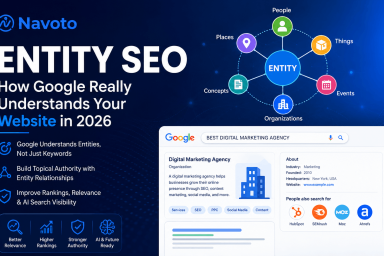
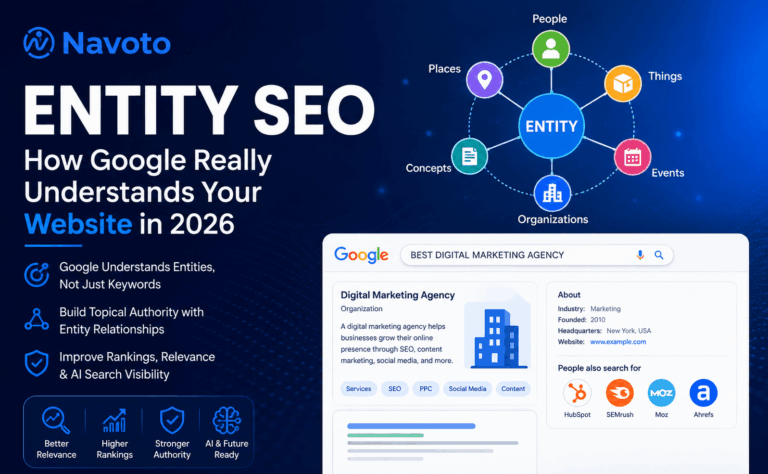
Quick Answer: Entity SEO is the practice of optimising your website so that Google understands your brand, content, and expertise as distinct, real-world “entities” — not just a collection of keywords. In 2026, Google uses the Knowledge Graph, AI systems, and structured data to understand meaning, context, and relationships. Businesses that master entity SEO build lasting authority that no algorithm update can easily erase. This guide covers everything: what entities are, how Google uses them, and exactly how to implement entity SEO on your website step by step.
1. What Is Entity SEO?
Entity SEO is the practice of structuring your website’s content, data, and digital presence so that search engines can clearly identify and understand your brand, people, products, services, and topics as distinct, real-world things — not just strings of text to be matched against search queries.
In traditional SEO, you optimise for keywords. In entity SEO, you optimise for meaning. The difference is enormous.
An entity is anything that is unique, clearly defined, and distinguishable from everything else. It can be:
- A person (a CEO, a doctor, a celebrity)
- A brand or organisation (Google, Navoto, Apple)
- A place (Mumbai, the Eiffel Tower, a restaurant)
- A product (iPhone 16, a software tool)
- A concept or topic (SEO, democracy, machine learning)
- An event (the Olympics, a product launch)
When Google sees the word “Apple” in your content, it does not just read the letters. It uses context to determine whether you are talking about the technology company, the fruit, or something else entirely. This contextual understanding is powered by entities and the relationships between them.
💡 Key Definition: Entity SEO is the practice of optimising content for the people, places, things, concepts, and brands that search engines recognise as distinct entries in their Knowledge Graph. Where traditional SEO targets keywords, entity-based SEO targets the underlying concepts those keywords represent.
At Navoto’s SEO services, entity optimisation is built into every strategy we execute — because without it, even technically perfect websites miss out on the deep search visibility that modern Google rewards.
2. Keywords vs Entities: The Big Shift in How Google Works
For the first decade of SEO, everything revolved around keywords. You researched what words people typed, you put those words on your pages, and Google ranked you for them. It was a system built on string matching — comparing character sequences.
That world is gone. In 2026, Google has shifted from understanding strings to understanding things.
| Traditional Keyword SEO | Modern Entity SEO |
|---|---|
| Focuses on matching words | Focuses on understanding meaning |
| Keyword density matters | Context and relationships matter |
| Ranks individual pages | Builds authority for your brand as a whole |
| Vulnerable to algorithm updates | Builds compounding, long-term authority |
| Works for search results only | Works for Google, AI Overviews, and voice search |
| Easy for competitors to copy | Brand identity is uniquely yours |
This shift happened gradually, powered by Google updates like Hummingbird (2013), RankBrain (2015), BERT (2019), and MUM (2021). By 2026, the entity-based model is not a future trend — it is the current reality that determines which websites rank and which get left behind.
⚡ Real-World Result
One SEO practitioner documented starting with entity optimisation on a new website and achieving 6,795 organic clicks, 668,000 impressions, and an average ranking position of 4.5 within 6 months — all driven by entity foundation work before any significant link building.
3. What Is Google’s Knowledge Graph?
The Google Knowledge Graph is a massive database that stores information about real-world entities and the relationships between them. Launched in 2012, it has since grown into the backbone of how Google understands the world.
Think of it as Google’s own version of an encyclopaedia — except instead of articles, it stores structured facts about entities and maps the connections between them.
When you search for “Marie Curie,” Google does not just find pages containing those words. It pulls a pre-established entity profile containing attributes like “Nobel Prize winner,” “physicist,” “Polish-French,” and “radioactivity research.” This is the Knowledge Graph at work.
What the Knowledge Graph Powers in 2026
- Knowledge Panels — the information boxes that appear on the right side of search results for brands and people
- AI Overviews — Google’s AI-generated answer summaries at the top of search results
- Featured Snippets — selected answers pulled from pages Google trusts as entity authorities
- People Also Ask boxes — related entity questions surfaced from the graph
- Voice Search answers — responses spoken by Google Assistant and similar AI tools
- Gemini AI citations — Google’s AI is trained on the Knowledge Graph, meaning entities in the graph are what AI cites in answers
💡 Critical 2026 Insight: Google’s Gemini AI is trained on the Knowledge Graph. This means brands with strong entity representations in the Knowledge Graph have a structural advantage in AI-generated answers and AI Overviews — not just traditional organic rankings. Entity SEO is now also Answer Engine Optimisation (AEO).
Understanding this connection is why our technical SEO approach at Navoto always includes Knowledge Graph signals as a core component of every website optimisation project.
4. Types of Entities Google Recognises
Not all entities are created equal in Google’s system. Understanding the different types helps you plan your entity SEO strategy. Google broadly categorises entities into the following types:
| Entity Type | Examples | Schema Type | SEO Relevance |
|---|---|---|---|
| Person | CEO, author, expert, influencer | Person schema | Critical for E-E-A-T signals |
| Organisation | Business, brand, agency | Organization schema | Highest-leverage schema type |
| Place | City, restaurant, landmark | LocalBusiness / Place schema | Essential for local SEO |
| Product | Software, physical goods, services | Product schema | Rich results and shopping |
| Concept / Topic | SEO, machine learning, democracy | Article / BlogPosting schema | Topical authority building |
| Event | Conference, product launch, webinar | Event schema | Event rich results |
For most businesses, the most important entities to establish are the Organisation entity (your brand) and Person entities (your key authors and experts). These two form the foundation of your entity SEO strategy and directly feed into your E-E-A-T signals — which we cover in depth later in this guide.
What Is Entity Salience?
Entity salience is a score from 0 to 1.0 that tells Google how important a specific entity is to a given page. A salience score of 1.0 means the entity is the entire subject of the page. A score of 0.1 means it is only mentioned in passing.
For entity SEO, you want your primary entity to have a high salience score on every page. This means placing your primary entity in the H1, in the first 100 words, and throughout the content naturally — not stuffing keywords, but building rich semantic context around the thing you want to be known for.
5. Why Entity SEO Matters More Than Ever in 2026
Five major forces have made entity SEO the single most important long-term investment in your digital marketing strategy in 2026:
5.1 Google AI Overviews
AI Overviews now appear at the top of a large proportion of search results. These answers are generated by Gemini, which is trained on the Knowledge Graph. If your brand is not established as a recognised entity in the Knowledge Graph, you are essentially invisible to AI-generated answers — which increasingly capture the top click-through on the results page.
5.2 Algorithm Update Resilience
Websites built on entity authority recover faster from core updates and are less vulnerable to ranking volatility. This is because entity SEO builds brand identity rather than exploiting technical loopholes. Keyword-only strategies are constantly at risk; entity strategies compound over time.
5.3 The Rise of Semantic Search
Google now understands synonyms, context, and intent. You do not need to repeat the exact keyword phrase dozens of times. What you need is comprehensive semantic coverage of your topic — using related concepts, co-occurring entities, and contextual signals that prove your expertise.
5.4 Voice Search and AI Assistants
When someone asks a voice assistant a question, the answer almost always comes from an entity recognised in the Knowledge Graph. Voice search responses are brief, direct, and entity-driven. If you want to be the answer to “Who is the best SEO agency in [city]?”, you need entity authority.
5.5 Brand Recognition and Trust Signals
When Google recognises your brand as a verified entity, it displays a Knowledge Panel in search results — a powerful trust signal that increases click-through rates and brand credibility. Businesses with Knowledge Panels look more established and authoritative than those without.
Want to see how your website currently performs on entity signals? Our professional SEO audit includes a full entity and Knowledge Graph assessment as part of the technical review.
6. How to Implement Entity SEO: Step-by-Step
Here is Navoto’s proven step-by-step framework for implementing entity SEO on any website:
Step 1: Define Your Core Entities
Before anything else, clearly define the entities that matter most to your business:
- Your brand/organisation — the primary entity everything else connects to
- Your key people — founders, authors, lead experts
- Your core services or products — each is its own entity
- Your location(s) — for local businesses
- Your topic areas — the concepts your brand is an expert on
Step 2: Consistency Across All Platforms
Google builds its entity understanding through triangulation — when it sees the same information about your brand on your website, your social profiles, and third-party directories, it confirms your entity status. This means:
- Identical business name, address, and phone number (NAP) everywhere
- Consistent brand description across Google Business Profile, LinkedIn, Facebook, Twitter/X
- Uniform founding date, leadership names, and service descriptions
- The same logo and brand visuals across all platforms
⚡ Pro Tip
In 2026, fragmentation weakens your entity signals. Consistency strengthens them. If your company is called “Navoto” on your website, “Navoto Digital” on LinkedIn, and “Navoto SEO” on Google Business Profile, Google cannot confidently connect these as the same entity. Choose one name and use it everywhere, always.
Step 3: Build Your Entity Home Page (About Page)
Your About page is your primary entity home — the page that Google uses as the authoritative source of information about your organisation. It must include:
- Your accurate founding date
- Leadership names and bios
- A clear description of what your organisation does and its geographic scope
- Links to your verified social profiles (LinkedIn, Twitter/X, Facebook)
- A JSON-LD Organisation schema block (see Section 7)
Step 4: Claim and Optimise Your Google Business Profile
Your Google Business Profile is one of the most direct signals Google uses to establish your organisation entity. Ensure it is fully completed, verified, and consistent with your website. For local businesses, this is also the foundation of your local SEO strategy.
Step 5: Build External Entity Mentions (Citations)
External mentions of your brand (without necessarily including a link) are called brand mentions or unlinked citations. These reinforce your entity status. Build them through:
- Press releases and PR campaigns
- Industry directories and listing sites
- Guest posting on authoritative websites
- Podcast appearances mentioning your brand
- Wikipedia and Wikidata entries (if your brand qualifies)
7. Schema Markup and Structured Data for Entity SEO
Schema markup (also called structured data) is code you add to your website that acts as a direct communication channel between your site and Google. Instead of Google having to interpret your content and guess what it means, schema markup tells it explicitly what each piece of information represents.
For entity SEO in 2026, the most important schema types are:
Organisation Schema — The Most Critical
Organisation schema is the single highest-leverage structured data type available in 2026. It establishes your brand as a verified entity in Google’s Knowledge Graph. The essential properties to include are:
- @type — Organization
- @id — set to your canonical domain URL (e.g. https://www.navoto.com)
- name — your exact brand name
- url — your website URL
- logo — URL to your logo image
- sameAs — array of your verified social profiles (LinkedIn, Twitter, Facebook, Wikipedia if applicable)
- foundingDate — the year your organisation was founded
- description — a concise, accurate description of what your organisation does
- knowsAbout — declare the topics your organisation has genuine expertise in (e.g. “SEO”, “content marketing”, “technical SEO”)
⚠ Important: The sameAs property is particularly critical because it connects your entity to authoritative external sources that Google uses for Knowledge Graph verification. An organisation schema that declares knowsAbout specific topics is more likely to be cited by AI systems for queries in those domains than an equivalent organisation with no topic declarations.
Person Schema — For E-E-A-T Authority
Person schema defines your key authors and experts as individual entities. This directly feeds into E-E-A-T signals (Experience, Expertise, Authority, Trust) which Google uses to evaluate content quality. Every blog post and article should have an author with a Person schema profile linking to their bio page.
Article / BlogPosting Schema — For Content Entities
Every piece of content you publish should use Article or BlogPosting schema. This clarifies the topic entity of each page, connects the content to its author entity, and tells Google the publication and modification dates — all signals that affect both ranking and AI Overview eligibility.
How to Add Schema Markup in WordPress
The easiest way to implement schema in WordPress is via a plugin:
- Rank Math SEO — offers the most comprehensive Organisation schema with fields for sameAs, knowsAbout, and other advanced properties. Recommended as the most complete solution in 2026.
- Yoast SEO — generates Organisation and Person schema automatically from your site settings. Excellent for getting started quickly.
- Schema Pro — dedicated schema plugin for advanced implementations beyond what Yoast and Rank Math cover.
Whichever plugin you use, always validate your schema using Google’s Rich Results Test and Schema.org Validator after implementation. Incorrect schema is worse than no schema — it sends confusing signals to Google.
Schema implementation is a core part of what we include in every technical SEO engagement at Navoto. If you are unsure whether your schema is correctly implemented, our SEO audit service includes a full structured data review.
8. Building Your Entity Home Page
Your entity home page is the page on your website that Google uses as the canonical reference point for your brand entity. For most businesses, this is the About page. For large organisations, it may also include a dedicated brand page.
Here is the complete entity home page checklist:
- Accurate founding date of your organisation
- Leadership names and roles clearly stated
- Clear geographic scope (where you operate)
- Concise description of your services and expertise areas
- Links to all verified social profiles (opens in new tab)
- Organisation JSON-LD schema embedded on the page
- NAP information (Name, Address, Phone) consistent with all other platforms
- Press mentions or notable citations — third-party validation of your entity
- Author bio links — connecting your people entities to your organisation entity
⚡ Quick Win
If you do nothing else from this guide today, audit your About page against this checklist. Missing items are likely the reason your brand does not yet appear in a Knowledge Panel. This is the single fastest entity SEO improvement most small businesses can make.
9. Entity SEO and Topical Authority
Topical authority is the degree to which Google recognises your website as a comprehensive, trustworthy source on a specific subject. It is one of the most powerful ranking factors in 2026 — and it is built entirely through entity-based content strategy.
Here is the core principle: the more comprehensively you cover a topic and all its related sub-entities, the more Google trusts you as an authority on that topic.
For example, Navoto wants to rank for “SEO services.” To build topical authority around this entity, we would create comprehensive content covering every related entity and sub-topic: technical SEO, local SEO, SEO audits, keyword research, link building, content strategy, Core Web Vitals, and more.
How to Build Topical Authority Through Entity SEO
- Create pillar pages for each core entity your business covers (e.g. “SEO Services,” “Technical SEO,” “Local SEO”)
- Create cluster content around every related sub-entity and question
- Internal link between related entities using descriptive, entity-rich anchor text
- Use co-occurring entities naturally in your content (related concepts that appear together in expert writing)
- Cover entities completely — Google rewards pages that fully address a topic, not pages that just mention it
Strong internal linking between your entity cluster pages is critical. Every link should use descriptive anchor text that includes the entity name — not generic text like “click here” or “learn more.” This reinforces entity relationships for Google and improves navigation for users. Our SEO services team builds these entity-driven content architectures from the ground up for every client.
10. Entity SEO and E-E-A-T: How They Connect
E-E-A-T stands for Experience, Expertise, Authority, and Trust. It is Google’s quality evaluation framework for web content, used by human quality raters and increasingly embedded in algorithmic signals.
E-E-A-T and entity SEO are deeply connected because Google evaluates E-E-A-T at the entity level, not just the page level. When Google assesses whether your content is trustworthy, it looks at the entity behind the content — your brand, your authors, and your track record.
| E-E-A-T Signal | What It Means | Entity SEO Action |
|---|---|---|
| Experience | First-hand experience with the topic | Author bios with real credentials; case studies; original data |
| Expertise | Deep knowledge of the subject | Person schema; author pages; expert content depth |
| Authority | Recognised as a go-to source by others | Backlinks; brand mentions; Knowledge Panel; citations |
| Trust | Accuracy, transparency, and safety | Organisation schema; reviews; consistent NAP; HTTPS |
The practical implication is that every piece of content on your website should be clearly attributed to a named, credentialled entity (a person) who is connected to your organisation entity via schema and internal links. Anonymous content has lower E-E-A-T trust signals in 2026 than clearly attributed expert content.
11. Common Entity SEO Mistakes to Avoid
Even experienced SEO teams make these errors when transitioning to entity-first strategies:
- Inconsistent brand names across platforms — the single biggest entity confusion signal you can send. Fix this immediately.
- Schema markup that does not align with real entity attributes — declaring yourself an expert in topics you do not actually cover is worse than no schema at all.
- Generic or missing schema markup — using basic schema without the sameAs and knowsAbout properties loses 80% of the value.
- No author entity pages — publishing content without linking to credentialled author bio pages weakens E-E-A-T signals significantly.
- Treating entity SEO as a one-time task — entity signals require ongoing maintenance. Your organisation changes, your topics evolve, your author team grows. Update your entity data regularly.
- Over-optimisation / unnatural entity placement — stuffing entity names into content unnaturally undermines readability and trust. Entities should feel natural in context.
- Ignoring unlinked brand mentions — if your brand is mentioned on other websites without a link, ask for the link. These are entity confirmation signals waiting to be maximised.
- Forgetting to validate schema — always test your structured data with Google’s Rich Results Test after any implementation.
12. Best Tools for Entity SEO in 2026
Here are the most valuable tools for researching, implementing, and monitoring your entity SEO strategy:
| Tool | Use For | Free or Paid? |
|---|---|---|
| Google NLP API | See how Google extracts entities from your content; check salience scores | Free (limited) |
| Google Rich Results Test | Validate schema markup and check for errors | Free |
| Google Search Console | Monitor brand query performance; track Knowledge Panel impressions | Free |
| Rank Math SEO (WordPress) | Implement Organisation, Person, Article schema with advanced properties | Free + Paid |
| Ahrefs / Semrush | Competitor entity gap analysis; backlink and brand mention monitoring | Paid |
| Wikidata | Add your brand entity to Wikidata (feeds directly into the Knowledge Graph) | Free |
| Schema.org Validator | Validate all structured data types against Schema.org standards | Free |
Want a Full Entity SEO Audit for Your Website?
Navoto’s team will audit your brand’s entity signals, Knowledge Graph presence, schema implementation, and topical authority gaps — then build you a step-by-step entity SEO roadmap.
13. Frequently Asked Questions About Entity SEO
What is the difference between entity SEO and regular SEO?
Regular SEO focuses on optimising individual pages for specific keyword phrases. Entity SEO focuses on building Google’s understanding of your brand, people, and topics as real-world things with defined relationships. Entity SEO works at the website and brand level; keyword SEO works at the page level. In 2026, you need both — but entity SEO provides the foundation that makes your keyword strategy far more effective.
How do I get my brand into Google’s Knowledge Graph?
You cannot directly submit your brand to the Knowledge Graph. Instead, you influence it by: (1) adding Organisation schema with sameAs properties to your website, (2) maintaining consistent brand information across your website, Google Business Profile, and social platforms, (3) getting your brand mentioned on authoritative third-party websites, and (4) creating a Wikidata entry for your organisation if you qualify. Over time, as Google collects consistent signals, your brand entity will be incorporated into the Knowledge Graph.
Does entity SEO help with AI Overviews?
Yes — directly and significantly. Google’s Gemini AI, which powers AI Overviews, is trained on the Knowledge Graph. Brands and content that are established as recognised entities in the Knowledge Graph have a structural advantage in AI Overview citations. Entity establishment is now effectively a prerequisite for AI search visibility, not just a traditional ranking factor.
What is entity salience and why does it matter?
Entity salience is a score from 0 to 1.0 that Google assigns to indicate how central a specific entity is to a given piece of content. A salience score of 1.0 means the entity is the primary subject of the page. Higher salience for your target entity means Google more confidently associates your page with that entity — improving both ranking relevance and the likelihood of being cited in AI answers.
How long does entity SEO take to show results?
Entity SEO is not a quick-fix tactic — it is brand infrastructure that compounds over time. Initial schema implementation and consistency work can show improvements in Knowledge Panel appearance within 2–4 months. Topical authority gains typically take 6–12 months of consistent content and entity signal building. However, once established, entity authority is far more resilient and durable than keyword-only rankings.
Do I need a Wikipedia page for entity SEO?
Not necessarily. While a Wikipedia page is one of the strongest entity confirmation signals Google uses, most small and medium businesses do not qualify for Wikipedia notability standards. A Wikidata entry is a more accessible alternative. More practically, consistent Organisation schema, Google Business Profile completion, and cross-platform brand consistency will achieve strong entity results for most businesses without requiring Wikipedia.
Conclusion: Entity SEO Is Brand Infrastructure, Not a Tactic
Entity SEO is not a clever trick or a temporary ranking shortcut. It is the architectural foundation of how Google understands your brand in 2026 and beyond. Businesses that invest in entity SEO today — building consistent entity signals, implementing structured data, establishing topical authority, and connecting their brand to the Knowledge Graph — are building compounding, algorithm-resistant search visibility.
Instead of chasing keywords, they build identity. Instead of reacting to algorithm changes, they strengthen semantic authority. And in a world where AI Overviews are reshaping how search results look and work, entity authority has become the key to remaining visible at the top of the results page.
At Navoto, entity SEO is embedded into everything we do — from SEO audits that assess your current entity signals, to technical SEO implementations that build your schema foundation, to ongoing SEO strategies that grow your topical authority month by month.
Ready to make Google understand exactly who you are and what you stand for? Get in touch with the Navoto team today for a free consultation.