If you don’t get one, or if the information that appears is vague or wrong, that’s a signal worth paying attention to. It means Google is still guessing about your brand, rather than knowing it with confidence. This matters more in 2026 than it ever has. Search engines no longer just match keywords to pages. They reason about meaning. They understand that “running shoes” and “athletic footwear” refer to the same concept. They know that “Marie Curie” is a scientist who won the Nobel Prize, not just two random words. And when someone asks ChatGPT or Perplexity a question, those AI systems draw from the same web of semantic knowledge to decide which brands and sources to cite.
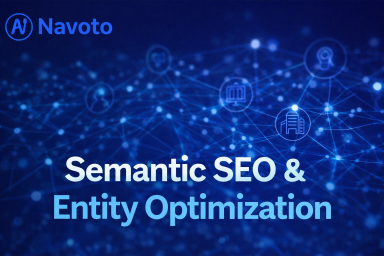
Semantic SEO and entity optimization are how you get your brand into that web of knowledge. This guide covers what they actually are, why they’ve become essential, and exactly how to implement them.
What Semantic SEO Actually Means
The word “semantic” comes from linguistics — it refers to meaning rather than just the surface form of words. Semantic SEO, then, is the practice of optimising your content so search engines understand what it means, not just what words it contains.
In the early days of search, Google was essentially a very fast counting machine. It looked at how many times a page contained a keyword and ranked accordingly. This is why “keyword stuffing” existed — people would repeat “best pizza New York” fifteen times on a single page and it would actually work.
That approach collapsed with algorithm updates like Hummingbird (2013), RankBrain (2015), and BERT (2019). Each one pushed Google further toward understanding language the way humans do — reading for context, intent, and relationships between concepts rather than just matching character strings. By 2026, Google’s Natural Language Processing is sophisticated enough that a page about “cardiovascular exercise benefits” will rank for “how running improves heart health” even if that exact phrase never appears once on the page.
Semantic SEO is the strategy of working with this shift instead of against it. It means building content around topics and their relationships rather than chasing individual keywords. It means structuring your site so that Google can map your subject matter comprehensively. And it means making your brand a verifiable, recognisable entity rather than just a domain name.
Quick distinction: Traditional keyword SEO asks “does this page contain the right words?” Semantic SEO asks “does this page demonstrate genuine understanding of this topic?” The second question is harder to game — and that’s exactly why Google now relies on it.
What an Entity Is — and Why Google Thinks This Way
An entity, in Google’s framework, is any distinct, uniquely identifiable thing. Not a word — a thing. A person, a place, an organisation, a product, a concept. The critical property of an entity is that it can be distinguished from everything else, even when the name itself is ambiguous.
Take the word “apple.” To Google circa 2005, that’s just a string of five letters. To Google today, it’s a disambiguation problem with a clear answer based on context. If the surrounding content talks about iPhones, App Store, and Tim Cook, “Apple” is a technology company with its own Knowledge Graph entry, a market cap, a founding date, and dozens of relationships to other entities. If the surrounding content talks about orchards, varieties, and Granny Smith, it’s a fruit. Same word, two completely different entities.
Your brand is an entity. Your CEO is an entity. Your main product categories are entities. Each of these has attributes — properties that describe it — and relationships to other entities. When you search for Marie Curie, Google doesn’t dig through web pages for keyword matches. It looks up the Marie Curie entity in its Knowledge Graph and pulls pre-stored facts: physicist, chemist, two Nobel Prizes, Polish-born, died 1934. The page ranking process follows that entity understanding, it doesn’t precede it.
Types of entities Google recognises:
🏠
People
Authors, founders, executives
🏛
Organisations
Your brand, partners, competitors
📍
Places
Cities, regions, premises
📚
Concepts
Topics, disciplines, ideas
📦
Products
Tools, services, software
Google’s Knowledge Graph — Explained Without the Jargon
Google launched the Knowledge Graph in 2012 with 570 million entities. By 2026, that number has grown to 8 billion entities storing 800 billion facts about relationships between them. It’s the largest structured knowledge database in human history, and it underpins how Google understands the web.
Think of it like a web of connected dots. Each dot is an entity. The lines connecting the dots are relationships — this organisation was founded by this person, who is known for this concept, which relates to these other concepts. When Google looks at your website, it’s not just reading words. It’s asking: how does this content connect to entities we already know? Does it add new information about existing entities? Does it introduce a new entity we should recognise?
The practical implication is significant. When someone asks Google (or ChatGPT, or Perplexity) a question, the AI doesn’t just match keywords. It traverses this entity graph, finds the most relevant nodes, and assembles an answer from the facts and relationships stored there. If your brand exists as a well-defined, verified node in that graph, you’re in the conversation. If you’re not, you’re invisible to the systems deciding whose content gets cited.
⚠ Without entity recognition
- Google treats your content as disconnected text
- Your brand may rank for keywords but remain unknown as an entity
- AI systems can’t describe your brand accurately
- No Knowledge Panel. Vague or absent AI mentions
✓ With entity recognition
- Google understands what your brand is and what it does
- AI systems cite you accurately in generated answers
- Knowledge Panel appears for branded searches
- You rank for related queries without keyword-matching every one
Why This Matters More Right Now Than Ever Before
Semantic SEO has been a topic since at least 2013. So why is 2026 the year people are finally treating it as urgent?
Two reasons. First, AI Overviews. Google now shows AI-generated answer summaries at the top of results for around 18–19% of all queries in the US. When that happens, the traditional organic links get pushed down or eliminated entirely. The brand that gets mentioned in the AI Overview is the one Google has identified as a trusted, relevant entity. If you’re not in that entity graph, you don’t make it into the Overview.
Second, the rise of conversational AI search. When people ask ChatGPT or Perplexity industry questions, those systems pull information from indexed web content — but they synthesise it through an entity lens. They’re looking for clearly defined, trustworthy sources. A brand with strong entity signals (verified profiles, consistent schema markup, topical authority, named authors) will be cited. A brand without them won’t, regardless of its Google rankings.
Both Google and Microsoft publicly confirmed in March 2025 that they use schema markup for their generative AI features. That’s not a speculation — it’s an official statement from the two largest search companies in the world. Schema markup, the main technical implementation of entity SEO, is now a direct signal for AI-generated answers.
Relevant reading from navoto.com
Understanding how AI search is changing visibility is the first step. How AI is reshaping SEO in 2026 covers the broader shift — including why entity signals now affect your visibility on platforms beyond Google.
Topical Authority: The Content Side of Entity SEO
Entity optimization has two sides: the content side and the technical side. Most people focus on the technical (schema markup, structured data) and neglect the content side, which is a mistake. You can have perfect schema markup and still have no topical authority.
Topical authority is Google’s way of assessing whether a site genuinely covers a subject area comprehensively. It’s measured by entity coverage — does the site address all the significant subtopics, questions, and connected concepts within its niche? A site with 40 well-structured articles on a topic will outperform a site with one thin keyword-stuffed page, even if the latter has more backlinks.
The way to build topical authority is through content clusters. You pick a central pillar topic — something your brand has genuine expertise in — and build a web of content around it. A pillar page covers the topic broadly. Cluster articles go deep on individual subtopics. Every piece links to the pillar and to relevant siblings. This structure isn’t just good content strategy; it literally maps your semantic neighbourhood in a way Google can read and trust.
Building a Content Cluster — The Practical Steps
Pick 3–5 pillar topics that define your brand’s expertise
Ask: what could we write 20+ articles about without running out of genuinely useful things to say? Those are your pillars. Everything else branches off them.
Map the entity relationships around each pillar
Use Wikipedia, People Also Ask, and tools like Google’s NLP API to find the entities that naturally surround your topic. These become your cluster articles.
Write for complete coverage, not keyword density
Each article should leave the reader (and the crawl bot) with no major unanswered questions on that subtopic. Depth within the piece matters more than how many times you used the target phrase.
Connect the cluster with consistent internal linking
Every cluster article should link to the pillar. The pillar should link to every cluster article. Sibling articles should cross-link where relevant. This creates the semantic web that signals topical ownership.
A strong content cluster typically includes one pillar page supported by eight to fifteen related articles. The number that matters isn’t fifteen — it’s completeness. If there’s an important subtopic or frequently asked question in your space that your site doesn’t address, that’s a gap in your topical authority, and Google knows it.
Worth reading alongside this
Topical authority and answer engine optimization are closely connected — AI systems specifically reward the same kind of depth. The answer engine optimization guide explains how that content structure translates into AI citations directly.
Schema Markup: The Technical Side of Entity SEO
If topical authority is the content side, schema markup is the technical side. Schema is structured data — specifically, a vocabulary from Schema.org that you embed in your pages to explicitly tell search engines what entities are present and what their relationships are.
Think of schema as the CliffNotes for your content, written specifically for machines. Your blog post might be 2,000 words of nuanced prose that a human can read and understand. Schema takes the key facts — this is an Article, written by this Person, published on this date, about this topic — and puts them in a format a machine can parse instantly without reading the whole piece.
Schema markup doesn’t directly determine rankings — Google is clear on that. What it does is reduce ambiguity. When your schema says “This is an Article written by a named author who is a member of this Organisation which operates in this industry,” Google can classify your content faster, more confidently, and more accurately. That confidence translates into better treatment in search results, eligibility for rich results, and higher likelihood of appearing in AI Overviews.
The Schema Types That Matter Most for Entity SEO
| Schema Type | What it does | Priority |
|---|---|---|
| Organization | Declares your brand as a verified entity with name, URL, logo, social profiles | Essential |
| Article / BlogPosting | Classifies content type, links to author Person entity, provides dates | Essential |
| Person | Defines authors as named entities with credentials, social links, expertise | Essential |
| FAQPage | Structures Q&A content so AI systems can extract clean answers directly | High |
| HowTo | Tells Google your page is a procedural guide — eligible for rich results | High |
| BreadcrumbList | Communicates site hierarchy and how pages relate to each other semantically | High |
| WebSite / WebPage | Connects individual pages back to the Organisation entity — ties it all together | Good to have |
The sameAs Property — Your Most Underused Entity Signal
Inside your Organization schema, the sameAs property is where you list every authoritative external profile that refers to your brand — Wikipedia, Wikidata, LinkedIn, Crunchbase, Google Business Profile, industry directories. Each one is a signal telling Google: “These external, trusted sources all agree this entity is the same thing.”
Cross-referencing matters because Google verifies entities by checking consistency across sources. If your About page, your Wikidata entry, your LinkedIn page, and your schema markup all consistently describe your brand the same way, Google’s confidence in your entity record increases. Inconsistency — different founding dates, different descriptions, different brand names across platforms — damages entity clarity and makes Google less likely to surface you confidently.
Basic Organization schema with sameAs — paste in <head> or via plugin:
{
“@context”: “https://schema.org”,
“@type”: “Organization”,
“@id”: “https://navoto.com/#organization”,
“name”: “navoto.com”,
“url”: “https://navoto.com”,
“logo”: “https://navoto.com/logo.png”,
“sameAs”: [
“https://www.linkedin.com/company/navoto”,
“https://en.wikipedia.org/wiki/Navoto”,
“https://www.wikidata.org/wiki/Q…”
]
}
Building Your Brand as a Recognised Entity
Schema markup is necessary but not sufficient. Google’s entity knowledge doesn’t come only from structured data on your own website — it comes from corroborating evidence across the web. The more authoritative external sources that consistently describe your brand, the more confident Google becomes in your entity record.
Jason Barnard, one of the most cited researchers on brand entity SEO, uses the phrase “entity home” to describe your About page. The theory is that your About page should be the single most authoritative place on the web for information about your brand. It’s where Google goes to understand who you are — and it’s what AI systems read when they’re deciding how to describe you in a generated answer. If your About page is vague, generic, or light on factual specifics, you’re missing the most important entity optimisation opportunity you have.
The Six External Signals That Build Entity Authority
- 1
Wikidata entry
Wikidata is one of the primary sources Google uses to build the Knowledge Graph. A Wikidata entry for your brand — with accurate attributes and external identifiers — is the closest thing to a direct ticket into the entity graph.
- 2
Google Business Profile
Even if you’re not a local business, a claimed and complete Business Profile tells Google you’re a real, verified organisation. The data you provide there feeds directly into the Knowledge Graph.
- 3
LinkedIn company page
LinkedIn is consistently cited as one of the most-referenced domains by major LLMs. A complete, consistently named Company Page reinforces your entity across the platforms AI systems read most.
- 4
Crunchbase / industry directories
For businesses in the tech or startup space, Crunchbase is a high-authority source that Google cross-references. Industry-specific directories relevant to your niche carry similar weight.
- 5
Editorial mentions in authoritative publications
When a well-known publication names your brand in a story — especially with consistent information about what you do — it adds corroborating evidence to your entity record. Not all press mentions are equal; relevance and authority both matter.
- 6
Named authors with their own entity signals
When your content is written by named individuals who have their own entity presence — their own bylines, bios, external profiles, and topic associations — their entity credibility transfers to your content. Anonymous content has no E-E-A-T signal at all.
Building entity authority for AI visibility
The same entity signals that improve your Google rankings also determine whether ChatGPT and similar platforms recommend your brand. The complete guide to ranking on ChatGPT in 2026 goes into exactly what those platforms look for when deciding whose content to cite.
How to Structure Content for Semantic Search
Semantic search requires a different writing discipline than keyword SEO. The goal is not to “use” a keyword the right number of times. The goal is to clearly communicate what an entity is, what its attributes are, and how it relates to other entities your audience cares about. Some specific practices that make a real difference:
Define entities early and explicitly
When a page is about a specific concept or entity, name it clearly in the first paragraph and define it. “Entity salience” is the technical term for how prominently an entity is featured on a page — scored 0 to 1 by Google’s NLP. Entities mentioned in the H1 and in the first 100 words have higher salience scores, which means Google treats them as the primary focus of the page.
Use descriptive, standalone headings
A heading like “How it works” tells a machine nothing. A heading like “How Google’s Knowledge Graph processes entity relationships” tells a machine exactly which entities this section covers and what relationship it’s explaining. Descriptive H2s and H3s are how AI systems segment your content into extractable answer chunks.
Use synonyms and related concepts naturally
Semantic search rewards topical depth, and topical depth shows up through natural variation in language. A page about “semantic SEO” that also naturally uses “natural language processing,” “entity recognition,” “Knowledge Graph,” and “structured data” is signalling genuine command of the topic. A page that just repeats “semantic SEO” fourteen times is signalling the opposite.
Cite your claims with real data
AI systems are trained to evaluate claim credibility. Content that makes a specific, verifiable claim — “Google’s Knowledge Graph contains 8 billion entities as of 2026” — and attributes it to a source is treated as higher-quality than content that makes vague assertions. Data citations also function as entity signals: the organisation you cite becomes a related entity on your page.
Content structure and AI visibility
If you’re also trying to optimise for Google AI Mode specifically, the structured content principles here apply directly. The complete Google AI Mode optimisation guide covers the additional formatting and technical signals that influence those results.
Internal Linking as a Semantic Signal
Most people think of internal links as a tool for spreading PageRank around the site. That’s still true — but internal links are also semantic signals. When you link from one page to another using descriptive anchor text, you’re telling Google: “These two pages are about related entities, and this specific phrase represents the relationship.”
A link with anchor text “entity-based SEO guide” establishes a semantic relationship between the source page and the linked page around the entity “entity-based SEO.” Google uses these relationships to build its understanding of how your site’s content is connected — which directly feeds into topical authority assessment.
Some practical rules for semantic internal linking:
- →Use entity names or descriptive phrases as anchor text, not generic phrases like “click here” or “read more”
- →Link from pillar pages to every cluster article — this signals that the pillar is the authority hub for that topic
- →Cross-link sibling articles when they discuss related entities — this creates the “semantic web” within your cluster
- →Audit orphaned pages — any page with no internal links pointing to it is semantically isolated, which weakens its authority regardless of content quality
Search everywhere, not just Google
Semantic SEO builds the foundation for visibility across every discovery channel — not just traditional search. Search everywhere optimisation explains how to extend that foundation across social platforms, AI tools, and other surfaces where your audience is actively looking.
Tools to Use for Semantic & Entity SEO
You don’t need an expensive tech stack to get started. The free tools will tell you most of what you need to know initially:
🔍 Google NLP API
Paste your page content and see exactly which entities Google extracts, their salience scores, and how they’re categorised. Free. Shows you what Google actually sees, not what you think it sees.
✓ Schema Markup Validator
Google’s Rich Results Test and the Schema Markup Validator at Schema.org. Use both. They catch different errors and tell you whether your structured data is correctly formed and eligible for rich results.
📈 Google Search Console
Your impression data shows which queries Google associates with your pages. If you’re ranking for semantically related queries you didn’t explicitly target, your entity associations are working. If you’re not, they’re not.
🌐 InLinks / WordLift
Specialist entity SEO tools that map entity relationships across your site, suggest semantic gaps, and help implement entity-aware internal linking. More advanced, but valuable for larger sites.
For tracking AI visibility specifically — which brands are being cited in AI answers for your target queries, and how your share of that is changing over time — traditional SEO tools don’t help much. This is a different measurement problem that requires a different approach.
Measuring entity visibility in AI search
Understanding how an AI search monitoring platform works is the logical next step once your entity optimisation is in place — so you can actually see whether it’s getting you cited in the places your audience is searching.
Mistakes People Make with Semantic & Entity SEO
Most of the mistakes in this space come from either misunderstanding how entity SEO actually works, or applying it as a surface-level add-on to a keyword-first strategy without changing the underlying approach.
✗
Treating schema as a “set and forget” task
Schema markup needs to stay consistent as your site changes. A rebrand, a new product line, or a URL structure change can break entity relationships you’ve spent months building. Validate your markup regularly.
✗
Inconsistent brand naming across platforms
If you’re “Navoto” on your website, “NavoTo Ltd” on LinkedIn, and “Navoto Technologies” on Crunchbase, you’re creating entity disambiguation problems. Google needs to see the same entity described consistently to build confidence. Pick a canonical name and use it everywhere.
✗
Anonymous content
Publishing content without a named author means zero E-E-A-T signal from a Person entity. Google can’t verify expertise it can’t attribute. Even if your content is excellent, anonymous publishing significantly limits its entity authority.
✗
Confusing topical clusters with just “writing more content”
Publishing 40 articles that don’t relate to each other is not a content cluster. It’s noise. The structure matters as much as the volume. Each piece needs to connect back to a pillar topic and link to sibling articles. Disconnected content doesn’t build topical authority.
✗
Only focusing on your own website
Your entity record is built from the entire web, not just your domain. If you’re doing all the right things on your website but neglecting Wikidata, external profiles, and community presence, you’re only doing half the work.
✗
Ignoring SearchGPT and non-Google AI platforms
Entity optimisation isn’t just for Google anymore. ChatGPT’s SearchGPT, Perplexity, and Bing Copilot all use entity signals to decide which sources to trust and cite. If you’re optimising only for the Google Knowledge Graph and ignoring everything else, you’re leaving AI visibility on the table.
Entity signals in SearchGPT
OpenAI’s search product uses its own version of entity trust when deciding what to cite. The SearchGPT optimisation guide breaks down exactly what those trust signals look like and how to optimise for them specifically. And if you’re thinking about AI chatbot platforms more broadly, the complete guide to AI chatbot platforms for businesses gives useful context on how these systems actually use brand information.
Frequently Asked Questions
Continue learning — navoto.com
More from the navoto.com SEO resource hub
Answer Engine Optimisation
Search Everywhere Optimisation
Rank on ChatGPT: 2026 Guide
Optimise for Google AI Mode
SearchGPT Optimisation Guide
AI Search Monitoring Platform
AI Chatbot Platforms Guide
© 2026 navoto.com — All rights reserved