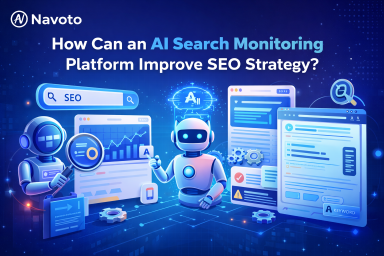
AI search monitoring platforms do more than track rankings. They predict ranking drops before they happen, surface competitor moves in real time, identify content gaps your team would never find manually, and tell you exactly why your traffic changed — and what to do next. This is the complete guide.
⚡ Quick Answer
An AI search monitoring platform improves SEO strategy by automating rank tracking across traditional and AI-generated search results, detecting algorithm changes in real time, identifying technical issues before they damage rankings, uncovering competitor gaps, and using machine learning to predict which content and keywords will drive the most growth. Instead of reacting to SEO problems after they happen, AI monitoring lets you act before traffic drops.
What is an AI Search Monitoring Platform?
An AI search monitoring platform is a tool that uses artificial intelligence — specifically machine learning and natural language processing — to continuously watch, analyze, and interpret how your website performs in search engines. It goes far beyond the old model of “check your keyword ranking once a day.”
Traditional SEO tools show you data. AI monitoring platforms explain that data, find patterns in it that humans would miss, and tell you what action to take next. They watch your rankings, your competitors, Google’s algorithm, your site’s technical health, and increasingly — your visibility inside Google’s AI-generated answer boxes — all simultaneously, all the time.
❌ Old SEO Monitoring
- Shows keyword rankings once a day
- You spot a traffic drop after it happens
- Manual checking of competitor pages
- Technical audits run once a month
- You guess what caused the ranking change
- Only tracks traditional blue-link results
✅ AI Search Monitoring
- Predicts ranking drops before they happen
- Alerts you to issues within hours
- Auto-tracks all competitor content changes
- Continuous technical monitoring 24/7
- Explains exactly why rankings changed
- Tracks AI Overviews, featured snippets, PAAs
In 2026, with Google’s AI Mode reshaping how search results are displayed, AI monitoring platforms have become even more essential. They now track whether your content appears inside Google’s AI-generated answers — a visibility channel that traditional rank trackers were never built to handle.
How Does an AI Search Monitoring Platform Work?
Understanding how these platforms work helps you use them more effectively. There are four core layers of technology working together:
Data Collection Layer
The platform continuously crawls search results, your website, and competitor websites — collecting ranking positions, SERP features, page content, backlinks, technical signals, and click data. This happens across hundreds or thousands of keywords simultaneously, in multiple locations and devices.
Machine Learning Analysis Layer
ML models analyze historical patterns in the collected data. They learn what “normal” looks like for your site. When something deviates from that pattern — a ranking drop, a traffic spike, a sudden competitor move — the AI flags it immediately and begins diagnosing the likely cause.
Natural Language Processing Layer
NLP models read and understand the actual content on your pages and competitor pages. They identify semantic relevance, topic gaps, readability issues, and whether your content matches the search intent behind specific queries. This is what makes AI monitoring smarter than simple keyword-matching tools.
Insight and Recommendation Layer
The most advanced platforms don’t just report findings — they generate prioritized action recommendations in plain language. Instead of showing you a graph of declining rankings, they say: “Your page for ‘keyword X’ dropped 8 positions because three competitors published longer, more comprehensive content. Here’s what to add.”
9 Ways an AI Search Monitoring Platform Improves Your SEO Strategy
This is the core of what you need to know. Here are the nine most impactful ways these platforms directly improve real-world SEO outcomes — with specific examples of what that looks like in practice.
Predicts Ranking Drops Before They Happen
This is the most powerful capability of AI monitoring and the one that saves businesses the most traffic and revenue. Traditional tools show you that your rankings dropped yesterday. AI platforms analyze signals — changes in competitor content, shifts in click behavior, crawl frequency changes, algorithm update patterns — and warn you that a drop is likely before it occurs.
Real example: An AI monitoring platform detects that three competing pages on the same keyword have all been updated and expanded in the past two weeks, while your page has not been touched in six months. The AI flags this as a high-risk situation and recommends a content update — before you lose a single position.
Business impact: Proactive vs. reactive SEO means protecting revenue instead of recovering it. The typical cost of a page-one ranking drop for a high-value keyword is weeks or months of lost traffic. Catching it early cuts that loss dramatically.
Delivers Real-Time Algorithm Change Detection
Google runs thousands of algorithm changes every year. Most are minor. But major updates — Core Updates, Helpful Content Updates, spam updates — can wipe out months of SEO progress overnight. AI monitoring platforms detect these changes faster than any manual process by watching patterns across thousands of websites simultaneously.
When a broad algorithm change rolls out, an AI platform will detect unusual volatility across many keywords at the same time, correlate it with industry-wide movement, and confirm whether your site has been positively or negatively affected — usually within hours of the update starting to roll out.
| Detection Method | Traditional Tool | AI Monitoring Platform |
|---|---|---|
| Speed of detection | 1–3 days after the fact | Within hours |
| Cause identification | Manual analysis required | AI explains likely cause |
| Recovery recommendations | None | Specific action items provided |
| Cross-industry comparison | Not available | Benchmarks against your industry |
Uncovers Hidden Content Gaps Your Team Would Miss
Manual keyword research shows you what keywords exist. AI monitoring shows you the specific sub-topics, questions, and angles that your content is missing — compared to the content that is actually ranking and getting cited in AI Mode responses.
AI platforms analyze the full semantic landscape around your topic. They look at what the top-ranking pages cover, what questions appear in “People Also Ask” boxes, what appears in AI Overview responses, what’s in featured snippets, and what your competitors cover that you don’t. Then they map all of this into a prioritized content roadmap.
💡 Practical Example
You have a page targeting “AI SEO tools.” An AI monitoring platform analyzes the SERP and tells you: your page covers 7 of the 14 sub-topics that top-ranking pages cover. The 7 you’re missing are: pricing comparisons, free vs paid tiers, integrations with Google Search Console, API availability, review aggregations, small business use cases, and setup time comparisons. Adding these sections would close your content gap and significantly improve your chances of appearing in AI Overviews for related queries.
Automates 24/7 Technical SEO Monitoring
Technical SEO problems are silent killers. A page that gets accidentally blocked from crawling, a site speed regression after a plugin update, broken canonical tags, or duplicate content from a CMS change — these issues can take weeks to notice manually, by which time significant ranking damage has already been done.
AI monitoring platforms watch your site continuously and alert you the moment a technical issue appears. More importantly, they prioritize issues by their likely SEO impact — so you fix the things that actually matter first, not the things that are easiest to find.
🚨 High Priority Alerts
- Pages accidentally noindexed
- Core Web Vitals failures
- Crawl budget waste detected
- Sitemap errors found
- HTTPS certificate issues
⚠️ Medium Priority Alerts
- Page speed regressions
- Broken internal links found
- Missing meta descriptions
- Duplicate title tags detected
- Schema markup errors
Provides Deep Competitor Intelligence Automatically
Manual competitor monitoring is time-consuming and incomplete. You can check a few competitors occasionally, but you cannot watch every content update, keyword acquisition, new backlink, and SERP feature gain across your entire competitive landscape at once. AI monitoring platforms can.
These platforms continuously track what your top competitors are publishing, which new keywords they are targeting, what backlinks they are earning, and when they gain or lose visibility in high-value SERP positions including AI Overviews. When a competitor makes a significant move, you get an alert and an analysis of what it means for your strategy.
📌 Strategic Use Case
You are monitoring three SEO competitors. One publishes a new comprehensive guide on Monday. By Tuesday, your AI monitoring platform has already analyzed that guide, identified which of your existing pages it threatens, quantified the keyword overlap, and given you a prioritized list of page updates to make in response — before that competitor’s content even has a chance to gain traction.
Improves Content Quality with AI-Driven Scoring
Before you publish or update content, AI monitoring platforms can score that content against what is currently ranking — and tell you with precision what needs to improve. This goes far beyond keyword density. The AI evaluates semantic depth, topic coverage, readability, E-E-A-T signals, structural completeness, and passage-level relevance for AI Mode citations.
The best platforms give you a real-time content score as you write or edit, updating the score as you add or remove content. This turns content optimization from a guessing game into a measurable, data-driven process.
Semantic completeness score — are you covering all the sub-topics the AI expects for this query?
Citation readiness score — is each passage clear, self-contained, and factual enough to be extracted by Google’s AI?
Competitive gap score — which specific sections of competing pages are outperforming yours?
E-E-A-T signal score — does your content demonstrate experience, expertise, authority, and trust sufficiently?
Identifies High-ROI Keyword Opportunities with Predictive Analysis
Traditional keyword tools look backwards — they show you what people searched last month. AI monitoring platforms look forward. They analyze emerging search trends, rising query patterns, seasonality models, and competitor positioning shifts to surface keyword opportunities before they become competitive and while search volume is still growing.
This predictive capability is especially powerful for businesses in fast-moving industries. An AI platform that flags a keyword cluster trending upward three months before it peaks lets you publish and rank well before every competitor floods the space.
Beyond trend prediction, AI monitoring also calculates opportunity scores that combine search volume, keyword difficulty, your site’s current authority in the topic area, and the competitive intensity of the SERP — to show you not just which keywords are valuable, but which ones you can actually win.
Scales SEO Across Large Sites That Cannot Be Managed Manually
For websites with hundreds or thousands of pages — ecommerce sites, news sites, large service businesses — manual SEO management is simply impossible. There are too many pages, too many keywords, and too many variables to track by hand. AI monitoring platforms are built specifically for this scale challenge.
They can monitor 10,000 pages for technical issues simultaneously, track rankings for 50,000 keywords across multiple countries and devices, analyze the performance of every content type on the site, and surface the highest-priority issues and opportunities from that enormous data set — all without requiring a human to manually check any individual page.
Turns Data into Decisions with Intelligent Reporting
One of the biggest problems in SEO is not a lack of data — it is too much data with no clear path to action. Traditional SEO platforms give you dashboards full of metrics. AI monitoring platforms give you decisions: what to do, in what order, with what expected impact.
The best platforms generate weekly strategy briefs that prioritize the top five to ten actions your team should take based on current data — ranked by projected traffic impact. This transforms SEO from an overwhelming data-management exercise into a focused, prioritized execution plan that any team member can follow.
AI Mode and AI Overview Tracking — The New Frontier
In 2026, perhaps the most important new capability in AI search monitoring is tracking visibility inside Google’s AI Mode and AI Overview results. This is a genuinely new challenge that traditional rank tracking tools were not designed to solve.
When Google generates an AI-powered answer at the top of the search results page, it cites specific sources. Being cited in those AI answers is now one of the most valuable search visibility positions available — arguably more valuable than ranking #1 for the traditional blue links on many informational queries.
🔑 The Critical Insight About AI Mode
Research shows that ranking #1 in traditional search results only gives you approximately a 25% chance of being cited in the AI Overview for that same query. That means 75% of the time, Google’s AI is pulling from a different source than whoever is ranked first. AI monitoring platforms that track AI Overview citations separately from traditional rankings show you the full picture of your search visibility.
Advanced AI monitoring platforms now track:
📊
AI Overview citation frequency
How often your content appears as a cited source in Google’s AI-generated answers, tracked per keyword cluster
📋
Passage-level citation data
Which specific paragraphs from your pages are being extracted and used in AI answers — so you know what’s working
🏆
Competitor AI visibility comparison
How often your competitors are cited in AI answers vs how often you are, across shared keyword spaces
📈
AI citation trend tracking
Whether your AI Mode visibility is growing or shrinking over time, with correlation to content updates you’ve made
Top AI Search Monitoring Platforms Compared (2026)
The market for AI SEO monitoring has grown rapidly. Here is an honest breakdown of the major platforms, who they are best suited for, and what makes each one stand out:
| Platform | Best For | Key AI Features | AI Mode Tracking | Price Range |
|---|---|---|---|---|
| Semrush | All-in-one teams | AI content writing, intent clustering, SEO forecasting | Partial | $130–$500+/mo |
| Ahrefs | Link analysis focus | AI keyword clustering, content gap analysis | Partial | $129–$449/mo |
| Surfer SEO | Content optimization | Real-time content scoring, NLP analysis, SERP analysis | Limited | $89–$299/mo |
| Profound | AI citation tracking | AI Overview tracking, brand citation monitoring across AI engines | Advanced | Enterprise pricing |
| SE Ranking | SMBs & agencies | AI content editor, SERP feature tracking, competitor monitoring | Partial | $65–$260/mo |
| Google Search Console | Free baseline tool | Performance insights, crawl data, Core Web Vitals | No | Free |
💡 Recommendation for Most Businesses
Start with Google Search Console (free) for baseline data. Add SE Ranking or Semrush for comprehensive AI-assisted monitoring. If AI Overview visibility is critical for your business, add Profound for dedicated AI citation tracking. Most businesses don’t need all three — pick based on your primary pain point.
How to Set Up an AI Search Monitoring Platform for Your Business
Setting up AI search monitoring properly takes a few hours upfront but pays off immediately through better visibility into your SEO performance. Here is the practical setup process:
Connect Your Core Data Sources
Link Google Search Console, Google Analytics, and your website to the platform. This gives the AI access to your real performance data — not just estimated rankings. Without this integration, the AI is working with incomplete information.
Define Your Core Keyword Set
Import or manually enter your target keywords, organized by topic cluster and priority. Be specific — don’t just add 1,000 random keywords. Focus on the keywords that represent your actual business goals. Most platforms let you tag keywords by funnel stage, topic, and business unit.
Add Your Top 5 Competitors
Enter your main SEO competitors. The AI will begin monitoring their content changes, keyword acquisitions, and backlink activity. Choose competitors that are actually competing for the same keywords and audience — not just the biggest names in your industry.
Configure Your Alert Thresholds
Set up alerts for: ranking drops above a certain number of positions, traffic decreases exceeding a set percentage, new technical errors detected, competitor ranking gains on your core keywords, and appearances or disappearances in AI Overview results. Start with broad thresholds and tighten them over time as you get a feel for normal volatility on your site.
Run Your First AI Audit and Build a Priority List
Once connected, run a full site audit. The AI will surface its initial findings across technical issues, content gaps, and competitive opportunities — ranked by estimated impact. Use this as your first 30-day SEO action plan. Review the weekly AI-generated strategy brief and execute against it consistently.
5 Common Mistakes Businesses Make with AI SEO Monitoring
Having the right platform is only half the battle. Most businesses that fail to see results from AI monitoring tools are making one of these five mistakes:
❌ Mistake 1: Using the platform only for rank tracking
Many businesses pay for a premium AI monitoring platform and use it exactly like a traditional rank tracker — just checking where their keywords sit. The most valuable features — content gap analysis, predictive alerts, competitor intelligence, AI citation tracking — go completely unused. Set aside time each week to explore insights beyond the rankings dashboard.
❌ Mistake 2: Setting up alerts and then ignoring them
AI monitoring only helps if you act on what it tells you. A common pattern: businesses configure alerts, get notified of a ranking drop or technical issue, and then the notification sits in an inbox for two weeks. Build a process where alerts get triaged within 24 hours and assigned to a team member with a deadline for resolution.
❌ Mistake 3: Tracking too many keywords with no prioritization
Adding 5,000 keywords to track sounds thorough. In practice it creates noise that buries the signals that matter. Be ruthless about which keywords you actively monitor. Organize them into tiers: Tier 1 (mission-critical, high-value), Tier 2 (important, medium-value), Tier 3 (informational, low-value). Set your alerts and review cadence differently for each tier.
❌ Mistake 4: Not tracking AI Overview or AI Mode visibility separately
A business can maintain strong traditional rankings while losing AI Mode visibility — or vice versa. These are separate metrics that require separate attention. If your platform supports AI Overview tracking, set it up and monitor it with the same discipline you apply to traditional rankings. If it doesn’t, supplement with a tool that does.
❌ Mistake 5: Treating AI recommendations as commands rather than inputs
AI monitoring platforms make recommendations based on data patterns. They don’t understand your brand, your audience’s nuances, or your business strategy. Use the AI’s output as a highly informed starting point, not a final instruction. The best results come from teams that combine AI insights with human editorial judgment and genuine subject-matter expertise.
Frequently Asked Questions
What is the difference between an AI SEO tool and an AI search monitoring platform?
An AI SEO tool is usually focused on one specific task — like generating content, finding keywords, or analyzing backlinks. An AI search monitoring platform is a comprehensive system that continuously watches your entire search presence: rankings, technical health, competitors, content quality, and increasingly, AI Overview visibility. The key differentiator is the monitoring and alerting capability — it is always watching and actively notifying you when something changes.
Can a small business benefit from AI search monitoring, or is it only for large companies?
Small businesses benefit significantly from AI monitoring — arguably more than large companies with dedicated SEO teams. A small business owner without deep SEO expertise can use an AI platform to surface the three most important things to fix or improve each week, without needing to manually analyze hundreds of data points. Tools like SE Ranking, Ubersuggest Pro, and the free tier of Google Search Console provide meaningful AI-assisted insights at price points accessible to small businesses.
How does an AI monitoring platform help with Google’s AI Mode specifically?
Advanced AI monitoring platforms track whether your content is being cited in Google AI Mode answers, which specific passages are being used, and how your AI Mode visibility compares to competitors. They can also analyze your content against AI Mode requirements — like passage-level clarity, answer-first structure, FAQ schema presence, and topical completeness — and tell you specifically what to change to improve your chances of being cited.
How often should I review the data from my AI search monitoring platform?
For most businesses: check alerts daily (these are time-sensitive), review the weekly strategy brief every Monday to set priorities, do a thorough monthly review of trends, competitor movements, and content performance, and conduct a quarterly strategic review to realign your keyword targets and content plan based on what the data shows. Daily manual deep-dives are not necessary — that is the point of AI monitoring. Trust the alerts to surface what is urgent.
Does AI search monitoring replace the need for an SEO agency or specialist?
No. AI monitoring platforms make SEO specialists and agencies significantly more effective — they don’t replace them. A human SEO strategist who uses AI monitoring can accomplish in a week what would have taken a month manually. They can also make better decisions because they have access to richer, more current data. For businesses without in-house SEO expertise, AI monitoring supplements the tool — but the strategic thinking, content creation, and decision-making still require human judgment. Think of it as a power tool, not a replacement worker.
What metrics should I track to measure the ROI of my AI monitoring platform?
Track these metrics before and after implementing AI monitoring: organic traffic volume, keyword ranking improvements (average position for your Tier 1 keywords), time-to-detection for technical SEO issues (should decrease significantly), number of content gaps identified and closed, AI Overview citation rate for target keywords, and organic traffic to pages that were updated based on AI recommendations. Most businesses see meaningful improvements in ranking and traffic within 60 to 90 days of implementing AI monitoring and consistently acting on its recommendations.
📌 Key Takeaways
- AI search monitoring platforms predict ranking drops before they happen — the biggest competitive advantage they provide
- They detect algorithm changes within hours and explain the likely cause — not days later with no context
- Content gap analysis powered by AI surfaces specific sub-topics and sections your content is missing vs competitors
- 24/7 technical monitoring means issues are caught before they damage rankings rather than weeks after
- In 2026, AI Overview and AI Mode citation tracking is the new critical visibility metric beyond traditional rankings
- The best platforms generate prioritized weekly action lists — turning data into decisions
- Start with Google Search Console (free), add SE Ranking or Semrush for AI monitoring, supplement with Profound for AI citation tracking if needed
- Review alerts daily, strategy briefs weekly — consistent action on AI insights is what drives results
Navoto · AI SEO & Digital Marketing
Want Navoto to Build Your AI SEO Monitoring Strategy?
We set up, manage, and act on AI search monitoring for businesses that want better rankings, faster — without needing to hire a full in-house SEO team. Let’s talk about your current search visibility.
We audit your current AI search visibility and show you exactly what your monitoring stack is missing.