Local SEO gets oversimplified constantly. “Claim your Google Business Profile.” “Get more reviews.” “Make sure your NAP is consistent.” That’s the version of the advice you’ll find everywhere — and while it’s not wrong, it’s maybe 20% of what actually moves the needle.
The businesses ranking in the Local Pack right now — those three listings under the map that get the lion’s share of clicks — are doing considerably more than the basics. They have structured website pages targeting specific service and location combinations. Their citations are consistent across dozens of directories, not just the three everyone knows about. They’re earning reviews steadily, responding to all of them, and building local backlinks most of their competitors haven’t even thought about.
The numbers make the investment obvious. Nearly 46% of all Google searches have local intent. 78% of people who search for something local on a mobile device visit a business within 24 hours. Local searches lead to purchases 28% of the time. These are not casual browsers — they’re people who have already decided they want what you offer. Local SEO is about making sure they find you instead of a competitor.
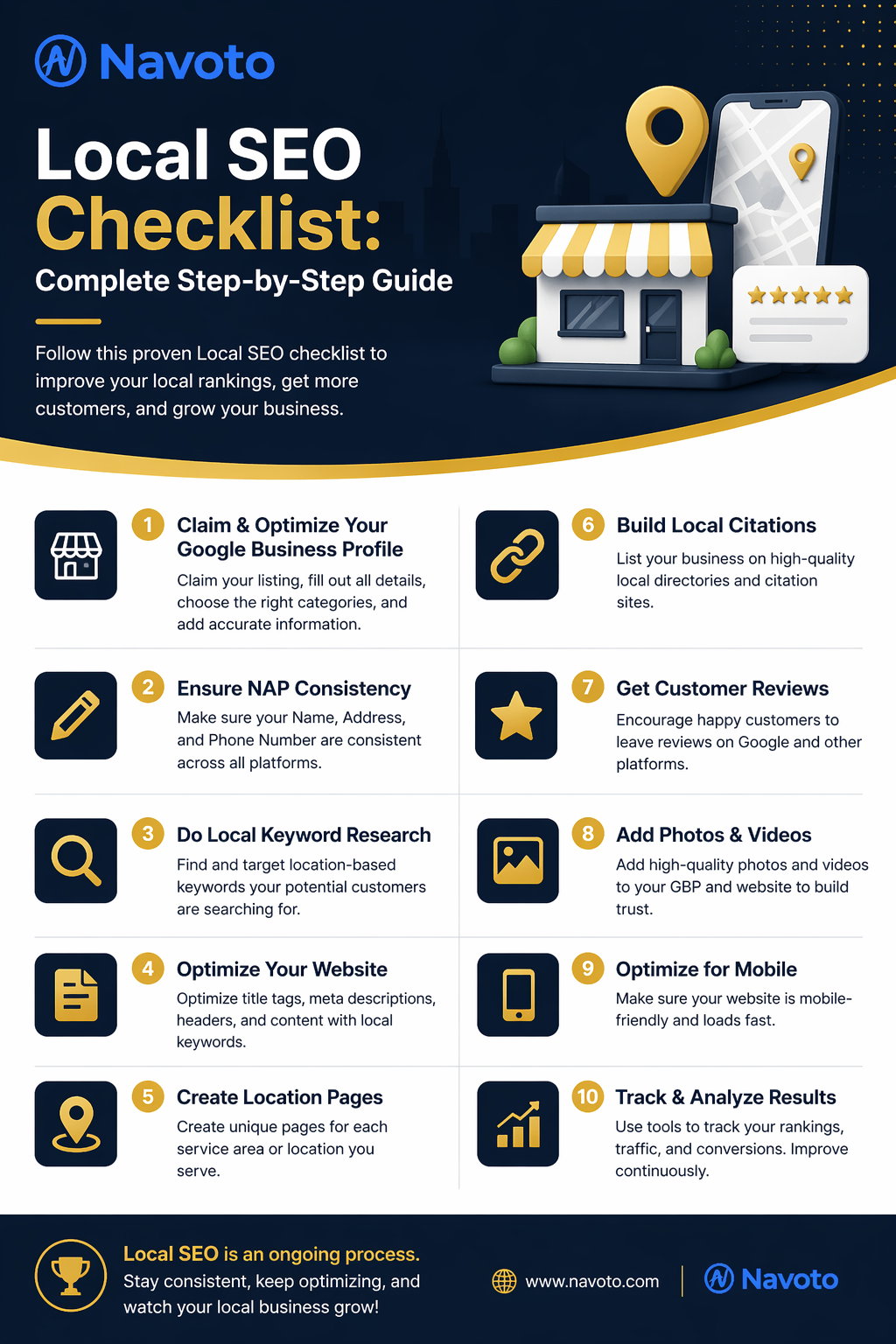
This checklist is built to give you every action that actually matters — in the right order, with enough context to understand why each item works and not just what to do.
Before You Start: Set a Baseline First
Don’t start optimising without knowing where you stand. If you don’t create a baseline before you make changes, you won’t know what actually moved the needle and what didn’t. Three things to do first:
☐
Set up rank tracking for your target local keywords
Use a tool like BrightLocal or Local Falcon to track how you rank in Google Maps and organic local results for your most important service + city combinations. Geo-grid reports show you exactly how your rankings vary across different areas within your service zone — useful for spotting blind spots.
☐
Identify your actual local competitors
Search your top five local keywords from a mobile device (or use an incognito window in the same city). The three businesses in the Map Pack for each of those searches are your real competition — not necessarily the businesses you think of as rivals. Note which ones appear repeatedly across multiple searches. Those are the ones to focus on.
☐
Run a Google Search Console check
Look at which local queries are already sending you impressions. Often businesses find they’re getting impressions for “near me” searches and location-based queries without ever having optimised for them — which means there’s low-hanging fruit that can be converted to clicks with targeted improvements.
Google Business Profile Checklist
Your Google Business Profile (GBP) is the single most important asset in local SEO. Before anything else, it needs to be claimed, verified, and completely filled out. Partially completed profiles leave ranking signals on the table that your competitors are picking up instead.
Key fact: Google gives disproportionate weight to the primary category you select. This single field has more impact on what searches you appear for than almost any other element in your profile. Choose the most specific category that accurately describes your main service — don’t go broad.
The Foundation
☐
Claim and verify your listing at business.google.com
Verification can be done by postcard, phone, video, or email depending on business type. Without verification, your profile is publicly viewable but doesn’t carry full ranking weight.
☐
Business name: use your real name, no keyword stuffing
Adding “best” or your city to your business name violates Google’s guidelines and can get your profile suspended. Your GBP name should match exactly how you’re legally registered and branded everywhere else.
☐
Select the most accurate primary category
Search Google for your category to see what other established businesses in your niche are using. The right primary category is often more specific than you’d initially think.
☐
Add all relevant secondary categories
Secondary categories expand the range of searches you’re eligible for. A plumber might have “emergency plumbing service,” “water heater installation service,” and “drain cleaning service” as secondaries alongside the primary “plumber.”
☐
Write a full business description (up to 750 characters)
Describe what you do and where you serve. Naturally include one or two location references and your main services. This is not the place for marketing language — write it the way you’d explain your business to someone asking a genuine question.
☐
Set accurate business hours including holiday/special hours
Outdated hours cause “temporarily closed” markers to appear, which destroys trust and hurts rankings. Update holiday hours before the holidays, not after.
☐
Add phone number, website URL, and appointment link (if applicable)
Make sure the phone number matches exactly what’s on your website and other directories. Even formatting differences (brackets vs dashes) can create consistency issues.
Content & Media
☐
Upload at least 10 high-quality photos
Include: logo, cover photo, exterior (so customers can find you), interior, team at work, products or completed jobs. Profiles with photos receive 42% more direction requests than those without. Geotagging photos before uploading adds another entity signal.
☐
Build out your Services and Products sections fully
Each service entry should have a name, description, and price or price range. This directly expands the keyword footprint of your GBP and helps Google match you to more specific local queries.
☐
Enable Google Posts and use them weekly
Posts expire after 7 days. Consistent posting signals that the profile is actively managed — a quality signal Google uses to differentiate engaged businesses from neglected listings. Use posts for promotions, events, service highlights, and seasonal content.
☐
Set up the Q&A section proactively
Don’t wait for customers to ask questions and let them go unanswered. Add the most common questions yourself and answer them. This also lets you naturally include service and location terms in a Q&A context.
☐
Fill in all applicable Attributes
Attributes vary by category — accessibility features, payment methods, service options (online appointments, curbside pickup), and so on. Users filter by attributes when searching. Missing applicable attributes means missing those filtered searches.
NAP Consistency & Citation Building
NAP stands for Name, Address, Phone Number. The principle is simple: every directory listing, social profile, and web mention of your business should use exactly the same formatting for these three things. “St.” versus “Street.” “(0161)” versus “0161”. These inconsistencies look minor but they create a verification problem for Google — and when Google can’t confidently verify basic facts about your business, your local rankings pay for it.
☐
Audit every existing listing your business already has
Search your business name in quotes across the major directories — Google, Bing Places, Yelp, Facebook, Apple Maps, TripAdvisor (if relevant). Note every discrepancy in name, address, phone, and category.
☐
Fix all inconsistencies to match your canonical NAP format
Choose one authoritative version of your name, address, and phone number format and standardise everything to it. The version on your GBP should be the canonical reference.
☐
Find and delete or merge duplicate listings
Duplicate listings split your authority and confuse users. They’re more common than most businesses realise, especially on platforms like Yelp and Bing. Remove them or flag them to the platform.
☐
Build listings on the core data aggregators
Data aggregators feed dozens of smaller directories from their database. Getting your information correct at the source (Neustar Localeze, Data Axle) cascades correct information outward automatically over time.
☐
Claim all major general directories
At minimum: Google Business Profile, Bing Places, Apple Maps Connect, Yelp, Facebook, Foursquare, Better Business Bureau, Yellow Pages, Angi (for service businesses). These carry the most weight as citation sources.
☐
Build industry-specific and local directory listings
A dentist should be on Healthgrades and Zocdoc. A restaurant needs OpenTable or Resy. A contractor benefits from Houzz and HomeAdvisor. Industry-specific directories often rank well in local search results on their own, so they’re double value — a citation AND potential direct traffic.
Reviews & Reputation Management
Google has confirmed that review signals — quantity, velocity, recency, and sentiment — are ranking factors for the Local Pack. But the value of reviews goes beyond rankings. 63.6% of consumers check Google Reviews before visiting a business. A profile with 6 reviews from two years ago competing against one with 140 recent reviews isn’t really a competition.
The most effective review strategy is also the simplest one: ask every satisfied customer, immediately after the experience, through a direct link. The complication most businesses introduce is that they ask sporadically, or only when they remember to, which creates review velocity gaps that make the profile look inactive.
☐
Create a short, shareable review link for Google
Go to your GBP dashboard, click “Get more reviews,” and copy the short link. Use this in follow-up emails, text messages, receipts, and on-site signage. Reduce friction to zero — the fewer steps between “happy customer” and “written review,” the higher the completion rate.
☐
Build a consistent review request process into your operations
A process that runs without you having to think about it beats occasional remembering every time. Whether it’s a post-job email sequence, an SMS 24 hours after service, or a card handed to customers at checkout — make it repeatable and measure it monthly.
☐
Respond to every single review — positive and negative
Google has confirmed that responding to reviews improves rankings. It also matters enormously for potential customers reading the conversation. For negative reviews, respond calmly, acknowledge the concern, and offer to resolve it offline. The response is public — it’s as much for other readers as for the reviewer.
☐
Diversify reviews across multiple platforms
Google is the priority, but Facebook reviews, Yelp reviews, and industry-specific review platforms also appear in branded search results. Having reviews across multiple platforms increases your credibility footprint and provides more surface area in SERPs.
☐
Monitor for and flag fake negative reviews
Use Google’s review management tools to flag reviews that violate guidelines (spam, fake, irrelevant, off-topic). Document your flagging attempts. If the review isn’t removed, respond professionally — it signals to potential customers that you take quality seriously.
Website Optimisation for Local Search
Your website is where your GBP sends traffic, and it’s what Google crawls to verify what your business actually does and where it serves. If the website doesn’t clearly communicate your location and services, no amount of GBP optimisation will fully compensate for it.
On every page of the site
☐
NAP in the footer (matching GBP format exactly)
☐
Click-to-call phone number on mobile
☐
LocalBusiness schema markup (see schema section)
☐
Internal links from service pages to location pages and back
On your Contact page
☐
Embedded Google Map of your location
☐
Full address with area context (neighbourhood, landmarks)
☐
Opening hours visible without scrolling
☐
Service area listed if you’re a service-area business
Title Tags & Meta Descriptions for Local Pages
Every local page needs a unique title tag that includes your primary service and location. The format that consistently works: [Service] in [City] | [Brand Name]. For example: “Emergency Plumber in Manchester | Acme Plumbing.” Keep title tags under 60 characters, and don’t write the same title for multiple pages — each page needs to target a distinct service-location combination.
☐
Unique title tags on every local service/location page
Format: [Primary Service] in [City/Area] | [Business Name]. Under 60 characters.
☐
Meta descriptions written as direct, persuasive one-liners
Include a benefit, a location reference, and a clear next action. “Get same-day boiler repairs in Sheffield. Call for a free quote.” Under 155 characters.
☐
H1 that includes service + location, naturally worded
“Trusted Plumber Serving Manchester and Surrounding Areas” works. “Manchester Plumber Manchester Services Manchester” does not.
Local Keyword Research
Local keyword research follows the same basic principles as general keyword research — find what people are searching, build content around it — but it has some distinct patterns worth knowing about. Local searches fall into two buckets: explicit local intent and implicit local intent.
Explicit local intent: The user includes a location in the query. “Dentist in Brighton.” “Emergency locksmith Liverpool.” “Italian restaurant near Covent Garden.” The intent is unambiguous.
Implicit local intent: The user doesn’t include a location, but Google infers it from their device’s location. “Dentist near me.” “Emergency plumber.” “Best sushi.” For implicit queries, your Map Pack ranking is determined by proximity, relevance, and prominence — your GBP and website optimisation together.
| Keyword type | Example | Where to optimise |
|---|---|---|
| Service + city | “plumber Manchester” | Service pages + GBP description |
| Near me | “dentist near me” | GBP optimisation + proximity |
| Service + neighbourhood | “restaurant Shoreditch” | Neighbourhood-level location pages |
| Emergency / urgent | “emergency plumber 24 hour” | Dedicated service page + GBP services |
| Best / top | “best accountant Leeds” | Reviews + content proving expertise |
| How-to + local | “how to find a good solicitor in Bristol” | Local blog content |
☐
Validate local intent by searching keywords from a mobile device
If the search returns a Map Pack result, it’s a local intent keyword. This is the quickest way to confirm your target queries before building content around them.
☐
Mine People Also Ask and related searches for long-tail local queries
These surfaces show you the exact phrasing real people use. Long-tail local queries often convert better because the searcher has already narrowed down exactly what they need.
☐
Listen to how your customers actually describe what they need
The phrases your team hears on calls and in emails are often better keywords than anything a tool generates. If three customers this month asked for “same-day boiler repair,” that phrase belongs on your website.
Location Pages & Service Pages
If you serve more than one city or neighbourhood, location pages are the most direct route to ranking in those additional areas. One well-built location page — genuinely localised, not a copy of your homepage with the city name swapped — can rank for dozens of local search variations on its own.
The quality test for a location page: Could this page only have been written about this specific location? If you could swap the city name for any other city and the page would read identically, it’s not localised enough. Genuine localisation includes references to local landmarks, local context, service-specific details for that area, and ideally reviews from customers in that location.
☐
Create one page per location you actively serve
Don’t build fifty location pages at once if you can’t make them genuinely different. Build five great ones and scale once you have a quality template that works.
☐
Include: local intro, core services, local proof, contact details, embedded map
Proof can be testimonials from customers in that area, case studies of local jobs, before/after examples, or local certifications. The more locally specific the better.
☐
Build dedicated service pages for each core offering
A plumber shouldn’t have one general “plumbing services” page. They should have separate pages for boiler repair, emergency callouts, bathroom fitting, pipe work, and so on. Each page targets a specific service keyword and captures searches at that level of specificity.
☐
Link service pages and location pages to each other logically
Your “Manchester” page should link to “Boiler Repair” and “Emergency Plumber.” Your “Boiler Repair” page should link to each city page where you offer it. This internal linking structure tells Google exactly what you offer and where.
Schema Markup for Local SEO
Schema markup is structured data — code on your website that tells search engines, in explicit machine-readable terms, what your business is and what it does. For local SEO, it’s one of the highest-impact technical tasks with one of the lowest effort requirements once it’s set up, especially if you’re using WordPress with a plugin like Yoast SEO or Rank Math.
LocalBusiness
Declares your business as a local entity with name, address, phone, coordinates, hours, and category. The foundation of local schema.
GeoCoordinates
Your latitude and longitude. Helps Google anchor your business precisely on the map, especially useful for businesses in dense urban areas.
OpeningHoursSpecification
Your opening hours in structured format. Enables the opening hours rich result in search, which appears directly in local results.
FAQPage
Structured Q&A on service pages. Captures People Also Ask positions and is read by AI systems when generating local recommendations.
Review / AggregateRating
Displays star ratings in search results. Significantly improves click-through rates for local service pages with testimonials.
☐
Implement LocalBusiness schema on your homepage and all location pages
Use the most specific sub-type available — Dentist, Plumber, Restaurant, LegalService, etc. — rather than the generic LocalBusiness type where possible.
☐
Add sameAs property linking to all authoritative profiles
List your GBP URL, Facebook page, LinkedIn, Yelp, and any other verified directory profiles. This corroborates your entity across sources — exactly how Google verifies facts about businesses.
☐
Validate all schema with Google’s Rich Results Test
Run every key page through the tester after implementation. Schema errors silently fail — you won’t know they’re broken unless you test them.
☐
Add FAQPage schema to service pages
Write genuine FAQs covering the real questions your customers ask — pricing, timelines, process, what’s included. These often capture People Also Ask positions and are increasingly read by AI systems when answering local service queries.
Local Link Building
Backlinks remain a major ranking factor in local SEO. But local link building is different from general link building — you’re not just looking for high-authority sites. You’re looking for locally relevant sites. A link from your city’s local newspaper, the Chamber of Commerce, or a respected neighbourhood business association is worth more for local rankings than a link from a high-DA site with no geographic connection to your area.
☐
Join your local Chamber of Commerce and get listed on their directory
Chamber websites carry genuine local authority. The membership fee is almost always worth it from an SEO perspective alone, before considering the networking value.
☐
Sponsor local events, teams, or community organisations
Sponsorships typically come with a listing on the organisation’s website — a locally relevant link that costs far less than traditional link outreach and comes with community goodwill on top.
☐
Get covered by local news and publications
Local journalists need stories. A notable hire, a community initiative, a business milestone, a charitable effort — these are all legitimate angles. Even a mention in a “local business spotlight” column adds a high-value local citation.
☐
Build relationships with complementary local businesses for cross-referrals
A plumber and a bathroom fitter. An accountant and a solicitor. A photographer and a wedding venue. Complementary businesses that serve the same customers can link to each other naturally in a resources section or a “trusted partners” page.
☐
Analyse competitor backlinks and target the same sources
Run your top local competitors through Ahrefs or SEMrush. Any local directory, publication, or organisation that links to them and not to you is a gap you can close. Particularly look for sites linking to two or more competitors — those are the highest-priority targets.
Technical SEO for Local
Local searches happen overwhelmingly on mobile devices — someone out and about, looking for a business nearby. If your site loads slowly on mobile or breaks on a smaller screen, you’re losing those visitors before they ever engage with your content.
Mobile & Speed
☐
Pass Google’s Mobile-Friendly Test
☐
LCP under 2.5 seconds on mobile
☐
Compress images — a common speed killer
☐
Enable caching and use a CDN where possible
Crawlability & Indexing
☐
All key local pages indexed (check Search Console)
☐
XML sitemap submitted to Google
☐
No crawl errors on location or service pages
☐
Canonical tags correct on all pages
URLs & Structure
☐
Location pages at clean URLs: /manchester-plumber/
☐
No session IDs or tracking parameters in indexable URLs
☐
HTTPS across the entire site
☐
Broken internal links fixed (run monthly crawl)
Local Content Strategy
Most local businesses think of content as optional. The ones in the Local Pack treat it as a competitive weapon. Content that targets the questions local customers actually ask — before they’ve even decided to call — positions your business as the obvious expert in the area before competitors have said a word.
The highest-converting local content isn’t about your business. It’s about the customer’s problem. A plumber who publishes a detailed guide to “what to do if your boiler breaks down in winter in Manchester” isn’t just targeting a keyword. They’re capturing someone who’s cold, stressed, and actively looking for help — which is a significantly more valuable visitor than someone casually browsing.
☐
Build a content plan around local questions, not just keywords
Look at People Also Ask for your core services. Mine your own customer emails and calls for recurring questions. Each genuine question your customers ask is a content brief that answers real demand.
☐
Create locally-specific how-to and advice content
The more geographically specific, the less competition. “How to find a conveyancing solicitor in Leeds” competes with far fewer pages than “how to find a solicitor.”
☐
Publish case studies from real local projects
A case study that mentions the specific neighbourhood, the challenge, the solution, and the outcome does three things at once: builds trust with prospects, demonstrates expertise to Google, and targets location-specific search terms naturally.
☐
Link all blog and content posts back to relevant service or location pages
Content that floats without internal links is SEO value that doesn’t flow anywhere useful. Every article about a local topic should have at least one contextual link to the service or location page most relevant to what the reader would want next.
Local SEO and AI search are converging
In 2026, more people are using ChatGPT and voice assistants to find local services. Answer engine optimisation covers how to structure your content so AI systems can extract and recommend your business — which is increasingly relevant even for local searches.
Monthly Maintenance Rhythm
Local SEO isn’t a one-time project. It’s a system. The businesses that hold their Map Pack positions long-term aren’t the ones who did an optimisation sprint two years ago. They’re the ones doing small, consistent things every month. Here’s a sustainable routine that keeps the signal strong without taking over your schedule:
| Cadence | Tasks |
|---|---|
| Weekly | Publish a GBP Post · Respond to any new reviews · Check for new Q&As on GBP |
| Monthly | Check GBP Insights (queries, views, actions) · Check rank tracking movement · Add new photos to GBP · Request reviews from that month’s customers · Review Search Console for new local query opportunities |
| Quarterly | Audit NAP consistency across directories · Check for new competitor activity · Update content on underperforming location pages · Run a site crawl for technical errors · Review and update schema markup |
| Annually | Full local SEO audit · Competitor backlink gap analysis · Content gap review · Schema audit · GBP category review (categories evolve) |
Common Local SEO Mistakes That Kill Rankings
✗
Keyword stuffing your business name on GBP
Adding “best” or your city name to the GBP business name field violates Google’s policies. Competitors can flag this and have your profile suspended. The ranking benefit is temporary anyway — Google’s algorithm has become good at detecting it.
✗
Building location pages that are just clones with the city name swapped
Google’s quality systems detect near-duplicate content. Thin location pages with no genuine local substance not only fail to rank — they can actively drag down the quality score of the whole domain.
✗
Never responding to negative reviews
A string of unanswered negative reviews tells potential customers (and Google) that the business doesn’t engage. A thoughtful, professional response to a 2-star review often impresses potential customers more than the negative review damages trust.
✗
Ignoring Bing Places and Apple Maps
A significant percentage of local searches happen through Bing (particularly in enterprise Windows environments) and Apple Maps (on every iPhone). These take ten minutes to claim and can send meaningful referral traffic most competitors have left on the table.
✗
Treating local SEO as a one-time task
Google’s local algorithm is not static. Profile completeness decays as competitors add more content. Review velocity matters — a business with 200 reviews that stopped getting new ones three years ago will eventually lose ground to one with 90 reviews and a fresh, active stream coming in.
Monitoring local AI visibility
As more local searches shift to AI platforms, tracking where your brand is cited matters as much as tracking rankings. How AI search monitoring improves your SEO strategy explains how to measure this visibility properly.
AI search for local businesses
Voice assistants and AI chatbots are increasingly being used for local business discovery. Understanding search everywhere optimisation ensures you’re visible across all the channels your customers actually use.
The Full Checklist at a Glance
Print this or bookmark it. Work through each section and check items off as you complete them. Not everything needs to happen in a day — but everything on this list will make a measurable difference over 90 days of consistent work.
Foundation
- Baseline tracking set up
- Competitors identified
- GBP claimed and verified
- GBP fully completed
- GBP Posts active weekly
- Bing Places claimed
- Apple Maps claimed
Citations & Reviews
- NAP audit complete
- Duplicates removed
- Core directories listed
- Industry directories listed
- Review system in place
- All reviews responded to
Website
- NAP in site footer
- Location pages built
- Service pages built
- Title tags optimised
- Schema implemented
- Schema validated
- Mobile-friendly confirmed
- Core Web Vitals passing
Links & Content
- Chamber of Commerce listed
- Local sponsorships active
- Competitor link gap checked
- Local content plan live
- Blog linked to service pages
- Monthly rhythm running
Frequently Asked Questions
Google AI search
Local businesses increasingly appear in Google’s AI-generated results. Optimising for Google AI Mode covers the additional signals that influence those results.
ChatGPT local recommendations
People use ChatGPT to ask for local service recommendations. Ranking on ChatGPT in 2026 walks through how to make that happen for your business.
How AI is changing search
For the full picture of what’s shifting in 2026, how AI is changing SEO this year connects local SEO changes to the broader transformation in search.
Continue reading — navoto.com
More from the navoto.com SEO resource hub
Answer Engine Optimisation
Search Everywhere Optimisation
Rank on ChatGPT 2026
Google AI Mode Guide
SearchGPT Optimisation
AI Search Monitoring
AI Chatbot Platforms Guide
© 2026 navoto.com — All rights reserved