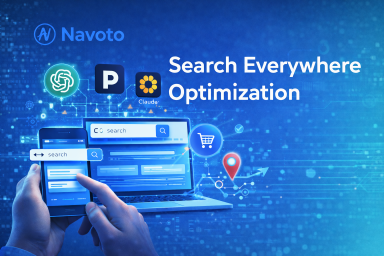
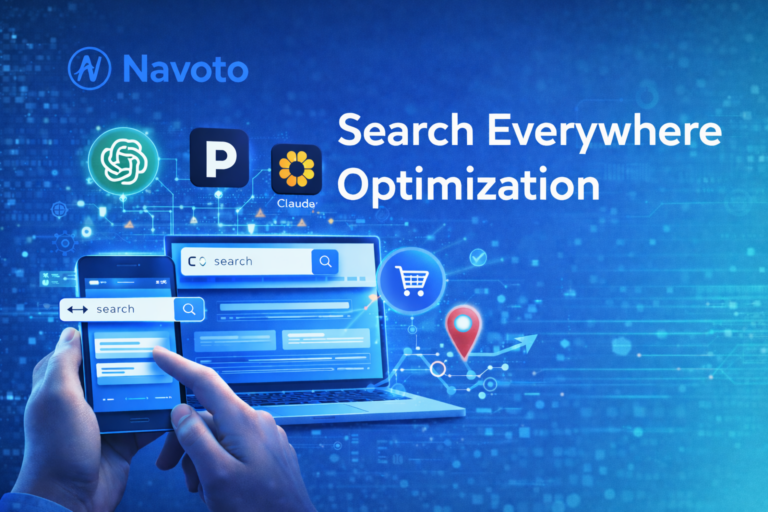
If someone told you in 2020 that Google would no longer be the only place you needed to rank, you might have dismissed the idea. Nobody’s dismissing it today. In 2026, your audience searches on TikTok for product reviews, asks ChatGPT for buying advice, watches YouTube tutorials, scrolls Reddit for honest opinions, and occasionally lands on your website from a Perplexity citation. Traditional SEO alone cannot capture these moments. That is why Search Everywhere Optimization — or SEO — has become the definitive visibility strategy for forward-thinking brands.
This guide gives you the complete 2026 playbook: definitions, platform breakdowns, content frameworks, measurement templates, and a step-by-step action checklist — everything you need to outrank competitors and build brand equity across every search surface that matters.
What Is Search Everywhere Optimization (SEO)?
Search Everywhere Optimization (SEO) is the practice of building brand visibility across every platform where your audience searches, discovers content, and makes decisions — not just Google. It combines traditional SEO, social search optimization, AI visibility, generative engine optimization (GEO), and answer engine optimization (AEO) into one unified strategy.
📌 Quick Definition
Search Everywhere Optimization = optimizing your content, brand, and entity authority so you appear wherever people search — on Google, AI chatbots, social platforms, video sites, marketplaces, review sites, and forums — at every stage of the buyer journey.
Where classic SEO asked “How do I rank on Google?” — SEO asks “How do I become discoverable everywhere my audience searches?”
The relationship between SEO and related disciplines is important to understand:
To understand how AI is reshaping the foundation beneath SEO, read our deep-dive on how AI is changing SEO in 2026 — it explains the algorithmic forces making multi-platform optimization mandatory.
Why SEO Is Non-Negotiable in 2026
Three seismic forces converged to make Search Everywhere Optimization essential rather than optional:
AI Overviews Dominate Google
Google AI Overviews now appear on over 65% of informational queries, collapsing organic click-through rates and reshaping what “ranking” means entirely.
Fragmented Search Behaviour
45+ billion searches happen daily across all platforms, yet Google accounts for only 18% of them. TikTok, YouTube, Reddit, and AI assistants absorb the rest.
Traditional Search Volume Declining
Traditional Google search volume is projected to drop by 25% by end of 2026 as users shift to conversational AI tools for research and decision-making.
The practical implication is clear: if your brand only exists on Google, you are invisible in every moment that doesn’t happen on Google — and those moments now represent the majority of digital search behaviour.
When buyers evaluate a $10K software solution, they search across 25+ different places before deciding. Your website alone is no longer enough. This is why visibility across the web matters more than ever — and why platforms like ours at AI search monitoring are critical for tracking your SEO performance in real time.
65%
of Google queries now show AI Overviews
82%
of buyers use 3+ search platforms before buying
25%
projected drop in traditional Google search volume by end-2026
43%
higher AI citation rates for properly optimised content
The 8 Core Search Platforms to Optimize
SEO does not mean doing everything everywhere at once. It means being present on the platforms that matter most to your audience. Here are the eight non-negotiable search surfaces for 2026:
1. Google Search & AI Overviews
Still processes 8.3 billion searches per day. Organic search drives 53% of all website traffic, but AI Overviews now reshape how answers are presented. You must optimize for both traditional rankings and AI citation.
2. ChatGPT & SearchGPT
Hundreds of millions of users now query ChatGPT for research, product recommendations, and how-to guidance. Appearing as a cited source requires structured content with clear authorship and factual depth. See our complete ChatGPT ranking guide and SearchGPT optimization guide.
3. Perplexity AI
Perplexity has emerged as the search engine of choice for power users who want cited, real-time answers. Its ranking signals favour authoritative sources, clean structured data, and consistent brand mentions across the web.
4. TikTok Search
TikTok’s in-app search is the dominant discovery engine for Gen Z and Millennials. Short-form video content with keyword-rich captions, on-screen text, and strong hooks drives discoverability for product categories across every niche.
5. YouTube
The world’s second-largest search engine. Buyers research products through YouTube tutorials and reviews, and Google indexes YouTube transcripts directly into search results. Title, description, and chapter optimization all drive discoverability.
6. Reddit
Reddit is now deeply indexed by Google and cited heavily by AI models. Being present and authentic in relevant subreddit discussions drives direct traffic, AI citations, and E-E-A-T signals simultaneously.
7. Amazon & Ecommerce Search
For product brands, Amazon’s A9/A10 algorithm and emerging AI search layers on ecommerce platforms are critical. Learn how ecommerce search engines have evolved to incorporate AI-driven discovery.
8. AI Chatbot Platforms
Gemini, Microsoft Copilot, Claude, and Meta AI collectively process billions of queries. Each platform has unique citation and retrieval behaviours. Our guide to AI-powered chatbot platforms for businesses explains how each system surfaces branded content.
Google SEO + AI Overviews: The New Ranking Reality
Google remains the dominant search engine, but the way it presents results has fundamentally changed. AI Overviews (formerly Search Generative Experience) now synthesize answers from multiple sources, pushing traditional blue-link results further down the page.
For a full breakdown of how to appear in AI-generated answers, read our dedicated guide: How to Optimize for Google AI Mode.
Key tactics for Google in 2026:
✅ Optimize for AI Overviews with structured answers
Place clear, direct answers within the first 100 words and under relevant H2 headings. Google’s AI extracts answers from well-structured, clearly-labeled content. Use one H1, descriptive H2s, short paragraphs, and bulleted lists where appropriate.
✅ Implement Schema Markup
Article, FAQ, HowTo, and BreadcrumbList schema give search engines and AI models structured data to interpret and cite correctly. 52% of sources in Google AI Overviews already rank in the top 10 — schema helps you get there.
✅ Prioritize E-E-A-T Signals
Google rewards Experience, Expertise, Authoritativeness, and Trustworthiness. Add author bios with credentials, cite original research, and link to reputable sources to build trust signals at the content level.
✅ Build Topical Authority through Content Clusters
One great article pales against ten interlinked great articles on the same topic. Create pillar pages that link to supporting content across your site. Strategic internal linking distributes authority and signals topical depth to Google.
AI Search Engines: Ranking in ChatGPT, Perplexity & Gemini
AI chatbots are no longer tools — they are search engines. Users ask layered, natural-language questions and expect synthesized, cited answers. If your brand is not cited, you simply do not exist in that conversation.
This is the domain of Generative Engine Optimization (GEO) and Answer Engine Optimization (AEO) — two complementary disciplines that sit inside the broader SEO framework. Our Answer Engine Optimization guide covers AEO tactics in full depth.
5 GEO Tactics That Drive AI Citations
1️⃣
Write Quotable Paragraphs
Structure 40–60 word paragraphs that directly answer a question. AI models extract passage-level answers — make yours impossible to ignore.
2️⃣
Build Brand Entity Authority
Consistent brand name, description, and service info across Wikipedia, Wikidata, Crunchbase, LinkedIn, and review platforms builds AI trust signals.
3️⃣
Earn Third-Party Mentions
AI models trust what others say about you more than what you say about yourself. Pursue guest posts, PR mentions, and industry directory listings.
4️⃣
Use Conversational Headings
Frame H2 and H3 headings as the exact questions users ask AI tools: “What is search everywhere optimization?” beats “Overview” every time.
5️⃣
Add Original Data & Research
AI models heavily cite unique statistics, case studies, and original research. One proprietary data point is worth a hundred paraphrases.
Social Search: TikTok, YouTube & Reddit SEO
Social platforms have matured from engagement channels into full-fledged search engines with their own algorithms, ranking factors, and user intent patterns. Ignoring them means surrendering a growing share of discovery moments.
The smartest approach is the content waterfall method: create one flagship long-form piece on your website, then atomize it into platform-native formats. The same core content becomes a blog post, Instagram carousel, TikTok video, YouTube deep-dive, and Reddit thread — reaching your audience at every search touchpoint without starting from scratch each time.
E-E-A-T & Entity Authority: Your Competitive Moat
E-E-A-T (Experience, Expertise, Authoritativeness, Trustworthiness) is no longer just a Google ranking consideration. It is the universal trust signal evaluated by every search platform and AI model in 2026.
The brands investing in real expertise — real authors with real credentials and original research — are building something no AI content farm can replicate. That expertise, consistently expressed across every platform, is the competitive moat of the SEO era.
🏅
Experience
First-hand knowledge, case studies, real-world examples from direct involvement
🎓
Expertise
Original insights backed by deep research, credentials, and subject-matter depth
⭐
Authoritativeness
External citations, backlinks, mentions in high-authority publications and forums
🔒
Trustworthiness
Accurate information, transparent authorship, secure site, up-to-date content
Entity Authority is the SEO extension of E-E-A-T. It is the degree to which search systems — including AI models — can confidently identify your brand as a distinct, trustworthy entity. Strong entity authority requires:
- Consistent NAP (Name, Address, Phone) across all directories
- Knowledge Panel verification and Wikidata/Wikipedia presence
- Consistent brand voice and descriptions across all platforms
- Active social profiles linked to your website
- Third-party brand mentions from credible publications
- Schema markup identifying your organization on every key page
The SEO Content Strategy Framework
Effective SEO content is not about doing more — it is about doing the right things in the right sequence. Here is the four-phase framework we recommend at Navoto:
Audience & Intent Research
Before picking platforms, understand how your specific audience searches. Mine sales calls, support tickets, Reddit threads, and review platforms for the exact language your buyers use. Map this language to platforms: where is this conversation most active — Google, TikTok, YouTube, or Reddit?
Create Pillar Content on Your Website
For each priority topic, publish one flagship article on your website that is comprehensive, clearly structured, schema-marked, and E-E-A-T optimized. This becomes the “source of truth” that gets cited, linked, and atomized everywhere else. Interlink related articles to build topical authority clusters.
Atomize & Distribute (Content Waterfall)
Repurpose your pillar content into platform-native formats: a LinkedIn article for B2B buyers, a TikTok video for product discovery, a YouTube walkthrough for how-to searchers, a Reddit comment thread for trust signals, and a Perplexity-ready snippet for AI citations. Same core content — seven search surfaces covered.
Monitor, Audit & Iterate
SEO is not a one-time campaign — it is an ongoing compounding system. Track AI citation rates, branded search lift, referral traffic from AI platforms, and share of voice across your target queries. Re-audit pillar content every 90 days. Platforms and algorithms evolve; your content must evolve with them.
💡 Pro Tip: Internal Linking as a Ranking Signal
Strategic internal linking is one of the most underused SEO tactics. When you link your new Search Everywhere Optimization article to your existing content on AI SEO changes, answer engine optimization, and SearchGPT ranking, you distribute authority across your entire content cluster — lifting the whole domain in topical authority, not just a single page.
9. Metrics & Measurement for SEO
Traditional SEO metrics only capture part of the SEO picture. To measure success across all platforms, you need an expanded KPI framework:
Using a dedicated AI search monitoring platform is the most efficient way to track your brand’s citation health across ChatGPT, Gemini, Perplexity, and other AI engines simultaneously — replacing the manual, time-consuming process of querying each tool individually.
10. The 2026 SEO Action Checklist
Use this checklist as your quarterly SEO audit. Each item is a concrete action, not a vague recommendation.
🔍 Google & Traditional SEO
- ☐ Publish/update pillar content with FAQ schema and Article schema
- ☐ Ensure each page has one H1, clear H2s, and short paragraphs
- ☐ Add or update author bios with credentials on all key articles
- ☐ Audit internal links — every pillar should have 5+ contextual links
- ☐ Check and fix Core Web Vitals, mobile performance, and HTTPS
🤖 AI & Answer Engine Optimization
- ☐ Rewrite introductions to answer the target query within first 100 words
- ☐ Add “What is X?” definition sections for every major topic
- ☐ Audit brand mentions across ChatGPT, Gemini, and Perplexity monthly
- ☐ Build Wikidata and Knowledge Panel presence for your brand entity
📱 Social Search
- ☐ Identify your top 3 pillar articles and create a TikTok/YouTube version of each
- ☐ Research relevant subreddits and contribute genuinely (not spammy) to discussions
- ☐ Optimize YouTube video titles and descriptions with target keywords
📊 Measurement
- ☐ Set up GA4 to track referral traffic from AI platforms separately
- ☐ Track branded search volume in Google Trends (monthly baseline)
- ☐ Run a quarterly SEO audit scoring yourself on each of the 8 core platforms
Frequently Asked Questions
What is the difference between SEO, GEO, and AEO?
Search Everywhere Optimization (SEO) is the overarching strategy covering all search surfaces. Generative Engine Optimization (GEO) is a subset focused on being cited by AI-generated responses. Answer Engine Optimization (AEO) focuses specifically on appearing in featured snippets and direct answer boxes. SEO includes both GEO and AEO plus social search, marketplaces, and traditional SEO.
Is traditional SEO dead in 2026?
No. Traditional SEO is the foundation that makes SEO work. Sites with strong Google SEO fundamentals are significantly more likely to appear in AI Overviews, Perplexity citations, and other AI-driven results. SEO builds on top of — not instead of — traditional SEO best practices.
How long does SEO take to show results?
Similar to traditional SEO, SEO requires patience. You can see early signals within 4–8 weeks (AI mentions, branded search lift), but meaningful organic ranking improvements and AI citation consistency typically take 3–6 months of consistent effort. SEO compounds over time — the more you build, the faster it grows.
Do I need to be on every platform?
No. The worst way to do SEO is to spread yourself thin across every platform simultaneously. Start with your highest-impact, lowest-effort channels. For most B2B brands, that is Google + LinkedIn + Reddit. For B2C brands, it is Google + TikTok/YouTube + Amazon. Build quality on a few platforms before expanding.
How does SEO relate to AI chatbot platforms for businesses?
AI chatbot platforms are one of the primary search surfaces in the SEO landscape. Ensuring your brand appears as a trusted source within these platforms requires GEO-optimized content, strong entity authority, and consistent third-party mentions. Our guide on AI-powered chatbot platforms for businesses explains how each major platform retrieves and cites external content.
What tools do I need for SEO?
Core: Google Search Console (organic rankings), Google Analytics 4 (traffic sources including AI referrals), Semrush or Ahrefs (competitor analysis and content gap identification), Brand24 or Mention (brand monitoring). For AI visibility: Goodie AI or the Semrush AI Visibility Toolkit. For social search: native platform analytics plus SparkToro for audience intelligence.
Start Optimizing Everywhere — Not Just Google
Search Everywhere Optimization is not a trend — it is the natural evolution of SEO for a world where discovery happens across dozens of platforms and AI has fundamentally changed how answers are generated. The brands winning in 2026 and beyond are building visibility that compounds across every surface where curiosity sparks.