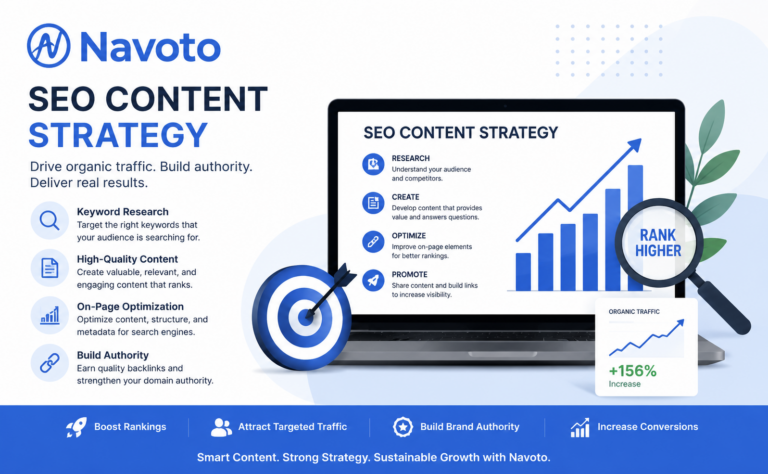
Quick Answer: An SEO content strategy is a documented plan for creating, optimizing, and publishing content that ranks in search engines and converts visitors into customers. It combines keyword research, search intent analysis, content planning, on-page optimization, and performance measurement into one repeatable system. Businesses with a documented SEO content strategy generate 3x more leads than those without one.
Most businesses create content. Very few create content strategically. The difference shows up clearly in the analytics: one approach generates compounding organic traffic month after month; the other produces articles that nobody reads. An SEO content strategy is the system that separates the two. This guide gives you the complete framework — from keyword research and content planning through to writing, optimization, and measurement — so every piece of content you publish works toward the same goal: more organic visibility, more qualified traffic, and more customers.
Long-tail keywords account for 70% of all search traffic. 70.6% of content marketers say that meeting search intent is one of their top frustrations in 2025. Both statistics point to the same problem: most content misses what searchers actually want. A properly built content strategy for website SEO solves this at the source — before a single word is written.
|
3×
More leads from documented content strategy
|
70%
Of all search traffic comes from long-tail keywords
|
260%
Organic traffic increase from refreshing old content
|
45%
Higher ROI when content is tied to business outcomes
|
What Is an SEO Content Strategy?
An SEO content strategy is a structured plan that defines what content you will create, which keywords it will target, what search intent it must satisfy, how it will be optimized, and how you will measure whether it achieves its goal. It is the blueprint that connects your business objectives to the specific search queries your audience uses every day.
Without a strategy, most organizations end up creating content in one of two broken patterns: they publish whatever feels interesting to the team internally, or they chase whatever appears to be trending with no connection to their core customer acquisition goals. Both patterns waste time, budget, and the compounding potential that systematic content marketing and SEO could generate.
A properly built SEO content strategy operates as a growth engine. Each piece of content is designed to rank for a specific set of searches, satisfy those searchers’ intent, build topical authority across your domain, and — ultimately — convert readers into customers or leads. The individual articles compound: each new piece of well-targeted content increases the authority of every other page on your site through internal linking and topical depth signals.
Why Your SEO Content Strategy Determines Everything Else
Technical SEO clears the path. Backlinks amplify authority. But content is what actually earns the rankings, satisfies the searcher, and converts the visitor. Refreshing historical content with new data, links, and multimedia led one site — Express Writers — to achieve a 260% increase in organic traffic within 90 days. Content is the lever with the most direct relationship between effort and outcome.
Here is the specific hierarchy of how an SEO content strategy affects your overall search performance:
The 8-Step SEO Content Strategy Framework
This is the complete, step-by-step system for building an SEO content strategy from scratch — or auditing and fixing one that is underperforming. Each step builds on the one before it. Skip any step and the downstream work loses precision and efficiency.
Step 1: Define Your Goals and Audience Before Any Keyword Research
Every SEO content strategy must begin with two non-negotiable questions: what do we want content to achieve, and who specifically are we creating it for? Without these anchors, keyword research produces a list of topics with no connection to business outcomes.
Define your content goals in terms of measurable outcomes — not content output. “Publish 20 blog posts” is not a goal. “Generate 150 organic leads from informational content by Q3” is a goal. Specific outcome goals determine which keywords are worth targeting (informational vs transactional), what content format to use, and how to measure success.
Build your audience definition around search behavior — not just demographic profiles. Understand the exact questions your ideal customer asks at each stage of the buyer journey: awareness (what is this problem?), consideration (what are my options?), and decision (which solution should I choose?). Map these to search query types and you have the skeleton of your entire content plan before you have written a single word.
Step 2: Keyword Research — Finding High-Volume, Low-Competition Opportunities
How to create an SEO content plan that actually ranks starts with finding keywords you can realistically win. The strategic goal is identifying terms with sufficient search demand to drive meaningful traffic and low enough keyword difficulty (KD) that a site of your current authority can reach page one.
High-volume terms are overcrowded and take months to rank. The smarter play is low competition keywords — they rank faster, cost less, and attract visitors through an AI SEO SERP visibility that targets snippets, PAA, and AI summaries where intent is strongest. This is especially critical for newer or lower-authority domains where competing for broad, high-difficulty terms produces no results for 12+ months.
The Keyword Opportunity Matrix
| Keyword Type | KD Range | Time to Rank | Best For |
|---|---|---|---|
| Quick wins (long-tail) | 0–29 | 2–8 weeks | New sites, early traction, specific intent |
| Growth targets | 30–49 | 2–5 months | Core content cluster topics |
| Authority plays | 50–69 | 6–12 months | Pillar pages once authority is established |
| Long-term brand plays | 70+ | 12–24+ months | High-DR sites targeting category-defining terms |
How to find low competition keywords with high search volume: Start with your seed topics. Enter them into a keyword research tool (Semrush, Ahrefs, Ubersuggest). Filter for KD under 35. Look for terms where the current top 10 includes forum posts, thin articles, or low-authority pages — these are “weak spots” where a properly optimized article can break in. Google Trends reveals rising topics before they become saturated, giving you a head start on competitors who haven’t noticed them yet.
Also check Google’s “People Also Ask” boxes and “Related Searches” section for your primary keywords. These reveal the exact keyword strings your audience uses — often extending up to 15-word phrases — that represent some of the most precise, low-competition opportunities in any niche.
Step 3: Map Search Intent to Content Type
Keyword difficulty and search volume tell you whether to target a keyword. Search intent tells you what format and content type Google wants to see ranking for it. A mismatch between your content type and the dominant search intent for a keyword is one of the most common reasons well-optimized content fails to rank.
| Intent Type | What the Searcher Wants | Correct Content Format | Example Keyword |
|---|---|---|---|
| Informational | To learn or understand something | In-depth guide, explainer, how-to article | “what is SEO content strategy” |
| Commercial | To compare options before buying | Comparison post, best-of list, review | “best SEO content strategy tools” |
| Transactional | To take an action or buy | Landing page, product/service page | “hire SEO content strategist” |
| Navigational | To find a specific website or page | Homepage, brand page, login page | “Navoto SEO content strategy” |
To confirm intent for any keyword: Google it and analyze the top 5 results. Are they blog posts? Product pages? Videos? That pattern reflects Google’s understanding of what searchers want. If the top 5 are all long-form guides, a short product page will not outrank them regardless of how well it’s technically optimized.
Step 4: Build a Topic Cluster Architecture
A topic cluster is a group of interlinked content pieces covering a topic from every relevant angle: one comprehensive pillar page covering the topic broadly, surrounded by 5–15 cluster articles covering specific subtopics in depth, all internally linked back to the pillar and to each other.
This architecture signals to Google that your site has complete topical authority — not just one good article. Moz achieved sustained ranking for competitive terms like “domain authority” by consistently using structured headings, concise meta descriptions, and schema markup — building a clear topical web rather than isolated posts.
| Pillar Page | Cluster Articles (5–8 per pillar) |
|---|---|
| SEO Content Strategy (this article) | Keyword research guide · How to write SEO content · SEO content calendar template · Content audit guide · Topic cluster model · SEO writing tips · How to measure content ROI |
| Technical SEO Guide | Core Web Vitals · Site speed optimization · Schema markup guide · Crawl budget management · XML sitemaps · Canonical tags · Mobile SEO |
| Local SEO Guide | Google Business Profile · Citation building · Local keyword research · Review management · Local link building · NAP consistency · Multi-location SEO |
Step 5: Create an SEO Content Calendar
A SEO content calendar is the operational tool that converts your keyword research and topic cluster architecture into a publishing schedule. Without a calendar, content creation becomes reactive and inconsistent — the two qualities most damaging to long-term SEO authority building.
Your content calendar should include, for every planned piece: target keyword, secondary keywords, content type, target word count, assigned writer, due date, publication date, internal links needed, and the specific business goal it serves. Build the first 90 days of content in detail, and the next 90 days at outline level, before you publish anything.
| Week | Primary Keyword | Content Type | Intent | KD | Goal |
|---|---|---|---|---|---|
| Week 1 | SEO content strategy | Pillar guide | Informational | 25 | Top of funnel leads |
| Week 2 | how to do keyword research | How-to guide | Informational | 22 | Topical authority |
| Week 3 | SEO content writing tips | List post | Informational | 20 | Featured snippet |
| Week 4 | content marketing strategy for SEO | Guide | Informational | 22 | Brand authority |
| Week 6 | SEO content audit | How-to guide | Commercial | 18 | Mid-funnel conversion |
Step 6: On-Page Optimization — SEO Content Writing Tips That Actually Matter
The quality of your writing is the foundation. The on-page optimization is what amplifies it into search visibility. Every piece of content published as part of your content marketing strategy for SEO should hit these technical benchmarks before it goes live.
| On-Page Element | SEO Content Best Practice |
|---|---|
| Title Tag | Primary keyword within first 40 characters. Total length 50–60 characters. Avoid truncation. Include a compelling reason to click beyond the keyword. |
| Meta Description | 150–160 characters. Include primary keyword naturally. Write a genuine value proposition — what will the reader gain? Include a soft CTA verb (learn, discover, get). |
| H1 | One per page. Contains primary keyword. Can differ slightly from title tag — the H1 can be longer and more descriptive since it doesn’t face truncation in SERPs. |
| H2 Subheadings | Use question format where possible (“How do you…” / “What is…”). Include secondary and LSI keywords naturally. Aim for one H2 every 300–400 words of body content. |
| Opening 100 Words | Primary keyword appears naturally within the first paragraph. This is the single highest-impact placement for topical signals. 44% of LLM citations reference content from the first 30% of a page. |
| Keyword Density | 1–2% for primary keyword. Use synonyms, LSI terms, and related phrases naturally throughout. Never force keywords — if it reads unnaturally aloud, rewrite it. |
| Image Alt Text | Describe the image accurately, include keyword where naturally relevant. Every image must have alt text — for both SEO and accessibility. |
| URL Slug | Lowercase, hyphenated, keyword-rich, short. /seo-content-strategy/ — not /blog-post-06-14-2026-our-guide-to-creating-content/ |
| Internal Links | 3–5 internal links per article, using descriptive anchor text. Link to related cluster articles and to relevant pillar pages. Never use “click here” as anchor text. |
| Schema Markup | Article schema on all blog posts. FAQPage schema on all FAQ sections. HowTo schema on step-by-step guides. Increases chance of rich results and AI citations. |
The single most important SEO content writing tip in 2026: Write the complete, direct answer to the article’s main question in the first 60 words of the article body. This “BLUF” (Bottom Line Up Front) structure captures featured snippets, feeds AI Overviews, and reduces bounce rate by immediately confirming to the reader that they have found what they searched for.
Step 7: Content Distribution and Link Acquisition
Publishing excellent content is necessary but not sufficient for ranking in competitive markets. Distribution amplifies your content’s reach, generates the brand mentions that feed AI citation algorithms, and creates the conditions for natural backlink acquisition.
The distribution hierarchy for SEO content:
Internal linking first: Every new article should be linked to from at least 3 existing pages on your site. This immediately passes authority to the new page and helps Google discover and crawl it faster.
LinkedIn and Reddit for expert visibility: Share key insights from your article as native posts — not just a link. Engagement on these platforms feeds the third-party brand mention signals that AI models use to evaluate authority. Reddit and LinkedIn are among the most-cited sources by major LLMs.
Email newsletter: Sending new content to an engaged email list generates immediate qualified traffic and behavioral signals (time on page, low bounce rate) that reinforce the page’s relevance to Google’s quality assessment systems.
Link outreach for data-rich content: Articles that contain original research, survey data, unique statistics, or comprehensive how-to guides earn natural backlinks. Reach out to journalists, bloggers, and industry publications who cover your topic — share your data as a potential reference for their own content.
YouTube companion content: Adding an embedded YouTube video to a blog post — covering the same topic visually — significantly improves rankings for that post. Video content that embeds in your article creates a compounding visibility asset across both Google Search and YouTube Search simultaneously.
Step 8: Measure, Audit, and Refresh — The Maintenance System
An SEO content strategy is not a publishing schedule. It is a living system that improves continuously based on performance data. Companies that connect keyword performance to business outcomes see a 45% higher ROI from their SEO efforts. The measurement framework is not optional — it is what separates teams that improve over time from those that keep repeating the same approach regardless of results.
| Metric | Tool | What to Act On |
|---|---|---|
| Organic keyword rankings | Google Search Console, Semrush | Position 5–15 = refresh and optimize. Position 16–30 = add depth and links. Position 1–4 = defend with fresh content updates. |
| Organic click-through rate | Google Search Console | CTR below 2% for a page ranking in top 5 = rewrite title and meta description immediately. |
| Time on page / scroll depth | GA4 | Under 1 minute avg = content is not matching intent. Restructure the opening, improve formatting, or add visual content. |
| Organic conversions | GA4 + CRM | The ultimate SEO content strategy KPI. Track which articles generate leads, trials, or sales and double down on that format and topic area. |
| AI referral traffic | GA4 referral source filter | Filter for chat.openai.com, perplexity.ai, gemini.google.com. Growing AI referral = your GEO content strategy is working. |
The content refresh system: Every article ranking between position 5 and 20 for its target keyword represents a high-ROI optimization opportunity. A targeted refresh — adding new statistics, updating examples, improving structure, and strengthening internal links — typically moves these articles up 3–8 positions within 60–90 days. Refreshing existing content consistently outperforms publishing new content for improving overall organic traffic at scale. Conduct a comprehensive content review every 3 to 6 months — search trends, user behaviors, and industry landscapes shift constantly, and a keyword list that worked six months ago may already be outdated.
SEO Content Strategy for Different Business Types
SEO Content Strategy for Small Businesses
Small businesses win at content SEO by going narrow and deep rather than broad and shallow. Pick one or two core topic clusters that directly map to your highest-value services. Dominate those topics locally before expanding. Low competition keywords SEO is especially powerful here — targeting long-tail, specific queries that larger competitors ignore because the individual volume seems too small, while the cumulative traffic across dozens of such terms can be substantial. Focus on publishing authority content at a sustainable pace rather than chasing volume.
SEO Content Strategy for SaaS and B2B
SaaS and B2B content strategies need to map tightly to the buyer journey — awareness, consideration, and decision content in proportion to your sales funnel. Bottom-of-funnel content (comparison pages, use case pages, integration pages) often drives direct trial signups despite lower search volume. Build a complete funnel: informational blog posts feed the top, comparison and feature content serves the middle, and landing pages with detailed specifications and case studies close the bottom. Prioritize conversion-oriented content once your top-of-funnel is established.
Content Marketing Strategy for SEO Agencies
For agencies, the SEO content strategy must demonstrate the expertise you are selling. Every article is a proof of competence and a lead generation asset simultaneously. Focus on publishing guides that are genuinely more comprehensive and data-rich than what competitors have published — not incremental improvements, but step-change upgrades in depth and quality. Original research (surveys, data studies, benchmarks) creates content that earns backlinks, gets cited in industry publications, and positions your agency as a thought leader rather than just a service provider.
Common SEO Content Strategy Mistakes (And How to Fix Each One)
Mistake 1: Publishing content with no Xkeyword targeting
The most common failure mode. “Topic-first” content creation — writing what feels interesting rather than what people actually search for — produces content that earns no organic traffic regardless of its quality. Fix: build every content brief from a keyword-first, intent-verified foundation before a single word is written.
Mistake 2: Keyword cannibalization
Publishing multiple articles targeting the same primary keyword splits authority and confuses Google about which page should rank. Fix: maintain a keyword map that assigns one unique primary keyword per URL. Audit for cannibalization quarterly using Google Search Console’s performance data.
Mistake 3: Creating thin content to hit publishing frequency targets
500-word articles with minimal original insight or data actively suppress rankings for your entire domain by creating low-E-E-A-T signals. Fix: reduce publishing frequency if necessary and increase depth per article. A 2,500-word, data-rich, well-cited guide outperforms five 500-word posts every single time.
Mistake 4: No internal linking system
Isolating content pieces — publishing them without linking to or from related articles — leaves search equity on the table and slows indexing. Fix: every new article requires a pre-publication internal linking audit: identify 3–5 existing pages that should link to this new article, and add those links before or immediately after publishing.
Mistake 5: Publishing once and never refreshing
85% of AI Overview citations come from content published in the last two years, and 50% of Perplexity citations reference content from 2025 alone. Stale content loses rankings to fresher competitors. Fix: build a content refresh schedule into your calendar — every article ranking in positions 5–20 for its keyword should be reviewed and updated every 6–12 months.
Mistake 6: Measuring rankings but not conversions
Position #1 for a keyword that doesn’t drive leads or revenue is a vanity metric. Fix: track organic conversions from the start. Set up GA4 goals for every meaningful action (form submission, trial signup, phone call) and attribute them to the specific articles that drove them. Build your content calendar around the topics and formats that convert, not those that just rank.
Related Guides on Navoto
Build the complete organic growth system with these related guides:
- Generative Engine Optimization (GEO): The Complete 2026 Guide — how to get your content cited by ChatGPT, Perplexity, and Google AI Overviews.
- How Many Keywords Should You Use for SEO? The Definitive Answer — keyword density, placement rules, and the exact number per page.
- White Label Local SEO Services: The Complete Agency Guide — how to scale SEO delivery without building an in-house team.
- Dental SEO: The Complete Guide to Getting More Patients in 2026 — SEO content strategy applied specifically to dental and healthcare practices.
- Google Ads for Doctors: The Complete Patient Growth Strategy — how to complement organic SEO with paid search for maximum new patient acquisition.
Frequently Asked Questions About SEO Content Strategy
Conclusion: Build the System, Then Let It Compound
An SEO content strategy is not a content calendar. It is not a keyword list. It is not a collection of well-written articles. It is a compounding system where every element — keyword research, intent mapping, topic clusters, on-page optimization, distribution, and measurement — reinforces every other element over time.
The businesses generating consistent, scalable organic growth in 2026 are not publishing the most content. They are publishing the most strategically targeted, intent-matched, topically deep, and consistently maintained content. They treat their content library as a long-term asset, not a series of one-off publications. They measure what matters — conversions and revenue, not just rankings and pageviews. And they refresh systematically, keeping their highest-value content competitive as the search landscape evolves.
The 8-step framework in this guide — goals and audience, keyword research, intent mapping, topic clusters, content calendar, on-page optimization, distribution, and measurement — is the same system that drives the most effective content marketing strategy for SEO across every industry and business type. Execute each step in sequence, maintain consistency, and the compounding returns become clearer with every passing quarter.
Need an SEO Content Strategy Built for Your Business?
Navoto builds data-driven SEO content strategies for agencies, SaaS companies, and local businesses — from keyword research and topic cluster architecture through to content production, optimization, and measurement. Get a free content strategy audit and a clear roadmap for organic growth.