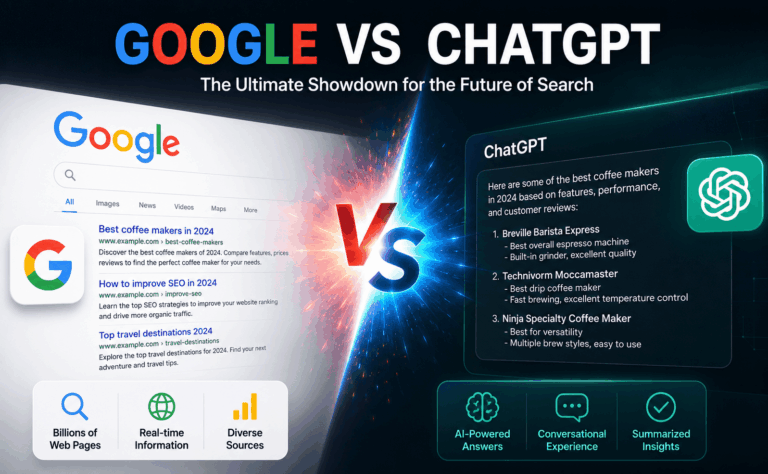
For more than two decades, the phrase “Google it” has been synonymous with finding information online. Google has held an undisputed monopoly over the internet search landscape, acting as the primary gateway for billions of users worldwide. However, the launch of OpenAI’s ChatGPT in late 2022 sent shockwaves through the tech industry. For the first time in history, a new technology emerged that didn’t just challenge Google’s dominance—it completely reimagined how we retrieve and consume information.
This paradigm shift has sparked a massive, ongoing debate: Google vs ChatGPT. Is generative AI poised to completely replace the traditional search engine? Or are these two technologies destined to coexist and serve entirely different purposes?
For digital marketers, business owners, and content creators, understanding the nuances of this battle is not just a matter of curiosity—it is vital for survival. The way consumers search for products, services, and information is evolving rapidly. If you want to ensure your business remains visible in this changing landscape, staying ahead of the curve is critical. To build a future-proof strategy, consider partnering with experts like those at Navoto to navigate these complex digital marketing waters.
In this comprehensive guide, we will dive deep into the fundamental differences between Google Search and ChatGPT, analyze their strengths and weaknesses, and break down exactly what this means for your website’s SEO and content strategy in 2024 and beyond.
Understanding the Contenders: How Do They Actually Work?
To accurately compare Google and ChatGPT, we first need to understand the underlying technology powering each platform. While they both answer user queries, the mechanics behind how they generate those answers couldn’t be more different.
Google Search: The Master of Information Retrieval
At its core, Google is an information retrieval system. Its primary objective is not to generate answers, but to direct you to the best possible existing sources on the internet. To accomplish this, Google uses three main processes:
- Crawling: Automated bots (Googlebots) constantly scour the web, discovering new pages, reading content, and following links.
- Indexing: The discovered pages are stored and organized in a massive database—the Google Index—which acts like a giant library catalog.
- Ranking: When you type a query, Google’s complex algorithms (incorporating hundreds of ranking factors like relevance, authority, backlinks, and user experience) evaluate the indexed pages and serve the most useful links in milliseconds.
Google’s strength lies in its ability to connect users directly with primary sources, real-time news, and transactional websites (like ecommerce stores). It is built for scale, speed, and accuracy, relying on the collective knowledge published by humans across the web.
ChatGPT: The Pioneer of Information Synthesis
Unlike Google, ChatGPT is a generative Artificial Intelligence powered by Large Language Models (LLMs), such as GPT-4. It does not search a traditional index of web pages to find answers (though newer versions do have web-browsing capabilities). Instead, it relies on patterns learned from being trained on massive datasets containing billions of words from books, articles, websites, and human conversations.
When you ask ChatGPT a question, it is not “looking up” the answer; it is mathematically predicting the next most logical word in a sequence based on its training. This process is known as information synthesis.
Because it synthesizes information rather than just retrieving links, ChatGPT can hold context over long conversations, write original code, draft essays, translate languages fluently, and explain highly complex topics in a conversational, human-like tone.
Direct Comparison: Google vs ChatGPT
Let’s break down the head-to-head comparison across several critical factors that impact user experience and information gathering.
1. Information Delivery vs Information Creation
The most fundamental difference lies in how you receive your answer. When you search Google for “how to bake a chocolate cake,” you are presented with a list of 10 blue links. You must click through multiple recipe blogs, scroll past lengthy personal stories, and dodge pop-up ads just to find the ingredient list. Google delivers you to the information.
If you ask ChatGPT the same question, it immediately creates the answer. It provides a clean, concise ingredient list and step-by-step instructions directly in the chat window. There is no clicking, no scrolling through ads, and no external websites needed.
2. Accuracy, Reliability, and “Hallucinations”
Google remains the undisputed champion of verifiable accuracy. Because it links you directly to the source (e.g., a government website, a recognized news outlet, or an official brand page), you can easily evaluate the credibility of the information yourself. If you need to know today’s stock prices or breaking news, Google is essential.
ChatGPT, while incredibly smart, suffers from a phenomenon known as “hallucination.” Because it is predicting words based on patterns, it can sometimes generate answers that sound incredibly confident but are entirely factually incorrect. It does not intrinsically “know” what is true and what is false. While its web browsing features have improved its fact-checking, it is still not as inherently reliable as a direct link to a primary source.
3. User Intent: Navigational vs Exploratory
Search engines classify user queries into different types of “intent.”
- Navigational and Transactional Intent: If you want to go to a specific website (e.g., “Facebook login”) or buy a specific product (e.g., “buy Nike Air Max size 10”), Google is vastly superior. ChatGPT cannot complete purchases or act as a directory.
- Exploratory and Informational Intent: If you are researching a broad topic, comparing abstract concepts, or brainstorming ideas (e.g., “Give me 10 marketing campaign ideas for a coffee shop”), ChatGPT excels. It can synthesize ideas instantly, whereas Google would just give you articles about marketing.
4. Efficiency and Cognitive Load
Google often requires a high cognitive load. The user is responsible for reading multiple sources, verifying the data, and piecing the puzzle together. ChatGPT drastically reduces cognitive load by doing the heavy lifting for you. It reads, analyzes, and summarizes the data, saving the user significant amounts of time when researching complex subjects.
The Impact on SEO and Digital Marketing
So, what does the rise of ChatGPT mean for your website? If users can get their answers directly from an AI chat interface, will they stop visiting your blog or service pages?
The short answer is: traditional SEO is changing, but it is not dying. Instead, it is evolving into something entirely new. Google has already responded to the threat of ChatGPT by rolling out “AI Overviews” (formerly Search Generative Experience), which places AI-generated summaries directly at the top of Google search results.
Here is how you need to adapt your strategy to survive the Google vs ChatGPT battle:
1. Embrace Generative Engine Optimization (GEO)
Optimizing for AI engines is different from traditional SEO. AI models look for clear, concise, and highly structured data to pull into their answers. You must format your content with distinct headings, bulleted lists, and direct answers to common questions. Make it incredibly easy for an AI bot to extract the exact value from your page. Ensure your content is highly readable and directly addresses user pain points.
2. Double Down on E-E-A-T (Experience, Expertise, Authoritativeness, Trustworthiness)
AI can generate endless amounts of generic, informational content. Therefore, generic content is no longer valuable. To stand out, you must provide what AI cannot: real human experience. Google’s algorithms now heavily reward content that demonstrates genuine expertise and firsthand experience. Include personal anecdotes, original data, unique case studies, and strong opinions in your content. If you need help crafting high-quality, authoritative content that ranks well in both traditional search and AI queries, consider exploring the content marketing services at Navoto.
3. Focus on Long-Tail and Conversational Queries
Because users interact with AI in a conversational manner, their queries are becoming longer and more specific. Instead of searching for “best running shoes,” a user might ask an AI, “What are the best running shoes for flat feet if I am training for a marathon on pavement?” Your content needs to anticipate these highly specific, conversational questions and answer them comprehensively.
4. Build Brand Authority
If users are relying on AI to summarize information, you want your brand to be the one the AI trusts enough to cite as the source. Building high-quality backlinks, getting mentioned in reputable industry publications, and establishing a strong brand presence will make your website a primary source of truth for AI models to draw from. A comprehensive strategy from an agency like Navoto’s SEO experts can help solidify your brand’s authority across the web.
Real-World Scenarios: When to Use Which
To truly understand the Google vs ChatGPT dynamic, it helps to look at practical use cases.
When you should definitely use Google:
- Finding a local restaurant and checking its opening hours.
- Comparing flight prices for an upcoming trip.
- Reading breaking news about a live event.
- Verifying a specific statistic or finding original research papers.
- Navigating to a specific login page or software tool.
When you should definitely use ChatGPT:
- Writing a polite email to a difficult client.
- Explaining the theory of relativity in simple terms.
- Generating boilerplate code for a new software project.
- Brainstorming a list of potential names for a new startup.
- Summarizing a 50-page PDF document into three bullet points.
The Future: Will ChatGPT Replace Google?
The ultimate question in the Google vs ChatGPT debate is whether one will eventually make the other obsolete. The reality is that they are on a collision course, but a total replacement is unlikely in the near future.
Google is actively integrating generative AI into its core search product, blending the best of both worlds: the reliability of direct links with the convenience of AI synthesis. Meanwhile, OpenAI is continuously improving ChatGPT’s ability to browse the live web and cite its sources accurately, making it function more like a search engine.
We are moving toward a hybrid future. The “search engine” of tomorrow will be an AI assistant that understands your personal context, synthesizes information from trusted sources, and provides direct links when you need to make a transaction or verify a fact.
Conclusion
The rise of generative AI has forever altered the digital landscape. The battle of Google vs ChatGPT isn’t about choosing a winner; it’s about understanding that user behavior has fundamentally shifted. People no longer want to just search for information—they want to converse with it, synthesize it, and apply it instantly.
For website owners, relying on outdated SEO tactics is a guaranteed path to obsolescence. You must elevate your content, focus on genuine expertise, and adapt to Generative Engine Optimization. The transition can be complex, but you don’t have to do it alone. By partnering with a forward-thinking digital agency like Navoto, you can ensure your website not only survives the AI revolution but thrives in it.
“`