Something shifted in the last couple of years. Google is still the biggest search engine on the planet — but it no longer holds a monopoly on where people actually find answers. ChatGPT now processes over a billion queries every single day. Perplexity handles 230 million monthly searches. Google’s own AI Overviews now show up on roughly 13% of all searches.
For anyone running a website or working in digital marketing, this creates a real question: is the SEO you’ve been doing still enough? Or do you need to think about things differently?
The honest answer is that traditional SEO isn’t dead — not even close. But it’s no longer the whole game. AI-powered search has added a new layer on top of everything that came before it. And if you only understand one of the two, you’ve got a blind spot.
This guide breaks down exactly how they differ — across goals, content, technical requirements, measurement, and more — without the hype or the filler.
First, What Do We Actually Mean by Each?
People throw both terms around loosely, so let’s be precise before comparing them.
Traditional SEO
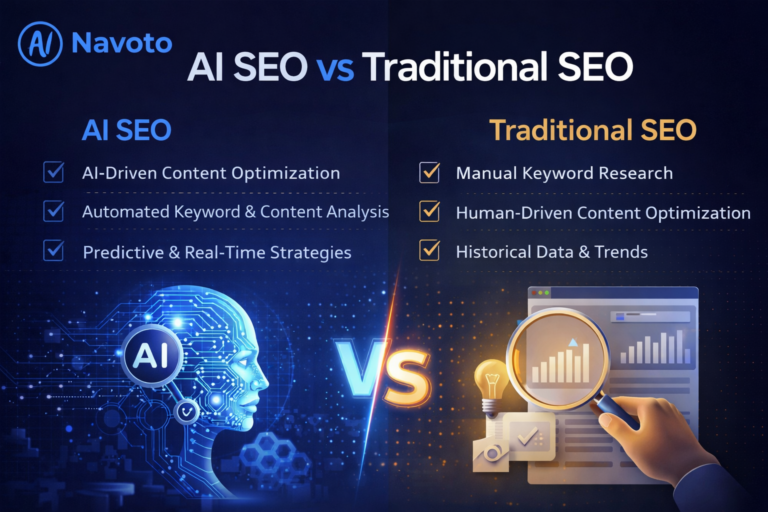
The practice of optimising a website so that Google (and Bing, etc.) rank it higher in search results. It’s about earning a position on page one so that users searching for your topic click through to your site. The output is a ranked URL on a results page.
AI SEO
Optimising content so that AI search platforms — ChatGPT, Perplexity, Google AI Overviews, Gemini — read your content, trust it, and cite it in their generated answers. The output isn’t a ranked URL. It’s a mention, a citation, or a recommendation inside a conversational response.
The underlying goal — get your content in front of the right people — is the same. But the mechanism is completely different. Traditional SEO puts you in a list. AI SEO puts you inside the answer itself.
AI SEO also goes by a few other names depending on who you’re talking to: Generative Engine Optimisation (GEO), Answer Engine Optimisation (AEO), or LLM optimisation. They all refer to the same shift. If you want to understand the answer engine optimisation approach in detail, it’s worth seeing how it differs from standard SEO in its own right.
The Core Goal: Ranking vs Being Cited
This is the fundamental split, and everything else flows from it.
Traditional SEO is about position. You want to show up on page one, ideally in the top three results, for keywords your target audience types into Google. When they see your listing, they click it. Traffic lands on your site. That’s the model — and it’s worked for 25 years.
AI SEO is about selection. When someone asks ChatGPT or Perplexity a question, the AI doesn’t show them ten links. It reads multiple sources, synthesises the information, and writes a single answer — citing the sources it found most credible and relevant. Being one of those cited sources is the goal. There’s no position one or two. There’s cited or not cited.
The traffic vs visibility distinction matters here. Major publishers like Reuters and The Guardian get cited by AI platforms constantly — but less than 1% of their referral traffic comes from those citations. The value isn’t always the click. It’s the brand mention, the association with expertise, and the influence over a user’s decision-making before they ever visit your site.
When visitors do come from AI sources, they convert significantly better. The Washington Post reported that AI-referred visitors converted to paid subscriptions 4–5 times more often than traditional search visitors. The traffic is smaller in volume but higher in intent and quality.
Keyword Research: Short Phrases vs Full Questions
Traditional keyword research has always been about finding the phrase people type — usually two to four words — and building content that targets that phrase. Tools like Ahrefs, SEMrush, and Google Keyword Planner are built for exactly this. You find a keyword, check the volume, assess the competition, and decide if it’s worth targeting.
AI search doesn’t work that way. Nobody types “best project management tool” into ChatGPT. They ask, “What’s a good project management tool for a five-person team that doesn’t want to spend more than $20 per person per month?” The query is a full sentence. It has context. It has constraints. And the AI uses what’s called query fan-outs — running multiple related searches in the background — to assemble a comprehensive answer.
So for AI SEO, keyword research shifts to question mapping. Instead of targeting “best running shoes”, you’re writing content that thoroughly answers “What are the best running shoes for flat feet under £100?” You’re not chasing a phrase. You’re answering a real human question completely enough that an AI would quote you.
Content Strategy: Keyword Density vs Topical Depth
Traditional SEO content strategy is built around the keyword. You pick a primary keyword, a handful of related secondary keywords, and you weave them through the article at a sensible density. Title tag, H1, a few H2s, the intro paragraph, the body — that’s the standard playbook. The goal is for Google to match your page to searches that contain those words.
AI search doesn’t match keywords. It reads pages the way a human researcher would — looking for whether the content actually, thoroughly answers the question. An AI system doesn’t care if you used your keyword four times or fourteen times. It cares whether it can extract a clear, trustworthy answer from your content and present it to the user.
This pushes AI SEO toward what’s being called topical authority. The question isn’t “did I target this keyword?” — it’s “does my site comprehensively cover this subject?” A brand that has 40 well-written pieces about running shoe care is going to be cited more often in running-related AI answers than a brand with one keyword-optimised article.
Related reading from navoto.com
Search engines are no longer the only place people find answers — which is why search everywhere optimisation has become a serious strategy for brands that want to stay visible wherever their audience is looking.
How Content Format Differs
Traditional SEO content is written to be read by humans who landed on the page. AI SEO content is also written to be read by humans — but it also has to be readable by machines that are parsing it looking for extractable answers. This creates some specific format differences:
Traditional SEO prioritises
- Keyword placement in title, H1, first paragraph
- Internal linking for crawl depth
- Word count competitive with top-ranking pages
- Meta title and description click-through rate
- Optimising for featured snippets
AI SEO prioritises
- Clear question-answer pairs in content
- Descriptive H2/H3 headings that stand alone
- Data, statistics, and cited sources within content
- FAQ sections written in natural question format
- Complete topic coverage, not just the target keyword
Technical Requirements: Crawlers Have Changed
Both approaches share the same technical foundation — fast pages, clean code, no crawl errors, a logical site structure. That hasn’t changed. What’s changed is which crawlers you need to care about and what they’re looking for when they visit your site.
Traditional SEO is built around Googlebot and Bingbot. Make sure they can reach and index your pages. Good robots.txt, clean sitemap, no noindex on pages you want ranked — that’s the baseline.
AI SEO adds a new set of crawlers to the list: GPTBot (OpenAI), Claudebot (Anthropic), and Petalbot (Huawei), among others. According to data from the 2025 Web Almanac, GPTBot crawl rates grew by 55% in a single year. Claudebot nearly doubled. These bots are actively indexing the web to train and update AI models — and if your robots.txt blocks them, you simply won’t exist in the information they use to answer questions.
robots.txt — make sure these are allowed:
User-agent: GPTBot
Allow: /
User-agent: Bingbot
Allow: /
User-agent: Claudebot
Allow: /
Schema markup is the other big technical difference. Traditional SEO used schema markup selectively — mainly for rich results like reviews, recipes, or events. AI SEO depends on it much more broadly. Article schema, FAQPage schema, HowTo schema, Person schema on author pages — these structured signals help AI systems understand not just what your page is about, but how to categorise the information when building a response.
Page speed still matters for both — but AI SEO adds an additional reason. SearchGPT and similar platforms retrieve and read pages in real-time. A page that loads too slowly might not be fully read before the AI assembles its answer.
Links & Authority: Backlinks vs Brand Credibility
Link building is one of the most time-consuming parts of traditional SEO — and for good reason. Google has used backlinks as a primary authority signal since the PageRank era. A link from a high-authority site tells Google that your content is trusted. More high-quality backlinks generally means better rankings.
AI systems use a different version of this. They can’t directly read your backlink profile the way Google’s algorithm does. What they can evaluate is your broader credibility — whether your content is written by a named expert with verifiable credentials, whether your brand is mentioned positively across the web, and whether your claims are supported by data from recognised sources.
According to EMARKETER analysis, Reddit, LinkedIn, and YouTube were among the most-referenced domains by major LLMs in late 2025. These platforms aren’t about backlinks — they’re about brand presence in the places where real people talk about your industry. This is why AI SEO pushes brands toward community engagement, podcast appearances, and consistent publishing on platforms where conversations happen.
Tracking authority in AI search
Traditional rank tracking tools don’t tell you whether you’re being cited in AI answers. Understanding how AI search monitoring works is the first step toward measuring your actual AI visibility — not just your Google position.
How Success Is Measured
Traditional SEO has a clear, well-established measurement framework. You track keyword rankings, organic traffic, click-through rates, and conversions from organic search. Google Search Console, Google Analytics, and any rank tracking tool will tell you exactly how you’re performing. The data is clean and there’s 20+ years of benchmark data to compare against.
AI SEO measurement is still developing. You don’t get a “rank” in ChatGPT. You either get cited or you don’t — and it varies depending on how the question is phrased, which version of the model is being used, and whether the AI’s training data or live retrieval favours your content on a given day. As EMARKETER’s analysts put it: “The industry needs better visibility metrics, not just traffic metrics.”
What you can measure in AI SEO right now:
- →Citation frequency — how often your brand appears in AI-generated answers when you query relevant topics
- →Share of voice in AI answers vs competitors across your key topics
- →Referral traffic from AI platforms — tracked as a separate traffic source in analytics
- →Conversion quality from AI-referred visits — which, as noted above, tends to run 4x+ higher than traditional organic
Tools: Familiar Platforms vs a New Stack
Traditional SEO has a mature, well-populated tool ecosystem. Ahrefs and SEMrush for keyword research, backlink analysis, and technical audits. Google Search Console for direct performance data. Screaming Frog for site crawls. These tools have years of data behind them and clear attribution models. You know what changed and why.
AI SEO tooling is newer and less standardised. Some of the major SEO platforms are beginning to add AI visibility features, but specialist tools are where the most useful data currently lives. The basic free approach — manually querying ChatGPT, Perplexity, and Google AI Overviews with your target questions and noting whether your brand is cited — is genuinely useful as a starting point.
For AI-powered platforms specifically, understanding how they handle conversations with users is important context for your optimisation strategy. The full guide to AI chatbot platforms for businesses covers what these tools are capable of and how they’re being used — which directly affects the kind of queries you need your content to answer.
Full Side-by-Side Comparison
Here’s every meaningful difference in a single table you can bookmark and come back to:
| Dimension | Traditional SEO | AI SEO |
|---|---|---|
| Primary goal | Rank on page one of Google | Get cited inside AI-generated answers |
| User behaviour | User searches → sees a list → clicks a link | User asks question → gets one synthesised answer |
| Keyword approach | Target short search phrases by volume | Map full conversational questions to topics |
| Content goal | Rank for a specific query | Build topical authority across a subject |
| Content format | Keyword-optimised, competitive word count | Q&A pairs, clear headings, data-backed, FAQ sections |
| Schema markup | Selective (reviews, events, recipes) | Comprehensive (Article, FAQ, HowTo, Person, Org) |
| Key crawlers | Googlebot, Bingbot | Googlebot, Bingbot + GPTBot, Claudebot, Petalbot |
| Authority signal | Backlinks from high-DA domains | E-E-A-T, brand mentions, named authors, community presence |
| Measurement metric | Keyword rank, organic traffic, CTR | Citation frequency, AI share of voice, referral quality |
| Tools | Ahrefs, SEMrush, Search Console, Screaming Frog | AI monitoring platforms, manual prompt testing, GEO tools |
| Time to results | Weeks to months | Variable — depends on crawl frequency and model updates |
| Where it appears | Google, Bing SERPs | ChatGPT, Perplexity, Gemini, AI Overviews, voice search |
| E-E-A-T role | Important, especially for YMYL topics | Essential — AI won’t cite untrustworthy or anonymous sources |
| Content freshness | Helps but not always critical | Strongly weighted — stale content is deprioritised in retrieval |
Where They Actually Overlap
Despite the differences, there’s a lot of shared ground — and this is important, because it means you don’t have to completely rebuild what you’re already doing.
Both approaches require well-structured, readable content. Both benefit from strong E-E-A-T. Both penalise thin, duplicate, or low-quality content. Both reward consistent publishing and a site that actually solves the user’s problem.
The technical overlap is also significant. If your site is fast, properly indexed, structured with good heading hierarchy, and free from crawl errors — you’ve already laid the foundation for both. AI SEO builds on top of traditional SEO; it doesn’t replace it. LLMs pull from indexed web content. Without a solid traditional SEO foundation, there’s nothing for AI systems to find and cite.
The bigger picture
The reason both strategies are now necessary is the same reason search itself has changed. How AI is reshaping SEO in 2026 goes deeper into what this transition means for brands trying to stay visible across both traditional and AI-powered discovery.
Which One Do You Actually Need?
The question isn’t “which one” — it’s “in what proportion.” Traditional search engines still drive the majority of web traffic. Google reaches 95% of Americans every month. But AI platforms are converting visitors at 4.4 times the rate of traditional organic traffic. Ignoring either side is a mistake.
A sensible allocation in 2026 looks something like: 70–80% of your SEO effort going to traditional foundations (technical health, keyword targeting, backlink building), and 20–30% going to AI-specific optimisation (schema, topical authority, E-E-A-T improvements, content freshness, AI monitoring).
Some specific situations where AI SEO should move up your priority list:
✓
Your audience is already using ChatGPT or Perplexity to research decisions in your industry
✓
Your category is highly conversational — people ask questions rather than typing product names
✓
You’re seeing Google AI Overviews appearing on searches that used to show your traditional organic rankings
✓
Competitors are being cited in AI answers for topics where you’re the actual category expert
Going deeper on AI search
If ChatGPT is now a channel you need to rank in, the complete guide to ranking on ChatGPT covers exactly what it takes to get cited there in 2026.
SearchGPT specifically
OpenAI’s search product operates by its own rules. The SearchGPT optimisation guide breaks down what actually gets you cited there.
Don’t forget Google AI Mode
Google is rolling out its own AI Mode alongside traditional search results. If you’re already investing in Google SEO, optimising for Google AI Mode is the logical next step — and many of the tactics overlap with what this guide covers.
The Short Version
Traditional SEO
🔸 Rankings in Google and Bing
🔸 Keyword targeting + backlinks
🔸 Drives the majority of web traffic
🔸 Clear measurement tools exist
🔸 Still the foundation everything else depends on
AI SEO
🔸 Citations in AI-generated answers
🔸 Topical authority + E-E-A-T
🔸 Higher-quality, higher-converting traffic
🔸 Measurement still developing
🔸 Growing fast and should be on your radar now
What you actually need
🔸 Both — in the right proportion
🔸 ~70–80% traditional SEO foundation
🔸 ~20–30% AI search optimisation
🔸 Adjust based on your audience behaviour
🔸 Monitor both channels separately
Frequently Asked Questions
More from navoto.com
Keep reading — go deeper on AI search
Rank on ChatGPT: 2026 Guide
Optimise for Google AI Mode
Search Everywhere Optimisation
Answer Engine Optimisation
SearchGPT Optimisation Guide
AI Search Monitoring
AI Chatbot Platforms Guide
© 2026 navoto.com — All rights reserved