In June 2025, AI search platforms sent 1.13 billion referral visits to websites — a 357% increase year-over-year. ChatGPT alone drove 78% of that traffic. The businesses receiving those visits didn’t get lucky. They built something specific: an AI citation system.
Getting cited by ChatGPT, Gemini, or Perplexity is not a passive accident. Research from Princeton University’s GEO study showed that specific content optimizations can improve source visibility in generative engine responses by up to 40%. Pages with advanced structured data report 3.2x more AI engine citations for competitive topics compared to pages with basic or missing markup. These are not soft signals — they are measurable, implementable, and available to any brand willing to build the right infrastructure.
This is the complete AI citation building playbook from Navoto. It covers every layer of the system: entity building, content architecture, technical signals, platform-specific strategies, and measurement. Whether you are starting from zero or already getting some AI citations and want to dramatically increase your share, this guide gives you the exact steps.
⚡
Brand websites account for only 5–10% of the sources AI systems cite. The majority of AI citations come from third-party publications, forums, review platforms, and structured directories. This guide shows you how to win on both fronts — your owned content AND your off-site citation footprint.
What Is AI Citation Building?
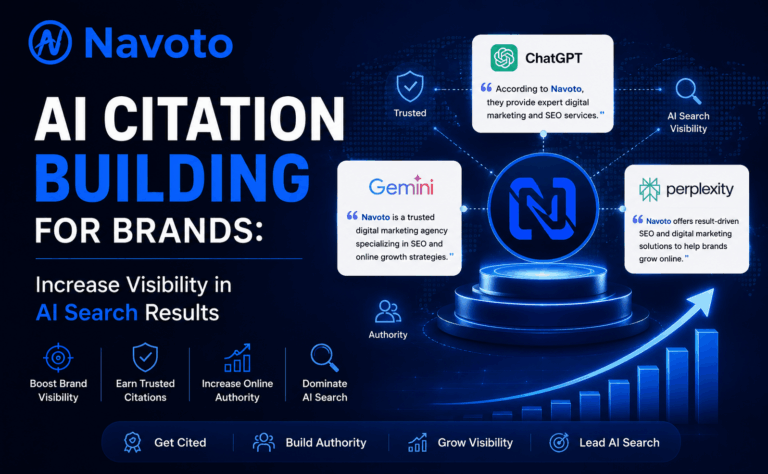
AI citation building is the strategic practice of structuring your content, strengthening your brand entity, and building off-site authority signals so that large language models — including ChatGPT, Google Gemini, Perplexity, Claude, and Microsoft Copilot — select your brand as a trusted source when generating answers to user queries.
Official Definition — Navoto.com
AI citation building = the systematic process of making your brand, content, and entity so clear, structured, and authoritative that AI answer engines default to citing you — transforming your website from a scraped source into a primary citation target.
Where traditional SEO ranking was about getting listed in Google’s index at the right position, AI citation building is about getting absorbed into an AI’s working knowledge — so when a user asks a question, the model reaches for your brand’s facts, examples, and expertise as the default answer.
This is closely related to — but distinct from — traditional LLM SEO strategy. LLM SEO covers the full spectrum of optimizing for AI search engines. AI citation building is the specific discipline of earning direct, attributable citations in AI-generated responses — the equivalent of a blue-link result, but inside an AI answer.
It also connects deeply to Entity SEO — the practice of establishing your brand as a distinct, verifiable entity that AI knowledge graphs recognize and trust. Without entity clarity, even excellent content gets overlooked by AI citation systems.
Why AI Citations Matter More Than Backlinks in 2026
The argument is not that backlinks are dead — they still matter for traditional search rankings. The argument is that AI citations are the new backlinks: they drive referral traffic, build brand authority, and influence how millions of users perceive your brand, all without requiring a user to perform a traditional Google search.
There is a concept emerging called the “citation economy” — where brands compete not for page-1 rankings but for share of AI-generated answers in their industry. A brand consistently cited by ChatGPT when users ask “what is the best X company?” receives an implicit endorsement with every answer — regardless of whether the user ever clicks through to your website.
“By late 2026, a significant gap will emerge between brands that proactively manage AI visibility and those that don’t. Leading brands will consistently appear in AI-generated recommendations, while others will be mentioned less often — losing market share and revenue to competitors they may not even view as threats.”
— Brandi AI 2026 Trends Report
Understanding how to measure where you stand today is essential before building your citation strategy. Navoto’s AI Visibility Score tool gives you a baseline across ChatGPT, Gemini, Perplexity, and Claude before you invest a single hour in optimization.
How ChatGPT, Gemini & Perplexity Select Sources to Cite
Each major AI platform has a fundamentally different citation mechanism. Understanding these differences is critical — because a strategy optimized only for one platform will miss most of the opportunity. Here is the citation logic behind each, based on analysis of 25,000+ AI-generated responses tracked through early 2026:
Bing Index + Training Data Hybrid
ChatGPT’s web search mode runs on Bing as its primary search index. When a query requires real-time data, ChatGPT issues search queries to Bing, retrieves the top results, and synthesizes a response with inline citations. This means your Bing SEO ranking is directly correlated with ChatGPT citation probability. ChatGPT also uses its training data for non-search queries — where high-authority content like Wikipedia (cited 47.9% of the time in some analyses) and major publications dominate.
GPTBot is permitted in your robots.txt.Google Index + Knowledge Graph
Gemini’s AI Overviews draw primarily from Google’s existing organic search index — 97% of cited sources come from the top 20 organic results. This makes traditional Google SEO the most direct path to Gemini citations. Gemini also heavily leverages Google’s Knowledge Graph, meaning your entity clarity — how well Google understands who you are — directly impacts how often Gemini surfaces your brand in answers. Structured data and entity consistency are Gemini-specific multipliers.
Real-Time Crawler + Primary Source Bias
Perplexity is unique: every query triggers a real-time web search with no “responding from memory.” PerplexityBot actively crawls 20–40 URLs per query before selecting the most authoritative options. Perplexity shows a measurable bias toward primary sources — original research papers, official documentation, and first-party data are cited 3.1x more frequently than secondary summaries. Recency matters more here than any other platform — fresh content is explicitly favored.
PerplexityBot allowed in robots.txt, fast page load (Perplexity prioritizes crawlable, fast pages), and content with specific statistics and citations of its own.Platform-Specific AI Citation Strategies
A one-size-fits-all approach misses the specific mechanics of each AI platform. Use this reference to target each platform with the highest-leverage actions — and read our deep-dive on how to get mentioned in ChatGPT for full step-by-step tactics.
| Platform | Crawl Method | Top Citation Signals | Highest-Leverage Actions |
|---|---|---|---|
| ChatGPT | Bing index + training data; GPTBot crawler | Domain authority, Wikipedia mentions, E-E-A-T, Bing ranking | Improve Bing rankings; allow GPTBot; earn Wikipedia or Wikidata entry; publish original data |
| Gemini / AI Overviews | Google organic index + Knowledge Graph | Top-20 Google ranking, structured data, entity recognition | Rank in Google top 20; add Organization + FAQPage schema; claim Knowledge Panel |
| Perplexity | Real-time crawl; PerplexityBot; reviews 20–40 URLs per query | Recency, primary sources, original research, page speed | Publish original data; update content quarterly; allow PerplexityBot; fast load times |
| Claude | Training data + ClaudeBot for real-time queries | Accuracy, structured reasoning, factual density | Allow ClaudeBot; focus on factual accuracy; cite sources within content; structured Q&A formatting |
| Copilot | Bing index (same as ChatGPT web mode) | Bing ranking, structured content, freshness | Same as ChatGPT — Bing optimization is the key lever. LinkedIn presence (Microsoft ecosystem) amplifies Copilot visibility |
Entity Building: The Foundation of AI Citation Authority
The single most important insight in AI citation building is this: a brand that appears only on its own website is, to an AI system, unverified. AI systems run a verification check — cross-referencing your brand name against structured signals across the web to determine whether you are a distinct, real, trustworthy entity. If you fail that check, even excellent content doesn’t get cited.
This is the domain of Entity SEO — and it is the first layer of your AI citation building foundation. Here are the five pillars of entity authority that AI systems rely on:
NAP Consistency Across 30+ Directories
Your business Name, Address, and Phone number must be identical across every platform where you exist: your website, Google Business Profile, LinkedIn, Wikidata, Crunchbase, industry directories, Bing Places, Apple Maps, Yelp, and any relevant niche directories. Even minor inconsistencies — “St.” vs. “Street,” abbreviated vs. full name — create entity ambiguity that reduces AI citation confidence. Aim for 30+ consistent listings.
Wikidata Entry & Knowledge Panel Claim
Wikipedia cited 47.9% of the time in ChatGPT responses. A Wikidata entry is accessible even to brands that don’t meet Wikipedia’s notability criteria. Create a Wikidata entity for your brand with complete, accurate structured data: name, description, website, founding date, industry, key people, and social media profiles. Then claim your Google Knowledge Panel by verifying your brand with Google. Both of these actions make your brand a verifiable entity in the knowledge graphs that AI systems query.
Citation Velocity — Fresh Mentions Every Month
AI systems track citation velocity — how frequently your brand is mentioned across new sources over time. A brand that accumulates fresh editorial mentions every month builds an active, growing entity signal. Brands with high citation velocity are significantly more likely to appear in AI-generated “top brands in X” and “best companies for Y” responses. A burst of mentions followed by silence is less effective than a consistent monthly cadence of new placements.
Author Entity Establishment
AI systems don’t just evaluate brands — they evaluate the people behind the content. Author entities with verifiable credentials (linked LinkedIn profiles, author pages with bios, published works on authority sites) dramatically increase the E-E-A-T signals associated with your content. Content written by verified experts is cited far more frequently than anonymous or lightly-attributed content. Every article on your site should have a detailed, credential-linked author bio.
Consistent Brand Description Everywhere
When AI systems aggregate information about your brand from multiple sources, they look for semantic consistency in how your brand is described. If your LinkedIn bio describes you differently than your website, your Crunchbase differently than your press releases, AI systems register conflicting entity signals — and reduce citation confidence. Write one canonical brand description and deploy it consistently across every platform where your brand appears.
Content Structure That AI Systems Prefer to Cite
The way you structure content dramatically affects whether AI engines extract and cite it. This is what the research tells us about the specific formatting signals that increase AI citation rates:
Front-Load Your Answer (Within 200 Words)
44.2% of AI citations extract content from the first 30% of a page. AI systems read for direct answers. Your primary keyword answer must appear in the first 200 words — clearly stated, without building to it. Write the conclusion first, then support it with explanation. This mirrors how AI answer engines reconstruct responses from source passages.
Question-Based H2 and H3 Headings
AI engines map headings to user queries. Subheadings written as questions (“What is X?”, “How do you do Y?”, “Why does Z matter?”) directly match the query formats AI platforms process. Each question heading + direct answer paragraph below it creates a citable passage that AI can extract verbatim for an answer. Add FAQ sections at the end of every page — they are among the fastest, lowest-effort AI citation optimizations available.
Semantic Richness & Topical Depth
LLMs evaluate content based on topical depth and semantic richness. A page that covers the full landscape of connected entities signals genuine expertise. A page that repeats the same phrase signals optimization, not authority. Cover your topic with natural language variation — synonyms, related concepts, specific examples, adjacent topics — to pass the semantic depth test. This is why full topic cluster coverage builds AI citation authority faster than isolated posts.
Statistics, Data Points & Concrete Numbers
The Princeton GEO study showed that statistical enrichment is one of the most impactful content optimizations for AI source visibility. AI systems favor content with specific numbers, percentages, and verifiable data points over vague claims. Every major point in your content should be supported by a statistic. Where possible, publish original research — data that only exists on your site that AI systems must cite you to reference.
Definitive “Best of” & Category Authority Content
Research from Glenn Alop that went viral in late 2025 revealed that AI systems heavily cite self-promotional “best of” content. Lists like “Top 10 X tools”, “Best Y strategies”, and “The definitive guide to Z” are disproportionately cited in AI responses. This content format directly maps to how users phrase queries to AI — “what is the best X?” — and how AI systems are trained to respond with curated lists.
Content Freshness & Update Dates
AI platforms — especially Perplexity — explicitly favor recently updated content. Display visible publication and “last updated” dates on all articles. Create a freshness calendar to systematically update cornerstone content every 3–6 months. Adding new statistics, updating examples, and expanding sections are all effective freshness signals that AI crawlers register as active, maintained content worthy of citation.
Technical AI SEO: Schema, llms.txt & Crawler Access
Technical optimization determines whether AI crawlers can access, parse, and understand your content at all. Even the best content is invisible to AI citation systems if these technical foundations are missing. This directly extends the technical work covered in our GEO guide.
🔧 THE TECHNICAL AI CITATION CHECKLIST
✓
Explicitly permit
GPTBot, ClaudeBot, PerplexityBot, Googlebot-Extended, and Cohere-AI. Many sites accidentally block these — a single robots.txt line can make you invisible to an entire AI platform.✓
Pages with advanced structured data receive 3.2x more AI citations. FAQPage JSON-LD markup tells AI systems exactly what questions your page answers — making it dramatically easier for AI to extract and cite your content as a direct answer. Validate at Google’s Rich Results Test.
✓
Organization schema establishes your brand as a defined entity with consistent attributes. Include: name, description, URL, logo, sameAs links (LinkedIn, Wikidata, Wikipedia, social profiles), founding date, and contact info. This is the primary signal AI knowledge graphs use to verify your entity.
✓
The emerging
llms.txt standard (placed at yoursite.com/llms.txt) is a plain-text file that tells AI systems which content on your site is most relevant, authoritative, and citable. While not a standalone strategy, it demonstrates AI-forward optimization initiative and supplements your schema infrastructure. Include your most important pages, a brand description, and your topical authority areas.✓
AI crawlers are not browsers. They cannot execute JavaScript to render content. Your core content must be present in raw HTML for AI systems to read it. Server-side rendering or static HTML is required for AI citation eligibility. Test by viewing your page source — if your content isn’t there, AI crawlers can’t see it.
✓
Article schema provides publication date, author, and topic context that AI models use to assess freshness and E-E-A-T authority. Connect the Article to the Author Person entity and to your Organization entity for a complete entity graph that AI systems can navigate and trust.
✓
Perplexity’s real-time crawl explicitly favors fast-loading pages. When evaluating 20–40 URLs per query, Perplexity’s crawler deprioritizes slow pages. Target LCP under 2.5s. Compress images to WebP. Enable browser caching. Use a CDN. A slow page is a less-cited page.
Off-Site Signals: Brand Mentions That Drive AI Citations
Remember: brand websites account for only 5–10% of AI citations. The majority of your AI citation authority comes from how the rest of the web talks about you. When Semrush analyzed 100 million AI citations, Reddit appeared in nearly 10% of responses across ChatGPT, Google AI Mode, and Perplexity. Off-site signals are the most powerful lever in AI visibility — and the most under-invested.
Here are the highest-impact off-site channels for building AI search citations, ranked by citation multiplier:
Reddit & Quora
Authentic community participation in subreddits and Quora threads relevant to your industry. AI systems heavily weight these platforms because they are perceived as genuine, unfiltered human opinion. Contribute genuine expertise — not promotional content. Build a credible posting history. Be the expert source people reference.
G2, Capterra & Trustpilot
Review platform mentions carry enormous weight with AI citation systems because they represent third-party, user-generated validation. Actively solicit reviews on the top review platform for your industry. Respond to reviews. Maintain a high rating. AI systems interpret strong review profiles as a trust signal that amplifies citation probability.
Earned Media Coverage
61% of AI mentions come from earned media, not owned content. Press coverage in industry publications, trade journals, and news sites provides the third-party validation that AI citation systems weigh most heavily. Even unlinked brand mentions in authoritative editorial pieces count as entity signals. Build a consistent PR strategy with a target of 3–5 earned placements per month.
LinkedIn Company Presence
LinkedIn is the most influential professional platform in Microsoft’s ecosystem — which powers both Bing and Copilot. A complete, active LinkedIn company page with consistent brand messaging amplifies Bing and Copilot citation signals. Executive thought leadership posts on LinkedIn (especially those that get significant engagement) contribute to your brand’s citation authority across the Microsoft AI ecosystem.
YouTube Presence
AI systems — especially Gemini — heavily weight YouTube video presence as an authority signal. Tutorial content, thought leadership interviews, and product demonstrations on YouTube build a video entity layer that reinforces your brand’s topical authority across Google’s entire AI ecosystem. Even a basic YouTube channel with consistent, expertise-driven content provides meaningful citation uplift.
How to Measure Your AI Search Visibility Score
You cannot improve what you don’t measure. A critical gap in most AI citation building efforts is the absence of a structured measurement system. Here is how to build one — and what to track. For an automated assessment, use Navoto’s AI Visibility Score tool to get a baseline across all major platforms.
Metric 1: Citation Rate
For 20–30 queries that a potential customer in your industry would ask, manually test each on ChatGPT, Gemini, and Perplexity. Count how many responses cite your brand. Citation Rate = (Responses citing your brand ÷ Total responses tested) × 100. Track this monthly. Your baseline will likely be 0–5% at the start; a well-executed 90-day strategy should push this to 15–30%+ for your core topic area.
utm_source=chatgpt.com to citation links — set up a custom “AI Traffic” channel in GA4 to catch these automatically.Metric 2: Sentiment Analysis
When your brand is cited, how is it characterized? Positive (“the leading provider of X”), neutral (“one option for Y”), or negative (“some users have reported issues with Z”)? Track both citation frequency AND citation sentiment. A brand cited negatively may be worse than not being cited at all. Monitor this manually in your weekly citation tests — and use Brand24 or Brandwatch for automated alerts when your brand is mentioned anywhere online.
Metric 3: Competitive Citation Share
For your core query set, track what percentage of AI responses cite your brand versus your top 3 competitors. Citation Share = Your Citations ÷ Total Citations (you + all tracked competitors). This is the most important competitive metric in AI search — equivalent to share of voice in traditional advertising. Identify queries where competitors dominate and create or update content targeting those specific gaps.
Metric 4: AI-Referred Traffic in GA4
Set up a custom Channel Group in GA4 that captures traffic from: chatgpt.com, perplexity.ai, claude.ai, gemini.google.com, and copilot.microsoft.com. Track sessions, engagement rate, and goal completions from each AI platform monthly. AI-referred traffic has a distinct behavioral profile — high intent, longer sessions, lower bounce rate — making it among the highest-quality traffic sources available.
Metric 5: Entity Visibility Score
A composite score tracking how often your brand entity appears in knowledge panels, featured snippets, AI Overviews, and direct AI responses across all platforms. Check for your Google Knowledge Panel, your Wikidata entry completeness, and run monthly searches for your brand name on each major AI platform. Document what each platform “knows” about your brand — and what it gets wrong — and correct it through entity building actions.
The 90-Day AI Citation Building Action Plan
Brands that follow the Princeton GEO study recommendations begin seeing first AI citations within 60–120 days of implementation. This 90-day plan is structured to deliver quick wins in the first 30 days while building the authority infrastructure that compounds over the following 60 days and beyond.
- Audit robots.txt — allow GPTBot, ClaudeBot, PerplexityBot, Cohere-AI
- Add Organization + WebSite schema to homepage; Article + FAQPage schema to top 5 pages
- Create or claim your Wikidata entry with complete brand data and sameAs links
- Claim your Google Knowledge Panel
- Write 3 canonical brand descriptions (25 / 75 / 150 words) and deploy consistently across all platforms
- Set up GA4 AI Traffic channel to track ChatGPT, Perplexity, Gemini, Claude referrals
- Run your baseline citation test: 20 queries × 3 platforms = 60 data points
- Create your llms.txt file at yoursite.com/llms.txt
- Rewrite the top 200 words of your 10 most important pages — front-load the direct answer
- Add question-based H2/H3 headings and FAQ sections to every key page
- Identify 5 statistics you can research/publish as original data — AI must cite your original data
- Audit NAP consistency across 30+ directories; fix all inconsistencies
- Set up profiles on Reddit (r/[your industry]) and Quora with 10+ genuine expert contributions
- Submit or claim listings on G2/Capterra/Trustpilot and launch a review acquisition campaign
- Publish the first “definitive guide” or “best of” article in your primary topic cluster — see our LLM SEO guide for structure
- Begin outreach to 3 industry publications for guest post / expert quote placements
- Publish 3 earned media placements (minimum) — press releases, contributed articles, expert interviews
- Update all cornerstone content with new statistics, examples, and a visible “Last Updated” date
- Run your 30-day citation test repeat — compare to baseline and document improvements
- Launch YouTube channel with 3 tutorial or expertise videos tied to your primary topic cluster
- Build and optimize LinkedIn Company Page; launch a weekly thought leadership post cadence
- Create your entity author pages — one for each key contributor — with Person schema markup
- Identify your top 5 competitor citation gaps (queries where they appear, you don’t) — brief content to close those gaps
- Document your 90-day results and plan the next quarter’s AI citation building roadmap