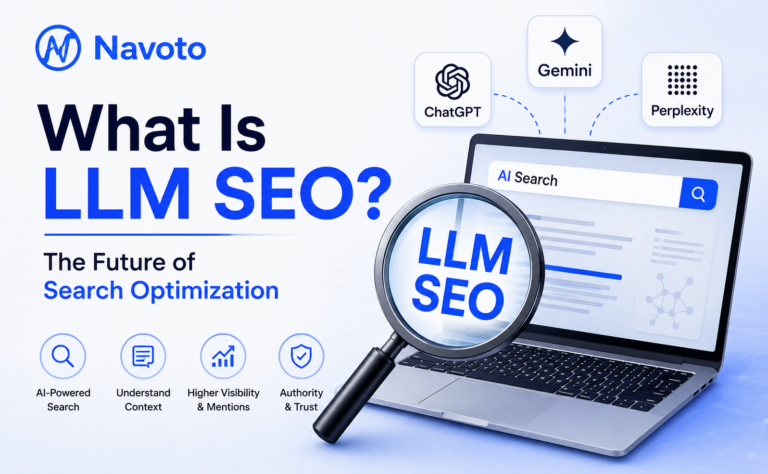
Google is no longer the only door to being found online. Millions of people now ask ChatGPT, Gemini, Perplexity, and Claude their questions and get a single synthesized answer — without clicking any link. If your website isn’t optimized to be understood and cited by these AI systems, you are invisible to an enormous and growing audience.
This guide from Navoto breaks down exactly what LLM SEO means, why it matters, and the specific strategies you need to implement today. Whether you manage a small business site or an enterprise content operation, this is the most important SEO shift of the decade.
What Is LLM SEO? (Full Definition)
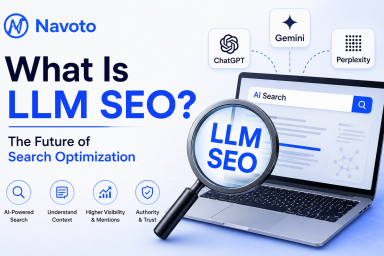
LLM SEO (Large Language Model Search Engine Optimization) is the practice of structuring, writing, and publishing your content so that AI-powered tools like ChatGPT, Google Gemini, Perplexity, and Anthropic’s Claude can find, understand, trust, and cite your content when answering user queries.
Simple Definition
“LLM SEO = making your content so clear, structured, and authoritative that AI engines quote you as the expert.”
Traditional SEO was about ranking on Google’s blue-link results page. LLM SEO is about being absorbed into the AI’s knowledge — so that when a user asks “What is the best way to do X?”, the AI responds with your facts, your brand name, or a link to your page.
Unlike old-school keyword stuffing, LLM SEO focuses on three pillars: structure (can the AI parse your content?), authority (does the AI trust your source?), and intent alignment (does your content directly answer the questions people are asking?).
Why LLM SEO Matters in 2026
The numbers are staggering. Google’s AI Overviews now attract 1.5 billion monthly users. Early adopters of LLM SEO have reported traffic increases of over 527% from AI-sourced sessions, with some sites receiving 22,000+ monthly visits from ChatGPT alone.
There is a brand-new concept called “invisible traffic” — users who get your information from AI without ever visiting your website. While this might sound bad, it actually builds enormous brand trust. When ChatGPT credits your website as the source of an answer, your authority grows with every user who reads that response.
The brands that dominate traditional SERPs are now becoming invisible in AI tools unless they evolve. Our SEO services at Navoto are specifically built to bridge this gap — helping you stay visible in both worlds.
“LLM SEO isn’t a future trend — it’s happening now. Brands that prioritize AI search optimization today will gain a decisive competitive advantage.”
— Industry consensus, 2025–2026
LLM SEO vs Traditional SEO: Key Differences
Understanding the difference is the foundation of building the right strategy. Traditional SEO and LLM SEO share some DNA, but they diverge dramatically in what actually drives results.
| Factor | Traditional SEO | LLM SEO |
|---|---|---|
| Primary Goal | Rank on Google Page 1 | Get cited in AI answers |
| Key Ranking Signal | Backlinks & keywords | Entity recognition & topical authority |
| Content Format | Keyword-optimized pages | Structured, Q&A, definitive answers |
| Success Metric | Click-through rate & rank position | AI citation frequency & brand mentions |
| Trust Signals | Domain authority, PageRank | E-E-A-T, brand consistency, fact density |
| Link Strategy | Backlinks reign supreme | Web mentions + structured data matter more |
The key insight: LLMs evaluate your brand’s entire digital footprint — who you are, who mentions you, your expertise, and your factual accuracy — not just who links to you. This is a fundamental shift from link-building to brand-building. To learn how Navoto can help you build that footprint, explore our content strategy services.
How LLMs Discover and Cite Your Content
Understanding the mechanics behind AI search helps you optimize correctly. Large Language Models don’t crawl the web the same way Googlebot does. Here is the journey your content takes to reach an AI response:
Training Data Absorption
LLMs are trained on enormous datasets scraped from the web. Well-organized, fact-based content that appears consistently across multiple sites is far more likely to be absorbed into the model’s base knowledge.
Real-Time Retrieval (RAG)
Modern AI tools like Perplexity and ChatGPT’s Search Mode use Retrieval Augmented Generation (RAG) — actively crawling the live web for fresh content. Your site must be crawlable by AI bots like GPTBot and ClaudeBot.
Passage-Level Capture
Google’s AI Overviews (powered by Gemini) and other AI engines don’t just read pages — they capture specific passages, entities, and structured data to rebuild knowledge graphs. If your content is disorganized or vague, passages won’t be extracted.
Citation in Generated Answers
When a user asks a question, the AI synthesizes its answer. Sources it deems authoritative, factual, and well-structured get cited. This is your goal: become a source the AI cites by default.
8 Proven LLM SEO Strategies for 2026
These are the strategies that are driving real results across industries. At Navoto’s blog, we document our own application of each of these with case data.
STRATEGY 01
Build Topic Clusters, Not Isolated Posts
Instead of creating single, loosely related blog posts, group your content around a central subject (a “pillar”) and cover it from every angle — beginner’s guide, advanced tips, common mistakes, expert interviews, use cases, FAQs. This teaches AI that you are a genuine expert in that domain, not just someone with one good post.
Action: Identify 5–7 core topics that define your brand. Build a pillar page for each, then create 8–12 supporting articles that interlink back to it.
STRATEGY 02
Write in Conversational, Q&A Formats
LLM queries are overwhelmingly phrased as “What are the best ways to…” or “How do I handle…”. Structure your content with clear question-based headings and direct answers beneath them. This mirrors how AI reads, parses, and ultimately re-generates answers.
Action: Add an FAQ section to every major page. Write each answer in 2–4 clean sentences — direct, factual, citable.
STRATEGY 03
Use Semantic Keywords and Natural Language Variants
LLMs understand synonyms, related terms, and semantic context. Including varied language around a topic — “AI search visibility,” “generative engine optimization,” “LLM citation,” “AI-powered answers” — signals depth and prevents your content from feeling thin or repetitive.
Action: Use NLP tools (e.g. SurferSEO, NeuronWriter) to find semantic variations of your main keyword and weave them naturally throughout your content.
STRATEGY 04
Implement Schema Markup (Structured Data)
Schema markup is machine-readable code (JSON-LD) that tells search engines and AI systems exactly what your content is about. FAQPage, HowTo, Article, and Organization schemas are especially powerful for LLM discoverability. AI crawlers build knowledge graphs from structured data — if you have it, you get included; if you don’t, you might not.
Action: Add FAQPage schema to every blog post. Add Organization + WebSite schema to your homepage. Test with Google’s Rich Results Test tool.
STRATEGY 05
Build a Strong, Consistent Brand Entity
LLMs don’t “know” your business — they rely on information about your brand across the entire web. Your business name, description, location, and offering must be consistent across every platform: your website, Google Business Profile, LinkedIn, Wikipedia (if applicable), Crunchbase, industry directories, and press mentions.
Action: Audit every listing of your brand online. Ensure NAP (Name, Address, Phone) consistency and that your brand description reads the same everywhere. Learn more in our brand authority guide.
STRATEGY 06
Allow AI Crawlers in robots.txt
Many sites accidentally block AI crawlers in their robots.txt file. If GPTBot (OpenAI) or ClaudeBot (Anthropic) can’t access your content, you will simply not appear in AI-generated answers from those platforms. This is a zero-cost fix with massive upside.
Action: Open your robots.txt file and check for any rules blocking GPTBot, ClaudeBot, PerplexityBot, or Googlebot-Extended. Remove any unintentional blocks.
STRATEGY 07
Earn Brand Mentions on Authoritative Sites
Research shows that nearly half of ChatGPT’s most-cited sources come from Wikipedia (47.9%). The lesson: being mentioned on authoritative, high-trust web properties signals to LLMs that your brand is a legitimate, expert source. Guest posts, PR coverage, academic citations, and industry round-ups all build this “web presence score.”
Action: Develop a PR and digital outreach strategy targeting industry publications, news sites, and niche authority blogs. Even 5–10 strong mentions can shift your LLM visibility significantly.
STRATEGY 08
Track Your AI Visibility (Not Just Google Rankings)
Because LLMs don’t have fixed rankings, traditional rank-tracking tools miss most of the picture. You need to monitor how often your brand is mentioned or cited in AI outputs across ChatGPT, Gemini, Perplexity, and Claude. Tools like Brandwatch, BrandMentions, and new AI-specific trackers are emerging for exactly this purpose.
Action: Run weekly prompt tests on major AI platforms. Ask “What is the best [your service] company?” and “Who are the top experts in [your niche]?” — and track whether you appear.
Technical LLM SEO: What to Fix on Your Site
Technical SEO remains the foundation. If your site has crawl errors, slow load times, or poor mobile performance, no amount of great content will get you cited. Here’s the technical checklist every site needs:
✓
lastmod dates tells AI crawlers which pages have fresh content worth re-indexing.✓
✓
/what-is-llm-seo) are far easier for LLMs to categorize than dynamic URLs with query strings.✓
✓
✓
E-E-A-T and LLM Authority Signals
Google’s E-E-A-T framework (Experience, Expertise, Authoritativeness, Trustworthiness) is now the blueprint that LLMs use to evaluate whether a source deserves to be cited. Here’s what each pillar means for LLM SEO:
Experience
Show first-hand knowledge. Use case studies, original data, personal examples, and tested recommendations — not generic advice.
Expertise
Display credentials. Author bios with real qualifications, linked LinkedIn profiles, and topic-specific depth signal domain expertise to AI.
Authoritativeness
Get mentioned and linked from reputable sources in your industry. Press coverage, awards, and industry partnerships build authority.
Trustworthiness
Accurate facts, cited sources, transparent policies, clear contact information, and a secure website all signal that you can be trusted.
Frequently Asked Questions About LLM SEO
Your 30-Day LLM SEO Action Plan
Start here. This 30-day roadmap gives you quick wins and long-term foundations simultaneously.
- Audit your robots.txt and allow all major AI crawlers
- Check and update your XML sitemap with lastmod timestamps
- Run a Core Web Vitals audit (Google PageSpeed Insights)
- Add Organization + WebSite schema to your homepage
- Identify your 5 most important pages and rewrite headings as questions
- Add an FAQ section with FAQPage schema to each of those pages
- Create or update your author bios with real credentials and links
- Audit internal links — ensure every important page is 3 clicks from home
- Map out your first topic cluster (1 pillar + 5 supporting articles)
- Publish your first definitional/explainer article in your niche
- Use semantic keyword research tools to expand content depth
- Develop an original data point, statistic, or study you can be cited for
- Audit your brand entity: consistent NAP across all directories
- Reach out to 3 industry publications for guest post opportunities
- Set up AI citation monitoring (manual weekly tests on ChatGPT/Gemini)
- Document your baseline and set 90-day review checkpoints
Ready to Dominate AI Search?
Navoto specializes in LLM SEO strategies that get your brand cited by ChatGPT, Gemini, and Perplexity. Let’s build your AI visibility together.