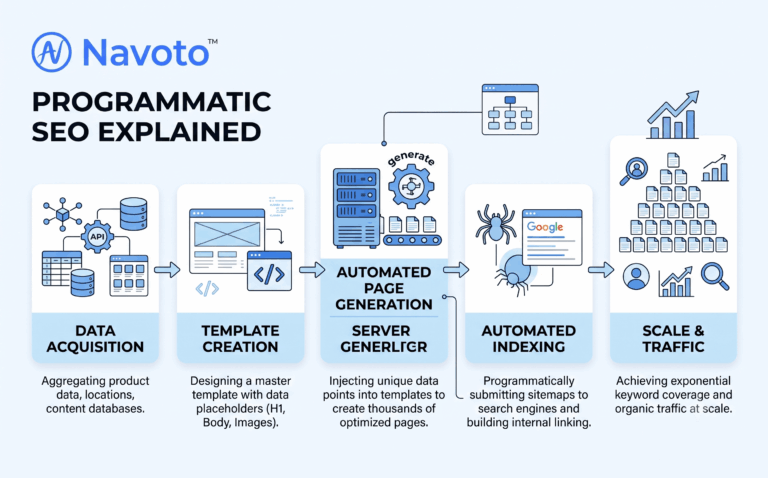
Most sites publish one page at a time. A handful of sites — Zapier, Wise, TripAdvisor, Yelp — publish thousands, using the exact same core page over and over with different data dropped in. That’s programmatic SEO, and it’s the reason a company like Zapier can rank for over a million keywords without a million-person content team. This guide breaks down exactly what it is, how it works mechanically, real examples with real numbers, and a step-by-step framework for building a program that grows traffic instead of getting your site penalized.
What Is Programmatic SEO?
Programmatic SEO (pSEO) is the practice of generating large numbers of search-optimized pages from a single template and a structured dataset, instead of writing every page by hand. One template, filled with different rows of data, becomes hundreds or thousands of unique, indexable URLs — each one built to answer a specific, narrow search query.
Think of it as the difference between building one house and running a housing development. A traditional blog post is custom-built: a writer researches one topic, drafts it, and publishes one URL. Programmatic SEO is the development — you design one solid blueprint (the template), then apply it across a dataset of variables (cities, products, integrations, currencies, job titles) to produce a whole street of houses that all share good bones but sit on different lots.
The technique isn’t new — directory and comparison sites have used it since the early 2000s — but it’s become a mainstream growth channel because three things lined up: cheap structured data, no-code publishing tools, and search behavior that’s increasingly made up of long, specific queries rather than broad ones. Somebody searching “usd to eur” or “plumber in Austin” wants one precise answer, not a 2,000-word essay, and that’s exactly the kind of query pSEO is built to satisfy.
Programmatic SEO vs. Traditional SEO
The two approaches aren’t competitors — most mature sites run both side by side. Traditional content, built around a solid SEO content strategy, earns the links, brand awareness, and top-of-funnel traffic. Programmatic pages capture the long tail underneath it. Here’s how they actually differ in practice:
| Factor | Traditional SEO | Programmatic SEO |
|---|---|---|
| Page creation | Manual, one page at a time | Templated, data-driven, published in batches |
| Keyword type | Broad, high-volume, high-competition | Long-tail, narrow, low individual volume |
| Where it wins | Original research, opinion, brand authority | Location pages, comparisons, tools, listings |
| Team required | Writers, editors | Writers + a developer or no-code database |
| Biggest risk | Slow to scale | Thin or duplicate content at scale |
Neither approach builds topical authority on its own. The strongest programmatic programs sit on top of a site that has already established itself as a legitimate source on the subject — the templated pages inherit trust from the rest of the domain instead of trying to create it from scratch.
How Programmatic SEO Actually Works
Strip away the tooling and every programmatic SEO program is built from the same five moving parts:
The part almost every guide glosses over is step five. A thousand orphaned pages with no path back to your site’s main navigation will sit un-indexed indefinitely. This is the same principle behind entity-based internal linking — every generated page needs a deliberate route in from a hub page and a deliberate route out to related variations, not just a sitemap entry and a prayer.
7 Real Programmatic SEO Examples (With Numbers)
Theory is easy to nod along to. Here’s what programmatic SEO looks like when it’s actually working, across seven very different business models:
1. Zapier — App Integration Pages
Zapier’s “Connect [App A] + [App B]” pages cover every combination of the thousands of tools it integrates with. This single pattern is widely cited as the largest known pSEO deployment on the web, with hundreds of thousands of indexed pages ranking for hundreds of thousands of keywords — the majority of Zapier’s total organic footprint.
2. Wise — Currency Conversion Pages
Every currency pair gets its own page: a live rate, a historical chart, and a short conversion guide. The pattern is almost mechanical — “[currency] to [currency]” — but it captures millions of highly specific, high-intent searches that a single “currency converter” page never could.
3. TripAdvisor — “Things to Do In [City]”
TripAdvisor layers city, cuisine, neighborhood, and price-range variables on top of each other to generate an almost unlimited number of travel and restaurant pages, each pulling from the same underlying reviews-and-listings database.
4. Figma — Color Meanings Library
Figma built a page for individual colors and hex codes, then extended each one with color psychology and design tips. It’s a good model for SaaS companies: the pages are genuinely useful on their own, and they tie back naturally to Figma’s design tools.
5. Atlassian — Use-Case Pages for Jira
Instead of one generic product page, Atlassian runs “Jira for agile project management,” “Jira for incident management,” and dozens of other use-case variants — each one speaking directly to a different buyer instead of trying to be everything to everyone at once.
6. Nomad List — City Data Pages
Each city page blends live data (cost of living, internet speed, air quality) with community-sourced reviews. The mix of real-time data and user content is what keeps these pages fresh without constant manual rewriting.
7. Two Men and a Truck / KrispCall — Location Pages
Service businesses with a physical or regional footprint use city and area-code pages to answer the one question that matters most before a purchase: “do you cover my area?” These are some of the simplest programmatic patterns to build and among the highest-converting, because the search intent is almost entirely transactional.
Programmatic SEO Statistics for 2026
300–500%
Typical organic traffic growth within 6 months for well-executed programmatic programs
$5–$50
Approximate cost per templated page, versus $500–$2,000+ for a manually written page
80%+
Healthy indexing-rate target within 6 weeks of publishing a new batch
5–15%
Share of pages typically flagged as thin content when quality controls are weak
Figures are directional industry benchmarks compiled from multiple 2025–2026 programmatic SEO case studies and vendor research; actual results vary widely by niche, execution quality, and existing domain authority.
The 7-Step Programmatic SEO Framework
This is the part that actually matters, and it’s the part most “programmatic SEO” articles skip in favor of tool screenshots. Here’s the sequence we follow when building a program for a client, end to end.
Step 1: Validate the keyword pattern before you build anything
The single most expensive mistake in programmatic SEO is building the entire system before confirming demand exists. Pull 8–10 representative variations of your proposed pattern into a keyword tool and check two things: does aggregate search volume across the full variation set clear a meaningful threshold, and does keyword difficulty stay low enough for a newer set of pages to realistically compete. A pattern with strong demand on 5 sample terms and near-zero demand on the other 5 is not a pattern — it’s a coincidence. This is the same discipline covered in our guide to building an SEO content strategy: start from evidence of demand, not assumption of it.
Step 2: Build a clean, structured dataset
Your dataset is the ceiling on your content quality — a template can’t add nuance a spreadsheet doesn’t contain. Every row needs consistent fields, no blanks in required columns, and at least one or two data points per row that a competitor’s generic page won’t have (a live price, a local statistic, a proprietary rating). Messy or incomplete data is the fastest route to thin, near-duplicate pages.
Step 3: Design a template that earns its ranking
A template needs unique title tags and meta descriptions generated from the data (never a single static template repeated verbatim), an H1 that states the specific variation plainly, at least one data visualization or comparison element unique to that row, and enough genuinely written context — not just swapped nouns — that the page would still be useful if the data table were removed. If two pages from your template are interchangeable except for one word, that’s the definition of the thin content Google’s spam policies are built to catch.
Step 4: Add a uniqueness layer
This is what separates programs that scale from programs that get deindexed. Layer in dynamic FAQs pulled from real user questions, local or contextual data points, comparison tables against 2–3 relevant alternatives, and short expert commentary that varies meaningfully by category. The goal isn’t cosmetic variation — it’s making each page independently worth ranking on its own merits.
Step 5: Handle the technical SEO before you publish
Every generated page needs a self-referencing canonical tag, clean and predictable URL structure, correct schema markup for its content type (Product, FAQPage, LocalBusiness, or Article schema depending on the page), fast load times, and mobile-first rendering. Skipping this step is the single most common reason programmatic pages fail to index at all — a problem we cover in depth in our complete guide to Google rankings.
Step 6: Publish in batches, not all at once
Push out 50–100 pages, run your indexing checklist, watch how Google Search Console responds for two to three weeks, then publish the next batch. Dumping 5,000 pages live in one afternoon gives Google no reason to trust the new section of your site and makes it far harder to isolate what’s actually causing a quality problem if one shows up.
Step 7: Measure the program, not individual pages
Track indexing rate, average position across the entire variation set, and click-through rate as your core dashboard — not the ranking of any single URL. A programmatic page ranking #7 for a term with 20 monthly searches is not a failure; a whole batch stuck at under 60% indexed six weeks after launch is a structural problem worth pausing for. This is exactly the kind of ongoing tracking we build into every organic SEO engagement at Navoto.
Programmatic SEO in the Age of AI Search
By 2026, a large share of searches surface an AI-generated answer before a single blue link — a shift we break down in detail in our guide to Google’s Search Generative Experience and how AI is changing SEO. This changes the bar for programmatic pages in one important way: they now need to work as citation-ready units for language models, not just rankable documents for a crawler.
In practice, that means leading each generated page with a concise, quotable answer in the first two or three sentences, defining key terms explicitly rather than assuming context, and structuring data in clean tables and lists that are trivial for an AI system to extract accurately. It also means AI-written filler is riskier than ever — search systems have gotten measurably better at spotting synthetic templating with no real informational value behind it. The pages that get cited are the ones that pair a solid template with real data and real editorial judgment, which is the whole philosophy behind Hybrid Engine Optimization — treating SEO, AEO, and GEO as one unified system instead of three separate scrambles.
Common Mistakes That Get Programmatic Sites Penalized
Google has been explicit that programmatic approaches aren’t against the rules — but that mass-produced pages offering little to no genuine value to the reader are treated as spam, regardless of how they were built.
- Publishing before validating demand. Hundreds of pages built around a pattern nobody actually searches for is wasted engineering time and a diluted site.
- Treating “unique” as swapping one noun. If the only difference between two pages is the city name, they’re duplicate content with a find-and-replace pass, not two separate pages.
- Skipping internal linking. Pages with no route in from the main site structure frequently never get crawled, let alone indexed.
- No maintenance plan. Prices go stale, integrations get discontinued, statistics age out — an unmaintained programmatic section decays fast and drags down trust in the rest of the domain.
- Scaling before the template is proven. Publish a small pilot batch, confirm it indexes and ranks, then scale — not the other way around.
Is Programmatic SEO Right for Your Business?
Programmatic SEO tends to work well when a business has structured data (locations, products, integrations, prices), a keyword pattern with at least 50+ realistic variations, and the resources to maintain — not just launch — the pages. It tends to work poorly when a topic genuinely requires deep expertise or original reporting on every page, or when the total addressable keyword pattern is under 100 variations, where a focused, strategic SEO approach to a smaller set of excellent pages will simply outperform the overhead of building a template system.
Smaller businesses shouldn’t assume programmatic SEO is out of reach, though — even a modest location or service-variant pattern can be built affordably as part of a broader plan. It’s worth reviewing alongside affordable SEO packages built for small business budgets before ruling it out.
Tools You’ll Actually Need
A working programmatic SEO stack usually covers four jobs: keyword and pattern research, dataset storage, template publishing, and ongoing rank tracking. You don’t need every tool in every category — most small and mid-sized programs run comfortably on a spreadsheet, a no-code database like Airtable, and a WordPress import plugin. We keep a full, regularly updated breakdown of what’s worth paying for at each budget level in our best SEO tools guide for 2026.
Frequently Asked Questions
Is programmatic SEO the same thing as AI-generated content?
No. Programmatic SEO is about the publishing method — templates plus structured data. AI can be used to help write the variable text inside a template, but plenty of long-running programmatic sites (Wise, Zapier’s earliest pages) were built with rules-based text generation and human editing, no generative AI involved at all.
Will programmatic SEO get my site penalized?
Not inherently. The risk is thin, duplicate, or low-value pages — not the technique itself. A well-built program with genuine data variation, unique context per page, and proper technical SEO carries a low risk of manual action.
How many pages do I need for programmatic SEO to be worth it?
Most practitioners consider 50 or more solid variations the practical floor. Below that, the overhead of building a template and dataset usually costs more than simply writing the pages by hand.
Do I need a developer to run a programmatic SEO program?
Not necessarily at a small scale — no-code tools can connect a spreadsheet or Airtable base to WordPress, Webflow, or a static site. Larger programs, or ones needing live data feeds and custom schema, generally benefit from developer support.
How long does it take to see results from programmatic SEO?
Indexing typically begins within days to a few weeks of a batch going live. Meaningful traffic usually builds over 2–6 months, faster than most manually written content because each individual page targets far less competitive keywords.
Can a small local business use programmatic SEO?
Yes — service-area pages (“[service] in [neighborhood]”) are one of the most accessible and effective programmatic patterns available, and don’t require enterprise-level datasets to execute well.
Want a programmatic SEO program built for your business?
Navoto plans, builds, and maintains programmatic SEO programs alongside full SEO and web development services — from keyword pattern validation through indexing and ongoing optimization.