70% of AI-driven referral traffic is misclassified as “Direct” in Google Analytics 4. That means the majority of visits driven by ChatGPT, Gemini, and Perplexity are invisible to most marketing teams — hidden inside a traffic category that looks like someone typed your URL directly. The commercial decisions being made on this blind spot are costing brands real revenue every day.
Tidio’s 2026 research found that AI influences half of all purchase decisions — yet receives attribution credit for less than 1% of web traffic. Contentsquare puts AI-referred sessions at just 0.2% of total retail visits. The gap between AI’s actual commercial influence and what analytics dashboards show is the defining measurement challenge of 2026. It has a name: “Dark AI.”
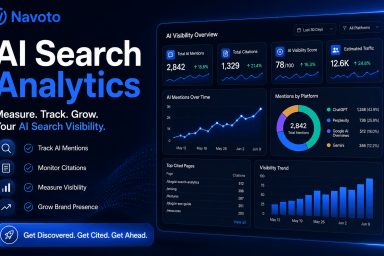
This complete guide from Navoto covers every aspect of AI search analytics: what it is, why the standard tools miss most of it, how to set up accurate tracking in GA4, which metrics actually matter, the best dedicated tools for 2026, and how to turn analytics data into a strategy that grows your AI search visibility. Every step is backed by published research and includes the exact code and configurations you need.
What Is AI Search Analytics?
AI search analytics is the discipline of measuring, attributing, and optimizing a brand’s presence and performance across AI-powered search platforms — including ChatGPT, Google Gemini, Perplexity AI, Claude, Microsoft Copilot, and Google’s AI Overviews — using a combination of specialized tracking tools, first-party analytics data, and behavioral signal analysis.
Official Definition — Navoto.com
AI search analytics = the complete measurement system for tracking how often your brand is cited by AI platforms, how much traffic those citations generate, what those visitors do on your site, and how AI-influenced journeys ultimately convert — closing the attribution gap between AI’s commercial influence and what traditional analytics tools report.
AI search analytics sits at the intersection of three established disciplines: traditional web analytics (GA4, Search Console), brand monitoring (measuring citations and mentions), and the emerging practice of LLM SEO — optimizing content for AI search engine visibility. It is what makes the invisible visible: converting AI’s influence from a guessed estimate into a measurable, reportable, and improvable performance channel.
Unlike traditional SEO analytics — where Google Search Console gives you precise impressions, clicks, and average position for every keyword — AI search analytics requires assembling a measurement picture from multiple fragmented sources. No single platform shows you the complete picture in 2026. Building an effective AI search analytics stack means combining what GA4 can track, what dedicated AI visibility tools measure, what Bing Webmaster reports, and what behavioral signal analysis can infer about unattributed AI influence.
AI search analytics is a core component of any complete AI marketing strategy. Without it, you cannot prove AI search ROI, identify what content earns citations, or make data-driven decisions about where to invest your optimization effort.
Why AI Search Analytics Matters in 2026
The case for investing in AI search analytics is not a future argument — it is a 2026 revenue measurement imperative. Here is exactly why:
Your Analytics Are Lying to You
70% of AI-referred visits appear as Direct traffic in GA4. When someone reads a ChatGPT recommendation for your brand, opens a new browser tab, and types your URL — GA4 calls that “Direct.” The AI that initiated the journey gets zero credit. Marketing teams making budget decisions on this data are systematically under-investing in their highest-impact discovery channel.
AI Traffic Converts at Premium Rates
AI-referred visitors browse 12% more pages per visit and show a 23% lower bounce rate than average site traffic (Adobe Business, 2026). They arrive pre-qualified — they read an AI summary first and clicked through for depth. One AI citation case study (Runpod via Scrunch AI) reported 4× growth in paying customers within 90 days. AI traffic is small in volume but enormous in intent quality.
Traditional Traffic Is Declining
Gartner projects traditional search traffic will decline 25% by 2026 as AI-powered answer engines absorb query volume. Google itself sends 190x more traffic than ChatGPT today — but that gap is closing exponentially. Brands that build AI search analytics infrastructure now will have the measurement maturity to respond as the balance shifts.
“90% of human traffic will go away as consumers outsource browsing to AI agents. Brands must adapt from targeting ‘best pages’ to providing ‘best answers.'”
— Chris Andrew, CEO of Scrunch AI, 2026
Traditional SEO analytics tools were not built for this new reality. They track keyword rankings, organic sessions, and backlinks — none of which tell you whether ChatGPT is recommending your brand, how often Perplexity cites your content, or what share of AI-generated answers about your industry feature your competitors instead of you. You need a different measurement system. This guide builds that system.
The Dark AI Attribution Problem (And How to Solve It)
“Dark AI” is the term coined by Tidio’s 2026 research to describe AI’s commercial influence that is invisible in standard attribution models. It is the defining analytics challenge of the AI search era — and understanding it is essential before you can build a reliable measurement system.
How Dark AI Works: The Invisible Journey
User asks ChatGPT: “What is the best AI marketing agency?”
ChatGPT recommends your brand with a description and link in its generated answer
User opens a new browser tab and types your domain URL directly
GA4 records this as “Direct” traffic — ChatGPT receives zero attribution credit
This mechanism is responsible for the massive gap between AI’s actual influence (50% of purchase decisions per McKinsey) and the 0.2% of web traffic attributed to AI in standard analytics. The AI platform that initiated the journey is structurally invisible in traditional attribution models because it doesn’t pass referral headers when a user opens a new tab.
There is no perfect solution — but there are four approaches that together close most of the gap:
FIX 1
Capture Properly-Tagged AI Referrals in GA4
Since June 2025, ChatGPT appends utm_source=chatgpt.com to cited links. Perplexity, Claude, and other platforms send standard referral headers when users click directly from within the AI interface. Set up a dedicated AI channel in GA4 to capture all of these properly. The full setup is in Section 5 below.
FIX 2
Behavioral Signal Analysis for Dark Traffic Estimation
AI-influenced visitors who arrive as “Direct” leave distinct behavioral fingerprints: they land on deep content pages rather than the homepage, have longer session durations on first visit, show unusually high conversion rates compared to other direct traffic, and follow navigation paths consistent with research intent. Build a GA4 segment for Direct traffic that matches these behavioral criteria — it provides a statistical estimate of dark AI influence on your Direct channel.
FIX 3
Correlate Branded Search Volume With AI Citation Events
When ChatGPT begins recommending your brand, branded search queries typically spike within 7–14 days as influenced users who didn’t click directly instead search Google for your brand name. Monitor branded search volume in Search Console alongside your manual citation testing schedule. A correlation between new ChatGPT citations and branded search upticks is one of the most reliable signals of dark AI commercial influence on your business.
FIX 4
Dedicated AI Visibility Tools for Citation Tracking
Purpose-built AI search analytics platforms (Profound, Peec AI, Omnia, KIME) track citation frequency across ChatGPT, Gemini, Perplexity, Claude, and others — independent of whether users click through. These tools measure your Share of AI Voice metric (what % of relevant AI responses mention your brand vs. competitors) regardless of traffic attribution. When combined with GA4, they give the most complete picture available of your AI search footprint. See the full tool comparison in Section 7.
The 7 Key AI Search Analytics Metrics You Must Track
Traditional SEO metrics — rankings, organic sessions, backlinks — measure the wrong things for AI search. These seven metrics form the core of a complete AI search analytics framework in 2026:
METRIC 01
Share of AI Voice (SoAIV)
Definition: The percentage of AI-generated responses about your topic category that mention or cite your brand — compared to all brands mentioned. Formula: Your AI Mentions ÷ Total AI Mentions (you + all tracked competitors) × 100. This is the most important competitive metric in AI search analytics — the AI-era equivalent of Share of Voice in traditional advertising. A SoAIV of 15% means your brand appears in 15% of all relevant AI responses in your category.
METRIC 02
AI Citation Rate by Platform
Definition: How often your content is cited with a direct source link (vs. just mentioned by name) in responses from each AI platform — tracked separately for ChatGPT, Gemini, Perplexity, Claude, and Copilot. A citation with a link drives direct traffic; a mention without a link builds brand awareness. Both matter, but citations are the higher-value signal because they drive measurable sessions in GA4 and provide direct evidence of content authority recognition.
METRIC 03
AI-Referred Sessions & Engagement Quality
Definition: The volume and behavioral quality of sessions directly attributed to AI platform referrals in GA4. AI-referred visitors exhibit measurably superior engagement: 12% more pages per session, 23% lower bounce rate, and higher conversion rates than average site traffic. Track this channel’s sessions, engagement rate, average session duration, pages per session, and conversion rate monthly. Even small AI-referred session volumes at high conversion rates can represent significant pipeline impact.
METRIC 04
AI Citation Sentiment Score
Definition: When AI platforms mention or cite your brand, how are they characterizing you? Positive positioning (“industry-leading,” “trusted source,” “recommended for”) vs. neutral (“one option among many”) vs. negative (“some users report issues with”) dramatically affects the commercial value of each citation. A brand cited neutrally 100 times may receive fewer qualified visits than one cited positively 30 times. Sentiment analysis gives you visibility into whether your brand authority is being reinforced or eroded by AI responses.
METRIC 05
Branded Search Volume Lift
The increase in Google searches for your brand name correlated with AI citation events. This is the most reliable proxy for dark AI influence — users who encounter your brand in AI responses but navigate via branded Google search rather than clicking the AI source link. Track branded query impressions monthly in Google Search Console. Spikes following new AI citation placements confirm commercial dark AI impact.
METRIC 06
Most-Cited Pages Report
Which specific pages on your site are being extracted and cited by AI platforms? Tracking this by page URL reveals which content formats, topics, and structures your AI search analytics show are earning citations — giving you a replicable blueprint for future content. Pages that receive disproportionate AI citations should be studied and cloned across your content program. This insight is only available in dedicated AI analytics tools, not in GA4.
METRIC 07
AI-Assisted Conversion Attribution
AI rarely acts as the final touchpoint before conversion — it typically influences early research, then a user later converts through a different channel. AI-assisted conversion tracking captures this indirect influence by recording all sessions where an AI platform appeared anywhere in the multi-touch conversion path. Set up multi-touch attribution in GA4 (Data-Driven Attribution model) and create AI-specific conversion path reports to see where AI search is contributing to revenue even when it’s not the last click.
How to Set Up AI Search Analytics in GA4 (Step-by-Step)
Google Analytics 4 is the foundation of your AI search analytics tracking — not because it captures everything, but because it integrates with your existing measurement infrastructure and provides the conversion data that dedicated AI tools lack. Here is the complete setup:
Step 1: Create a Custom AI Traffic Channel Group
A custom Channel Group lets you see all AI platform traffic in one place without disrupting your existing GA4 reports. Navigate to: Admin → Data Display → Channel Groups → Create New Channel Group.
GA4 Channel Group — Add These Rules for Each AI Platform
Channel Name: "AI Search"
Rule Type: Source OR Source/Medium

Add conditions (ANY match):
─────────────────────────────────────────
Session source     contains   chatgpt.com
Session source     contains   chat.openai.com
Session source     contains   perplexity.ai
Session source     contains   claude.ai
Session source     contains   gemini.google.com
Session source     contains   bard.google.com
Session source     contains   copilot.microsoft.com
Session source     contains   copilot.microsoft
Session medium     contains   chatgpt.com
UTM source         contains   chatgpt.com
UTM source         contains   perplexity
─────────────────────────────────────────
Channel Group Name: "AI Search Channels 2026"
Step 2: Create a Custom Exploration Report With Regex Filter
For ad-hoc analysis and a saved, reusable view, create a custom Exploration in GA4 that filters all AI traffic in one report. Navigate to: Explore → Create New Exploration → Free Form.
Exploration Configuration
Dimensions: Page Location, Session Source
Metrics: Sessions, Total Users, Engagement Rate,
         Avg Session Duration, Key Events

Filter:
  Dimension → Session Source
  Match type → Matches Regex
  Value →
(?i)(chatgpt\.com|chat\.openai\.com|perplexity\.ai|
claude\.ai|gemini\.google\.com|bard\.google\.com|
copilot\.microsoft\.com|you\.com|kagi\.com|
openai\.com|anthropic\.com|mistral\.ai)
Step 3: Set Up Conversion Goals for AI Traffic
Without conversion tracking on your AI channel, you cannot prove ROI. In GA4, create a new Audience segment for AI traffic, then build a conversion funnel showing how AI-referred visitors progress to your key conversion events (form submission, trial signup, purchase, etc.).
Audience Segment: AI-Referred Visitors
Audience Name: "AI Search Referrals"
Condition:
  Session source MATCHES REGEX
  (?i)(chatgpt|perplexity|claude|gemini|copilot|openai)

Use this audience in:
  → Conversion reports (compare AI vs. Organic vs. Direct)
  → Funnel Exploration (trace AI visitor journey)
  → User Lifetime value comparison
  → Attribution reports (AI-assisted conversions)
Step 4: Create a Dark AI Behavioral Segment
Capture the hidden AI influence within your Direct channel by identifying Direct visitors who exhibit AI-influenced behavioral patterns. These are statistically your most likely dark AI arrivals.
Dark AI Proxy Segment Configuration
Segment Name: "Potential Dark AI Visitors"
Conditions (ALL must match):
  Session default channel group = Direct
  Landing page ≠ / (homepage) — entered on content pages
  Session duration > 120 seconds
  Pages per session > 2
  First visit = True (new user)

Report: Compare this segment's conversion rate against
your overall Direct traffic baseline.
If this segment converts 2x+ higher than average Direct,
it is a strong indicator of dark AI influence.
Bing Webmaster Tools: The Hidden AI Analytics Goldmine
Most marketers overlooked Bing Webmaster Tools in the Google-centric SEO era. In 2026, it is one of the most valuable AI search analytics resources available — and it’s completely free.
In February 2026, Microsoft launched AI Performance reporting in Bing Webmaster Tools — showing how your content performs within Microsoft Copilot and Bing AI-generated answers directly. Since ChatGPT’s live web search runs on Bing’s index, your Bing analytics data is a direct signal of your ChatGPT citation potential. This makes Bing Webmaster data uniquely valuable for AI search analytics in ways that Google Search Console cannot replicate.
What Bing Webmaster’s AI Performance Report Shows You
AI Impression Data
How many times your content was surfaced in Copilot and Bing AI Overviews responses — even when users didn’t click through to your site. This is the AI equivalent of Google Search Console’s impression data.
Citation Click Data
Clicks from Bing’s AI-generated answers to your pages — the direct traffic from Microsoft’s AI ecosystem that you can see and measure with first-party data accuracy.
Query Performance
Which specific search queries are triggering AI responses that include your content — directly showing you where your ChatGPT SEO optimization is working and where gaps remain.
Position in AI Answer
Whether your content appears as the primary cited source, secondary reference, or footnote citation in AI-generated responses — signaling how prominently you feature in Copilot and Bing AI answers for target queries.
Set up Bing Webmaster Tools immediately if you haven’t already. Verify your site, submit your XML sitemap, and check the new AI Performance section monthly. This data is the closest thing available to a direct ChatGPT citation reporting dashboard — and it’s completely free. For more on how Bing ranking feeds ChatGPT visibility, see our complete guide to SEO for ChatGPT.
The 10 Best AI Search Analytics Tools in 2026 (Compared)
The AI analytics tool landscape has matured rapidly. These are the platforms delivering the most reliable AI search analytics data in 2026, organized by primary function — so you can build the right stack without redundancy. For deeper tool reviews, see our search visibility tool comparison guide.
| Tool | Starting Price | Primary Function | AI Platforms Tracked | Standout Feature |
|---|---|---|---|---|
| Profound | Custom | AI citation analytics | ChatGPT, Gemini, Perplexity, Claude | 680M+ citations tracked — largest AI citation database; GTM integration for revenue attribution |
| Peec AI | $99/mo | AI visibility tracking | 10 AI engines including Grok, Meta AI, DeepSeek | Widest AI engine coverage (10 platforms); daily tracking with “Actions” fix-list feature |
| Omnia | Custom | AI citation + sentiment | ChatGPT, Perplexity, Claude, Gemini | Share of AI Voice metric + competitive benchmarking — best for VC-backed scaleups vs. enterprise brands |
| Ahrefs Brand Radar | $199/mo add-on | LLM visibility tracking | ChatGPT, Gemini, Perplexity, Claude | 286M+ prompt database — largest available; integrates with Ahrefs traditional SEO data for unified view |
| Scrunch AI | Custom | AI traffic + conversion | All major + Cloudflare integration | Cloudflare AI crawler monitoring + GTM revenue attribution; documented 4× customer growth case study |
| Nightwatch | $29/mo | Unified SEO + AI tracking | ChatGPT, Perplexity, Google AI | Best value; bridges traditional rank tracking with AI citations in one dashboard — ideal entry-level tool |
| KIME | $59/mo | AI visibility + analytics | ChatGPT, Gemini, Perplexity, Claude | Rapid iteration based on user feedback; strong value for growing teams building AI analytics from scratch |
| Semrush AI Toolkit | Included in Pro ($139.95) | AI Overview tracking | Google AI Overviews primarily | Seamlessly integrated into existing Semrush SEO workflow; best for teams already on Semrush |
| AirOps | Custom | AI analytics consolidation | All major AI platforms | Consolidates visibility tracking, brand mention monitoring, attribution analytics, and content audit in one workflow platform |
| Bing Webmaster | FREE | AI Performance reporting | Bing AI / Copilot / ChatGPT (via Bing index) | Only tool with first-party AI performance data from Microsoft’s AI ecosystem; Feb 2026 AI reporting launch |
Building Your AI Search Analytics Dashboard & Reports
Data without a reporting structure is just noise. Here is how to build a monthly AI search analytics report that your team and leadership can actually act on — using the tools and metrics from the sections above:
📊 THE MONTHLY AI SEARCH ANALYTICS REPORT STRUCTURE
- AI-referred sessions (total + per platform) vs. last month
- AI-referred vs. Organic vs. Direct: engagement rate comparison
- AI-referred conversion rate and revenue contribution
- Top landing pages from AI traffic — which content is driving sessions
- Dark AI proxy segment performance vs. overall Direct channel
- Top 5 most-cited pages — what they have in common
- Pages with zero AI citations that should be earning them — gaps identified
- Sentiment analysis summary — any negative positioning trends?
- Bing AI Performance data — impressions and citations from Copilot/ChatGPT
- Branded query impressions this month vs. last month (Search Console)
- Any spikes correlated with new AI citation placements or PR coverage?
- Branded search growth rate as proxy for dark AI commercial influence
- Which queries to target for new content based on citation gap analysis
- Which existing pages need freshness updates or schema additions
- Planned off-site citation building actions (PR targets, Wikidata updates)
- Content scheduled for publishing with AI citation optimization built in
Turning AI Search Analytics Into a Growth Strategy
The goal of AI search analytics is not to collect dashboards — it is to drive better content, technical, and off-site decisions. Here is how the world’s most effective AI search programs translate analytics data into measurable growth:
🔍 Identify Your “Citation Gap” Queries
Use your citation audit data to find queries where competitors are consistently cited and you are not. These are your highest-priority content opportunities — queries where intent and commercial value align with your offering, but a competitor is currently winning the AI response. Build or update content specifically targeting these queries with answer-first structure and FAQPage schema. Track whether citations improve within 60 days of publishing. This data-driven content prioritization is more valuable than any keyword research tool in the AI search era.
📈 Replicate Your Top-Cited Pages
Your “Most-Cited Pages” report reveals what AI platforms actually value about your content. Analyze the top 5 pages getting AI citations: what topics do they cover? What format do they use? How many statistics do they include? What schema markup is implemented? How long are they? These characteristics are your AI citation blueprint. Apply the same formula to your next 10 pieces of content and measure whether citation rates improve. This systematic replication approach consistently outperforms guesswork-based content planning.
🔗 Connect AI Analytics to Revenue Attribution
The only way to get sustained investment in AI search optimization is to prove its revenue contribution. Set up GA4 data-driven attribution (DDA) and track AI search as an assisted conversion channel. When AI-referred sessions convert at 2–3× the rate of average organic traffic, present that data clearly to leadership. Calculate the revenue value of each additional AI citation by dividing AI-attributed revenue by AI citation count. This CPCitation metric becomes your ROI justification for every subsequent AI search investment.
⚡ Build an AI-First Content Brief Template
Use your AI citation analytics to build a standardized content brief template for every new piece of content: Target the specific queries you want to earn citations for. Mandate answer-first opening. Require minimum 3 statistics per 500 words. Include FAQ section with 6 Q&A pairs. Require Article + FAQPage schema on publication. Set a 90-day citation review checkpoint. This template operationalizes your AI search analytics insights so every piece of content is optimized for citations from the moment of creation — not retrofitted afterward. Read our AI citation building guide for the full content optimization framework.