Search “AI agent” and “agentic AI” and you’ll get two different answers depending on which vendor’s blog you land on. Some use the terms interchangeably. Others insist they’re worlds apart. That confusion isn’t just academic — it shapes which tools you buy, how you brief your dev team, and whether your automation project does what you actually need it to do.
This guide settles it. We’ll define both terms precisely, walk through the differences that actually matter, show real examples across support, sales, SEO, and operations, and give you a simple framework for deciding which one your business needs right now.
Quick Answer
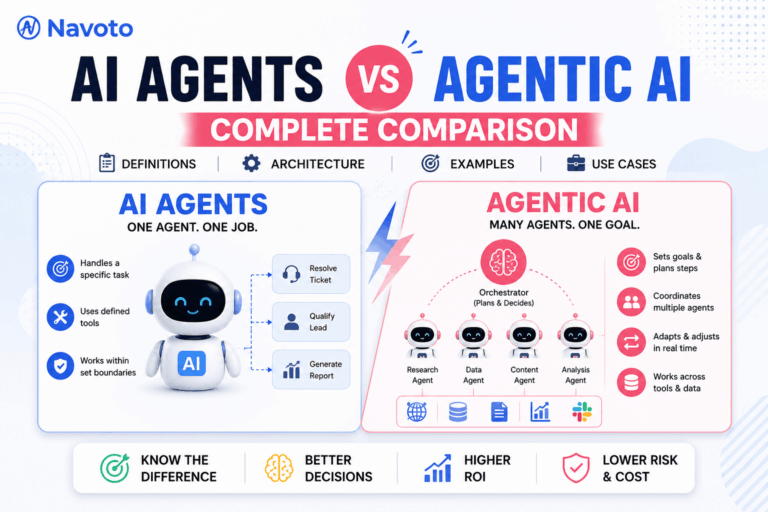
An AI agent is a single system built to handle one job — resolve a ticket, qualify a lead, pull a report — using an LLM plus a defined set of tools. Agentic AI is the layer above that: a system that sets goals, plans multi-step work, and coordinates several agents (and the tools and data behind them) to get a broader outcome done with minimal human input. Every agentic AI system is built from AI agents. Not every AI agent is part of an agentic system.
|
40%
of enterprise apps will embed task-specific AI agents by the end of 2026, up from under 5% in 2025
|
62%
of organizations are experimenting with or actively scaling AI agents in at least one function
|
40%+
of agentic AI projects are expected to be shelved by 2027, mostly over governance and unclear ROI
|
What Is an AI Agent?
An AI agent is a software system built around a large language model that can perceive a situation, decide what to do about it, and take action — usually by calling a defined set of tools — to complete one specific job. Instead of just generating a text response, it does something: looks up an order, sends an email, updates a record, runs a calculation.
Most AI agents are built from the same three ingredients:
- An LLM core that understands the request and decides what to do next.
- Tools — APIs, databases, or apps thae agent is allowed to call (a CRM, a search index, a payment system).
- Memory that lets it track context within a task, and sometimes across sessions, so it doesn’t ask the same question twice.
Crucially, an AI agent usually operates inside boundaries someone else set: a developer defined its tools, a business defined its goal, and a user triggered the task. It has real autonomy inside that scope, but the scope itself is fixed.
Types of AI Agents
Not all AI agents are built the same way. This taxonomy (adapted from classic AI systems design) is still the clearest way to think about capability levels:
| Type | How It Works | Example |
|---|---|---|
| Reactive (reflex) agents | Respond directly to a trigger using fixed rules — no memory of past interactions. | A chatbot that answers FAQs from a fixed script. |
| Model-based agents | Keep an internal picture of their environment so decisions account for context, not just the last input. | A support agent that remembers earlier messages in the same conversation. |
| Goal-based / utility agents | Weigh several possible actions and pick the one that best satisfies a defined objective. | A routing agent that picks the cheapest shipping option that still meets a delivery deadline. |
| Learning agents | Improve their behavior over time based on outcomes and feedback. | A lead-scoring agent that recalibrates as it sees which leads actually convert. |
There’s a natural fifth stage that doesn’t fit neatly in this table: what happens when you stop using one agent and start coordinating several of them toward a shared goal. That’s the tipping point where an AI agent becomes part of agentic AI.
What Is Agentic AI?
Agentic AI is a system that pursues a broader goal with limited human supervision by planning the steps, deciding which agents or tools to call, sequencing the work, and adapting the plan as conditions change. Where a single AI agent executes a task, agentic AI figures out which tasks need doing, in what order, and adjusts course when something doesn’t go as expected.
The defining traits of agentic AI:
- Goal-driven, not instruction-driven — it’s told an outcome, not a script.
- Multi-step planning — it breaks a goal into an ordered sequence of actions.
- Orchestration — it coordinates multiple agents, tools, and data sources.
- Adaptability — it revises its own plan mid-task if a step fails or new information appears.
In practice, this often looks like a “conductor” model — one orchestrating LLM that oversees the goal — directing several simpler, specialized agents underneath it. That architecture is powerful for sequential workflows, though it can create bottlenecks if the conductor itself gets overloaded, which is one reason governance and monitoring matter more here than with a single agent.
AI Agents vs Agentic AI: Side-by-Side Comparison
| Aspect | AI Agent | Agentic AI |
|---|---|---|
| Definition | A system built to complete one defined task using an LLM plus a set of tools. | A system that pursues a broader goal by planning and coordinating multiple agents and tools. |
| Autonomy | Acts within a narrow, pre-set scope. | Sets sub-goals and adapts its own plan as conditions change. |
| Task scope | A single task or a small family of related tasks. | Multi-step, often cross-system workflows. |
| Architecture | One model plus a defined tool set. | An orchestration layer coordinating several agents, data sources, and tools. |
| Decision-making | Follows defined logic for its one task. | Reasons about the overall goal and decides which agent or tool to use next. |
| Learning | Improves within its own narrow domain. | Adapts strategy across the entire workflow, not just one step. |
| Human oversight needed | Lower — narrow scope is easy to test and audit. | Higher — more decisions and more room for compounding errors. |
| Typical example | A support bot that resolves password-reset tickets. | A system that receives a complaint, checks the order, issues a refund, updates the CRM, and emails the customer — no human touch. |
6 Core Differences Explained
1. Autonomy & Initiative
An AI agent typically waits to be triggered — a ticket arrives, a form is submitted. Agentic AI can notice a problem on its own and decide a response is warranted, without anyone assigning it the task first.
2. Task Scope & Complexity
AI agents are specialists. Agentic AI is the generalist manager coordinating specialists across a workflow that spans teams and systems — support, billing, and shipping in one continuous process, for example.
3. Architecture: One Model vs an Orchestrated System
An agent is usually one model wired to a tool set. Agentic AI adds an orchestration layer that routes work between agents and tools. This is the same underlying idea behind protocols that let agents call a website’s own capabilities as tools — a concept we break down in our WebMCP guide.
4. Planning & Adaptability
If a step fails, most single-task agents stop and escalate to a human. Agentic AI re-plans: it tries an alternate path, calls a different tool, or reorders remaining steps to still hit the goal.
5. Learning Over Time
Both can improve with feedback, but agentic AI has more surface area to learn from — patterns across an entire workflow, not just one recurring task — because it sees how its decisions ripple across every agent it coordinates.
6. Human Oversight & Risk
More autonomy means more governance is required, not less. This is exactly where a lot of ambitious projects stall: Gartner’s own research points to governance gaps and unclear ROI as the leading reasons agentic AI initiatives get shelved. A narrower, agent-first rollout with clear approval gates is usually the safer path to earning that trust.
How They Actually Work Together
This isn’t really an either/or choice. Agentic AI doesn’t replace AI agents — it depends on them entirely. There’s no orchestration layer without individual agents doing the underlying work. In a mature setup, you’ll typically see:
- Several narrow, well-tested AI agents, each owning one job.
- An orchestrating layer (the “agentic” part) that decides which agent handles which step and in what order.
- Shared memory or context so agents don’t duplicate work or contradict each other.
- Human checkpoints on the highest-risk decisions — refunds above a threshold, anything customer-facing and irreversible.
Real-World Examples by Department
Customer Support
AI agent: a bot that triages and resolves password-reset or order-status tickets. Agentic AI: a system that receives a complaint, checks the order history, decides whether a refund is warranted, processes it, updates the CRM, and emails the customer — coordinating several specialist agents end to end.
Sales & Marketing
AI agent: a lead-scoring bot that ranks inbound leads. Agentic AI: a system that researches a prospect, drafts a personalized outreach sequence, books the meeting, and logs everything to the CRM without a rep touching it.
SEO & Content
AI agent: a single AI SEO agent that audits page titles and flags technical issues. Agentic AI: a system orchestrating keyword research, content brief creation, and Answer Engine Optimization checks together, then routing the draft for human review before publishing.
IT & DevOps
AI agent: a bot that restarts a failed service. Agentic AI: an incident-response system that detects the anomaly, diagnoses the likely cause, applies a fix, and files the postmortem — a pattern Gartner points to as one of the fastest-growing enterprise use cases.
Web & Autonomous Browsing
Tools like OpenAI’s Operator, Google’s Project Mariner, and Perplexity’s Comet are AI agents that browse and act on the open web on a user’s behalf — researching, comparing, and sometimes completing a purchase. We cover what this means for your site’s technical readiness in our guide to agentic browsing audits.
Why This Distinction Matters for Your Website in 2026
This isn’t just an internal tooling question anymore. Autonomous agents are now visiting business websites directly — researching, comparing, and sometimes buying on a person’s behalf — and that traffic is growing fast: AI-driven traffic to U.S. retail sites jumped roughly 4x year-over-year in early 2026, a trend we track in detail in our Agentic Search Optimization guide.
In practice, that means your site needs to work for two very different visitors: people, and the agents acting for them. A few things that matter for the second group:
- A clean, structured page an agent can actually parse and navigate.
- Content that answers questions directly, which is the core of Answer Engine Optimization.
- Broader visibility across AI-generated answers, which falls under Generative Engine Optimization.
- Actually being able to see this traffic — standard analytics tools routinely miscategorize it, which is why we built a full framework in our AI search analytics guide.
The businesses treating this as a technical SEO problem, not just an AI-tooling problem, are the ones showing up when an agent goes shopping for a vendor.
How to Choose the Right One
Ask these questions in order:
- Is the task singular and repeatable? If yes, start with a single AI agent.
- Does it span multiple systems or teams and need sequencing? That’s a candidate for agentic AI.
- Do you already have several working single-task agents? You’re in a good position to add an orchestration layer over them.
- What’s your governance maturity? If you don’t yet have logging, approval gates, and escalation paths, build those before adding autonomy — not after.
- What’s your timeline? Agents typically ship in weeks. Agentic systems take longer to test properly, and rushing this step is a major reason projects get shelved.
A reliable pattern for most businesses: prove out two or three narrow agents first, then orchestrate them once you understand where they actually need to hand off to each other.
Where This Is Headed Next
Gartner maps the shift in five broad stages: AI assistants embedded almost everywhere by the end of 2025, task-specific agents reaching roughly 40% of enterprise apps by the end of 2026, collaborative multi-skill agents handling around a third of complex implementations by 2027, multi-agent ecosystems coordinating dynamically across applications by 2028, and — by 2029 — a large share of knowledge workers building and governing their own agents on demand.
The connective tissue making all of this possible is orchestration standards — shared protocols that let agents call tools, other agents, and even websites in a predictable way. That’s the same shift behind emerging standards like WebMCP, which we cover in more depth in our WebMCP explainer.
Not sure if your business needs an agent or a full agentic workflow?
Navoto helps businesses figure out where automation actually pays off — and makes sure your website is ready for the growing share of AI agents visiting it too.
FAQ
What is the main difference between an AI agent and agentic AI?
An AI agent is a single system that completes one defined task using an LLM plus a set of tools. Agentic AI is the broader system that sets goals, plans multi-step work, and coordinates several agents to reach an outcome with minimal human input. AI agents are the building blocks; agentic AI is the architecture that puts them to work together.
Is ChatGPT an AI agent or agentic AI?
A chat assistant answering a question on its own is closer to generative AI than either category. It becomes an AI agent once it’s given tools and a specific task to complete autonomously, and edges toward agentic AI when it plans and executes a multi-step project by coordinating several of those steps itself.
Can you have agentic AI without individual AI agents?
No. Agentic AI is built from one or more underlying agents by definition — there’s no orchestration layer without something to orchestrate. You can, however, have a single AI agent operating with no broader agentic system around it.
Which is better for a small business: an AI agent or agentic AI?
For most small businesses, a handful of focused AI agents deliver faster returns with far less setup risk. Agentic AI earns its complexity once you have several working agents and genuine cross-functional workflows that need coordinating.
What industries use agentic AI the most in 2026?
Technology, media and telecom, financial services, and healthcare currently lead adoption, largely because they have the data infrastructure and volume of repetitive, multi-step workflows that make orchestration worthwhile. Retail and e-commerce are catching up quickly around agentic shopping and browsing.
Do AI agents and agentic AI require different levels of human oversight?
Generally, yes. A single-task agent is easier to test, audit, and roll back because its scope is narrow. Agentic AI makes more decisions across more steps with fewer built-in checkpoints, so it needs stronger guardrails before it’s handed real autonomy.
Will agentic AI replace individual AI agents?
No — it depends on them. Agentic AI doesn’t eliminate task-specific agents, it organizes them. Expect both to keep developing together: better individual agents make better agentic systems, and better orchestration makes individual agents more useful.
How do AI agents affect SEO and website visibility today?
A growing share of traffic hitting business websites now comes from autonomous browsing agents, not human visitors, researching and comparing options on a person’s behalf. That shifts the goal beyond ranking in search results to being structured so an agent can actually read, evaluate, and act on your page — the focus of our Agentic Search Optimization guide.
The short version: AI agents do the work, agentic AI decides what work needs doing and in what order. You don’t have to pick a side — you need to know which one solves the problem in front of you right now, and build toward the other as your workflows genuinely require it.