AI

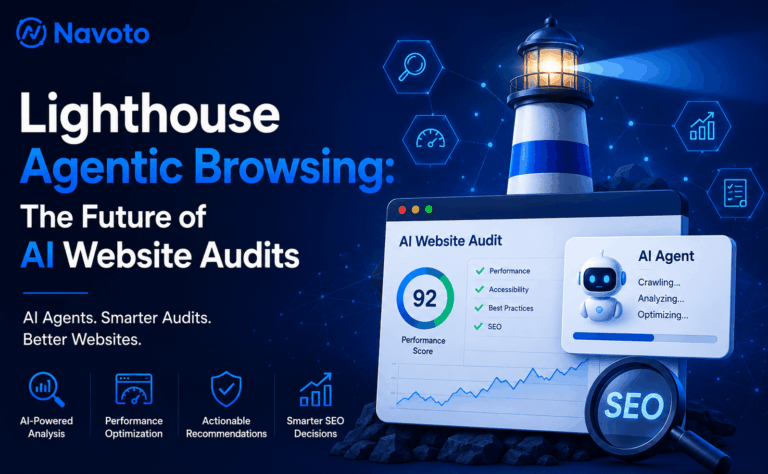
Lighthouse Agentic Browsing: Future of AI Website Audits

Lighthouse Agentic Browsing

Share Us:

What Google’s Lighthouse Agentic Browsing category is, every audit it runs, how to interpret your score, exactly how to fix every failure, how to run it in DevTools and CLI, and why this new AI website audit is the most important technical SEO signal of 2026.

Breaking: Lighthouse 13.3 Makes Agentic Browsing Default (May 7, 2026)
Lighthouse 13.3 (released May 7, 2026) moved the Agentic Browsing category out of experimental flags and into the default configuration. PageSpeed Insights inherited it within two weeks. Chrome 150 DevTools followed. Every Lighthouse run — including every PSI check, every SEO audit SaaS that wraps Lighthouse, and every CI/CD pipeline using Lighthouse CLI — now automatically surfaces Agentic Browsing results. Your clients, prospects, and competitors can already see your score.

In May 2026, Google changed what Lighthouse measures. For the first time in the tool’s history, it added a category that doesn’t measure performance, accessibility, SEO, or best practices for humans. The new Agentic Browsing category measures something different entirely: how well your website works for AI agents — the autonomous systems now browsing, comparing, booking, and purchasing on behalf of 800 million weekly AI search users.

This is not an experimental footnote. Lighthouse 13.3 (May 7, 2026) shipped Agentic Browsing as a default audit category. That means every PageSpeed Insights run, every Lighthouse CLI execution, and every SEO audit tool that wraps Lighthouse now reports Agentic Browsing scores automatically — to your team, your clients, and potentially your competitors. The window where you can safely ignore this has closed.

This complete guide from Navoto is the most thorough Lighthouse Agentic Browsing resource available. It covers every audit in precise technical detail, provides working fix code for every failure, explains how to run the audit via four different methods, and places the audit within the broader context of agentic search optimization — the emerging discipline that determines whether AI agents select your brand when acting on a user’s behalf. Everything in this guide is sourced from Google’s official Chrome for Developers documentation, Lighthouse 13.3 release notes, and real-world audit data.

What Is Lighthouse Agentic Browsing?

Lighthouse Agentic Browsing is a category within Google’s open-source Lighthouse web auditing tool — released in Lighthouse 13.3 on May 7, 2026 — that evaluates how well a website is constructed for interaction by autonomous AI agents, rather than by human users or traditional search crawlers.

Official Definition — Navoto.com

Lighthouse Agentic Browsing = a deterministic, pass/fail audit category in Google Chrome’s Lighthouse tool that evaluates your site’s accessibility tree integrity, layout stability, llms.txt presence, and WebMCP tool registration — producing a fractional pass-ratio score that signals how reliably AI agents can read, navigate, and take actions on your website.

Lighthouse is the industry-standard web quality tool built by Google and shipped with Chrome DevTools, the Lighthouse CLI, and PageSpeed Insights. Before the Agentic Browsing category, it had four scoring categories: Performance, Accessibility, Best Practices, and SEO. The addition of Agentic Browsing as a fifth category in 2026 represents Google’s first official, tool-based recognition that AI agents are a distinct audience that websites must accommodate — separate from human users and separate from traditional search crawlers.

Per Google’s official documentation, the category “evaluates how well your site is constructed for machine interaction through a set of deterministic audits.” The word “deterministic” is significant: unlike Lighthouse’s performance metrics (which can vary based on network conditions), Agentic Browsing audits produce consistent, reproducible results — making them suitable for CI/CD pipeline integration and automated quality gates.

The four audit areas checked by Agentic Browsing map directly to what real AI agents need to work effectively: a clean accessibility tree (how they navigate your page), layout stability (so elements don’t move between identification and interaction), an llms.txt file (to understand your site’s purpose without crawling everything), and WebMCP tool registration (to call your site’s capabilities as structured functions). Understanding what each checks — and how to fix each failure — is the core skill in agentic browsing optimization. Section 4 covers all four in full detail.

Why Google Added the Agentic Browsing Category

The answer is in the traffic data. Chrome’s engineering team can see that a meaningful and growing share of requests hitting public web servers are not coming from humans or traditional crawlers — they are coming from AI agents: OpenAI’s Operator, Anthropic’s Computer Use, Google’s Project Mariner, Perplexity’s Comet, and ChatGPT’s browse mode. Most of those agent visits fail — the agent either can’t extract the information it needs, can’t reliably interact with the page, or abandons and redirects to a competitor whose site works better.

Google’s position, articulated by Chrome AI engineering director Addy Osmani in April 2026, is that the cheapest place to fix agent-web compatibility is at audit time. Lighthouse has always been Google’s mechanism for operationalizing web quality opinions at scale: when Lighthouse flags something, developers fix it. When Lighthouse added a Core Web Vitals category in 2020, the entire web optimization industry shifted toward performance within 18 months. When Lighthouse added Accessibility scoring, accessible markup became mainstream. The Agentic Browsing category is following the same path — except the pace is faster, because the infrastructure (Google-Agent, WebMCP, UCP) is already live rather than theoretical.

The Three Types of Agentic Browsing Chrome Can Now Detect

1. AI Search Models

Google AI Mode, Perplexity, ChatGPT Search, Claude Search — crawl and extract content to answer questions in their interfaces. Most prevalent today; what GEO/LLM SEO optimizes for.

2. AI Browsing Agents

ChatGPT’s Agent Mode, Claude’s Computer Use, Google’s Project Mariner, Perplexity Comet — load real web pages in a real browser and interact on the user’s behalf. Growing rapidly in 2026.

3. Voice & Conversational AI

Next-gen Siri, Alexa, Google Assistant — making web requests on behalf of users to book, compare, or filter without screen interaction. The most future-looking tier.

The practical reality: Lighthouse 13.3 is now default, which means agents are already evaluating your site. A real-world test from seo-kreativ.de in June 2026 showed a typical well-maintained site scoring only 33% on Agentic Browsing — with only CLS passing, and llms.txt and the accessibility tree failing. That is not an outlier. Most websites were built for human eyes and keyword-crawling bots. The Agentic Browsing audit makes that gap visible for the first time.

How Lighthouse Agentic Browsing Scoring Works

Agentic Browsing deliberately breaks from Lighthouse’s standard 0–100 weighted scoring model. According to Google’s official documentation: “Because the standards for the agentic web are still emerging, the current focus is to gather data and provide actionable signals rather than a definitive ranking.”

Score Type 1

Fractional Pass Ratio

The headline score — a ratio showing how many agentic readiness checks your site passes. Example: "4 of 6 audits passed". This replaces the 0–100 number you’re used to from Performance and SEO. Your goal is to increase this ratio toward 6/6.

Score Type 2

Pass / Fail Status

Each individual audit returns a clear pass or fail. Some audits may also emit errors (hard failures with a specific technical requirement violated, like invalid WebMCP schema) or warnings (requirements met but with quality issues, like an llms.txt file that exists but is too short).

Score Type 3

Informational Counts

Some audits simply tally what exists on the page (e.g., number of WebMCP tools registered, number of forms, number of interactive elements) to add context rather than judgment. These don’t pass or fail — they help you understand your page’s complexity and completeness.

Why no 0–100 score? The “agentic web” standard is genuinely still forming. WebMCP is in a Chrome origin trial. The llms.txt specification has no RFC standard behind it. Google-Agent was added to official docs only in March 2026. Applying a weighted numeric score to audits in this state would create false confidence in a ranking that could become misleading as specs evolve. Google chose the fractional approach deliberately — and noted that results may fluctuate as your site changes how it registers tools or responds to agentic requests.

How to think about your score: The goal is not to “get a high score” — it is to eliminate each failure systematically. A site at 2/4 that fixes its accessibility tree issues goes to 3/4. A site that then adds llms.txt goes to 4/4. Each pass represents a genuine improvement in AI agent usability. The score is a progress tracker, not a ranking system. The broader implications of this for your agentic search optimization strategy are covered in our full guide.

All 4 Agentic Browsing Audits — Explained + Fixed

Google’s Lighthouse Agentic Browsing category runs four core audit areas. Here is every audit explained in detail — what it checks, why it matters to AI agents, what failure looks like in your report, and exactly how to fix it with working code examples.

AUDIT 01

Accessibility Tree Integrity

Priority: HIGHEST

What it checks: The Accessibility Tree is a simplified, machine-readable representation of your page structure — derived from the DOM but exposed through the browser’s accessibility API. AI agents use the accessibility tree as their primary data model for understanding and interacting with your page — not the visual rendering, not raw HTML, not screenshots. Lighthouse checks a subset of A11y audits that are critical specifically for machine interaction:

  • Names and labels: Every interactive element (button, form field, link, input) must have a programmatic name accessible via the accessibility API — not just a visual label
  • Tree integrity: Roles and parent-child relationships must be semantically valid — no invalid ARIA nesting, no role conflicts
  • Hidden content: Interactive elements must not be hidden from assistive systems using aria-hidden="true" when they serve a function

Why it matters: An AI agent navigating your checkout page uses the accessibility tree to find the “Add to Cart” button. If that button has no accessible name (it contains only an icon image with no alt text and no aria-label), the agent cannot identify it — and the task fails. This failure is structurally invisible when a human uses your site because they can see the icon. It is catastrophically visible when an AI agent tries.

Common failures in real-world audits:

❌ FAILS THE AUDIT — Common Patterns

<!-- No accessible name — icon-only button -->
<button><svg>...cart icon...</svg></button>

<!-- No label — placeholder is not a label -->
<input type="email" placeholder="Enter your email">

<!-- Invalid ARIA role nesting -->
<div role="list">
  <p role="listitem">Item 1</p> <!-- p can't be listitem -->
</div>

<!-- Interactive element hidden from accessibility tree -->
<button aria-hidden="true" onclick="submitForm()">Submit</button>

✅ PASSES THE AUDIT — Correct Patterns

<!-- Icon button with aria-label -->
<button aria-label="Add to cart">
  <svg aria-hidden="true">...cart icon...</svg>
</button>

<!-- Email field with associated label -->
<label for="email">Email address</label>
<input type="email" id="email" name="email">

<!-- Semantic list using correct elements -->
<ul>
  <li>Item 1</li>
  <li>Item 2</li>
</ul>

<!-- Navigation landmark -->
<nav aria-label="Main navigation">...</nav>
Fix Priority: Start here. This audit has the highest failure rate AND the highest impact on agent usability. Fixing accessibility tree issues simultaneously improves real user accessibility, Lighthouse Accessibility score, and agentic browsing score — three improvements for the same engineering work. Run Chrome’s built-in Accessibility audit first, fix every error, then re-run Agentic Browsing.

AUDIT 02

Cumulative Layout Shift (CLS)

Priority: HIGH

What it checks: Cumulative Layout Shift measures the visual instability of your page during load — specifically, how much page elements shift position after the initial render. The Agentic Browsing category reports this metric because layout shifts create a critical problem for AI agents: an agent identifies a target element, then the layout shifts before the agent can interact with it, causing the interaction to land on the wrong element or fail entirely.

Why agents are more vulnerable to CLS than humans: A human visitor sees a layout shift and visually reorients before clicking. An AI agent uses coordinates or accessibility tree identifiers captured at page-read time — if those positions change between identification and interaction, the click target is wrong. Google’s documentation explains: “Layout shifts caused by ads, images without dimensions, or injected content can move elements between the time an agent identifies them and the time it attempts an interaction.” Agents also act faster than humans — they may attempt interactions during the loading window when shifts are most likely to occur.

Good CLS target: under 0.1. The Lighthouse Performance target is unchanged in the Agentic Browsing context — but Chrome’s new Lighthouse Agentic Browsing audit specifically surfaces CLS as an agent interaction stability signal, separate from its Performance audit appearance. This is the one audit most sites already pass, which is why the real-world test from seo-kreativ.de showed CLS as the only passing audit — it was already optimized as a Core Web Vital.

✅ Fixes for Common CLS Causes

<!-- 1. Always set width + height on images -->
<img src="hero.jpg" width="1200" height="600" alt="...">

<!-- 2. Reserve space for ad slots -->
<div style="min-height:90px; width:728px;">
  <!-- ad loads here -->
</div>

<!-- 3. Use aspect-ratio for responsive images -->
<img src="product.jpg"
  style="width:100%; aspect-ratio:16/9; object-fit:cover;"
  alt="Product name">

<!-- 4. Avoid injecting content above existing content -->
<!-- Use transform animations instead of layout-affecting ones -->
.banner {
  /* BAD: top: 0 (causes layout shift) */
  /* GOOD: transform: translateY(0) */
  transform: translateY(0);
  transition: transform 0.3s;
}
Tool: Check your CLS score at PageSpeed Insights. Find specific elements causing shifts using Chrome DevTools → Performance tab → Layout Shift regions. Google Search Console → Core Web Vitals report shows site-wide CLS by page group.

AUDIT 03

llms.txt Presence & Quality

Priority: MEDIUM

What it checks: Lighthouse checks for the presence of a machine-readable summary file at your domain root — yourdomain.com/llms.txt. If the file exists, it additionally checks its quality: whether it includes an H1 header, whether it is too short (likely incomplete), and whether it contains any links to important pages.

Why Lighthouse checks llms.txt: Google’s documentation explains the agent efficiency rationale: “Without llms.txt, agents may spend more time crawling the site to understand its high-level structure and primary content.” A well-formed llms.txt gives an agent an immediate, structured overview of your site — what it covers, which pages matter most, and how to navigate efficiently — without needing to crawl hundreds of pages to build a mental model.

The tension you need to understand: Google’s Search Advocate John Mueller has publicly compared llms.txt to the early-2000s keywords meta tag and confirmed that Google Search does not use llms.txt for search ranking. Mueller’s statement: “You don’t need to create new machine-readable files, AI text files, markup, or Markdown to appear in generative AI search.” Lighthouse now contradicts this slightly by checking for the file — but the distinction is real: llms.txt matters for AI browsing agents (the Lighthouse context), not for Google Search ranking. These are different systems. The file is about agent navigation efficiency, not search visibility.

✅ Minimum Passing llms.txt Template

# Navoto.com — AI & SEO Agency

> Navoto is an SEO and AI search optimization agency helping
> brands achieve visibility in Google, ChatGPT, Gemini, and
> Perplexity through LLM SEO, AI citation building,
> and agentic search optimization (ASO).

## Core Topics
- LLM SEO and AI search optimization
- Agentic Search Optimization (ASO)
- AI citation building and GEO
- ChatGPT SEO strategy
- Search visibility tools and measurement

## Most Important Pages
- [LLM SEO Guide](https://navoto.com/llm-seo)
- [Agentic Search Optimization](https://navoto.com/agentic-search-optimization)
- [AI Citation Building](https://navoto.com/ai-citation-building)
- [SEO for ChatGPT](https://navoto.com/seo-for-chatgpt)
- [AI Search Analytics](https://navoto.com/ai-search-analytics)

## Contact
Website: https://navoto.com
Services: https://navoto.com/seo-services
Contact: https://navoto.com/contact
Quality requirements to pass: Must include an H1/markdown H1 header (# Your Brand Name). Must not be too short (minimum ~150 words recommended). Must contain at least one link to an important page. Place file at exactly yoursite.com/llms.txt — not in a subfolder.

AUDIT 04

WebMCP Tool Registration

Priority: FUTURE (Build Now if Rebuilding)

What it checks: WebMCP is a Chrome-driven browser protocol that lets websites register structured “tools” — capabilities like search, add-to-cart, or book-appointment — that AI agents can call directly as function calls rather than by screenshotting and guessing at pixels. Lighthouse monitors WebMCP tool registration by calling the Chrome DevTools Protocol (CDP) WebMCP domain to detect tool registration events. It verifies both declarative tools (defined in HTML markup) and imperative tools (registered at runtime via JavaScript).

Two ways to register WebMCP tools:

Method A: Declarative HTML (Lighthouse can verify statically)

<!-- Annotate existing HTML forms with WebMCP attributes -->
<form data-mcp-tool="search-products"
      data-mcp-description="Search our product catalog by name or SKU"
      method="GET" action="/search">
  <label for="q">Search products</label>
  <input type="search"
         id="q"
         name="q"
         data-mcp-param="query"
         data-mcp-description="Product name, SKU, or category">
  <button type="submit">Search</button>
</form>

Method B: Imperative JavaScript (registered at runtime)

// Register tools via navigator.modelContext API (Chrome 149+ with WebMCP flag)
if ('modelContext' in navigator) {
  navigator.modelContext.registerTool({
    name: 'check-availability',
    description: 'Check if a service appointment slot is available',
    parameters: {
      type: 'object',
      properties: {
        date: {
          type: 'string',
          description: 'ISO 8601 date string (YYYY-MM-DD)'
        },
        serviceType: {
          type: 'string',
          enum: ['consultation', 'audit', 'strategy-call'],
          description: 'Type of service appointment'
        }
      },
      required: ['date', 'serviceType']
    },
    handler: async (params) => {
      const res = await fetch(`/api/availability?date=${params.date}&service=${params.serviceType}`);
      return await res.json();
    }
  });
}

Important timing caveat: Imperative tools registered after Lighthouse takes its initial page snapshot will not be detected. If your tools register via JavaScript that runs after DOMContentLoaded + additional async operations, they may be missed by the audit. Register tools as early as possible in the page lifecycle — ideally in a synchronous script in <head> or at DOMContentLoaded.

Should you implement WebMCP now? Not urgently for most sites. The protocol is in active development, Chrome 149 origin trial only, and very few AI agents actually call WebMCP tools yet. However: if you are rebuilding a transactional page (checkout, booking, search, request demo) in the next 6–12 months, build WebMCP tool registration into the architecture from the start. The businesses that adopt it early will be the ones AI agents reach for first when the protocol matures to stable Chrome in late 2026.

How to Run the Lighthouse Agentic Browsing Audit (4 Methods)

There are four ways to run the Lighthouse Agentic Browsing audit in 2026. Choose the method that fits your workflow:

METHOD 1
Chrome DevTools (Live Page Testing)
Requires: Chrome 149+ · Lighthouse 13.3

Best for ad-hoc testing during development. Run against live pages, local dev servers, and local files.

1. Open Chrome 149 or newer
2. If Chrome 130–149: chrome://flags/#enable-webmcp-testing → Enabled → Relaunch
3. Navigate to the page you want to audit
4. Open DevTools (F12 / Cmd+Option+I)
5. Click "Lighthouse" tab
6. Under "Categories" — check "Agentic Browsing"
7. Set "Device" to Desktop or Mobile as appropriate
8. Click "Analyze page load"
9. Wait for audit to complete (30–60 seconds)
10. Review pass/fail ratios in the new "Agentic Browsing" section

METHOD 2
Lighthouse CLI (Command Line)
Best for: CI/CD · staging · batch testing

Best for automated testing and CI/CD integration. Supports batch URL testing and JSON output for pipeline processing.

# Install latest Lighthouse (13.3 or newer)
npm install -g lighthouse@latest

# Run with Agentic Browsing category (included by default in 13.3)
lighthouse https://yoursite.com --view

# Run and output JSON for CI processing
lighthouse https://yoursite.com \
  --output=json \
  --output-path=./agentic-audit.json \
  --only-categories=agentic-browsing

# Run against local dev server
lighthouse http://localhost:3000 \
  --preset=desktop \
  --view

# Check your current Lighthouse version
lighthouse --version
# Should be 13.3.0 or higher for default Agentic Browsing

METHOD 3
Chrome DevTools MCP (AI-Driven Audit)
New in 2026 · 43,000+ GitHub stars

Google’s official Chrome DevTools MCP server (43,000+ GitHub stars as of June 2026) lets AI agents like Claude Code, Cursor, or Gemini CLI drive a real Chrome browser and run Lighthouse audits automatically. This is the agentic SEO audit workflow of 2026 — an AI agent auditing your site’s readiness for AI agents.

# Install Chrome DevTools MCP
npx @google/chrome-devtools-mcp

# Add to Claude Code config (~/.claude.json):
{
  "mcpServers": {
    "chrome-devtools": {
      "command": "npx",
      "args": ["@google/chrome-devtools-mcp"]
    }
  }
}

# Then in a Claude Code session:
"Run a Lighthouse agentic browsing audit on https://yoursite.com"
"List all WebMCP tools registered on https://yoursite.com/checkout"
"Run lighthouse_audit with categories: agentic-browsing on my staging URL"

# Available tools:
# lighthouse_audit — runs full Lighthouse including Agentic Browsing
# list_webmcp_tools — shows all registered WebMCP tools on a page
# execute_webmcp_tool — calls a specific WebMCP tool with parameters

METHOD 4
PageSpeed Insights (Web Interface)
Easiest · No installation

PageSpeed Insights inherited the Lighthouse 13.3 Agentic Browsing category within two weeks of the May 7 release. No setup required — just paste your URL and look for the “Agentic Browsing” section in the results.

pagespeed.web.dev → Enter URL → Analyze → Scroll to “Agentic Browsing” section

Note: PSI uses Chrome’s lab data environment — if your site requires login, use the CLI method instead. PSI also runs Mobile-first by default — switch to Desktop for transactional sites where agent interactions are more common.

Interpreting Your Agentic Browsing Results

Here is how to read your Agentic Browsing report and understand what each result actually means for your site’s agent-readiness:

Result Type What It Looks Like What It Means What To Do
✅ Pass Green checkmark; counted in numerator of pass ratio This audit’s requirement is met. AI agents can use this aspect of your page correctly. Monitor quarterly to ensure changes don’t break it. Log baseline for comparison.
❌ Fail Red X; not counted in pass ratio This aspect of your site actively impedes AI agent interaction. Needs fixing. Prioritize by agent impact. Accessibility tree failures first, then CLS, then llms.txt.
⚠️ Warning Amber triangle; may still count as pass but flagged Technical requirement met but with quality concerns (e.g., llms.txt too short, incomplete links) Address when convenient — won’t fail the audit but indicates improvement opportunity.
ℹ️ Info Blue icon; tallied count (e.g., “3 WebMCP tools detected”) Informational context — not a pass/fail signal. Shows your site’s current state. Use to understand baseline. Track how counts evolve as you implement changes.
N/A Gray N/A (e.g., “WebMCP: Not applicable — no tools registered”) Protocol not implemented on this page. Not a failure — not a pass. Plan WebMCP implementation for transactional pages when rebuilding. Not urgent for content-only pages.

Priority Fix Order: What to Tackle First

Not all failures deserve equal urgency. Here is the recommended fix sequence based on agent impact, engineering effort, and maturity of the underlying standard:

1st

Accessibility Tree

Highest agent impact. Fixes benefit real users simultaneously. Every unlabeled interactive element is an agent navigation failure.
2nd

CLS (Layout Stability)

Most sites already pass this. If you’re failing, fix it — it breaks both agent interactions and human UX. Check images, ads, and injected content.
3rd

llms.txt

10 minutes to create. Passes the audit immediately. Low effort, no downside. Do this today regardless of where you stand on other audits.
4th

WebMCP Tools

Not urgently needed in mid-2026. Implement when rebuilding transactional pages. Start with one tool on your highest-value action (checkout / book).

Is Agentic Browsing a Google Ranking Factor?

This is the most-asked question about the new category — and the honest answer requires distinguishing between two different systems that are easily confused.

❌ NOT a Google Search Ranking Factor

Google’s John Mueller has been explicit: passing the Agentic Browsing audit does not improve your position in Google’s organic search results. Google Search does not use llms.txt, WebMCP registration, or Agentic Browsing scores as ranking signals. Mueller publicly compared llms.txt to the discredited keywords meta tag. Google’s own “Mythbusting generative AI search” documentation states: “You don’t need to create new machine-readable files, AI text files, markup, or Markdown to appear in generative AI search.”

✅ YES — An Agent Usability Factor

Agentic Browsing audit results directly determine whether AI browsing agents (Google’s Project Mariner, ChatGPT Agent Mode, Claude Computer Use) can successfully complete tasks on your site. A site that fails accessibility tree audits will have agents abandon mid-task and redirect to a competitor. A site with WebMCP tools will be selected over equivalent sites without them as agent coverage grows. This is commercial impact — it’s just not mediated through traditional search rankings.

The key distinction is which system you’re optimizing for. The Agentic Browsing audit is not about Google Search indexing — it’s about whether AI agents operating on behalf of users can use your site. Those are different questions with different optimization paths. The Core Web Vitals precedent is instructive here too: CLS became a search ranking signal in 2021, but it was introduced in Lighthouse as a UX signal in 2020. Lighthouse often leads Google’s ranking signals by 12–24 months.

The practical conclusion: implement the Agentic Browsing fixes because agents are already visiting your site and failing at it — not because it will move your Google rankings in 2026. The commercial value comes from agent usability, not from search position. For the full context, see our guide on agentic search optimization and what it means for brand selection by AI agents.

Lighthouse vs Other AI Website Audit Tools (Compared)

Lighthouse Agentic Browsing is not the only tool measuring AI agent readiness in 2026. Here is how it compares to the other major options for an autonomous website analysis of your AI readiness:

Tool Cost What It Audits AI Audit Signals Best For Weakness
Chrome Lighthouse 13.3 FREE Single URL, lab data A11y tree, CLS, llms.txt, WebMCP — the official standard Developers; CI/CD; authoritative source No citation tracking; no competitor benchmarking
Google Chrome DevTools MCP FREE Live browser, any page Full Lighthouse + WebMCP tool listing + AI-driven audit automation AI agents auditing sites autonomously inside Claude Code/Cursor Requires Claude Code or Cursor; technical setup
Cloudflare Agent Readiness FREE Public-spec agent checks Similar to Lighthouse public spec; isitagentready.com; 5-second results Quick pre-check; non-technical stakeholders Less detailed than Lighthouse; no CI/CD integration
Peec AI / Profound $99–Custom/mo AI citation tracking Citation rate, SoAIV, platform-by-platform — what Lighthouse can’t measure Marketing teams tracking AI visibility KPIs monthly No technical website audit; doesn’t measure on-page agent readiness
Semrush / Ahrefs $129–140/mo Site-wide crawl, rankings AI Overviews tracking (Semrush), Brand Radar (Ahrefs) — citation-side only Unified SEO + AI visibility tracking in one tool Technical agentic browsing readiness (A11y tree, WebMCP) not in scope yet
DebugBear $29+/mo Continuous monitoring Wraps Lighthouse 13.3 including Agentic Browsing; continuous monitoring alerts Teams needing ongoing monitoring vs point-in-time audits Not a substitute for hands-on Lighthouse for deep debugging

Running Agentic Browsing Audits in CI/CD Pipelines

Google’s documentation explicitly states that Agentic Browsing audits are “deterministic” and “suitable for integration into CI/CD pipelines.” Here is how to add agentic SEO quality gates to your deployment workflow:

GitHub Actions: Agentic Browsing Quality Gate

# .github/workflows/agentic-audit.yml

name: Lighthouse Agentic Browsing Audit

on:
  pull_request:
    branches: [main, staging]
  push:
    branches: [main]

jobs:
  agentic-audit:
    runs-on: ubuntu-latest
    steps:
      - uses: actions/checkout@v4

      - name: Setup Node.js
        uses: actions/setup-node@v4
        with:
          node-version: '20'

      - name: Install Lighthouse CLI 13.3+
        run: npm install -g lighthouse@latest

      - name: Run Agentic Browsing Audit
        run: |
          lighthouse ${{ env.STAGING_URL }} \
            --output=json \
            --output-path=./lighthouse-agentic.json \
            --only-categories=agentic-browsing \
            --chrome-flags="--headless"

      - name: Check Pass Ratio
        run: |
          PASS=$(node -e "
            const r = require('./lighthouse-agentic.json');
            const cat = r.categories['agentic-browsing'];
            console.log(cat.score || 'no-score');
          ")
          echo "Agentic Browsing pass ratio: $PASS"

      - name: Upload Audit Report
        uses: actions/upload-artifact@v4
        with:
          name: lighthouse-agentic-report
          path: lighthouse-agentic.json

      - name: Comment PR with Results
        if: github.event_name == 'pull_request'
        uses: actions/github-script@v7
        with:
          script: |
            const fs = require('fs');
            const report = JSON.parse(fs.readFileSync('./lighthouse-agentic.json'));
            const cat = report.categories['agentic-browsing'];
            const score = cat.score ? `${Math.round(cat.score * 100)}%` : 'See report';
            github.rest.issues.createComment({
              issue_number: context.issue.number,
              owner: context.repo.owner,
              repo: context.repo.repo,
              body: `## Lighthouse Agentic Browsing\nPass ratio: **${score}**\nAudit artifact uploaded above.`
            });

Real-World Audit Results: What Sites Actually Fail

Based on published real-world Lighthouse 13.3 audit results and analysis from the SEO community in May–June 2026, here is what the data shows about where sites actually stand:

Typical Audit Results by Site Type (June 2026 Data)

Site Type A11y Tree CLS llms.txt WebMCP Typical Score
Average website (no ASO work) ❌ Fail ✅ Pass ❌ Fail N/A 1/3 (33%)
Well-maintained accessible site ✅ Pass ✅ Pass ❌ Fail N/A 2/3 (67%)
Site with ASO foundation work done ✅ Pass ✅ Pass ✅ Pass N/A 3/3 (100%)
Site with WebMCP implemented ✅ Pass ✅ Pass ✅ Pass ✅ Pass 4/4 (100%)

The key insight from real-world data: The most common failure pattern is the “1/3 site” — CLS passes because Core Web Vitals work was done for SEO reasons, but accessibility tree issues exist because they were never surfaced by a ranking signal before, and llms.txt was never created because it wasn’t a standard audit. Fixing just these two — adding llms.txt (10 minutes) and fixing accessibility tree failures (1–3 days of engineering) — moves the average site from 1/3 to 3/3. That’s a full pass on everything except WebMCP (which isn’t applicable until it’s implemented). The fix effort is almost entirely front-loaded in accessibility work that provides compounding benefits for real users, traditional SEO, and agentic browsing simultaneously. For the strategic context of why this matters commercially, see our complete agentic search optimization guide.

Frequently Asked Questions
When did Lighthouse Agentic Browsing ship as a default category?

Lighthouse 13.3.0 was released on May 7, 2026, and moved the Agentic Browsing category from experimental flag-gated feature to the default configuration. PageSpeed Insights inherited the change within two weeks (approximately May 21). Chrome 150 DevTools shipped it in the official panel. If you’re running Lighthouse 13.3 or newer — in DevTools, CLI, or via npm — Agentic Browsing audits now run automatically without any additional flags. Check your version with lighthouse --version in terminal.

What is the difference between the Lighthouse Agentic Browsing audit and traditional SEO tools?

Traditional search visibility tools measure how well your site performs for human searchers and traditional search crawlers — keyword rankings, organic traffic, backlinks, technical SEO. The Lighthouse Agentic Browsing category measures something different: how well your site works for autonomous AI agents that navigate your page to complete tasks. These are different audiences with different technical requirements. A site can rank #1 in Google and fail every Agentic Browsing audit — because Google’s ranking algorithm doesn’t care whether an AI agent can click your checkout button. Conversely, a site can pass every Agentic Browsing audit without ranking well in Google. Both optimization layers are necessary in 2026.

Why does my Agentic Browsing score fluctuate between runs?

Google’s documentation acknowledges that results may fluctuate “due to changes in how your site registers its tools or responds to agentic requests.” The most common causes: (1) Imperative WebMCP tools registered via JavaScript may or may not be captured depending on when the script fires relative to Lighthouse’s snapshot. (2) Dynamic content that changes accessibility tree structure between renders. (3) A/B testing frameworks that alter page structure. (4) Lazy-loaded content that may or may not be present at audit time. The accessibility tree and CLS audits are generally stable; WebMCP timing is the most common source of fluctuation. Run 3 audits and take the median to get a reliable baseline.

Do I need Chrome 149+ to test Agentic Browsing, or can I use the Lighthouse CLI?

For Chrome DevTools testing: Chrome 130–149 requires enabling the WebMCP testing flag at chrome://flags/#enable-webmcp-testing. Chrome 150+ includes Agentic Browsing in the DevTools panel by default. For CLI testing: the Lighthouse CLI (npm package) at version 13.3.0+ runs Agentic Browsing audits regardless of your local Chrome version — it uses Puppeteer and Chrome’s DevTools Protocol directly. Install the latest Lighthouse globally (npm install -g lighthouse@latest) and run it — this is the most reliable method for consistent, reproducible results across environments.

How does Lighthouse Agentic Browsing connect to AI citation building and LLM SEO?

They operate on different — but complementary — optimization dimensions. LLM SEO and AI citation building optimize for being mentioned or cited by AI answer engines (ChatGPT, Gemini, Perplexity) when users ask questions — this is about content structure, entity authority, and schema markup for AI-generated responses. Lighthouse Agentic Browsing optimizes for AI browsing agents successfully interacting with your site — this is about accessibility tree integrity, layout stability, and WebMCP tool registration for task completion. A site can have strong AI citation performance (LLM SEO) and terrible agentic browsing readiness, or vice versa. In 2026, you need both: citations bring users to your brand in AI search results; agentic browsing readiness allows AI agents to complete tasks on your behalf. Together they form the complete agentic search optimization stack.

Run Your Agentic Browsing Audit Today

Navoto Audits, Fixes, and Monitors
Your Lighthouse Agentic Browsing Score

From full Lighthouse 13.3 agentic browsing audits and accessibility tree fixes to llms.txt creation, WebMCP planning, and CI/CD pipeline integration — Navoto builds agent-ready websites that pass every audit and get selected when AI acts on behalf of your next customer.


Type of Table

Most Popular

Category