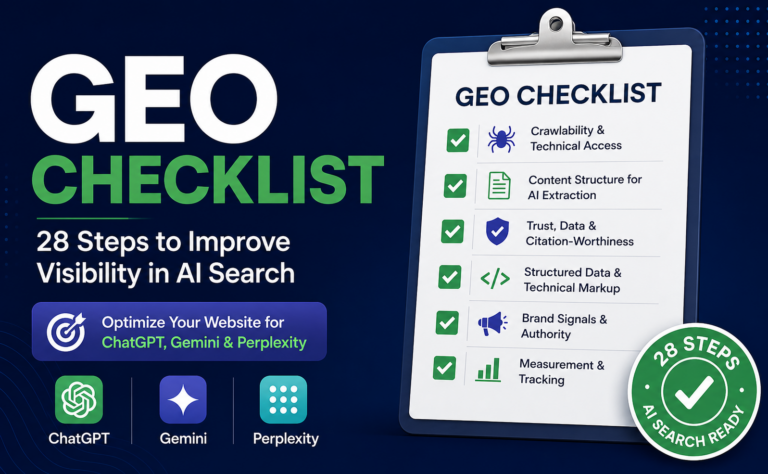
This isn’t another explainer of what GEO is — if you want that, our full GEO guide covers it in depth. This is the checklist itself: 28 specific, checkable items across crawlability, content structure, trust signals, structured data, and measurement, in the order we actually work through them during a client audit. Check them off as you go.
How to Use This Checklist
Run this against one important page first — a cornerstone guide or your highest-value service page — not your whole site at once. Work top to bottom: the categories are ordered the way they actually matter. A perfectly structured page that AI crawlers can’t reach (category 1) will never get cited, no matter how well you nail categories 2 through 6.
1. Crawlability & Technical Access
If AI crawlers can’t reach your content, nothing else on this list matters.
GPTBot (OpenAI’s training crawler) and separately for ChatGPT-User (the live browsing agent triggered by real user queries) — these are two different bots serving two different purposes, and a site can be visited by one without the other.2. Content Structure for AI Extraction
This is where most of the visibility gains actually come from — full breakdown in our complete GEO guide. Here’s the checklist version.
3. Trust, Data & Citation-Worthiness
AI systems can’t generate original data — they have to source it from somewhere. Give them a reason to source it from you.
4. Structured Data & Entity Signals
AI systems increasingly understand and cite brands as entities, not just as pages.
5. Off-Site & Community Signals
Your own site is only part of the picture — AI engines weigh what other sources say about you too.
6. Measurement & Iteration
You can’t improve what you’re not tracking — and GEO needs its own dashboard, not just your existing rank tracker.
Score Your Results
0–10 checked
Foundational work needed. Start with category 1 — technical access is worth nothing to fix downstream tactics until crawlers can actually reach your content.
11–20 checked
Solid progress. Focus next on whichever category has the most unchecked items — partial coverage across every category is weaker than full coverage in fewer.
21–28 checked
Strong GEO posture. Shift effort toward category 6 — measurement — so you can prove and defend the ROI of the work you’ve already done.
Common Mistakes During a GEO Audit
- Auditing the whole site before finishing one page. Prove the checklist works on a single cornerstone page first, then roll it out — auditing 200 pages at once with no validation just produces 200 pages of untested changes.
- Treating llms.txt as the priority fix. It’s the item most GEO content gets excited about and the one with the least direct evidence behind it for search visibility specifically — categories 2 and 3 matter far more.
- Skipping the measurement step. Without a “before” log of manual AI queries, you have no way to prove the checklist actually moved anything.
- Doing this once and considering it done. GEO is not a fixed destination — item 28 exists because the answer changes as models and platforms evolve.
Frequently Asked Questions
How is this different from a general GEO strategy guide?
This is the audit tool, not the strategy explainer. If you want the reasoning and data behind each tactic, our full GEO guide covers that; this checklist is built for working through page by page.
Do I need to check every item to see results?
No. Categories 1 and 2 (crawlability and content structure) carry the most weight — a page that nails those two categories alone will typically outperform a page with scattered coverage across all six.
Is this checklist the same for ChatGPT, Perplexity, and Google AI Overviews?
The core structural and trust items apply broadly, but each platform sources citations differently — Google’s AI Overviews lean heavily on the existing organic index, for example, while ChatGPT’s web search runs through Bing. Platform-specific mechanics are covered in our AI citation building guide.
How long until I see results after completing this checklist?
Technical fixes (robots.txt, schema) can get re-crawled within 2–4 weeks. Content-based citation improvements typically take 60–120 days to show up consistently. Entity and off-site signals build slower still — usually 3–6 months to meaningfully shift citation frequency.
Want us to run this checklist for you?
Navoto runs full GEO audits against all 28 items — plus the technical SEO foundation underneath them — as part of our organic SEO services.