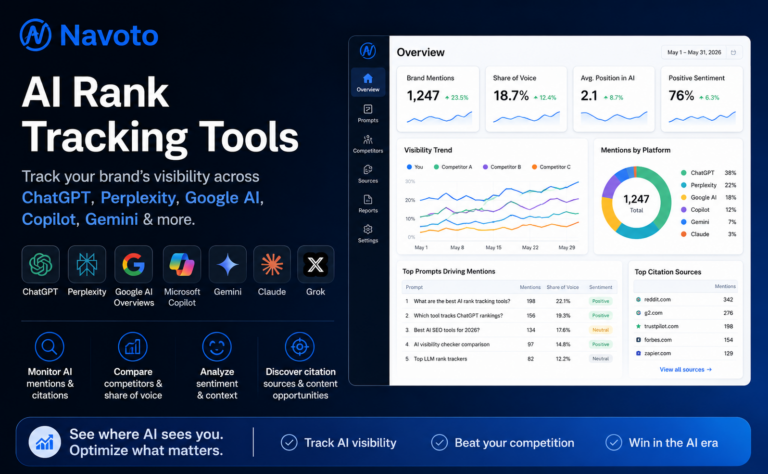
Quick Answer: An AI rank tracking tool monitors how your brand or content appears inside AI-generated answers — across ChatGPT, Perplexity, Google AI Overviews, Google AI Mode, Microsoft Copilot, Gemini, and Claude. Unlike traditional rank trackers that measure a position number in a list of blue links, AI rank trackers measure citation frequency, share of voice, and sentiment inside synthesised AI responses. In 2026, they are an essential part of any serious SEO stack.
Not long ago, rank tracking meant one thing: a number between 1 and 100 telling you where your page sat in Google’s results. Today, that number tells less than half the story. When a user asks ChatGPT for the best CRM, or prompts Perplexity to recommend an SEO agency, or lets Google AI Mode summarise the top dental implant specialists in their city — your traditional rank tracker has nothing to report. You are either in that AI-generated answer or you are not, and a position 1 ranking does not guarantee the former. This guide covers every AI rank tracking tool worth using in 2026 — what they track, how they differ, which suits your budget, and exactly what to do with the data once you have it.
The commercial case for tracking AI rankings is no longer theoretical. LLM-referred traffic converts at roughly 11.4% versus 5.3% for traditional organic search on US retail sites. Perplexity AI now processes 780 million queries per month. AI platforms generated 1.13 billion referral visits in June 2025 — a 357% year-over-year increase. If your brand is being cited in those answers, that traffic is converting at rates traditional SEO can rarely match. If it is not, you need to know that too — and fix it.
|
780M
Perplexity queries per month (DemandSage, Dec 2025)
|
11.4%
ChatGPT-referred traffic conversion rate vs 5.3% organic
|
1.13B
AI referral visits in June 2025 — up 357% YoY
|
21%
Of all Google keywords now trigger AI Overviews (Ahrefs)
|
What Is an AI Rank Tracking Tool — and How Is It Different from a Traditional Rank Tracker?
A traditional rank tracking tool polls Google (and sometimes Bing) for a keyword, records your page’s position in the organic results, and shows you a number. That number still matters — but it no longer tells you what a growing share of your potential audience actually sees when they search.
An AI rank tracking tool — also called an LLM rank tracker — works differently. It submits prompts to AI platforms like ChatGPT, Perplexity, Google AI Mode, and Microsoft Copilot, then analyses the responses to determine:
- Whether your brand is mentioned in the AI’s answer
- How prominently it is featured (first mention vs fifth mention)
- Which URLs or domains the AI cites as its sources
- What sentiment the AI associates with your brand (positive, neutral, or negative)
- How your citation frequency compares to named competitors for the same prompts
- Which third-party sources (Reddit, G2, Trustpilot, industry publications) the AI uses to form its views
The distinction matters because the signals that get you cited in AI answers are not the same signals that get you ranked on page one. Branded web mentions correlate with AI Overview appearances at 0.664 — far stronger than backlinks at 0.218 (Position Digital, 2026). Brands that built their SEO strategy around links alone are now discovering a visibility gap that backlinks cannot fix.
| Factor | Traditional Rank Tracker | AI Rank Tracking Tool (LLM Rank Tracker) |
|---|---|---|
| What it measures | Position 1–100 in Google/Bing organic results | Citation frequency, share of voice, sentiment in AI-generated answers |
| Platforms tracked | Google, Bing, Yahoo (blue link results) | ChatGPT, Perplexity, Google AI Mode, Google AI Overviews, Copilot, Gemini, Claude, Grok |
| Key metric | Ranking position number | Brand mention rate, share of voice, citation source |
| Data input | Keywords (short to mid-tail) | Prompts (conversational questions, buying queries, comparison requests) |
| Do you still need both? | — | Yes — 52% of AI Overview sources rank in the top 10 organically. Strong SEO feeds AI visibility. |
What to Look for in Any AI Rank Tracking Tool
The AI rank tracking market grew faster than any other SEO software category in 2025. There are now over 30 platforms competing for this space. Most are less than two years old. That means choosing poorly is easy and changing platforms later is painful. These are the criteria that actually separate the good tools from the ones that overpromise and underdeliver.
The major platforms to look for: ChatGPT, Google AI Overviews, Google AI Mode, Perplexity, Microsoft Copilot, Gemini, and Claude. Coverage varies widely between tools and pricing tiers. Some tools only track one or two engines on base plans and gate the rest behind expensive upgrades. Always verify which engines are included at your target price point before committing. The engine your audience actually uses should be your first filter.
Brand-level visibility dashboards show aggregate metrics. Prompt-level tracking shows you exactly which questions trigger mentions (or don’t), which competitor is cited instead, and what sources the AI used. Prompt-level data is what tells you what to fix. Without it, you have a visibility score but no clear action path.
The most actionable feature in any LLM rank tracker is citation source analysis — showing you which specific URLs, domains, Reddit threads, or third-party review platforms the AI used when constructing its answer. This tells you where to build presence, which publications to target, and which competitor content is outperforming yours in AI retrieval.
AI outputs can shift significantly day to day as LLMs update their models, indexes, and weighting. Tools that only refresh weekly can miss important visibility swings. For active SEO campaigns, daily tracking of priority prompts is ideal. Know your tool’s refresh schedule before relying on it for time-sensitive decisions.
Some tools use subscription pricing (predictable), others use credit-based systems (flexible but harder to forecast). Before signing up, model your expected monthly prompt volume and multiply it by the per-prompt credit cost. Coalition Technologies’ own analysis of Rankscale’s Enterprise plan is a useful benchmark: 12,000 credits at $780/month, with each cross-platform prompt run costing 1.75 credits — yielding roughly 6,857 runs per month. Run those numbers for your use case before committing.
A brand mention that says “some users report issues with X’s customer service” is technically a citation — but it is working against you. Sentiment analysis (positive, neutral, or negative) tells you whether your AI presence is building brand equity or eroding it. Tools that surface sentiment at the prompt level give you far more actionable intelligence than those that simply count mentions.
The Best AI Rank Tracking Tools in 2026: Honest Tool-by-Tool Review
These assessments are based on publicly documented features, independent test findings, and verified pricing as of May 2026. The market moves quickly — confirm current pricing and engine coverage directly with each vendor before purchasing.
1. Rankscale — Best Broad-Coverage LLM Rank Tracker
| Best for | Small businesses to enterprise — broadest engine coverage at the lowest entry price |
| Pricing | Essential $20/mo · Pro $99/mo · Enterprise ~$780/mo · 7-day free trial |
| Engines covered | 17+ including ChatGPT, Perplexity, Google AI Overviews, Google AI Mode, Gemini, Copilot, Claude, DeepSeek, Grok, Mistral |
Rankscale earned its position as the most-referenced rank tracking tool AI platform in independent tests for one straightforward reason: it covers more engines at a lower starting price than any comparable tool. The Essential plan at $20/month includes 17+ AI platforms — no engine gating behind higher tiers. For teams that need to track their brand across the full range of AI search environments, this breadth-to-price ratio is genuinely difficult to match.
Coalition Technologies ran approximately 2,700 prompts across ChatGPT, Perplexity, Google AI Overviews, and Google AI Mode during their testing, and observed Rankscale performing near 100% accurate on brand mention and citation detection against their ground truth dataset. That level of detection reliability is the baseline requirement for any rank tracker tool AI worth using at scale — if mention detection is inconsistent, teams chase data ghosts rather than real visibility trends.
The platform’s structural content audit — which analyses the authority and structural signals AI engines use to verify and cite content — is particularly useful for teams who want to understand not just where they stand, but what they need to fix. Prompt-level tracking shows which queries trigger your brand, which competitors are cited instead, and which source domains the AI relies on. The reporting export feature has been highlighted by agency users as one of the strongest in the category.
2. Otterly AI — Best Entry-Level AI Rank Tracking Tool for Small Teams
| Best for | Solo marketers and small teams who want fast setup and multi-engine coverage affordably |
| Pricing | Lite $29/mo · Standard $189/mo · Premium $489/mo · Free trial available |
| Engines covered | ChatGPT, Google AI Overviews, Perplexity, Copilot, Gemini, Google AI Mode (6 core engines) |
Otterly AI has grown rapidly — it is used by 20,000+ marketing professionals and was recognised as a Gartner Cool Vendor in 2025. The $29/month Lite plan makes it the most affordable multi-engine AI rank tracking option in the market today for teams that need more than one platform tracked. Setup is fast: account creation to first data in under an hour in independent tests.
The Brand Visibility Index — a single proprietary score that aggregates mention rate, sentiment, and citation frequency — is one of Otterly’s strongest features for reporting to stakeholders who need a simple, clear headline metric without wading through raw data. The Deep GEO Audit (available from the Standard plan) analyses 25+ on-page and technical factors correlated with AI citation patterns — schema markup, content length, crawl issues, multilingual structure — and converts them into urgency-ranked recommendations. For teams moving from monitoring into active GEO optimization, this bridges the gap.
Citation URL tracking shows exactly which pages AI models reference — not just which brands appear. Competitive share-of-voice on Perplexity is particularly detailed: you can see how your citation frequency compares to named competitors running the same prompts simultaneously, which is the kind of head-to-head data that actually drives strategy adjustments.
3. Profound — Best Enterprise AI Rank Tracking Platform
| Best for | Enterprise and Fortune 500 teams with dedicated AI optimization budgets and compliance needs |
| Pricing | Starter $99/mo (ChatGPT only) · Growth $399/mo · Enterprise: custom (mid-four figures) |
| Engines covered | ChatGPT, Perplexity + 9 more on Growth/Enterprise plans |
Profound is the most funded platform in the AI visibility category — having raised $58.5 million from Sequoia, Kleiner Perkins, and NVIDIA. Its client roster includes Ramp, MongoDB, Figma, DocuSign, and Walmart. The G2 Winter 2026 leader recognition in the AEO (Answer Engine Optimization) category reflects its position as the go-to platform for enterprise teams that need both comprehensive coverage and the kind of evidence trails and audit documentation that governance-heavy organizations require.
Profound’s core differentiator is prompt volume intelligence — the ability to understand not just which prompts are triggering your brand, but which prompt categories represent the highest opportunity based on query volume and competitor gaps. This moves the tool from a monitoring platform into a strategic planning tool. Coalition Technologies identified Profound as the best fit for sentiment-flip workflows — when brand perception shifts inside AI answers, Profound’s evidence trails let you trace the source of the shift and act on it methodically.
The research finding that Perplexity cites 6.6% of its sources from Reddit — surfaced by Profound’s data — is the kind of actionable insight that changes content strategy. Knowing that community-generated content on Reddit feeds directly into Perplexity citations gives teams a clear off-site action: build authentic Reddit presence in relevant subreddits rather than just optimizing the corporate website.
4. Semrush AI Visibility Toolkit — Best for Teams Already on Semrush
| Best for | Existing Semrush users who want AI rank tracking without adding a new tool |
| Pricing | $99/month add-on to any Semrush Pro, Guru, or Business plan |
| Engines covered | ChatGPT, Perplexity, Google AI Mode, Gemini, Google AI Overviews |
The Semrush AI Visibility Toolkit is the most logical first step for any team already running Semrush for keyword research, site auditing, and competitor analysis. Rather than onboarding a standalone AI rank tracking platform, you extend your existing subscription with a $99/month add-on that integrates AI visibility data directly into dashboards you already use.
The toolkit provides a visibility score that quantifies how often your brand appears in AI-generated responses across five major platforms. Share of voice metrics compare your citation frequency against named competitors. Sentiment analysis (positive, neutral, or negative) shows how AI engines describe your brand rather than just whether they mention it. For organisations focused on rank tracker tool AI overviews and Google specifically, Semrush’s deep integration with Google’s data infrastructure gives it an advantage in AI Overview tracking that standalone tools struggle to match.
The strongest argument for Semrush’s toolkit is consolidation. If you are already paying $139–$450/month for Semrush and adding a $99 AI visibility module, you have one platform, one login, one report, and one billing relationship. For teams that hate managing multiple vendor relationships, that operational simplicity has real value.
5. Peec AI — Best for Non-English Market AI Rank Tracking
| Best for | International brands tracking AI visibility across 115+ languages |
| Pricing | Starter $95/mo (50 prompts, 3 models) · Pro $245/mo · Advanced $495/mo · Custom plans |
| Engines covered | ChatGPT, Perplexity, Google AI Overviews (standard); Claude, Gemini, Copilot, AI Mode, Grok (add-ons/custom) |
Peec AI raised $30 million and reached a valuation of over $100 million in under a year — driven by an enterprise client base that includes Wix, Glide, and Merge, all of whom reported 5x+ increases in LLM-driven traffic after deploying the platform. The headline differentiator is methodology: rather than calling AI APIs directly (which can produce different results than what real users see), Peec AI simulates real user interactions through UI scraping. This “what the user actually sees” approach is the most honest measurement of AI visibility available.
The 115+ language support is genuinely rare in this category. For brands operating across multiple countries — tracking how ChatGPT responds to prompts in Spanish, French, German, or Japanese differently than English — Peec AI handles this at scale in a way most competitors simply cannot. Daily tracking of ChatGPT, Perplexity, and AI Overviews is included on all plans. Strategy recommendations — including specific subreddits where joining conversations can improve AI visibility — are a practical feature not commonly found in monitoring-only tools.
6. Ahrefs Brand Radar — Best for Existing Ahrefs Users Exploring AI Rank Tracking
| Best for | Ahrefs subscribers who want to add AI visibility without a new platform |
| Pricing | Available as add-on within Ahrefs subscription tiers |
| Engines covered | Google AI Overviews, Google AI Mode, ChatGPT, Perplexity, Copilot |
Ahrefs Brand Radar is close to plug-and-play. Choose a market, add your brand and up to five competitors, and review trend charts within minutes. For teams that already rely on Ahrefs for backlink analysis, keyword research, and site auditing, this is the lowest-friction path into AI rank tracking — no new vendor, no new login, no integration work.
The historical SERP snapshot archive — Ahrefs stores every SERP going back to 2015 — adds useful context for trend analysis. When your AI visibility dropped in March, you can check whether that coincides with a broader algorithm change or a specific content shift by a competitor. That longitudinal context is genuinely valuable for teams that need to build a narrative around AI visibility changes for internal stakeholders.
7. AIclicks — Best Free AI Rank Tracking Starting Point
| Best for | Teams looking for free ChatGPT rank tracking before committing to a paid tool |
| Pricing | Free tier available · Starter $59/mo · Pro $189/mo · Business $499/mo |
| Engines covered | ChatGPT, Perplexity, Gemini, Google AI Overviews, Claude, Copilot |
AIclicks is notable for two reasons: it offers a genuine free tier for free ChatGPT rank tracking, and its prompt-level tracking is detailed enough that the tool scales meaningfully from solo marketers to full agency teams. The free tier provides enough functionality to validate whether AI rank tracking is surfacing useful data for your brand before spending anything.
The platform shows which prompts trigger mentions, whether your website is cited, which sources influence ChatGPT’s recommendations, and where competitor brands are appearing instead. Prompt clustering — grouping related prompts into topic clusters and mapping them to page groups — is available on higher plans and enables the kind of systematic AI rank tracking online monitoring that teams managing large prompt libraries need.
8. LLMrefs — Best for Agencies Tracking Multiple Brands Across AI Engines
| Best for | Agencies managing multiple client brands needing broad engine coverage at low cost |
| Pricing | All-in-one: €79/mo, 500 prompts · Agency: from €245/mo |
| Engines covered | 10+ including Google AI Overviews, AI Mode, Gemini, ChatGPT, Perplexity, Claude, Copilot, Meta AI, Grok, DeepSeek |
LLMrefs offers one of the broadest engine coverage footprints — 10+ AI platforms — at one of the lowest price points in the category. The key workflow differentiator is its approach to prompt generation: rather than requiring teams to manually define prompts, LLMrefs imports your existing SEO keyword lists and automatically generates fan-out prompts based on real conversations happening across AI chatbots. For teams with established keyword libraries who want to extend into AI rank tracking without building a prompt library from scratch, this is the lowest-effort onboarding path in the market.
Unlimited projects across all plans make it genuinely agency-friendly — you can run parallel tracking for multiple clients without account juggling or per-client fees. The Reddit thread finder feature — surfacing specific subreddits that are feeding AI citations in your category — is a distinctive and practical addition for teams working on off-site GEO strategy.
Side-by-Side: Which AI Rank Tracking Tool to Choose
| Tool | Engines | Starting Price | Free Option | Best For |
|---|---|---|---|---|
| Rankscale | 17+ | $20/mo | 7-day trial | Broadest coverage, best value overall |
| Otterly AI | 6 | $29/mo | Trial available | Small teams, fast onboarding |
| Profound | 10+ | $99/mo (ChatGPT only) | No | Enterprise, governance-heavy orgs |
| Semrush AI Toolkit | 5 | $99/mo add-on | With Semrush trial | Existing Semrush subscribers |
| Peec AI | 6+ | $95/mo | No | International / multilingual brands |
| Ahrefs Brand Radar | 5 | Included in Ahrefs plans | With Ahrefs trial | Ahrefs users — quick visibility check |
| AIclicks | 6 | Free / $59/mo | ✅ Yes — genuine free tier | Free ChatGPT rank tracking, first step |
| LLMrefs | 10+ | €79/mo | No | Agencies, unlimited projects |
Platform-Specific AI Rank Tracking: ChatGPT, Perplexity, Copilot & AI Mode
Not every AI platform works the same way — and only 11% of domains are cited by both ChatGPT and Perplexity. Optimising for one does not guarantee visibility on the other. Here is what distinguishes each platform for rank tracking purposes.
ChatGPT Rank Tracking
ChatGPT now processes approximately 37.5 million prompts daily. Free ChatGPT rank tracking is possible at basic levels via AIclicks’ free tier. For meaningful data at scale, dedicated tools like Rankscale or Profound offer prompt-level ChatGPT monitoring with citation source analysis. A notable research finding: ChatGPT is more likely to cite content that uses definite language (not vague), contains a question mark in the heading, has high entity density, and uses simple sentence structures. These are structural signals your rank tracking tool AI data can help you correlate with citation patterns.
Perplexity Rank Tracking (Best Online Perplexity Rank Tracker)
Perplexity is the search engine among AI tools — it actively retrieves and cites sources with strong recency bias. The platform processes 780 million queries per month, drives 15% of all AI referral traffic globally, and converts at 1.66% versus traditional search’s 0.15% — an 11x conversion improvement. The best online Perplexity rank tracker options are Rankscale (for breadth and frequency), Otterly (for simplicity), and Peec AI (for multilingual tracking). One important operational note: Perplexity visits approximately 10 pages per query but only cites 3–4 sources. Visibility drops 2–3 days after publication, meaning weekly tracking misses key visibility swings — daily is the effective minimum for time-sensitive content.
Copilot Rank Tracking (Rank Tracking Tool Copilot)
Microsoft Copilot is powered by Bing — which means Bing SEO and Bing Webmaster Tools are the foundational signals for Copilot visibility. A rank tracking tool Copilot monitors how your brand appears in Copilot’s AI-generated answers, which competitors are cited for the same prompts, and which sources Copilot relies on. Otterly includes Copilot on all base plans. AIclicks offers Copilot monitoring on paid plans. Advanced Web Ranking (AWR) allows you to add Copilot as a selectable search engine with daily updates on brand appearance — particularly useful for teams that need to bridge Bing rank tracking with Copilot visibility in a single report.
Google AI Mode and AI Overviews Tracking
Google AI Mode is the most rapidly evolving AI search surface — AI Overviews appearances on desktop in the US rose by 492% from September 2024 to September 2025. A rank tracking tool AI mode must handle the specific complexity of AI Mode: the same query can surface different citations depending on location, device, and timing, making position-based tracking unreliable in the traditional sense. SE Ranking’s AI Overviews Tracker specifically identifies which keywords trigger AI Overviews, whether your site is listed as a source, and historical SERP versions — making it one of the most complete rank tracker tool AI overviews options available at its price point.
What to Do With AI Rank Tracking Data: A Practical Action Framework
Data without action is just a dashboard. The teams getting measurable results from AI rank tracking are following a systematic process — from measurement to insight to execution. Here is the workflow that consistently produces visibility improvements.
Free AI Rank Tracking Tools: What You Can Get Without Paying
Several free AI rank tracking tools exist — but the honest assessment is that free tiers are best treated as starting points for evaluation, not sustainable long-term monitoring solutions. Here is what is actually available at zero cost.
| Free Option | What You Get Free | Limitation |
|---|---|---|
| AIclicks free tier | Basic ChatGPT rank tracking, brand mention detection | Very limited prompt volume; single engine on free |
| Rankscale 7-day trial | Full platform access including 17+ engines for 7 days | Paid subscription required after trial |
| Google Search Console | AI Overview impression data for your own site | No competitor data, no LLM tracking beyond AI Overviews |
| GA4 AI referral tracking | Actual sessions from ChatGPT, Perplexity, etc. to your site | Only shows traffic that clicked through — not citation rate |
| Manual prompt testing | Check any AI engine for your brand manually | Not scalable, no historical data, no competitor comparison |
The practical recommendation: start with GA4 AI referral segmentation (free, immediate, actual conversion data) and manual prompt testing for your top 10 commercial queries (free, qualitative, useful for initial assessment). Use the data from those two free approaches to justify investment in a paid tool at the right tier for your actual prompt volume.
Related Guides on Navoto
- Generative Engine Optimization (GEO): The Complete 2026 Guide — the full strategy behind getting cited in ChatGPT, Perplexity, and Google AI Overviews.
- The Best AI-Powered SEO Tools in 2026: An Honest, Practical Guide — the broader AI SEO tool landscape, from content optimization to technical auditing.
- SEO Content Strategy: The Complete Step-by-Step Framework — how to build the content foundation that AI rank tracking data helps you optimise.
- Dental SEO: The Complete Guide to Getting More Patients in 2026 — how AI rank tracking applies to local and healthcare SEO, including dental implant SEO and visibility in AI-generated local answers.
- White Label Local SEO Services: The Complete Agency Guide — for agencies incorporating AI rank tracking into client reporting and GEO services.
Frequently Asked Questions About AI Rank Tracking
Conclusion: AI Rank Tracking Is Now Part of the Core SEO Stack
Three years ago, tracking how your brand appears in ChatGPT was a curiosity experiment. Today, it is a business-critical measurement — because the traffic that arrives from AI citation converts at 11.4% versus 5.3% for traditional organic search, and that gap is not narrowing.
The AI rank tracking tool that is right for you depends on your current situation: Rankscale if you need the broadest engine coverage at the lowest price. Otterly if you want fast setup and a clean reporting experience at an accessible monthly cost. Profound if you are an enterprise team that needs evidence trails, governance documentation, and prompt volume intelligence. Semrush or Ahrefs if you want to extend your existing SEO platform rather than add a new vendor. AIclicks if you want to test free AI rank tracking before committing budget.
What matters most is not which tool you choose — it is whether you act on the data it produces. A tool that shows you are not cited for your most valuable commercial prompts is giving you a specific, actionable signal: fix your content structure, build presence on the third-party sources AI trusts, and ensure your pages are technically accessible to AI crawlers. The teams closing the AI visibility gap fastest are the ones treating the tracking data as a starting point for action, not just a number to report.
Want to Know Where Your Brand Actually Stands in AI Search?
Navoto runs AI visibility audits that show exactly how your brand appears — and does not appear — across ChatGPT, Perplexity, Google AI Mode, and Copilot. Get a free audit and a clear action plan to improve your AI citation rate.