Why do some websites dominate Google’s first page while others — equally well-written — barely show up at all?
The answer almost always comes down to two things: on-page SEO and off-page SEO. Most businesses focus on one and neglect the other. That’s the mistake that quietly kills rankings.
In this guide, you’ll learn exactly what each one means, how they’re different, and — most importantly — how to use both together to build rankings that actually last in 2026.
What Is On-Page SEO?
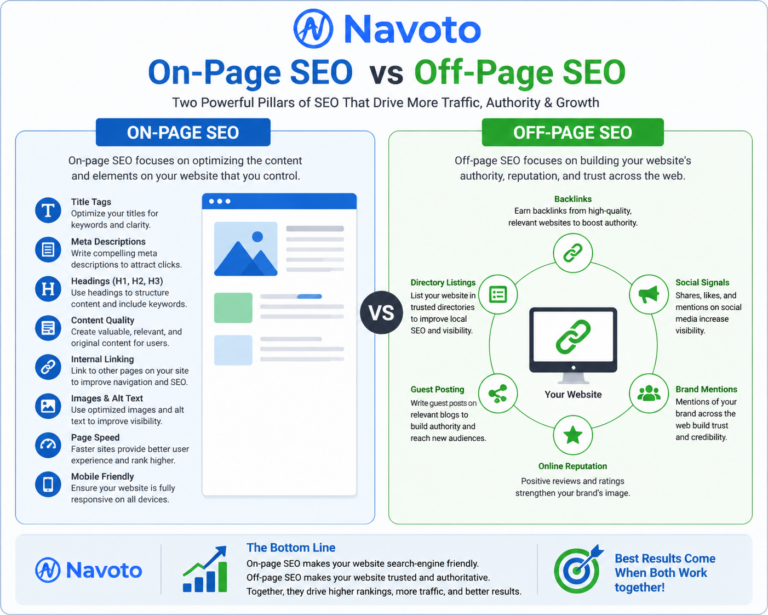
On-page SEO refers to everything you do directly on your website to help it rank higher in search engines. You have full control over it — it’s your house, your rules.
This covers:
- Title tags and meta descriptions — the labels Google reads before deciding whether to show your page
- Keyword placement — using your target keyword in the H1, opening paragraph, and subheadings
- Content quality and depth — answering the user’s question thoroughly, not just using keywords
- Internal linking — connecting related pages on your site to pass authority and guide users
- URL structure — clean, readable URLs (e.g.
/on-page-vs-off-page-seo/beats/p?id=492) - Image optimization — compressed images with descriptive alt text
- Core Web Vitals — page speed, visual stability, and interactivity (Google measures all three)
- Schema markup — structured data that helps Google and AI systems understand your content
Think of on-page SEO as setting up your shop. The layout is clean, the signage is clear, and a customer can walk in and find exactly what they need without asking.
What Is Off-Page SEO?
Off-page SEO refers to everything that happens outside your website that affects how Google views your authority and trustworthiness. You can influence it, but you can’t fully control it.
This includes:
- Backlinks — other websites linking to yours (still the #1 off-page ranking factor)
- Domain authority — the cumulative trust your site has built over time
- Brand mentions — references to your brand name even without a hyperlink
- Digital PR — getting featured in reputable publications and news outlets
- Social signals — shares and visibility on social platforms
- Guest posting — writing for other websites that link back to yours
- Online reviews — especially important for local SEO
Think of off-page SEO as your shop’s reputation in the neighborhood. Are other businesses recommending you? Are customers talking about you? Is your name showing up in the local paper?
On-Page vs Off-Page SEO: The Key Differences
| Factor | On-Page SEO | Off-Page SEO |
|---|---|---|
| Location | On your website | Outside your website |
| Control | Full control | Can influence, not control |
| Main focus | Content & structure | Authority & trust |
| Speed of results | Days to weeks | 3–6 months typically |
| Primary signals | Keywords, UX, schema | Backlinks, brand mentions |
| Best for | Relevance | Credibility |
The most important distinction is control. You can fix a title tag today and see a ranking change within two weeks. Earning a high-quality backlink from a major publication? That could take months of relationship-building.
Why You Need Both — The House Analogy
Here’s the simplest way to understand why neither alone is enough.
Imagine you’re opening a restaurant.
On-page SEO is making sure your restaurant is clean, the menu is easy to read, the food is excellent, and customers can find the bathroom without asking a staff member.
Off-page SEO is getting food critics to review you positively, having regulars recommend you to friends, and being featured in the city’s best dining guide.
You can have the best restaurant in the city, but with zero publicity, nobody walks through the door. And all the hype in the world won’t save a restaurant where the food is bad and the service is worse.
A site with strong on-page SEO but weak backlinks will struggle to outrank established competitors. A site with lots of backlinks but thin, low-quality content will see high bounce rates and ranking drops. Google evaluates both sides before deciding who ranks.
On-Page SEO: What Actually Matters in 2026
Google’s systems have become far smarter. They don’t just count keywords — they understand meaning, context, and whether your content actually satisfies what the user is looking for.
1. Search Intent Alignment
This is the single most important on-page factor right now. Before writing a word, ask: what does the person searching this keyword actually want?
Someone searching “on-page vs off-page SEO” wants a comparison guide — not a sales pitch, not just a definition. Match your content format (guide, list, tutorial, comparison) to what’s already ranking. Google’s first page is showing you the answer.
2. Title Tag and H1
Your title tag should be under 60 characters, front-load the keyword, and give the reader a reason to click. Your H1 (the headline users actually read) can be a little more creative but should still reflect the keyword and the content’s main promise.
3. E-E-A-T (Experience, Expertise, Authoritativeness, Trustworthiness)
Google wants to know who wrote your content and whether they actually know what they’re talking about. Use a real author bio with credentials, cite data from credible sources, and write from first-hand knowledge where possible.
4. Keyword Placement
Use your primary keyword in the first 100–150 words, in at least one subheading, and naturally throughout the body. Don’t stuff it — Google’s algorithms flag unnatural repetition. More importantly, include related terms and synonyms (LSI keywords) that show Google your content covers the topic thoroughly.
5. Internal Linking
Every blog post should link to 2–4 related pages on your site. This helps Google understand your site’s structure, passes ranking authority between pages, and keeps readers engaged longer — which itself is a positive user signal.
6. Page Experience and Core Web Vitals
Google measures Largest Contentful Paint (LCP), Cumulative Layout Shift (CLS), and Interaction to Next Paint (INP). Practically speaking: compress your images, avoid layout-shifting ads, and use a fast hosting setup. A slow page loses rankings and users.
7. Schema Markup
Structured data (JSON-LD) helps Google understand your page type — article, FAQ, how-to, product, local business. Pages with schema markup show a significantly higher selection rate in Google’s AI Overviews, which now appear in nearly half of all searches.
Off-Page SEO: What Actually Matters in 2026
1. Backlink Quality Over Quantity
One link from a respected industry publication outweighs fifty links from random low-authority directories. When Google sees a trusted site linking to yours, it treats it as a vote of confidence. The more relevant the linking site is to your topic, the stronger the signal.
Focus on earning links through genuinely useful content — original research, comprehensive guides, tools, data studies — content that other sites want to reference.
2. Brand Mentions (With and Without Links)
Google’s Quality Rater Guidelines emphasize that reputation signals come from what others say about you, not just what you say about yourself. Unlinked brand mentions on authoritative sites still contribute to how Google and AI systems perceive your brand’s credibility.
3. Digital PR and Publication Features
Getting mentioned or featured in credible news outlets, industry blogs, or niche publications does two things: it builds backlinks naturally, and it creates the kind of third-party validation that LLMs (like ChatGPT and Perplexity) use when deciding what to cite in their answers.
4. Guest Posting on Relevant Sites
Writing high-quality guest posts for reputable websites in your niche earns backlinks and exposes your brand to new audiences. The keyword here is relevant — a link from a site in your industry is worth far more than one from an unrelated topic.
5. Local SEO Signals (for Local Businesses)
For businesses targeting local customers, off-page SEO includes Google Business Profile optimization, local directory listings (NAP consistency), and reviews on Google, Trustpilot, or industry-specific platforms. These signals are critical for appearing in Google’s local pack.
How to Prioritize: New Sites vs Established Sites
If your site is new (less than 1 year old): Focus almost entirely on on-page SEO first. Build a solid content foundation, make sure every page is well-structured, and ensure your technical SEO is clean. You won’t rank for competitive terms immediately, but you’ll build the asset that off-page efforts will later amplify.
If your site is established (1+ years, existing traffic): Continue maintaining on-page quality, but invest more actively in off-page — link building outreach, digital PR, guest posting, and building brand mentions. This is where you can push rankings for competitive keywords.
In competitive niches (e-commerce, SaaS, legal, finance): You need both simultaneously. Strong content alone won’t beat competitors who have years of backlink authority, and backlinks alone won’t hold rankings if your content quality drops.
Common Mistakes That Kill Rankings
Focusing only on backlinks and ignoring content quality. A page with 100 backlinks but thin, unhelpful content will see Google lower its ranking over time — especially after core algorithm updates that target low-quality pages.
Publishing great content but doing zero promotion. Even excellent content rarely earns links naturally anymore without some proactive outreach. You need to get it in front of people who have audiences and reason to link to it.
Keyword-stuffing in 2026. Repeating your keyword 30 times doesn’t signal relevance to modern algorithms — it signals spam. Natural language with topical depth is what works.
Ignoring Core Web Vitals. Page experience is a direct ranking signal. A beautiful article on a slow, jumpy page loses to a decent article on a fast, stable one.
Using AI-generated images without real screenshots. Especially for tutorials and how-to guides, Google rewards original visual content. AI placeholder images signal low effort and low E-E-A-T.
On-Page SEO Checklist
Before publishing any page, verify these:
- [ ] Primary keyword in title tag (under 60 characters)
- [ ] Primary keyword in H1
- [ ] Keyword mentioned in the first 100–150 words
- [ ] Meta description written (under 160 characters, includes keyword)
- [ ] URL is short and keyword-inclusive
- [ ] At least 2–3 internal links to related pages
- [ ] Images compressed and have descriptive alt text
- [ ] Schema markup added (Article, FAQ, or relevant type)
- [ ] Content fully answers the search intent
- [ ] Page loads fast (test with Google PageSpeed Insights)
Off-Page SEO Checklist
On an ongoing basis, work through:
- [ ] Identify 5–10 relevant sites to pitch guest posts or collaborations
- [ ] Set up Google Alerts for brand mentions — reach out to unlinked mentions and request a link
- [ ] Submit to reputable industry directories and listing sites
- [ ] Build a digital PR outreach list (journalists, editors, niche bloggers)
- [ ] Create linkable assets: original data, infographics, free tools, or definitive guides
- [ ] Monitor your backlink profile monthly (Ahrefs or Semrush) and disavow toxic links
- [ ] Maintain Google Business Profile if local SEO applies to you
Frequently Asked Questions
Which is more important — on-page or off-page SEO? Neither is more important in isolation. On-page SEO establishes relevance; off-page SEO confirms authority. A site missing either will hit a ceiling. For brand new sites, start with on-page. For established sites competing in tough niches, off-page becomes the differentiator.
How long does on-page SEO take to show results? On-page changes can show results in days to a few weeks, depending on how frequently Google crawls your site. Significant on-page improvements to existing content often show ranking changes within 2–4 weeks.
How long does off-page SEO take? Link building and authority-building is a long game — typically 3–6 months before new backlinks meaningfully move rankings. Consistency over time matters far more than short bursts of activity.
Can I rank without backlinks? For low-competition keywords, yes — strong on-page SEO alone can get you to page one. But for competitive terms, you’ll almost always need backlinks to break through. The more competitive the keyword, the more off-page authority matters.
Does social media count as off-page SEO? Social media doesn’t directly pass “link authority” to your pages, but it amplifies content visibility, which leads to more natural backlinks and brand mentions. It’s a supporting signal, not a direct ranking factor.
What is technical SEO — is it separate? Technical SEO is often considered a third pillar alongside on-page and off-page. It covers site speed, crawlability, XML sitemaps, HTTPS, structured data, and mobile usability. Think of it as the plumbing — it doesn’t get seen, but everything breaks without it.
Conclusion
On-page SEO and off-page SEO aren’t competing strategies. They’re two sides of the same coin.
On-page SEO tells Google what your site is about and whether it deserves to rank. Off-page SEO tells Google whether your site can be trusted by showing that others across the web value and reference your content.
Start by building a strong on-page foundation: content that genuinely helps people, technical structure that search engines can easily read, and pages optimized for what users actually want to find. Then systematically build off-page authority through real relationships, quality backlinks, and a brand presence that earns mentions naturally.
The websites dominating Google in 2026 didn’t get there by gaming an algorithm. They built something worth ranking — and then made sure the right people knew about it.
Need help with your website’s SEO strategy? Contact Navoto — we build SEO systems that drive real, measurable results.