AI

GEO Checklist: Steps to Improve AI Search Visibility

GEO checklist
GEO checklist

Share Us:

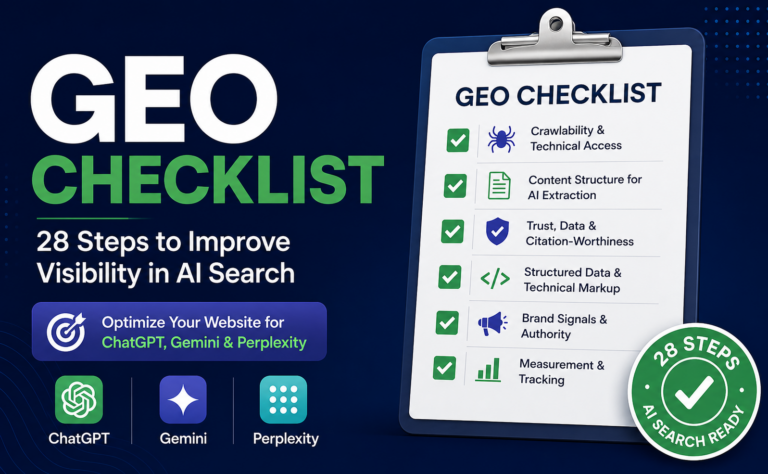
This isn’t another explainer of what GEO is — if you want that, our full GEO guide covers it in depth. This is the checklist itself: 28 specific, checkable items across crawlability, content structure, trust signals, structured data, and measurement, in the order we actually work through them during a client audit. Check them off as you go.

How to Use This Checklist

Run this against one important page first — a cornerstone guide or your highest-value service page — not your whole site at once. Work top to bottom: the categories are ordered the way they actually matter. A perfectly structured page that AI crawlers can’t reach (category 1) will never get cited, no matter how well you nail categories 2 through 6.

1. Crawlability & Technical Access

If AI crawlers can’t reach your content, nothing else on this list matters.

1. Confirm GPTBot, ClaudeBot, PerplexityBot, Google-Extended, and Amazonbot aren’t disallowed in robots.txt. These are the specific user-agent strings each platform’s training and retrieval crawlers use — check for each one by name, not just a generic “AI bot” rule.

2. Check whether your CDN or WAF is silently blocking AI bots. Cloudflare changed its default configuration to block AI crawlers automatically — if you’re on Cloudflare (or a similar provider) and haven’t checked this setting specifically, assume you’re blocked until you verify otherwise.

3. Search server logs for AI user-agents to confirm bots are actually visiting. Look for GPTBot (OpenAI’s training crawler) and separately for ChatGPT-User (the live browsing agent triggered by real user queries) — these are two different bots serving two different purposes, and a site can be visited by one without the other.

4. Verify important content renders server-side, not only after client-side JavaScript executes. Many AI crawlers don’t run a full JS engine — content that only appears after hydration may be invisible to them even though it renders fine in a human’s browser.

5. Get page speed genuinely fast, not just passing. Sites with First Contentful Paint under 0.4 seconds average measurably more AI citations than pages loading past 1.1 seconds — the full data behind this is in our GEO guide. Fast pages are simply easier for crawlers to fully process.

6. Decide deliberately on an llms.txt file — don’t add one just because it’s trendy. This one needs a real caveat: Google has stated directly that no special AI text file is required to appear in generative AI search, and llms.txt is not a Google ranking signal. Where it does matter is AI browsing agents navigating your site in real time — a different system entirely. See our Lighthouse Agentic Browsing guide for exactly where the line sits.

2. Content Structure for AI Extraction

This is where most of the visibility gains actually come from — full breakdown in our complete GEO guide. Here’s the checklist version.

7. Lead with a direct, complete answer in the first 40–80 words. A labeled “Quick Answer” or “TL;DR” box that fully answers the page’s core question — without requiring a scroll — is the single highest-leverage change on this entire list.

8. Write headings in question format where it fits naturally. “What is generative engine optimization?” gives an AI system a clean signal about section content that “Overview” or “Introduction” doesn’t.

9. Keep paragraphs short and self-contained. Under about 120 words each, and able to stand alone without the surrounding paragraphs for context — sometimes called the “Island Test.” AI systems chunk and process content in pieces, not as one continuous read.

10. Cover the sub-questions a complex query breaks into, not just the head term. AI engines often split a question into several smaller searches before synthesizing an answer — a query about “the best VPN for streaming in Europe” might be split into pricing, streaming compatibility, and regional server questions separately. Content that only addresses the broad topic misses the specific fragments AI is actually retrieving against.

11. Place a compact table or structured list near the top for comparison content. AI retrieval systems favor content it can extract directly into a structured answer over content it has to reconstruct from prose.

12. Pull key facts out of images, PDFs, and collapsed accordions into real, extractable text. If the answer only exists as text baked into an image or hidden until a user clicks to expand it, most AI crawlers never see it at all.

3. Trust, Data & Citation-Worthiness

AI systems can’t generate original data — they have to source it from somewhere. Give them a reason to source it from you.

13. Include original, specific statistics with named sources. “Revenue grew 22% in Q1” beats “revenue grew significantly” — specificity is a measurable citation signal, not just good writing. See the visibility-boost data in our Hybrid Engine Optimization guide.

14. Add direct quotations from named, credentialed experts. A quote attributed to a real person with a title gives an AI system something specific and attributable to extract — an unattributed claim doesn’t offer the same citation value.

15. Link out to authoritative external sources that back up your claims. Referencing academic research, government data, or established publications signals verifiability — AI models check whether content substantiates what it asserts.

16. Refresh cornerstone content every 60–90 days with a visible update. New statistics, a new example, and an updated “last updated” date all signal freshness — the majority of current AI Overview citations come from recently published or recently refreshed content.

17. Add real author bylines with genuine credentials. A named author with relevant expertise and a real bio is an E-E-A-T signal AI systems increasingly weigh — “Admin” or no byline at all is a missed opportunity on any page meant to earn a citation.

4. Structured Data & Entity Signals

AI systems increasingly understand and cite brands as entities, not just as pages.

18. Add FAQPage schema to pages with genuine Q&A content. Only mark up questions actually answered clearly on the page — schema that misrepresents the content works against you.

19. Add Organization schema to your homepage and About page. This explicitly tells crawlers your brand’s official name, description, founding date, and core offerings, rather than leaving them to infer it.

20. Keep your name, description, and contact details identical everywhere. Your website, Google Business Profile, Wikidata, Crunchbase, and LinkedIn should all describe your brand the same way — inconsistency weakens entity recognition. The full entity-authority framework is in our HEO guide.

21. Check for a Wikidata entry, and Wikipedia if you’re genuinely eligible. These serve as disambiguation anchors that help AI systems confirm which specific entity you are — never worth pursuing through paid or manipulative means, but worth doing properly if you qualify.

5. Off-Site & Community Signals

Your own site is only part of the picture — AI engines weigh what other sources say about you too.

22. Monitor and participate authentically in relevant Reddit and forum discussions. Reddit and YouTube are consistently among the most-cited domains across major LLMs — this makes genuine community presence a real, if unconventional, GEO signal. More detail in how AI is changing SEO.

23. Earn mentions on independent third-party sites, not just your own domain. AI systems apply a form of cross-source corroboration — a brand mentioned positively across multiple unaffiliated publications reads as more trustworthy than the same claims made only on the brand’s own site.

24. Treat digital PR as a GEO channel, not just a link-building tactic. Earned media and press coverage feed AI training and retrieval data the same way they feed backlink profiles — see our full AI citation building playbook for platform-specific timelines.

6. Measurement & Iteration

You can’t improve what you’re not tracking — and GEO needs its own dashboard, not just your existing rank tracker.

25. Manually query ChatGPT, Perplexity, Gemini, and Google AI Mode with your top 10–20 buyer prompts. Log which brands and URLs actually get cited for each one — the gap between where you should appear and where you currently do is your real GEO opportunity.

26. Set up ongoing AI visibility tracking once manual checks confirm it’s worth automating. Our AI rank tracking tools guide compares the options — note that only a minority of domains get cited consistently by more than one AI platform, so track each one separately rather than assuming visibility on one implies visibility on another.

27. Track citation rate and AI share of voice as core KPIs, not just organic rank. These are different metrics measuring a different outcome — being cited, not just ranking — and neither shows up in a standard Search Console report.

28. Re-run this entire checklist every 60–90 days on your priority pages. Models, retrieval methods, and which sources get favored all shift — a page that passed this audit in January can quietly fall out of citation by summer.

Score Your Results

0–10 checked

Foundational work needed. Start with category 1 — technical access is worth nothing to fix downstream tactics until crawlers can actually reach your content.

11–20 checked

Solid progress. Focus next on whichever category has the most unchecked items — partial coverage across every category is weaker than full coverage in fewer.

21–28 checked

Strong GEO posture. Shift effort toward category 6 — measurement — so you can prove and defend the ROI of the work you’ve already done.

Common Mistakes During a GEO Audit

  • Auditing the whole site before finishing one page. Prove the checklist works on a single cornerstone page first, then roll it out — auditing 200 pages at once with no validation just produces 200 pages of untested changes.
  • Treating llms.txt as the priority fix. It’s the item most GEO content gets excited about and the one with the least direct evidence behind it for search visibility specifically — categories 2 and 3 matter far more.
  • Skipping the measurement step. Without a “before” log of manual AI queries, you have no way to prove the checklist actually moved anything.
  • Doing this once and considering it done. GEO is not a fixed destination — item 28 exists because the answer changes as models and platforms evolve.

Frequently Asked Questions

How is this different from a general GEO strategy guide?

This is the audit tool, not the strategy explainer. If you want the reasoning and data behind each tactic, our full GEO guide covers that; this checklist is built for working through page by page.

Do I need to check every item to see results?

No. Categories 1 and 2 (crawlability and content structure) carry the most weight — a page that nails those two categories alone will typically outperform a page with scattered coverage across all six.

Is this checklist the same for ChatGPT, Perplexity, and Google AI Overviews?

The core structural and trust items apply broadly, but each platform sources citations differently — Google’s AI Overviews lean heavily on the existing organic index, for example, while ChatGPT’s web search runs through Bing. Platform-specific mechanics are covered in our AI citation building guide.

How long until I see results after completing this checklist?

Technical fixes (robots.txt, schema) can get re-crawled within 2–4 weeks. Content-based citation improvements typically take 60–120 days to show up consistently. Entity and off-site signals build slower still — usually 3–6 months to meaningfully shift citation frequency.

Want us to run this checklist for you?

Navoto runs full GEO audits against all 28 items — plus the technical SEO foundation underneath them — as part of our organic SEO services.


Type of Table

Most Popular

Category