94% of marketing teams now use AI in some capacity. Yet only 41% can actually prove the business value it generates. That staggering gap is the opportunity — and the warning — that defines AI marketing in 2026.
We are no longer in the era of AI hype. The brands winning right now are not the ones who tried the most tools. They are the ones who built a deliberate, integrated AI marketing system — one that connects data, strategy, creative, and execution in a continuous loop.
This complete guide from Navoto covers everything: what AI marketing actually means, which technologies power it, how the world’s fastest-growing brands are deploying it, and the exact strategy and tools you need to build your own AI-powered marketing machine in 2026. No sponsored tools. No fluff. Just what works.
What Is AI Marketing? (Full Definition)
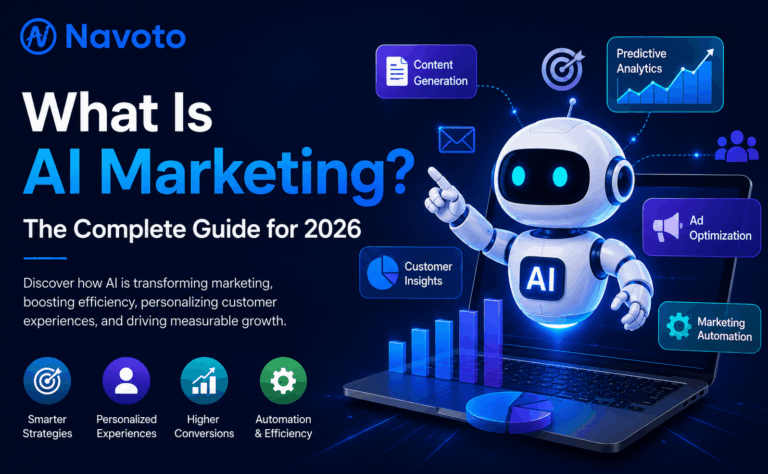
AI marketing is the practice of using artificial intelligence technologies — including machine learning, natural language processing, predictive analytics, and agentic AI — to analyze data, automate execution, and optimize marketing strategies at a scale and speed impossible for humans alone.
Official Definition — Navoto.com
AI marketing = using artificial intelligence to understand customers deeper, create content faster, distribute more precisely, and optimize campaigns in real time — replacing guesswork with data-driven intelligence at every stage of the marketing funnel.
In 2026, AI marketing has evolved from isolated point solutions — a chatbot here, an ad bidding algorithm there — into integrated agentic systems that can autonomously handle entire campaign lifecycles: audience identification, creative generation, channel deployment, real-time optimization, and attribution measurement, all with minimal human intervention at each step.
The key distinction today is autonomy. Previous generations of AI marketing tools functioned as sophisticated recommendation engines — you still made every decision. Modern AI marketing systems in 2026 can independently analyze customer data, select optimal content variants, adjust campaign parameters, and execute multi-step workflows without waiting for human approval at each stage.
This is why Shopify CEO Tobi Lütke has mandated that every employee must leverage AI tools in their workflows. It is no longer optional. The brands not using AI marketing today are watching their competitors pull ahead in a race that only gets faster. Discover how Navoto’s AI marketing services help businesses build this infrastructure.
Why AI Marketing Is Exploding in 2026
The numbers make the case better than any argument. AI marketing investment is not a future trend — it is an accelerating present reality with measurable, documented impact:
Three structural shifts are driving this explosion. First, agentic AI maturity — AI systems can now autonomously execute multi-step marketing workflows, not just assist with individual tasks. Second, tool ecosystem consolidation — the best platforms now integrate across the entire marketing stack rather than operating as disconnected point solutions. Third, AI-native workflow emergence — the most advanced marketing teams are not bolting AI onto old processes; they are redesigning their operations from the ground up with AI at the center.
The gap between organizations that have operationalized AI and those still experimenting is widening faster than most marketers realize. Every month of delay is a month of competitive disadvantage compounding. Our marketing strategy team at Navoto can help you close that gap quickly.
How AI Marketing Works: The Core Technologies
AI marketing is not a single technology — it is a stack of distinct AI capabilities, each solving a different marketing problem. Understanding what each does helps you deploy the right technology for the right job:
Machine Learning (ML)
ML algorithms learn from historical marketing data to predict future outcomes — which customers are most likely to convert, which ad creative will perform best, which email subject line drives the most opens. The more data you feed it, the more accurate it becomes over time.
Natural Language Processing (NLP)
NLP enables AI to understand and generate human language. It powers every content creation tool, chatbot, sentiment analysis system, and voice search optimization capability in your marketing stack. GPT-4, Claude, and Gemini are all built on advanced NLP architectures.
Predictive Analytics
Analyzes historical customer data to forecast future behavior — purchase likelihood, churn probability, lifetime value. Marketers use this to prioritize high-value prospects, intervene before customers leave, and allocate budget to the channels with the highest projected ROI before spending a dollar.
Agentic AI
The newest and most powerful tier. AI agents can autonomously execute complex multi-step marketing tasks — researching a market, writing a content brief, creating variations, scheduling across channels, and reporting results — with minimal human input. Gartner projects 40% of enterprise apps will embed agents by end of 2026.
Computer Vision
AI that can analyze, generate, and optimize visual content. Powers everything from AI-generated product photography to video analysis tools that identify which visual elements in an ad correlate with conversion. Midjourney, DALL-E, and Kling AI are built on this technology.
Semantic Search & RAG
Retrieval Augmented Generation (RAG) allows AI tools to pull fresh, real-time data from the web or your internal knowledge bases before generating content or analysis. This is what makes AI search engines like Perplexity so powerful — and why your content must be structured to be retrieved. See our LLM SEO guide for how to optimize for this.
10 Powerful AI Marketing Use Cases (With Real Brand Examples)
These are the highest-impact applications of AI marketing that real brands — including Shopify, Airbnb, Adidas, and Allianz — are actively deploying to drive measurable results right now:
USE CASE 01
Hyper-Personalization at Scale
AI analyzes behavioral data, purchase history, location, and browsing patterns to deliver individually tailored content, product recommendations, and offers to every single customer — automatically. Adidas uses AI to deliver personalized product recommendations that have measurably increased conversion rates across their digital channels. Amazon’s entire homepage is personalized per user, powered by ML models that predict what each person is most likely to purchase next.
USE CASE 02
AI-Powered Content Creation
LLMs like Claude, GPT-4, and Gemini can generate first drafts of blog posts, social media captions, email sequences, ad copy, product descriptions, and video scripts in seconds. The most effective teams use AI to handle volume and velocity, then apply human creativity for strategy and brand voice refinement. Tools like Jasper AI, Writer.com, and ContentShake AI are built specifically for marketing content workflows.
USE CASE 03
Predictive Lead Scoring & Customer Segmentation
Instead of treating all leads equally, AI scores each prospect based on their likelihood to convert — analyzing dozens of behavioral signals simultaneously. Allianz used AI-powered audience segmentation to deliver measurable ROI within days of deployment. Marketing teams using predictive scoring report 15–30% improvements in conversion rates simply by prioritizing the right leads at the right time.
USE CASE 04
Automated Competitor Intelligence
AI agents continuously monitor competitor websites, pricing, social media activity, ad campaigns, and content strategies — compiling automated reports that would take a human analyst days to produce. Instacart and Airbnb use internal AI systems for exactly this kind of competitive intelligence at scale. Tools like Browse AI, Gumloop, and Perplexity’s API make this accessible to teams of any size.
USE CASE 05
Programmatic Advertising & Smart Bidding
AI bidding algorithms analyze thousands of real-time signals — user location, device, browsing history, time of day, weather — to place the optimal bid for every single ad impression in milliseconds. Google’s Performance Max and Meta’s Advantage+ campaigns are both AI-driven systems. Pegasus used AI-powered audience targeting and social proof triggers to increase conversion rates and ROAS dramatically across their campaigns.
USE CASE 06
Conversational Marketing (AI Chatbots)
Avis reduced costs dramatically with AI-powered conversational customer experiences. Modern AI chatbots (Chatfuel, Drift, Intercom’s AI) have unstructured, context-aware conversations that qualify leads, answer complex questions, and book demos 24/7 without human agents.
USE CASE 07
Social Media Sentiment Analysis
AI aggregates and analyzes thousands of social mentions, reviews, and comments to measure brand sentiment in real time. Tools like Brand24 and Gumloop workflows alert marketing teams to negative sentiment spikes before they become crises — and identify moments of positive buzz to amplify.
USE CASE 08
AI-Powered Email Marketing
AI optimizes send times, subject lines, content, and sequences for each individual subscriber based on their behavior. Platforms like Reply.io’s AI assistant and Klaviyo’s AI features increase open rates and revenue per email significantly over manually managed campaigns.
USE CASE 09
AI Video & Visual Content Production
In 2026, video content drives the highest engagement across every platform. AI tools like Kling AI and Crayo enable brands to produce cinematic-quality video content in hours rather than weeks, at a fraction of traditional production costs.
USE CASE 10
SEO & AI Search Optimization
AI tools now power keyword research, content briefs, on-page optimization scoring, and technical SEO audits. With AI Overviews now appearing on 30% of Google searches, optimizing for AI citations is as critical as traditional ranking. See our complete guide to ranking in SEO for the full picture.
How to Build an AI Marketing Strategy From Scratch
The biggest mistake in AI marketing is starting with tools instead of strategy. Before selecting any software, you need a framework. The highest-performing companies treat AI as a catalyst to transform operations — not as a feature to bolt onto existing processes. Here is the framework we use at Navoto:
Audit Your Current Marketing Data Infrastructure
AI is only as powerful as the data it runs on. Before deploying any AI tool, audit what first-party data you have: customer purchase history, email engagement, website behavior, CRM records. Identify gaps. Build clean, centralized data pipelines. Without this foundation, AI tools will produce low-quality outputs and misleading insights. This step is where most AI marketing initiatives fail — they skip the data work.
Define Specific, Measurable AI Marketing Goals
Vague goals like “use AI more” produce no measurable results. Define specific outcomes: reduce content production cost by 40%, increase email open rate by 15%, cut customer acquisition cost by 20% within 6 months. Each goal should map to a specific AI capability. Clear goals also help you select the right tools and avoid accumulating expensive software that never gets properly used.
Select Tools That Integrate With Your Existing Stack
Integration complexity is the #1 cause of failed AI marketing implementations — 60% of failures cite poor integration with the existing martech stack as the primary problem. Prioritize tools with native integrations for your CRM, email platform, and analytics suite. A tool that works in isolation delivers 20% of the value of one that feeds seamlessly into your existing workflow. Start with one integration, prove it, then expand.
Build Human-AI Collaboration Workflows, Not Full Automation
Research is clear: organizations that combine AI automation with human creativity see 2.4x better campaign performance than those using full automation. AI handles data processing, pattern recognition, and execution at scale. Humans handle strategy, brand voice, creative direction, and ethical judgment. Design every workflow with explicit human review checkpoints for anything customer-facing.
Allocate Budget Based on Your Maturity Level
Early adopters should allocate 15–20% of marketing budget to AI tools while building foundational capabilities. Organizations with mature AI stacks can optimize at 25–30% allocation as they scale proven workflows. Expect a realistic ROI timeline of 6–18 months for sustained returns — not the weeks that some vendors promise. Plan for 12–18 months to achieve full operational maturity.
Measure AI Impact Separately From Overall Marketing Performance
The reason only 41% of teams can prove AI’s business value is that they never set up isolated measurement. Create controlled experiments: run identical campaigns with and without AI optimization and compare results. Track efficiency metrics (time saved, content volume) alongside business metrics (revenue per campaign, customer acquisition cost). Without this, you are flying blind on one of your biggest investments.
The Best AI Marketing Tools by Category (2026)
Rather than a list of 30 tools you won’t actually use, here are the best-in-class AI marketing tools organized by what job they actually do — so you can build a focused, integrated stack without overlap and wasted spend:
| Category | Best Tools | What It Does |
|---|---|---|
| AI Writing | Claude, Jasper AI, Writer.com, ContentShake | Generate blog posts, ad copy, email sequences, and social content at scale |
| AI Automation | Gumloop, Zapier AI, Make.com | Connect LLMs to your existing tools; build no-code AI agent workflows |
| SEO Optimization | Surfer SEO, Semrush AI, Ahrefs AI | Keyword research, content scoring, topical authority building |
| AI Video | Kling AI, Crayo, Arcads, LTX Studio | Generate short-form and long-form video content; AI ad creative production |
| AI Ads | Albert.ai, Google Pmax, Meta Advantage+ | Autonomous media buying, real-time bid optimization, creative testing |
| AI Analytics | FullStory, Paradigm AI, Coupler.io AI | Behavioral analytics, predictive reporting, campaign attribution |
| AI Email | Reply.io AI, Klaviyo AI, ActiveCampaign | Automated sequences, subject line optimization, send-time personalization |
| AI Social | Brand24, Hootsuite AI, Buffer AI | Sentiment monitoring, post scheduling, social listening, influencer discovery |
| AI Chatbots | Chatfuel, Userbot.ai, Drift AI | 24/7 lead qualification, customer support automation, conversational selling |
| AI Visuals | PhotoRoom, Midjourney, Lexica Art | AI image generation, product photography, blog thumbnails, creative assets |
Benefits of AI Marketing (And Hidden Costs)
Understanding both the rewards and the real costs of AI marketing prevents the disappointment that hits the 59% of teams who can’t prove its value. Here is an honest accounting:
✅ Proven Benefits
→
→
→
→
→
⚠️ Hidden Costs to Know
→
→
→
→
→
6 AI Marketing Mistakes to Avoid
01
02
03
04
05
06
Frequently Asked Questions About AI Marketing
Your 30-Day AI Marketing Action Plan
Stop reading and start doing. This 30-day roadmap moves you from zero to an integrated AI marketing foundation that delivers measurable results:
- Audit your current martech stack and identify data gaps
- Define 3 specific, measurable AI marketing goals for Q3
- Set up Google Analytics 4 and ensure all conversion events are tracking correctly
- Sign up for Claude or ChatGPT and start using it daily for content drafts
- Use AI to audit your top 10 pages against competitor content — find the gaps
- Rewrite 3 underperforming blog posts using AI-assisted optimization
- Add FAQ sections with structured data markup to your top 5 pages
- Build a 3-month AI content calendar aligned to your keyword research strategy
- Build one AI automation workflow (e.g., lead scoring + automated follow-up sequence)
- Set up an AI social listening alert for your brand name and top competitors
- Implement AI-driven subject line testing in your email platform
- Create your first AI-generated video or visual asset for social
- Compare week 1 baselines to current performance — document every change
- Identify the AI workflow that delivered the clearest positive impact
- Scale that workflow: document it, train your team on it, expand it
- Plan your 90-day AI marketing roadmap with the budget and tools identified