Every day, Google processes over 8.5 billion searches. The websites that appear at the top of those results capture the overwhelming majority of clicks, customers, and revenue. The ones that don’t — no matter how good their products or content — are effectively invisible.
Understanding ranking in SEO is not optional for any business with an online presence. It is the difference between being found and being forgotten. This complete guide from Navoto breaks down exactly what SEO ranking means, how Google’s algorithm works, which factors matter most in 2026, and the precise actions you need to take to move up.
Whether you are completely new to SEO or a seasoned marketer looking to sharpen your strategy, this is the most thorough, up-to-date resource you will find on the subject.
What Is Ranking in SEO? (Clear Definition)
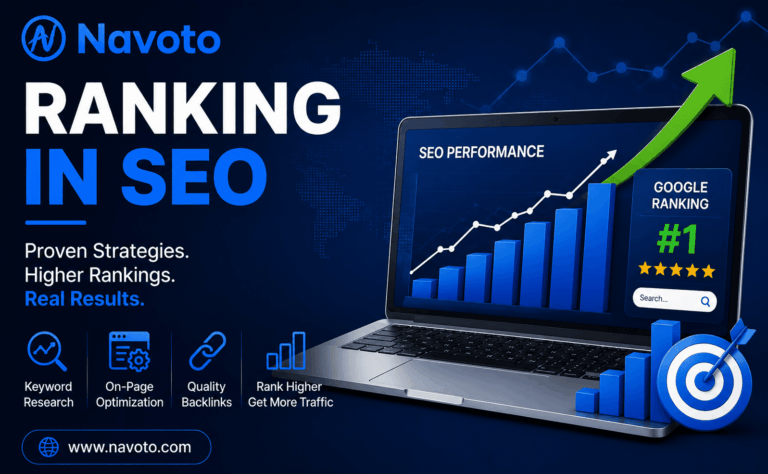
Ranking in SEO refers to the position a webpage holds on a Search Engine Results Page (SERP) for a specific keyword or search query. When someone types a question into Google, the engine returns results in a ranked order — Position 1, Position 2, Position 3, and so on. That position is your SEO ranking.
Official Definition
SEO Ranking is the ordered position a webpage occupies on a search engine results page (SERP), determined by the search engine’s algorithm based on relevance, authority, and user experience signals.
Your ranking is not a single fixed number. It changes based on:
- The specific keyword being searched
- The location of the searcher (local SEO rankings vary by city)
- The device used (mobile vs. desktop rankings can differ)
- Whether the user is logged into a Google account (personalization)
- The time of the search (some rankings fluctuate daily)
This is important: when we talk about improving your SEO ranking, we are always talking about a specific keyword on a specific search engine. Ranking #1 for one keyword doesn’t mean you rank well for every keyword — and that’s why a full keyword research strategy is essential.
Organic rankings vs. paid rankings: SEO ranking exclusively refers to organic (non-paid) positions. The ads you see at the top of Google with the “Sponsored” label are paid placements bought through Google Ads — they are not SEO rankings. True SEO ranking is earned, not bought, and it delivers long-term, compounding traffic value.
Why SEO Ranking Matters More Than Ever in 2026
The stakes of ranking well have never been higher. Over 90% of online experiences still begin with a search engine, and the gap between Page 1 and Page 2 results is enormous. Here’s the data that makes it undeniable:
The rise of zero-click searches and AI Overviews makes this simultaneously more challenging and more rewarding. Pages that rank in the top 3 positions are most likely to be extracted by Google’s AI to form an answer — meaning your ranking now drives both direct clicks AND AI-powered brand exposure.
The bottom line: ranking well is not just an SEO vanity metric — it is a direct revenue driver. Our SEO services at Navoto are built specifically around moving businesses up the rankings where it produces measurable business results.
How Google Ranks Websites: The Algorithm Explained
Google uses a sophisticated, multi-layered algorithm to rank every page for every search query. While the full algorithm remains a closely guarded secret with over 200 known signals, the process follows a clear sequence:
Crawling
Googlebot (Google’s web crawler) discovers pages by following links across the internet. It visits your site, reads your content, and follows your internal and external links. If your site isn’t crawlable, it doesn’t exist to Google.
Indexing
After crawling, Google processes and stores the page in its index — a giant database of all known web content. A page must be indexed before it can rank for anything. You can check your index status in Google Search Console.
Ranking
When a user submits a query, Google’s ranking algorithm instantly evaluates all indexed pages relevant to that query and sorts them by relevance, authority, and user experience signals — in milliseconds. The result is the SERP you see.
Re-ranking (Real-Time Updates)
Rankings update in real-time. A page ranked well today can drop tomorrow if a competitor publishes better content, earns stronger backlinks, or if Google rolls out an algorithm update. SEO ranking is never a one-time achievement — it requires ongoing maintenance.
“Modern SEO is no longer about chasing algorithms with shortcuts. Success comes from combining content strategy, user experience, technical SEO, and authority building into one complete system.”
— SEO industry consensus, 2026
The 10 Most Important SEO Ranking Factors in 2026
Google uses over 200 known signals to rank pages, but research consistently shows that a handful of factors drive the bulk of ranking outcomes. Here are the 10 that matter most right now, in order of impact:
#1 FACTOR
Content Quality & Relevance
Content quality is Google’s single most powerful ranking signal. Your content must be accurate, comprehensive, original, and directly aligned with what the searcher actually wants (search intent). Thin content, AI-spun text without human expertise, or content that doesn’t fully answer the query will not rank — and may be penalized. Google’s Helpful Content system specifically targets content created for search engines rather than for people.
#2 FACTOR
Backlinks (Link Authority)
Backlinks are hyperlinks from other websites pointing to your page. They function as votes of confidence — the more high-quality, relevant sites link to you, the more Google trusts you. Note that quality beats quantity: one link from a respected industry publication is worth more than 100 links from low-authority directories. According to First Page Sage’s 2025 analysis, backlinks now account for approximately 13% of Google’s algorithm weight — down from 50%+ historically, but still critical.
#3 FACTOR
Search Intent Alignment
Search intent is the underlying reason behind a search query. Google categorizes intent as: Informational (learning something), Navigational (finding a specific site), Transactional (buying something), or Commercial (comparing before buying). If your content format doesn’t match the intent — for example, a product page ranking for “how to” queries — Google will suppress it regardless of how good the writing is.
#4 FACTOR
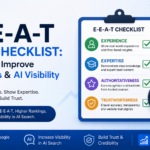
E-E-A-T (Experience, Expertise, Authoritativeness, Trustworthiness)
Google’s Quality Rater Guidelines center on E-E-A-T as the framework for evaluating whether a source deserves to rank highly — especially for YMYL (Your Money or Your Life) topics like health, finance, and legal advice. In 2026, demonstrating genuine first-hand experience is the newest and most powerful of these signals. Author bios with real credentials, original case studies, and tested recommendations all feed E-E-A-T.
#5 FACTOR
Page Speed & Core Web Vitals
Google confirmed page speed as an official ranking factor in 2010 and doubled down with Core Web Vitals in 2021. These are three specific metrics: LCP (Largest Contentful Paint — how fast the main content loads), FID/INP (Interaction to Next Paint — how responsive the page is), and CLS (Cumulative Layout Shift — how visually stable the page is). Sites that pass Core Web Vitals thresholds rank significantly higher, especially on mobile.
#6 FACTOR
Mobile-Friendliness (Mobile-First Indexing)
Since 2023, Google exclusively uses the mobile version of your website for indexing and ranking — a system called Mobile-First Indexing. If your desktop site is excellent but your mobile site is broken, slow, or incomplete, your rankings will suffer across all devices. With over 60% of global searches now performed on mobile, this is non-negotiable.
#7 FACTOR
Topical Authority & Content Depth
In 2026, Google rewards sites that demonstrate deep expertise across an entire topic, not just individual pages that rank for isolated keywords. This concept — topical authority — means covering a subject comprehensively through clusters of interlinked content. A site with 30 deeply researched articles all about the same subject will outrank a site with one thin article, even if that one article seems better on the surface.
#8 FACTOR
On-Page Keyword Optimization
Placing your target keyword in the right locations signals to Google exactly what your page is about. The most impactful placements are: the title tag (the HTML <title> element), the H1 heading, the first 100 words of the content, at least one H2 subheading, the URL slug, and the meta description. Avoid keyword stuffing — using a keyword so many times it reads unnaturally — as this is a negative signal.
#9 FACTOR
Internal Linking Structure
Internal links — links from one page on your site to another page on your site — serve two critical functions. First, they help Googlebot discover and crawl your pages efficiently. Second, they pass “link equity” (ranking power) between pages. A well-planned internal linking structure can dramatically boost rankings for key pages without any external backlinks. Pages that are deeply buried (more than 3 clicks from the homepage) are effectively invisible to Google’s crawlers.
#10 FACTOR
Site Security (HTTPS)
Google confirmed HTTPS as a ranking signal in 2014. Today, any site still using HTTP (insecure) faces a direct ranking disadvantage and browser security warnings that crush click-through rates. An SSL certificate is the most basic technical SEO requirement — a non-negotiable foundation for ranking.
On-Page Ranking Signals: What You Control Directly
On-page SEO refers to every element on your webpage that you can directly optimize. These are the ranking signals entirely within your control — no external relationships required. Here is the complete on-page ranking checklist:
| On-Page Element | What to Optimize | Impact Level |
|---|---|---|
| Title Tag | Include primary keyword, keep under 60 chars | HIGH |
| H1 Heading | One H1 per page, contains primary keyword | HIGH |
| URL Slug | Short, descriptive, keyword-included (/ranking-in-seo) | HIGH |
| Meta Description | 140–160 chars, keyword + clear value proposition | MEDIUM |
| H2/H3 Subheadings | Organize content hierarchy; include semantic keywords | MEDIUM |
| Image Alt Text | Descriptive text for every image; include keyword where natural | MEDIUM |
| Content Length & Depth | Cover the topic fully; longer ≠ better, but completeness matters | HIGH |
| Schema Markup | JSON-LD structured data (Article, FAQ, HowTo) | HIGH |
Off-Page Ranking Signals: Authority & Trust
Off-page SEO covers everything that happens outside your website that influences your rankings. These signals tell Google how the rest of the web perceives your site.
🔗
A diverse backlink profile from varied domains, industries, and content types signals natural, organic authority. Avoid buying links or running link schemes — Google penalizes these aggressively.
🏷️
Even when your brand is mentioned online without a hyperlink, Google’s algorithm detects these mentions as trust signals. Consistent, positive brand mentions across reputable sites build what’s now called “brand entity authority.”
📱
While Google has stated social shares are not a direct ranking factor, high social engagement increases content visibility, earns more backlinks organically, and drives branded search — all of which do affect rankings.
⭐
For local SEO, Google Business Profile reviews and star ratings are a major ranking factor. Positive reviews signal trustworthiness to both users and Google’s algorithm. Explore our local SEO guide for more on this.
Technical SEO Ranking: Site Health Signals
Technical SEO is the foundation that everything else is built on. Even the most brilliant content won’t rank if Google can’t crawl, index, or understand your site. Here are the core technical ranking signals you must address:
Crawlability
No crawl blocks in robots.txt for important pages. Accurate XML sitemap submitted to Google Search Console. No orphan pages (pages with no internal links pointing to them).
Indexability
No unintentional noindex tags on important pages. Canonical tags are correctly set to avoid duplicate content penalties. Hreflang implemented correctly for multilingual sites.
Performance
LCP under 2.5s. Compressed images (WebP format). Minified CSS/JS. CDN enabled for global delivery. Server response time under 200ms.
Structured Data
JSON-LD schema on all key pages. FAQPage schema for Q&A content. Organization + WebSite schema on homepage. Validated with Google’s Rich Results Test.
How to Improve Your SEO Ranking: Step-by-Step
Here is the action sequence that consistently moves rankings for our clients at Navoto. Follow these steps in order — each one builds on the last.
Run a Full SEO Audit
Before doing anything else, find out exactly where you stand. Use Google Search Console to identify crawl errors, indexing issues, and which pages are already ranking. Use Ahrefs or Semrush to audit your backlink profile, keyword rankings, and site health. Document everything — you need a baseline to measure improvement against. Our SEO audit service covers all of this comprehensively.
Do Deep Keyword Research
Identify keywords with the right balance of search volume, competition level, and intent alignment for your business. Focus on long-tail keywords (3–5 word phrases) first — they are easier to rank for and convert better. Group keywords by topic clusters, not individual pages. Understand the search intent behind each target keyword before writing a single word of content.
Fix All Technical Issues First
Technical problems are ranking killers. Address them before investing in content or links. Fix broken links (404 errors), resolve redirect chains, eliminate duplicate content, implement HTTPS if not already done, compress images, and ensure all key pages are indexed. Technical fixes often produce the fastest ranking improvements.
Create or Update Content Strategically
For each target keyword, either create a new page or update an existing one. Study the top 5 SERP results — then create something demonstrably better: more complete, better organized, with original data and real examples. Add FAQs, relevant images with alt text, internal links to supporting pages, and structured data markup. Update old content regularly to maintain freshness signals.
Build High-Quality Backlinks
Earn links from authoritative, relevant websites through: guest posting on industry blogs, creating original research others want to cite, digital PR campaigns that earn news coverage, and producing free tools or resources that naturally attract links. Never buy links or participate in link schemes — Google’s algorithms detect these and penalize heavily.
Monitor, Measure, and Iterate
SEO is an ongoing process. Track your keyword rankings weekly. Monitor organic traffic in Google Analytics. Watch for algorithm update announcements. Refresh content every 6–12 months. Test changes and measure their impact before rolling them out site-wide. The sites that rank consistently are the ones that treat SEO as a permanent discipline, not a one-time project.
7 SEO Ranking Mistakes That Are Killing Your Position
Avoiding these errors is just as important as implementing best practices. These are the most common ranking killers we find when auditing client sites at Navoto:
01
02
03
04
05
06
07
Frequently Asked Questions About SEO Ranking
Ready to Rank Higher?
Let Navoto Build Your SEO Ranking Strategy
From technical audits to content creation to link building — we build the complete SEO ranking system your business needs to dominate Page 1 in 2026.