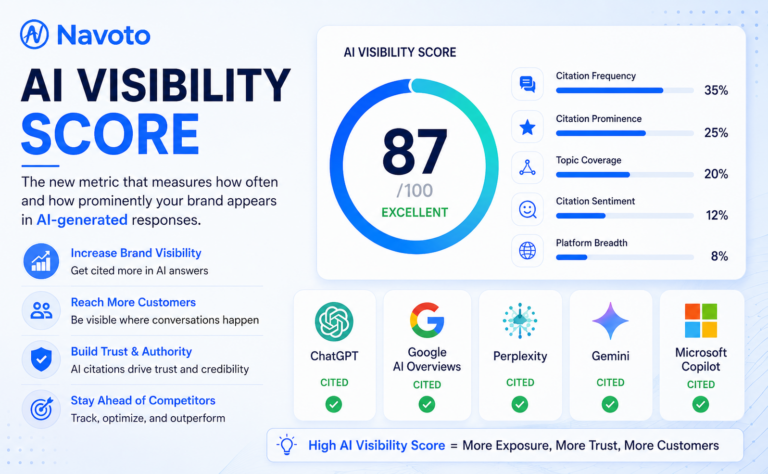
As AI-generated answers replace traditional search results, your Google ranking alone no longer tells the full story. AI Visibility Score is the new metric that measures how often and how prominently your brand appears inside AI responses — and it could be the most important number in your digital marketing strategy right now.
In this guide, you will learn exactly what AI Visibility Score means, how it is calculated, why it matters more than traditional rankings, and the proven strategies to improve it across ChatGPT, Perplexity, Google AI Overviews, and Gemini.
🔑 Key Takeaway: AI Visibility Score measures your brand’s presence inside AI-generated answers — not just in link lists. A brand with a low Google ranking but a high AI Visibility Score can be reaching more customers than one ranking #1. This guide explains everything you need to know to measure and improve it.
1. What Is AI Visibility Score?
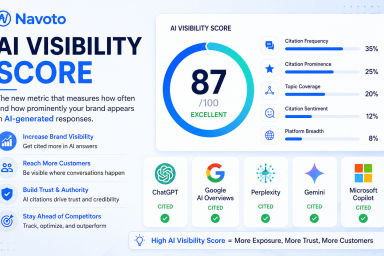
Definition: AI Visibility Score is a metric that quantifies how frequently and how prominently a brand, website, or piece of content is mentioned, cited, or recommended inside AI-generated responses — from platforms such as Google AI Overviews, ChatGPT Search, Perplexity AI, Gemini, and Microsoft Copilot.
Think of it as the AI-era equivalent of your organic search ranking — except instead of measuring where you appear in a list of blue links, it measures how often you appear inside the actual answer that an AI produces for your target topics.
A brand with a high AI Visibility Score appears consistently when users ask questions related to that brand’s products, services, or expertise. A brand with a low score is being systematically overlooked by AI engines — even if it ranks on page 1 of traditional search results.
This disconnect is exactly why AI Visibility Score has become one of the most discussed metrics in digital marketing. Companies that understand this gap are investing in strategies like Generative Engine Optimization (GEO) and Answer Engine Optimization to close it.
📌 Related Guide: How to Rank in AI Search Results: The Complete 2025–2026 Guide — Understand the full strategy behind improving your presence in AI-generated answers.
2. Why AI Visibility Score Matters More Than Traditional Rankings
For most of the past two decades, being on page 1 of Google was the ultimate goal of digital marketing. That logic is rapidly becoming outdated. Here is why AI Visibility Score is now more commercially significant:
Key Statistics You Need to Know
- 13.1% of all Google searches now trigger an AI Overview (early 2026)
- 47% of AI citations come from pages that do not rank in the organic top 5
- 3.2× more AI citations for brands with structured data vs. those without
- +73% higher AI selection rate for pages with proper schema markup
6 Reasons AI Visibility Score Now Matters More
1. Zero-Click Exposure
AI Overviews and chat responses deliver brand exposure before users click anything. A citation in an AI answer reaches the user even if they never visit your website.
2. Voice and Conversational Search
Voice search returns one answer, not ten links. If your brand is not in that answer, you are invisible to an entire growing channel of search behaviour.
3. Top-of-Funnel Trust
When an AI recommends your brand by name, it carries the implicit trust of the AI platform. Users treat AI citations as third-party endorsements — not advertisements.
4. Ranking Does Not Equal Citation
47% of AI citations come from pages outside the top 5 organic results. Ranking #1 does not guarantee AI visibility — and AI visibility does not require ranking #1.
5. Growing AI Search Share
AI Overviews appear in 13.1% of all Google queries. ChatGPT, Perplexity, and Gemini collectively handle hundreds of millions of queries per month — and this share keeps growing.
6. Competitive Intelligence
Tracking AI Visibility Score reveals which competitors are being cited instead of you — giving you precise targets for content and authority-building efforts.
⚡ The Shift in Plain English: Traditional SEO asked: “Where does my page rank in the list?” AI Visibility asks: “Does my brand get named when someone asks an AI a question I should be answering?” These are fundamentally different questions — and you now need to optimise for both. See how Hybrid Engine Optimization bridges the two strategies.
3. How Is AI Visibility Score Calculated?
There is no single universal AI Visibility Score standard — different tools calculate it differently. However, the core inputs across all major measurement platforms share the same logic. Understanding what feeds the score tells you exactly which levers to pull.
AI Visibility Score is built from five weighted components:
| Component | Weight | What It Measures |
|---|---|---|
| Citation Frequency | 35% | How often your brand is cited in AI answers for your target topics |
| Citation Prominence | 25% | Whether you are cited first, in the middle, or last in AI responses |
| Topic Coverage | 20% | How many different relevant queries trigger your brand’s citation |
| Citation Sentiment | 12% | Whether your brand is framed positively, neutrally, or negatively |
| Platform Breadth | 8% | How many different AI platforms (Google, ChatGPT, Perplexity, Gemini) cite you |
The key insight from this formula is that frequency alone is not enough. Where you appear (prominence), how many topics you are cited for (coverage), the tone of citations (sentiment), and how many platforms cite you (breadth) all feed the final score.
4. The 5 Core Components of AI Visibility Score — Explained in Detail
Component 1 — Citation Frequency (35%)
What It Means: How often your brand, website, or content pages are mentioned in AI-generated responses when users query your target keywords and topics.
Why it matters: Frequency is the most heavily weighted component because it is the most direct signal of AI recognition. A brand with high citation frequency appears reliably across a broad set of queries in its niche — not just for branded keyword searches.
How to resolve low citation frequency: Publish more semantically complete content on your core topics. Use structured FAQ sections, how-to formats, and answer-first writing where the main point comes in the first sentence. Build internal links between related content pages to create topical authority clusters. See the full guide on how to rank in AI search results for a step-by-step approach.
Component 2 — Citation Prominence (25%)
What It Means: Where your brand appears within an AI response — whether you are cited first (highest prominence), mentioned in the middle, or listed at the end of sources.
Why it matters: Just as position #1 in traditional search captures far more clicks than position #7, being the first source cited in an AI answer generates the most brand recognition. A brand mentioned last in a six-source AI response has far lower effective visibility than one cited first.
How to resolve low prominence: Build topical authority by owning a subject completely — not just one page on it. Publish the most comprehensive, data-backed content on your topic. Earn brand mentions from credible industry publications. Generative Engine Optimization (GEO) strategies are specifically designed to improve citation prominence.
Component 3 — Topic Coverage (20%)
What It Means: The breadth of topics, sub-topics, and query types for which your brand receives AI citations. High Topic Coverage means your brand is cited across a wide range of relevant questions — not just your brand name queries.
Why it matters: A brand cited only when someone types its exact name has shallow AI visibility. A brand cited when someone asks “what is the best tool for X,” “how do I solve Y,” and “compare A vs B” has deep AI visibility — it owns the conversation, not just the brand mention.
How to resolve low topic coverage: Map every informational, how-to, comparison, and problem/solution query your target audience asks. Build dedicated content pages for each. This is the core of Answer Engine Optimization — crafting content that directly answers the questions AI is being asked about your industry.
Component 4 — Citation Sentiment (12%)
What It Means: The tone in which your brand is cited — whether the mention is positive (recommended, praised), neutral (listed among options), or negative (cited as a cautionary example).
Why it matters: AI engines synthesise information from reviews, news articles, and public content. If negative sentiment dominates your brand’s web presence, AI responses will reflect that — citing you in negative contexts or skipping your brand in favour of competitors with better sentiment profiles.
How to resolve negative sentiment: Actively manage your brand’s online reputation. Encourage detailed positive customer reviews. Respond professionally to negative coverage. Publish case studies and testimonials that give AI engines positive, factual brand signals.
Component 5 — Platform Breadth (8%)
What It Means: How many different AI platforms cite your brand — Google AI Overviews, ChatGPT, Perplexity, Gemini, and Microsoft Copilot. A brand cited only on one platform has lower breadth than one appearing consistently across all five.
Why it matters: Different AI platforms have different user bases and content preferences. Being present across all platforms maximises reach and reduces dependency on any single channel.
How to resolve low platform breadth: Publishing consistently high-quality, structured, and externally cited content naturally improves your presence across all platforms. This is the Hybrid Engine Optimization approach — optimising for the full landscape of AI discovery channels simultaneously.
5. How to Measure Your AI Visibility Score
Measuring AI Visibility Score is different from traditional rank tracking. You are not checking where you appear in a list — you are checking whether AI mentions you at all when answering relevant questions. Here are three methods, from free to enterprise.
Method 1 — Free Manual Audit (Start Here)
Before investing in tools, do a manual audit. Open ChatGPT, Perplexity, and Google in AI Mode. Type the 10–15 most important questions your ideal customer asks about your industry. Record whether your brand is mentioned, where it appears, and how it is framed. This gives you a baseline score in under an hour.
💡 Pro Tip: Use incognito mode and a fresh device when doing manual audits. AI platforms can personalise responses based on search history, which would skew your baseline measurement.
Method 2 — AI-Specific Tracking Tools
| Tool | What It Measures | Platforms Covered |
|---|---|---|
| Peec.ai | Brand citation frequency, share of voice, competitor citations | ChatGPT, Gemini, Perplexity, Copilot |
| Semrush AI Toolkit | AI Overview appearances, citation frequency per keyword | Google AI Overviews |
| Visalytica | Full AI Visibility Score dashboard with component breakdown | ChatGPT, Perplexity, Google, Gemini |
| Visiblie.com | AI citation tracking, brand mention monitoring | Multiple AI platforms |
| SERanking AI Tracker | AI results monitoring, keyword-level visibility | Google AI Overviews |
| Google Search Console | AI Overview impressions and rich result data | Google only — Free |
📊 Full Comparison: AI Search Engine Optimization Tools: Full 2026 Comparison and Pricing — In-depth reviews of every tool for tracking AI citation frequency, brand mention share, and visibility scoring.
6. 7 Proven Strategies to Improve Your AI Visibility Score
Improving AI Visibility Score is not about gaming an algorithm — it is about making your brand the most trustworthy, complete, and clearly structured source in your niche. Here are the seven highest-impact strategies.
Strategy 1 — Publish Semantically Complete Content
AI engines prioritise content that can fully answer a question without the user needing to look elsewhere. This is called semantic completeness and it has the highest correlation (r=0.87) with being cited in AI responses.
Every article you publish should answer its primary question in the first two sentences, address every related sub-question, include inline definitions for technical terms, and cite verifiable data with sources. Ask yourself for every section: “If AI extracted only this paragraph and showed it to a user, is the answer complete?”
Strategy 2 — Use Answer-First, Extractable Formatting
Listicles, how-to steps, FAQ sections, and definition blocks receive up to 35% more AI citations than unstructured prose. AI systems need content they can extract a clean answer from. Structure every section so the answer comes first and supporting context follows.
This is the core principle of Answer Engine Optimization — formatting every piece of content so AI engines can lift your answer and cite it with confidence.
Strategy 3 — Build Topical Authority Through Content Clusters
Do not publish one page on your core topic. Build a content cluster: a pillar page covering the topic broadly, supported by detailed sub-pages covering every related angle. Internal links between these pages signal to AI that your site is the authoritative hub for this subject.
Strategy 4 — Earn High-Quality Brand Mentions
AI citation models treat third-party brand mentions as a trust signal. When credible news sites, industry publications, and authority blogs mention your brand in relevant contexts, AI engines treat your brand as a recognised entity worth citing. Invest in PR, original research, and expert commentary in your industry press.
Strategy 5 — Implement Schema Markup
Properly implemented JSON-LD schema markup improves AI citation rates by up to 73%. This is not a technical nicety — it is the machine-readable layer that tells AI what your content is, who wrote it, what question it answers, and why it should be trusted. Full implementation instructions are in Section 8 below.
Strategy 6 — Optimise for Conversational and Long-Tail Queries
AI search users ask in natural language: “What is the best way to improve my AI visibility?” — not just “AI visibility tips.” Map every conversational phrasing your audience uses and ensure your content naturally addresses each one. This directly expands your Topic Coverage score.
Strategy 7 — Keep Content Accurate, Fresh, and Dated
AI engines apply real-time factual verification before citing a source — content with traceable, current facts increases citation probability by up to 89%. Always display a visible “Last Updated” date, cite your sources explicitly, and refresh key statistics at least quarterly.
🚀 Strategy Guide: Generative Engine Optimization (GEO): The Complete Navoto Playbook — The full GEO framework including content architecture, authority building, and platform-specific optimisation.
7. E-E-A-T and AI Visibility Score
Research shows that 96% of content cited in Google AI Overviews displays strong E-E-A-T signals. E-E-A-T is not just a traditional SEO concept — it is the primary trust filter AI engines apply before deciding whether to cite your content.
What Each E-E-A-T Pillar Means for AI Visibility
Experience — First-hand, real-world engagement with the topic. Original data, case studies, and lived experience AI cannot source elsewhere. AI engines prioritise content written by people who have actually done the thing being described.
Expertise — Demonstrated knowledge depth. Detailed analysis, technical accuracy, author credentials, and content that goes significantly beyond surface-level coverage. Thin content with no depth is systematically skipped by AI citation logic.
Authoritativeness — External recognition. Citations from reputable third parties, industry mentions, backlinks from authority sites, and a Knowledge Graph entity presence all feed this signal.
Trustworthiness — Accuracy, transparency, cited sources, clear authorship, visible contact details, and an honest editorial standard. Sites with no clear identity, no author information, and no cited sources are deprioritised by AI trust filters.
How to Fix E-E-A-T Gaps That Are Reducing Your AI Visibility Score
- Add a detailed author bio with credentials and relevant background to every article
- Include original research, survey data, or proprietary insights that no other site can replicate
- Cite all statistics and claims with direct links to primary sources
- Display a clear “Last Updated” date on every content page — and keep it accurate
- Build a complete About page, Team page, and Contact page to establish brand identity
- Earn coverage from credible industry publications — each earned mention reinforces your Authoritativeness signal
- Encourage and respond to detailed customer reviews across Google and niche review platforms
8. Schema Markup That Directly Boosts AI Visibility Score
Schema markup is the single highest-ROI technical action for improving AI Visibility Score. A 2025 controlled study found that pages with proper JSON-LD schema were cited in AI Overviews at a 73% higher rate than identical pages without schema. The no-schema page in that study was not even indexed.
Schema tells AI engines exactly what your content contains — the type of information, who produced it, what question it answers, and what entities appear within it. Without schema, AI must infer all of this from your prose. With schema, it reads a precise, machine-friendly label for every piece of information.
Priority Schema Types for AI Visibility (2025–2026)
| Schema Type | What It Does for AI Visibility | Priority |
|---|---|---|
| Article / BlogPosting | Labels your content as a credible article with author, date, and headline | Tier 1 — Critical |
| FAQPage | Makes Q&A content directly extractable for AI conversational answers | Tier 1 — Critical |
| HowTo | Structures step-by-step instructions for AI procedural answer extraction | Tier 1 — Critical |
| Organisation | Establishes your brand as a Knowledge Graph entity | Tier 1 — Critical |
| BreadcrumbList | Helps AI understand your site structure and topical hierarchy | Tier 2 — Important |
| Speakable | Flags the exact passage AI should use for quick-answer extraction | Tier 2 — Important |
Important: Always use JSON-LD format — preferred by every major AI engine. Add it inside a <script type="application/ld+json"> tag in the <head> of your page, not inside the post body. In WordPress, use a plugin like Rank Math or Yoast SEO to add schema without touching code.
💡 Validate Before Publishing: Test every schema implementation using Google’s Rich Results Test (search.google.com/test/rich-results) and the Schema Markup Validator (validator.schema.org) before going live. A schema error is worse than no schema — it signals poor technical quality to AI crawlers.
🔖 Technical Guide: How to Rank in AI Search Results: Schema, E-E-A-T and Formatting Strategies — Copy-paste JSON-LD templates and implementation walkthroughs for every schema type that boosts AI visibility.
9. Best Tools to Track Your AI Visibility Score
Traditional rank trackers measure blue-link positions — they do not measure whether your brand appears inside AI-generated prose answers. You need purpose-built AI visibility tools for that.
Peec.ai — The most comprehensive tool for monitoring brand citations across generative search engines. Surfaces share of voice, competitor rankings, and the web sources driving AI outputs. Covers ChatGPT, Gemini, Perplexity, and Copilot.
Semrush AI Toolkit — Monitors AI Overview appearances and citation frequency for your tracked keywords. Excellent for Google-focused visibility tracking integrated into existing Semrush workflows.
Visalytica — Provides a full AI Visibility Score dashboard with breakdown by component — citation frequency, topic coverage, sentiment scoring, and competitor benchmarking across multiple platforms.
Visiblie.com — AI citation tracking and brand mention monitoring built for marketing teams. Clean interface with actionable visibility metrics and platform-level breakdown.
Google Search Console (Free) — Tracks AI Overview impressions, schema errors via Enhancements, and rich result eligibility. Always the starting point — free and essential.
Ahrefs + Clearscope — Ahrefs for topical authority gap analysis. Clearscope for semantic completeness optimisation — ensuring your content covers every sub-topic AI expects to see.
📊 Full Tool Comparison: AI Search Engine Optimization Tools: Full 2026 Comparison, Pricing and Reviews — Every tool compared side-by-side with platform coverage, pricing, and which score components each one measures.
10. The Complete AI Visibility Score Optimisation Checklist
Use this as your monthly audit framework. Every item directly moves at least one of the five AI Visibility Score components.
Content Foundations
- Every key article answers its primary question in the opening 1–2 sentences (answer-first structure)
- Each article includes a FAQ section with at least 5 conversational questions
- All FAQ questions use natural language matching how people ask AI assistants
- Content covers the topic semantically completely — no related angle left unanswered
- Every technical term has an inline definition — no unexplained jargon
- All statistics are cited with links to primary sources and include the publication date
- Content is refreshed and “Last Updated” dates are visibly accurate
Technical and Schema
- Article or BlogPosting JSON-LD schema on every content page
- FAQPage JSON-LD schema added alongside every FAQ section
- Organisation schema on homepage with sameAs links to all social profiles
- BreadcrumbList schema across all main content pages
- All schema validated — zero errors in Google Rich Results Test
- Core Web Vitals passing: LCP under 2.5s, CLS under 0.1
- Semantic HTML headings used correctly (H1 → H2 → H3)
E-E-A-T and Authority
- Detailed author bio with credentials on every article
- At minimum 3 new brand mentions from credible external sites per month
- Original research, data, or case study published at least quarterly
- Google Knowledge Panel claimed and information kept current
- Positive, detailed customer reviews actively encouraged
Measurement and Monitoring
- AI citation baseline recorded manually in ChatGPT, Perplexity, and Google AI Mode
- Tracking tool configured for top 20 target queries
- Competitor AI Visibility Scores benchmarked and documented monthly
- Google Search Console AI Overview impression data reviewed weekly
- Citation sentiment monitored — any negative AI brand framing investigated and addressed
11. Frequently Asked Questions About AI Visibility Score
What exactly is AI Visibility Score and why does it matter?
AI Visibility Score measures how often and how prominently your brand, website, or content is cited inside AI-generated answers from Google AI Overviews, ChatGPT, Perplexity, and Gemini. It matters because AI search engines now deliver answers directly — without users clicking through to websites. AI Overviews appear in 13.1% of all Google queries and that share keeps growing, making this score increasingly critical for brand discoverability.
How is AI Visibility Score different from a traditional SEO ranking?
Traditional SEO ranking measures where your page appears in a list of links. AI Visibility Score measures whether your brand is mentioned inside the AI’s answer itself — before any links appear. The two are completely disconnected: a page ranking #1 may never be cited by AI, while a page ranking #8 may be consistently cited because it is more semantically complete. 47% of AI citations come from pages outside the organic top 5.
What is the fastest way to improve AI Visibility Score?
The fastest improvements come from two actions: adding JSON-LD FAQPage and Article schema markup (which can improve citation rates within weeks of re-indexing), and reformatting your top content pages to answer-first structure. After those quick wins, focus on topical authority through content clusters and earning brand mentions from credible external sources. Full-score improvement typically takes 3–6 months of consistent effort.
Does AI Visibility Score work the same on ChatGPT, Google, and Perplexity?
Each platform uses slightly different citation logic. Google AI Overviews prioritise pages already in the traditional Google organic index. Perplexity favours real-time web data and source citability. ChatGPT values topically authoritative, well-structured content from trusted domains. Core strategies — semantic completeness, schema, E-E-A-T, and conversational formatting — improve visibility across all platforms simultaneously. For platform-specific details, see the guide to Hybrid Engine Optimization.
How does Generative Engine Optimization relate to AI Visibility Score?
Generative Engine Optimization (GEO) is the strategic practice of optimising content specifically to improve AI Visibility Score — particularly the Citation Frequency and Citation Prominence components. Where traditional SEO optimises for keyword ranking positions, GEO optimises for citation rate in AI-generated answers. It is the discipline that AI Visibility Score measures the output of.
What is Answer Engine Optimization and how does it connect?
Answer Engine Optimization (AEO) is the content-level practice of formatting and structuring every page so AI engines can directly extract and cite your answer. AEO improves Citation Frequency and Topic Coverage — two of the three highest-weighted components of AI Visibility Score. It involves answer-first writing, FAQ sections, how-to structures, and definition blocks that make your content instantly extractable.
Conclusion: AI Visibility Score Is the New Competitive Benchmark
AI search has fundamentally changed what visibility means in digital marketing. A top-10 ranking that never gets cited in an AI answer is less valuable than a position-8 page that appears consistently in AI Overviews, ChatGPT responses, and Perplexity citations.
Your AI Visibility Score — built from citation frequency, prominence, topic coverage, sentiment, and platform breadth — is now the most complete measure of your brand’s digital discoverability. The brands closing the gap between their traditional SEO performance and their AI Visibility Score are the brands that will dominate the next era of search.
The path forward is clear: publish semantically complete content, implement schema markup, build genuine E-E-A-T authority, earn brand citations from credible sources, and track your score with purpose-built tools.
🎯 Your Three Actions This Week:
1. Run a free manual audit — test your top 10 target queries in ChatGPT, Perplexity, and Google AI Mode.
2. Validate your homepage and top 5 articles in Google’s Rich Results Test — fix every schema error.
3. Set up Google Search Console AI Overview tracking and establish your baseline score.