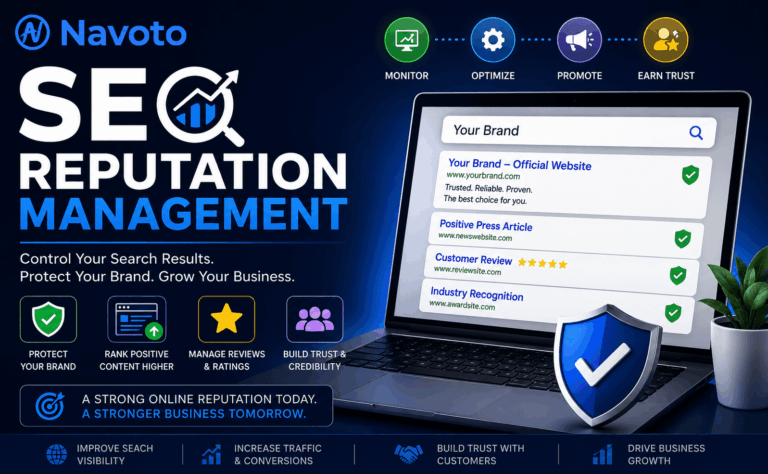
Quick Answer: SEO reputation management is the practice of using search engine optimization to control what appears when someone searches for your brand, business, or name online. It involves ranking positive content higher, suppressing negative results, managing reviews, and building trusted third-party presence — so that the story Google (and AI search engines) tell about your brand is accurate, positive, and working in your favour.
Your brand exists in two places: in the real world, where your products and people speak for themselves, and online, where search results speak for you whether you manage them or not. A bad review published in 2022 can still be the first thing a potential customer reads in 2026. A misleading news article from three years ago can rank above your own homepage. A competitor can run a campaign that poisons your brand keywords with negative associations — and if you are not managing your search presence proactively, you may not even notice until the damage is done. SEO reputation management is the discipline of making sure your brand’s search presence reflects reality — or better. This guide covers exactly how to do it, with the 2026 data, step-by-step strategies, and the AI search dimension that most reputation management guides have not caught up with yet.
The numbers make the case on their own. Over 90% of consumers say a brand’s online reputation directly influences their purchasing decisions. A single negative review can cost a company around 30 customers. 25% of a company’s market value is directly tied to its reputation. And the online reputation management market — valued at $6.88 billion in 2025 — is projected to reach $14.01 billion by 2031. This is not a niche concern for brands in crisis. It is a strategic priority for every business that wants to grow.
|
90%+
Consumers say online reputation influences purchase decisions (NEWMEDIA, 2026)
|
5–9%
Revenue increase per additional star rating (Harvard Business School / Yelp)
|
270%
Conversion rate increase when reviews are displayed on website (Spiegel Research)
|
25%
Of company market value is directly tied to reputation
|
What Is SEO Reputation Management?
SEO reputation management is the process of using search engine optimization strategies to shape what appears in search results when someone searches for your brand, business name, products, key executives, or related terms. It sits at the intersection of SEO, public relations, content marketing, and online reputation management (ORM) — combining technical search strategies with proactive brand building and reactive crisis response.
Think of Google as the world’s most-consulted reference document about your business. When a potential customer, investor, partner, or employee searches your name, they are essentially reading your brand’s public file. SEO reputation management gives you editorial influence over that file.
It is important to distinguish between two different applications of this discipline:
Both matter — and both use the same set of underlying SEO tools and techniques. The difference is timing and urgency. Brands that invest in proactive reputation management SEO respond to crises from a position of strength, with established authority they can mobilise quickly. Brands that only act reactively start from zero when they can least afford the delay.
Why SEO Reputation Management Matters: The Business Case in Numbers
Abstract arguments about brand trust rarely change behaviour. What changes behaviour is concrete revenue data. Here is the financial picture of online reputation in 2026.
The Revenue Impact of Reviews
- Each additional star in a Yelp rating can increase revenue by up to 9%, providing a clear ROI calculation for review management investments.
- Businesses with 4 or more stars on Google earn 28% more revenue than lower-rated competitors.
- Displaying verified reviews on a website can increase conversion rates by up to 270%.
- 31% of consumers will only use a business rated 4.5 stars or higher — nearly double the 17% from 2025.
- Customers spend 31% more at a business with excellent reviews.
- Businesses that reply to reviews on at least 25% of occasions earn 35% more revenue.
The Cost of a Damaged Reputation
- 41% of companies that experience a reputation crisis see a direct loss of brand value and revenue within the first year.
- Negative search results can cause a company to lose up to 70% of potential customers.
- 70% of investors say they avoid companies with recurring negative publicity or unresolved reputation issues.
- When 86% of prospective customers are deterred by 1–2 star reviews, the cost of poor review management becomes immediately apparent.
- A single negative review can cost a business about 30 customers.
The Compounding SEO Effect of Strong Reputation
Businesses with strong reputations generate more branded searches, which reinforces domain authority over time. For businesses running SEO programmes, this creates a compounding effect: improving your reputation generates more branded searches, which strengthens your domain, which improves your rankings for non-branded terms, which brings in more customers, who leave more reviews.
This compounding loop is one of the most powerful — and most underappreciated — forces in digital marketing. It means that SEO and reputation management are not separate strategies; they are two inputs feeding the same compounding system.
The 5 Core Components of SEO Reputation Management
A complete search engine reputation management strategy has five interconnected components. Each one feeds the others. Skipping any of them leaves gaps that negative content can fill.
1. Owning Your Brand’s First Page in Google
The top Google search result garners a 27.6% click-through rate, and 90% of worldwide internet users only look at the first page of search engine results. This means the first page for your brand name is the most valuable digital real estate your business has. The goal of reputation SEO for this component is to fill that page with positive, accurate, brand-controlled content.
Google only lists a maximum of two pages from the same domain in organic results. To own ten positions on your brand SERP, you need content spread across multiple platforms. Here is the full target list for first-page brand SERP ownership:
| SERP Position Target | How to Earn It | Priority |
|---|---|---|
| Your homepage | Brand keyword optimization, structured data, technical SEO — your homepage should rank #1 for your brand name | Critical |
| Google Business Profile | Fully complete GBP with categories, services, photos, and active review management | Critical |
| LinkedIn company page | Complete, keyword-optimized LinkedIn page ranks very consistently for brand name searches | Critical |
| Key service/product pages | Second page on your domain (Google allows two per domain in most SERPs) | High |
| Review platform profiles | Trustpilot, G2, Clutch, Google Reviews — these platforms rank naturally for brand searches | High |
| Featured snippet / position zero | FAQ content, structured answer blocks with schema markup targeting brand-related questions | High |
| Social media profiles | Twitter/X, Facebook, Instagram, YouTube — active profiles with complete branding rank for brand searches | Medium |
| Wikipedia or Wikidata | For established brands — Wikipedia ranks in position 1–3 for nearly every brand that has a page | Where eligible |
| PR / media mentions | Positive press in industry publications with high domain authority | Medium |
2. Review Management and Generation
Reviews are simultaneously a customer trust signal, a Google ranking factor, and an AI citation source. They are the most measurable, most actionable lever in SEO and reputation management. Yet most businesses treat them passively — hoping customers leave reviews without any systematic effort to generate them.
The data on review management effectiveness is some of the clearest in all of digital marketing:
- 91% of 18–34-year-olds trust online reviews as much as personal recommendations
- 67% of dissatisfied customers stay loyal to a brand when you respond quickly
- When 45% of consumers are more likely to visit a business that responds to negative reviews, it demonstrates that how you handle criticism can be as important as the criticism itself
- 75% of consumers say they trust a business more if it has both positive and negative reviews rather than only perfect ratings
- Businesses that reply to reviews on at least 25% of occasions earn 35% more revenue
The systematic review generation process your business should have:
Ask at the moment of highest satisfaction — immediately after a successful delivery, completion of service, or positive interaction. Research shows review conversion drops sharply after 48 hours. Train your team to ask verbally at this moment and follow up with a direct review link.
Make leaving a review a single click — Send a direct link that opens the Google review form immediately. Every additional step between the request and the submitted review reduces conversion rate significantly.
Respond to every review within 24 hours — Google indexes your review responses as SEO content. Include your business name, the service, and your location naturally. Respond to negative reviews with empathy, offer resolution offline, and never argue publicly.
Spread your review presence across multiple platforms — Google is the priority. Then Trustpilot, G2, Clutch, Yelp, Healthgrades, or industry-specific platforms depending on your sector. Multi-platform review presence signals broader community trust and provides more AI citation surface area.
3. Content Strategy for Reputation SEO
Content is the primary tool of reputation management SEO. Every high-quality piece of content that ranks for your brand terms is a position you control — a position that a negative result cannot take. The goal of your content strategy in the reputation context is to create comprehensive, authoritative coverage of your brand across as many indexed platforms as possible.
Content Types That Build Reputation SEO Coverage
| Content Type | Reputation SEO Purpose | Priority Level |
|---|---|---|
| About page + team bios | Establishes E-E-A-T, humanises the brand, ranks for “[brand name] about” and executive name searches | Critical |
| Authoritative blog content | Captures informational searches, builds topical authority, earns backlinks and AI citations | High |
| Case studies and testimonials | Social proof content that ranks for “[brand name] reviews” and “[brand name] results” searches | High |
| FAQ and Q&A pages | Targets “People Also Ask” boxes and answers negative or skeptical brand-related queries proactively | High |
| Press and media coverage | High-authority third-party pages that rank for your brand name — carry more trust weight than your own site | High |
| YouTube videos | YouTube ranks in Google results; brand-related videos add controlled search coverage and visual trust signals | Medium |
| LinkedIn thought leadership | Executive and company posts on LinkedIn rank in Google and build professional authority | Medium |
One of the most effective and underused reputation SEO tactics: Create content that proactively addresses the skeptical or negative questions people ask about your brand. If searchers are asking “Is [brand name] legitimate?” or “Are [brand name] reviews real?” — create honest, well-evidenced content on your own site addressing these questions directly. This gives you control of the narrative in searches that could otherwise be dominated by third-party negative content.
4. Technical SEO as a Reputation Foundation
Technical SEO is not usually the first thing people think of when they discuss SEO reputation management — but it underpins everything else. A technically sound website signals credibility to both users and search engines. Technical failures actively damage reputation in ways that are immediately visible to every visitor.
- Page speed: Users form an opinion about a website in just 0.05 seconds. A slow-loading page creates a negative first impression before a word of your content is read. Page speed is also a Google ranking factor — slow sites rank lower, which means positive content gets pushed down by faster-loading competitors or third-party negative pages.
- HTTPS security: Sites without SSL certificates display a “Not Secure” warning in the browser address bar. This is a direct, visible reputation signal to every visitor. HTTPS is both a trust signal and a confirmed Google ranking factor.
- Mobile usability: With 61% of Google searches happening on mobile, a poor mobile experience damages both user experience and search performance simultaneously. Mobile-unfriendly pages rank lower, allowing negative content more opportunity to appear above your own pages.
- Structured data / schema markup: LocalBusiness, Organization, Person, Review, and FAQPage schema markup gives Google clear, verified information about your business and helps you control how your information appears in rich results — including the knowledge panel that appears to the right of search results when users search your brand name.
- Knowledge panel optimization: Your Google Knowledge Panel is prime reputation real estate. Claim it through Google’s verification process, ensure all information is accurate, and use structured data on your website to reinforce the correct details.
5. Off-Page Signals: Link Building and Brand Mentions
Off-page SEO — specifically backlinks and brand mentions across authoritative external websites — is one of the two most important Google ranking factors. In the context of reputation management, it serves a dual purpose: it pushes your controlled content higher in rankings (and negative content lower), and it builds the third-party brand presence that AI systems use to assess and describe your business.
High-value link sources for reputation SEO:
- Industry association member directories and award pages
- Local news and community publications (particularly valuable for local businesses)
- Chamber of commerce and business directory listings
- Guest articles on respected industry publications
- Partner and client websites linking to your case studies
- PR coverage from company announcements, product launches, and community initiatives
- Academic or research citations if your business produces original data
How to Push Down Negative Search Results: A Step-by-Step Strategy
When negative content is already ranking for your brand name, the most effective strategy in most cases is not removal — it is displacement. You build enough high-authority positive content that the negative result gets pushed to page two, where 90% of searchers will never see it.
This process requires patience and systematic execution. Here is the exact sequence that works:
Audit your current brand SERP: Open an incognito window (to avoid personalized results) and search your brand name, brand name + reviews, brand name + [your city/industry], and key executive names. Record every result on the first two pages. Note which are positive, neutral, or negative, and which you control vs which you do not.
Identify the negative result’s authority signals: Check the domain rating, backlinks, and content quality of the negative page. Understand what gives it its current ranking position — is it on a high-authority domain? Does it have many backlinks? Is it simply the only content covering that specific query? This determines how aggressive your displacement strategy needs to be.
Create and optimize content targeting the same keyword context: If the negative result ranks for “[brand name] problems,” create authoritative content on your own site addressing that exact concern — honestly and thoroughly. If it ranks for your brand name alone, strengthen your homepage and create optimized profiles across authority platforms.
Build authoritative profiles on high-DA platforms: LinkedIn (DA 98), YouTube (DA 100), Crunchbase, Wikipedia (if eligible), Trustpilot, G2, Clutch — these platforms rank naturally for brand searches because of their domain authority. A complete, optimized profile on each of these can displace many negative results.
Earn media coverage from high-authority publications: A feature in Forbes, an industry trade publication, or a respected local news outlet creates a high-authority page that ranks for your brand name and provides positive narrative content. Focus PR efforts on stories that generate news — community initiatives, research data, product milestones.
Accelerate with internal and external link building: Link to your positive content (authoritative blog posts, case studies, testimonials) from your homepage and other high-authority pages on your site. Build backlinks to the specific pages you want to rank higher for brand queries.
Monitor weekly and adjust: Track your brand SERP rankings weekly during an active displacement campaign. Most well-executed campaigns see meaningful movement within 60–120 days. Document what moves and what doesn’t, and focus additional effort on the specific positions that remain stubbornly occupied by negative content.
SEO Reputation Management in a Crisis: The Response Framework
A reputation crisis — a viral negative review, a damaging news story, a social media incident — creates a specific set of SEO reputation management challenges. Crisis response windows have compressed to 15–30 minutes for initial acknowledgement. Here is the sequence that limits damage and begins recovery as fast as possible.
| Phase | Timeframe | SEO Action |
|---|---|---|
| Immediate | 0–30 minutes | Acknowledge publicly on your main platforms. Avoid silence — silence reads as confirmation of the negative narrative. Draft a brief, factual statement. Do not over-explain or get defensive. |
| Short-term | 24–72 hours | Publish a comprehensive, factual response article on your own website addressing the specific issue. This becomes your authoritative source and the content you want ranking for brand + incident queries. Optimize it for the exact search terms people are using. |
| Medium-term | Days 3–14 | Distribute your response through existing channels — email list, social media, PR. Reach out to relevant journalists or industry publications with your account of events. Build links to your response page to accelerate its ranking. |
| Recovery | Weeks 2–12 | Accelerate your broader positive content production. Intensify review generation. Execute the displacement strategy outlined above to push crisis-related results off the first page. Monitor closely and adjust based on what is and is not moving. |
AI Search and Reputation Management: The 2026 Dimension
This is the section of SEO reputation management that most existing guides have not caught up with — and it matters more than anything else in this field right now.
With 45% of consumers now using AI tools for business recommendations (up from just 6% in 2025), reputation is no longer about what ranks on page one — it’s about what ChatGPT, Gemini, and Perplexity say when someone asks about your brand.
When someone asks ChatGPT “Is [your brand] trustworthy?” or “What are the best [your service type] companies?” — the AI synthesises its answer from whatever publicly available sources it has indexed about your brand. 85% of AI brand mentions come from third-party sources, not your own website. This means the review platforms, community forums, industry directories, and media coverage you have built — or neglected — directly determine how AI describes your brand.
How to Manage Your Brand’s Reputation in AI Search
SEO Reputation Management for Different Business Types
For Local Businesses
Local businesses face the most direct and most measurable reputation management environment. 82% of U.S. shoppers use “near me” mobile searches, making local SEO a direct driver of foot traffic. Your Google Business Profile is both your most powerful reputation asset and your most visible vulnerability — a cluster of negative reviews can push your practice or business off the local map pack entirely. Google Business Profile optimization, systematic review generation, consistent citation management, and active community involvement are the four pillars of local business reputation SEO.
For E-commerce Brands
E-commerce businesses live and die by product reviews and brand sentiment in search. Your product pages rank alongside third-party review aggregators and comparison sites — giving you less control over your first-page SERP than most other business types. The highest-impact priorities for e-commerce reputation SEO are: product review generation on your own site and on Amazon/marketplace platforms, addressing negative product reviews publicly and constructively, schema markup for product reviews (which generates star ratings in Google search results), and building authoritative comparison content that gives you narrative control when potential customers search “[product] alternatives” or “[product] vs [competitor].”
For Service Businesses and Agencies
Service businesses sell trust before they sell anything else. A potential client searching for a digital marketing agency, a law firm, or a consulting company will do extensive research before making contact — reading multiple review platforms, checking case studies, evaluating team credentials. For B2B companies, trust and credibility are the primary factors in vendor selection, and a supplier’s online reputation — including thought leadership content, professional endorsements, and case study visibility — influences decisions before any sales conversation begins. Focus on Clutch, G2, and LinkedIn reviews, detailed case studies with named clients (where permitted), and thought leadership content that demonstrates expertise before any prospect makes contact.
For Executives and Personal Brands
Personal brand reputation SEO is increasingly important as hiring managers, investors, journalists, and potential partners routinely research individuals by name before making decisions. Build authoritative personal brand content: a well-optimized LinkedIn profile, authored articles on industry publications, speaking engagements and conference appearances that generate coverage, podcast interviews, and a personal website or biography page that ranks at position one for your name. Executive thought leadership also benefits the company brand — strong individual authority lifts brand authority in Google’s assessment of E-E-A-T signals.
Measuring SEO Reputation Management Success
Effective manage SEO reputation programs require clear KPIs that connect search performance to business outcomes. These are the metrics to track monthly.
| KPI | What It Measures | Tool |
|---|---|---|
| Brand SERP sentiment score | % of first-page brand SERP results that are positive, neutral, or negative | Manual audit + tracking spreadsheet |
| Branded search volume | Monthly searches for your brand name — growing volume = growing brand recognition | Google Search Console |
| Average review rating | Star rating across Google, Trustpilot, G2 — must maintain 4.0+ to maximise conversion | Review platform dashboards |
| Review velocity | New reviews per month — recency matters as much as total count to Google and AI | Review platform dashboards |
| Negative result positions | Position of any negative content for brand queries — goal is pushing below position 10 | Semrush, Ahrefs rank tracking |
| Direct/branded traffic | Sessions from direct navigation and branded search — reflects offline brand recognition | Google Analytics 4 |
| AI brand mention sentiment | How AI tools describe your brand — positive, neutral, or negative — when asked about your category | Semrush AI Toolkit, Brandwatch, manual prompt testing |
Related Guides on Navoto
- SEO Content Strategy: The Complete Step-by-Step Framework — how to build the content foundation that reputation SEO depends on.
- Generative Engine Optimization (GEO): Get Cited by AI Search Engines — the companion guide covering how to manage and improve your brand’s visibility in ChatGPT, Perplexity, and Google AI Overviews.
- The Best AI Rank Tracking Tools in 2026 — tools for monitoring how your brand appears (and is described) across AI-powered search platforms.
- Local SEO: The Complete Guide to Ranking in Google Maps — the local search foundation that underpins reputation SEO for businesses serving specific geographic areas.
- How Many Keywords for SEO? The Complete Evidence-Based Guide — keyword strategy for creating the content assets your reputation SEO program depends on.
Frequently Asked Questions About SEO Reputation Management
Conclusion: SEO Reputation Management Is Revenue Optimization
Reputation management is not branding. It is revenue optimization. The statistics are unambiguous — every star of review improvement, every negative result displaced, every authoritative brand mention earned translates directly into measurable business outcomes. Businesses with excellent reputations convert more visitors, retain more customers, attract better employees, and command higher prices.
SEO reputation management gives you the tools to make your brand’s search presence — and now its AI search presence — reflect the quality of what you actually deliver. The brands winning in search in 2026 are not just the ones with the most backlinks or the most content. They are the ones whose online presence, across every platform, tells a consistent, credible, and positive story.
Start with your brand SERP audit. Build the positive content assets you are missing. Systematise your review generation. Claim and optimize every platform where your brand name should appear. And begin tracking how AI tools describe your business — because that is where the next generation of reputation management battles will be won or lost.
Ready to Take Control of Your Brand’s Search Presence?
Navoto builds SEO reputation management programs that protect brand narratives in traditional search and AI platforms — from brand SERP audits and negative content displacement to review management systems and AI visibility monitoring. Get a free brand reputation audit and find out exactly what Google (and ChatGPT) says about your brand right now.