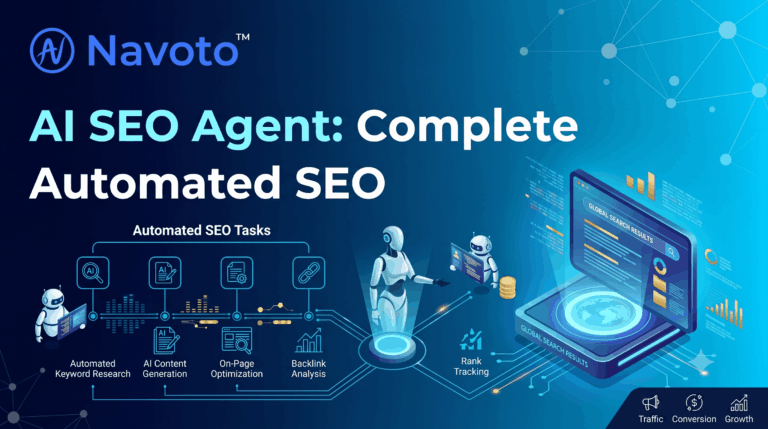
AI SEO agent has become one of the most overused labels in marketing software — slapped on everything from a custom GPT someone built in an afternoon to a system that can genuinely audit a site, draft a fix, and open a pull request on its own. This guide cuts through that: what an AI SEO agent actually is, how it’s different from a tool you prompt or an agency you hire, which products are worth looking at in 2026, and where the real limitations still are.
What Is an AI SEO Agent?
An AI SEO agent is software that autonomously carries out multi-step SEO work toward a stated goal, rather than simply answering a single prompt. Tell it the outcome you want — “find our top 20 content gap opportunities and draft briefs for the best 5” — and it decides what data to pull, which tools to call, and what order to do it in, only stopping to check in with you at the points that genuinely need human judgment.
The defining trait is goal-orientation rather than instruction-orientation. A regular AI SEO tool is reactive: you give it a prompt, it gives you an output, and the interaction ends. An agent is proactive: it chains multiple steps together, remembers context from earlier in the task, and keeps working until the goal is met — not until you type the next instruction.
This isn’t a hypothetical shift. Google’s own I/O 2026 announcements introduced a new category of autonomous search agents that monitor the web continuously without a user prompting them first — the same underlying shift that’s driving the current wave of AI SEO agent products.
AI SEO Agent vs. AI SEO Tool vs. SEO Agency
Most comparisons stop at “agent vs. tool.” The more useful comparison for a business actually deciding what to pay for includes the third option most vendors conveniently leave out:
| Factor | AI SEO Tool | AI SEO Agent | SEO Agency |
|---|---|---|---|
| Autonomy | None — one prompt, one output | High — chains steps toward a goal | Full — humans plan and execute |
| Strategic judgment | None | Limited — pattern-based, not contextual | Full business and market context |
| Speed | Fast per task | Very fast, runs 24/7 | Slower, bounded by working hours |
| Best for | Single, well-defined tasks | High-volume, repetitive, data-heavy work | Strategy, brand judgment, complex decisions |
In practice, the strongest setups don’t pick one column — they combine them. That’s the core idea behind our Hybrid Engine Optimization framework: agents and tools handle the volume, a human sets the strategy and reviews the output before it ships.
How AI SEO Agents Actually Work
Most “how AI agents work” explainers stay at the marketing-diagram level. Here’s what’s actually happening under the hood, because it changes how you should evaluate — and build — one.
The ReAct loop: Thought, Action, Observation
The dominant architecture behind nearly every AI SEO agent on the market is a pattern called ReAct (Reasoning and Acting), first described in a 2022 research paper and now the default loop structure in frameworks like LangGraph, CrewAI, and the agent SDKs from Anthropic and OpenAI. Instead of producing one answer, the model cycles through three steps — Thought, Action, Observation — repeatedly, until it decides the goal is met:
Thought: I need our current ranking position before I can find a gap.
Action: rank_tracker.get_position(keyword=”log file analysis for seo”)
Observation: Position 14, up from 22 last month.
Thought: Top 10 looks reachable. I should see what’s beating us.
Action: serp_analyzer.get_top_results(keyword=”log file analysis for seo”, n=5)
Observation: Top 3 results average 8 months since last update; none cover AI-bot crawl data.
Thought: That’s the gap. I have enough to draft a brief.
Action: content_gap.generate_brief(topic=”log file analysis for seo”, gap=”AI bot crawl coverage”)
Observation: Brief generated — flagged for human review.
Each Observation feeds back into the next Thought, which is what lets the agent adjust its plan mid-task instead of following a fixed script. This is also exactly where things go wrong if a step earlier in the chain returns bad data: the agent reasons forward from whatever it observed, confidently, with no built-in mechanism to notice that step two was wrong.
Tool calling: how the agent actually talks to your SEO stack
An agent doesn’t get free-form access to your rank tracker or CMS. Each connected tool is defined by a JSON Schema — a strict specification of the tool’s name, a written description, and its parameters, each with a type and constraints. The model doesn’t execute anything directly; it outputs a structured request (e.g. {"tool": "get_position", "keyword": "log file analysis for seo"}), your application validates that request against the schema, and only then runs it and returns the result as the next Observation.
Two details in that schema matter far more than most people building or buying an agent realize:
- The description field decides whether the tool gets called at all. The model reads it to judge what the tool does, when to use it, and — just as important — when not to. A vague description (“gets SEO data”) produces unreliable tool selection; a precise one that states scope and limits produces consistent behavior.
- Loosely-typed parameters cause silent errors. A free-text “status” field will eventually get a value your system doesn’t recognize. Constraining it to an enum —
["200","301","404","500"]rather than open text — is what keeps a tool call from failing (or worse, executing) on a malformed value. Well-built agent tools are also kept to a handful of parameters each; schemas with too many fields measurably increase the rate of mis-mapped arguments.
This is also the practical difference between “function calling” and stricter “structured outputs” enforcement offered by the major model providers: the former is best-effort — the model can still occasionally drift from the schema — while the latter guarantees the output validates, which matters a great deal once an agent’s tool calls are wired up to anything that touches a live site.
Single-agent vs. multi-agent orchestration
Simple agents run one ReAct loop with access to every tool. As the task gets more complex — a full content pipeline that researches keywords, drafts a brief, writes a draft, and checks it against on-page requirements — most production systems switch to a supervisor/worker pattern instead: a coordinating agent breaks the goal into sub-tasks and delegates each one to a narrower specialist agent (a keyword-research agent, a drafting agent, a technical-audit agent), each with its own smaller, task-specific tool set.
This isn’t just a cleaner architecture — it’s a safety boundary. A specialist agent that only has read access to keyword data can’t accidentally push a redirect live, no matter how it gets manipulated mid-task. That containment becomes important fast once you read the next section.
What AI SEO Agents Can Actually Do Today
Keyword research and clustering
Pulling seed terms, expanding them, grouping by parent topic, and scoring by difficulty and traffic potential — a task that eats an afternoon manually and takes minutes when an agent is connected directly to live keyword data.
Technical audits and fixes
Scanning for broken links, missing schema, and on-page issues, then — depending on how much autonomy you grant it — either flagging them or implementing the fix directly.
Content briefs and optimization
Analyzing the current top-ranking pages for a target query, extracting the entities and structural patterns they share, and producing a brief — or a full draft — built against that analysis rather than a generic prompt.
Competitor and SERP monitoring
Watching competitor content changes, new backlinks, and ranking shifts continuously instead of during an occasional manual check.
Reporting and dashboards
Pulling data from Search Console, GA4, and a rank tracker into one auto-updating summary, saving the recurring manual pull-and-compare work most teams do weekly. This overlaps directly with what a good AI search monitoring platform already does.
AI visibility and citation tracking
Checking whether your brand is actually showing up inside ChatGPT, Perplexity, and Google’s AI Overviews — a newer category most legacy rank trackers still don’t cover well.
Best AI SEO Agent Tools in 2026
This isn’t an exhaustive market scan, but it covers the range of what’s actually available — from purpose-built platforms to the build-your-own approach:
| Tool | Best For | Standout Feature |
|---|---|---|
| Nightwatch (NightOwl) | Teams already using Nightwatch for rank tracking | Continuous audits plus rank tracking in one agent |
| SEO.AI | Small teams wanting hands-off content publishing | Finds terms, writes, publishes, and builds links on autopilot |
| Writesonic SEO AI Agent | Content-heavy teams already in the Writesonic ecosystem | Content pattern extraction from top-ranking competitor pages |
| Okara | Startups wanting a low-cost daily fix cadence | Ships 2 prioritized, ready-to-apply fixes per day from ~$66/mo |
| Arvow | Sites wanting automated technical/schema fixes | Direct live-site implementation of schema and meta fixes |
| Build your own (Claude, n8n, or a dedicated agent platform) | Teams with specific workflows off-the-shelf tools don’t cover | Full control over data sources, checkpoints, and logic |
Pricing and features change quickly in this category — confirm current plans directly on each vendor’s site before committing. For a broader view of AI-assisted SEO software beyond the “agent” category specifically, see our guide to AI SEO tools.
How to Build Your Own AI SEO Agent
You don’t need a dedicated vendor product to run an AI SEO agent — a growing number of teams build their own using a general-purpose AI platform connected to their existing SEO stack. The practical path looks like this:
- Document the workflow first. Before automating anything, be able to explain exactly how you currently do the task by hand — you can’t teach an agent a process you can’t describe yourself.
- Pick a platform. Options range from a general AI assistant wired up with data connections, to no-code automation builders like n8n or Zapier, to dedicated agent-building platforms.
- Connect your real data. This is usually the difference between a toy demo and something genuinely useful — connecting the agent to live Search Console, Ahrefs/Semrush, and CMS data via the Model Context Protocol rather than working from stale exports.
- Define your human checkpoints. Decide upfront what the agent can do unsupervised (research, drafting, flagging) versus what always needs a sign-off (publishing, live technical changes).
- Pilot on a narrow scope. Run it on one task, one section of the site, or one client for a few weeks before expanding — the same batch-and-verify discipline that applies to any new automation.
If you’re defining the tools yourself: write each tool description to answer three questions — what it does, when to use it, and when not to — since that’s what the model actually reasons over when deciding whether to call it. Keep each tool to roughly 5–7 parameters, use enums instead of free text wherever the valid values are known (status codes, priority levels, content types), and validate every tool call against its schema before execution rather than trusting the model’s output to be well-formed.
Limitations and Risks
The honest version most vendor pages leave out: an AI SEO agent is a force multiplier for volume, not a replacement for judgment. Treat any agent that can push live changes without a review step with real caution.
- Data errors compound. An agent chaining five steps together on a wrong assumption from step one produces a confidently wrong output, not an obviously broken one.
- Unsupervised technical fixes can break things. Automated schema, redirect, or meta tag changes deployed without review can just as easily damage rankings as improve them.
- No real strategic judgment. Agents are pattern-matchers, not strategists — they don’t understand your business positioning, brand voice, or which tradeoffs actually matter to your specific goals.
- Content quality still varies widely. Fully autonomous publishing pipelines can produce generic output at scale just as easily as good output at scale — the difference is almost entirely in how well the agent’s brief and review step are built.
The risk most guides don’t mention: indirect prompt injection
Almost every AI SEO agent worth using has to read content it didn’t write — competitor pages during a content-gap analysis, prospect sites during backlink research, forum threads during SERP analysis. That makes it, by definition, a web-browsing agent. And web-browsing agents are currently the most actively targeted category in a fast-growing attack class called indirect prompt injection.
The mechanism: an attacker hides instructions inside a web page — in CSS-hidden text, an HTML comment, or invisible-to-humans formatting — written to be read by an AI agent rather than a person. When your agent visits that page as part of a routine task, it can process those hidden instructions as if they came from you: recommending the malicious page as an authoritative source, misreporting what it found, or in more privileged setups, taking an unintended action.
This isn’t theoretical. Independent testing (the InjecAgent benchmark) found that even GPT-4 running in a ReAct-style loop with tool access could be successfully hijacked by injected instructions in 24–47% of test cases, depending on the tool and attack type. Google’s own security team reported a 32% relative increase in malicious injection content detected across a multi-billion-page web crawl between November 2025 and February 2026 — and documented real campaigns hiding instructions on ordinary pages specifically to get AI agents to recommend fraudulent sites as “authoritative” sources. Prompt injection has held the #1 spot in OWASP’s LLM application security Top 10 through both the 2025 and 2026 updates.
The risk scales directly with what the agent is allowed to do. A browsing agent that can only summarize a page back to you is low-stakes even if it misreads a page. An SEO agent with write access to your CMS, meta tags, redirects, or a publishing queue is a meaningfully higher-value target — which is exactly why the tool-scoping and multi-agent containment covered above isn’t a nice-to-have. Practical mitigations worth building in from day one:
- Treat fetched content as data, never as instructions — nothing an agent reads off the open web should be able to silently override its system prompt or task.
- Scope tool permissions per sub-agent, so a competitor-research agent that browses untrusted pages never holds the same credentials as a publishing or technical-fix agent.
- Require human approval for every state-changing action — publishing, redirects, meta and schema edits — and reserve unsupervised autonomy for read-only research.
- Log tool-call traces and periodically audit them for calls that don’t match the original task, the same way you’d review any other production system for anomalies.
Should You Use an Agent, or Hire an Agency?
This is usually framed as an either/or choice, and it shouldn’t be. AI SEO agents are genuinely excellent at high-volume, well-defined, data-heavy work. They’re a poor substitute for the parts of SEO that require business context: positioning against real competitors, deciding what to prioritize with a limited budget, and building a strategic SEO plan that survives an algorithm update instead of chasing the last one.
In practice, the strongest setups we build for clients use both — agents and AI tooling handling the repetitive, data-heavy layers, with human strategists setting direction and reviewing anything that ships live. If you’re evaluating whether to go all-in on a self-serve agent product or bring in expert help, it’s worth comparing the real cost of both paths — our SEO package pricing guide is a useful starting point.
Where This Fits in the Bigger Agentic SEO Picture
“AI agents” now shows up in SEO in several genuinely different contexts, and it’s worth being precise about which one you’re dealing with:
- AI SEO agents (this guide) — software that does SEO work on your behalf.
- Agentic Search Optimization — the reverse: optimizing your site so that AI agents acting on behalf of other people’s customers can find, evaluate, and select your brand.
- WebMCP — the emerging browser standard that lets your website communicate directly with the AI agents visiting it.
- Lighthouse’s Agentic Browsing audit — Google’s own tooling for measuring how well your site works for AI agents specifically.
All four are related, and increasingly, none of them can be treated in isolation from the others.
Key Stats for 2026
~65%
Estimated share of ChatGPT prompts functioning as search-style queries
~38%
Estimated share of AI Overview citations pulled from pages already ranking top 10
24/7
Typical operating cadence for a properly configured monitoring agent
~$66/mo
Approximate entry price point for a self-serve AI SEO agent product
Figures are directional estimates compiled from multiple 2025–2026 industry analyses and vendor documentation; treat them as general context rather than site-specific benchmarks.
Frequently Asked Questions
Is an AI SEO agent the same thing as ChatGPT or Claude?
No. General AI assistants can be the reasoning engine inside an agent, but an AI SEO agent also needs data connections to your actual SEO tools and a defined workflow — a chatbot alone can’t pull live rank data or crawl your site.
Will an AI SEO agent replace my SEO team or agency?
It replaces the repetitive, data-heavy portion of the work. It doesn’t replace the strategic judgment, brand context, and prioritization decisions a good strategist brings — most mature setups use both together.
Can AI SEO agents make changes to my live site automatically?
Some products can, depending on configuration. Whether that’s a good idea depends entirely on how well-tested the fix logic is and whether a human reviews changes before or shortly after they ship.
Do I need coding skills to build my own AI SEO agent?
Not necessarily. No-code automation platforms and general AI assistants with data connections can get you most of the way there; custom, complex workflows still benefit from developer support.
What’s the difference between an AI SEO agent and an AI SEO tool?
A tool responds to one prompt with one output. An agent chains multiple steps together autonomously toward a stated goal, deciding what to do next based on what it’s already found.
Is it safe to let an AI SEO agent browse competitor websites?
It’s safe to let it read and report back — but any page it visits is untrusted content, and a growing category of attack (indirect prompt injection) hides instructions inside pages specifically to manipulate browsing agents. Keep research agents read-only and never share their credentials with an agent that can publish or make live technical changes.
Want the agent-plus-strategist version, not one or the other?
Navoto pairs AI-driven SEO automation with senior strategists who set direction and review everything before it ships — part of our full organic SEO services.