📡 The Numbers That Define Agentic Search in 2026
The most important thing you need to understand about agentic search is not what it is — it’s what it means for your brand’s visibility when no human ever reads the search result. In 2026, AI agents are researching vendors, comparing products, booking appointments, and completing purchases on behalf of users who set the task and then wait for a result. Your brand is either in the shortlist the agent generates — or it doesn’t exist for that user at all.
Agentic search is the third — and most commercially consequential — evolution of how people find information and make decisions online. Google’s I/O 2026 keynote was dominated by it: persistent information agents that proactively scan the web on a user’s behalf, without needing to be asked. Morgan Stanley projects that agentic shoppers — AI agents that research, compare, and purchase — could drive $385 billion in additional online sales by 2030. The Gartner projection that traditional search volume will fall 25% by end of 2026 is now tracking close to actual numbers.
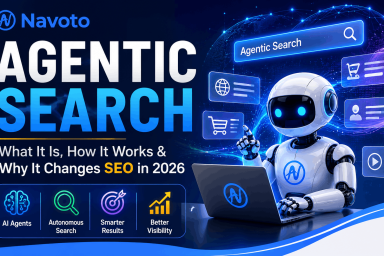
This complete guide from Navoto is the most comprehensive agentic search resource available in 2026. It covers every dimension: what agentic search is and how it differs from earlier search paradigms, how autonomous AI search agents actually work, the platforms leading the shift, 40+ verified statistics about the transition, how agentic browsing works in real browsers, the future of search engines through 2030, and the exact strategies brands must implement to remain visible in the agentic search era.
What Is Agentic Search?
Agentic search is the use of autonomous AI agents to perform multi-step search, retrieval, evaluation, and action tasks on a user’s behalf — going beyond answering a single question to executing complex research workflows, comparing options, and completing tasks without requiring human input at each step.
Official Definition — Navoto.com
Agentic search = AI-powered search and retrieval executed by autonomous agents capable of breaking complex queries into subqueries, selecting appropriate search tools, evaluating results, iterating based on findings, and taking follow-on actions — all without requiring step-by-step human instruction.
The word “agentic” comes from the AI concept of an “agent” — a system that perceives its environment, makes decisions, and takes actions toward a goal. In the context of search, it means an AI that doesn’t just return results when asked, but actively works toward completing a search objective, choosing tools, adapting strategies, and refining results in a continuous loop until the task is done.
There are two distinct contexts where the term “agentic search” is used in 2026 — and it’s important to understand both:
Context 1: Consumer Agentic Search
The user sets a goal (“find me the best project management tool for a 10-person startup team under $50/month”) and an AI agent autonomously searches, compares, evaluates, and delivers a shortlist — or completes the purchase directly. Google’s information agents (I/O 2026), ChatGPT’s agent mode, and Perplexity’s Comet are all live examples.
Context 2: Developer/Technical Agentic Search
AI agent systems (LLM-powered pipelines, AI assistants, coding agents) use search APIs to retrieve live web data for grounding their responses. These agent-to-web interactions are what tools like Brave Search API, Tavily, Exa, and Firecrawl are purpose-built for. Azure AI Search launched its agentic retrieval pipeline in April 2026 for exactly this use case.
This guide covers both — because they are interconnected. The technical infrastructure of developer agentic search (which APIs and data sources agents query) directly determines which brands get surfaced when consumers use agentic AI tools. Understanding how the whole system works — from the user’s intent to the search API to the citation in the agent’s response — is the foundation of visibility in the agentic search era. It connects directly to the work covered in our agentic search optimization guide.
The Three Eras of Search: Traditional → Generative → Agentic
Understanding agentic search requires understanding where it sits in the broader evolution of how information is retrieved. The shift from traditional to generative to agentic search isn’t a replacement — it’s a layering, each new era expanding the capability of what “search” can do:
ERA 1: 1995–2022
Traditional Search
How it works: User types a query → search engine returns a ranked list of links → user clicks a link and reads content → user forms a conclusion. The search engine’s job ends when it returns the list. Every subsequent action requires the human.
Output: list of links
Human does: all evaluation
Dominant: 2026 share 90%
ERA 2: 2023–2025
Generative Search (GEO Era)
How it works: User asks a question in natural language → AI synthesizes an answer from multiple sources → user reads the AI’s answer (often without clicking any link). Search engine now completes interpretation and synthesis, but the human still receives the answer and decides what to do with it. This is the era of LLM SEO and AI citation building.
Output: synthesized answer
Human does: reads answer + decides
93% of AI sessions: no click
ERA 3: 2025–PRESENT
Agentic Search (ASO Era)
How it works: User sets a goal (“book the cheapest flight to Lisbon in September with direct routing”) → AI agent plans a multi-step workflow → issues multiple search queries → evaluates and compares results → takes action (books the flight) → reports outcome to user. The human sets the goal and approves the outcome. The agent does everything in between — including browsing real websites, comparing options, and transacting. This is Agentic Search Optimization (ASO) territory.
Output: completed action
Human does: sets goal + approves
$385B projected by 2030
How Agentic AI Search Works: Inside the Agent Loop
Understanding the technical architecture of agentic AI search is essential for anyone optimizing content for this era. Here is exactly how an AI search agent processes a complex user query from goal to completion:
Original Query Analysis
The AI interprets the user’s intent beyond the literal text. A query like “find the best CRM for my consulting firm” is analyzed for: business size (solo or team?), budget indicators, industry context, functional requirements implied, and decision stage (researching or ready to buy?). The agent builds a semantic model of what a truly useful answer requires.
Query Planning & Fan-Out
The agent decomposes the original goal into multiple focused subqueries for better coverage. “Best CRM for consulting” might fan out to: “top-rated CRM for professional services 2026,” “CRM pricing comparison for small teams,” “CRM with project management features,” and “CRM reviews solo consultants Reddit.” This multi-query approach is called “query fan-out” — a core capability that distinguishes agentic search from single-pass retrieval.
Tool Selection & Parallel Execution
The agent selects which external tools to use for each subquery: web search APIs, website scrapers, review databases, pricing comparison services, social platforms. Subqueries run in parallel — an AI agent benchmarking study (aimultiple.com, 2026) showed the highest-performing search APIs are Brave Search (Agent Score 14.89) and Firecrawl (14.58). Results return simultaneously, not sequentially, enabling full coverage in seconds rather than minutes.
Semantic Re-ranking & Evaluation
Retrieved results from each subquery are semantically re-ranked to promote the most relevant matches. Azure AI Search’s agentic retrieval pipeline (GA April 2026) runs this step explicitly — each subquery’s results are scored and combined into a unified, relevance-weighted result set. This is where brands with poorly structured content, missing schema, or opaque pricing get systematically filtered out before the user sees anything.
Iterative Reasoning Loop
By reviewing results and previous steps, the agent refines its search in a continuous iterative loop. If the first search for “CRM for consultants” returns results that are all SMB-focused, the agent might pivot to a more targeted query. Unlike cached RAG systems, a live agentic search can adapt to what the data actually shows — this is the “agentic” part: goal-oriented, adaptive behavior, not just query-response.
Shortlist Generation & Action
The agent synthesizes findings into a shortlist (typically 2–5 options) with reasoning, and either presents it to the user or — in fully agentic commerce flows — takes action directly (adds to cart, books the appointment, sends the RFQ). Morgan Stanley’s research shows agentic shoppers operating at this completion layer will drive $385 billion in additional online sales by 2030.
40 Agentic Search Statistics That Prove the Shift Is Now
These statistics are drawn from Gartner, McKinsey, Semrush, Ahrefs, Similarweb, Adobe, BrightEdge, Search Engine Land, Exposure Ninja, Morgan Stanley, and multiple academic research papers. They paint an unambiguous picture of where search is going — and how fast.
📊 Market Size & Adoption
- Agentic AI market reached $8.5 billion in 2026, with 75% of enterprises deploying some form of AI agent (AEO Engine)
- 37% of consumers now start their searches with AI rather than Google — up from single digits two years ago (Search Engine Land, January 2026)
- 60% of U.S. adults have used AI to search for information; 74% among people under 30 (AP-NORC survey, July 2025)
- 52% of U.S. adults now use AI large language models (Elon University, 2026)
- ChatGPT commands an estimated 17% of digital queries by end of 2025, vs Google’s 78% (Basis/Similarweb)
- ChatGPT grew from 400M to 800M weekly active users between February 2025 and January 2026 — a 100% increase in 11 months
- ChatGPT processes over 2 billion daily queries and has become a top-5 search property globally by query volume
- Perplexity handles approximately 50 million weekly queries (Similarweb, 2026)
- The mean task completion rate across agentic AI platforms is 74.8% without human intervention (First Page Sage, 2026)
- 50% of consumers use AI assistants for search or product discovery (McKinsey, 2025)
💰 Traffic & Conversion Impact
- AI platforms generated 1.13 billion referral visits in June 2025 alone — up 357% year-over-year (Similarweb via TechCrunch)
- AI search traffic converts at 14.2% vs Google organic’s 2.8% — roughly 5× more valuable per session (Exposure Ninja)
- LLM visitors convert at 4.4× the rate of traditional organic search visitors (Seer Interactive)
- ChatGPT-referred traffic to retail sites converts at 11.4%, more than double Google organic’s 5.3%
- AI traffic to U.S. retail sites jumped 393% year-over-year in Q1 2026 (Adobe/Semrush)
- LLM-sourced traffic surged 527% year-over-year between early 2024 and mid-2025 (Previsible AI Traffic Report)
- AI-referred visitors browse 12% more pages per visit and show a 23% lower bounce rate than average (Adobe Business, 2026)
- $385 billion in additional online sales projected from agentic shoppers by 2030 (Morgan Stanley)
- AI-influenced purchases affect 50% of purchase decisions (McKinsey, 2025)
- Companies using GEO optimization reported visibility improvements of 30–40% within 60–90 days
📉 Traditional Search Decline
- Gartner predicts traditional search engine volume will drop 25% by end of 2026 — now tracking close to actual numbers
- Google’s global market share dropped from 93% in 2022 to 90% in 2026 — first time below 90% since 2015
- 58.5% of U.S. Google searches now end with zero clicks (Semrush, 2026)
- 93% of AI search sessions end without a website click (Superlines research)
- AI Overviews appear in 13.1% of desktop searches, up 72% year-over-year
- AI Overviews jump to 57% for long-tail, high-intent searches — exactly where ecommerce brands used to dominate
- Search results with an AI Overview show a 34.5% lower average CTR (April 2025 study)
- Some verticals face 30–50% reductions in organic traffic by 2028 (multiple analyst forecasts)
- Only 12% of URLs cited by ChatGPT rank in Google’s top 10 results (Status Labs, 2026)
- Roughly 40–55% of ChatGPT and Perplexity citations flow to fewer than 1,000 domains (BrightEdge/Ahrefs)
🚀 Agentic Commerce & Future
- Google launched persistent information agents at I/O 2026 — proactively scanning the web 24/7 on behalf of users without being asked
- ChatGPT’s in-chat purchasing opened to US users in February 2026
- Wayfair and Etsy are already completing transactions inside Google AI Mode via UCP
- 29% of adults will initiate daily searches with generative AI summaries in 2026 — 300% more than standalone AI tools (Deloitte TMT 2026)
- 25.7% of marketers plan to develop content specifically for AI citations in 2026 (Exposure Ninja)
- 54% of U.S. marketers plan to implement GEO strategies within the next 3–6 months
- HUMAN Security found AI agent traffic grew by thousands of percent year-over-year in some verticals
- By 2030, LLM-powered search and agents are projected to handle a majority of global queries (TTMS)
- AI search products converged on agentic browse capability through 2026 — now table stakes across ChatGPT, Perplexity, and Claude
- The EU AI Act’s implementation and FTC discussions may require disclosure when AI agents make commercial decisions on behalf of consumers
The Major Agentic AI Search Platforms in 2026
Each major AI search platform has developed distinct agentic capabilities. Here is where each platform stands on the consumer-to-agent maturity spectrum, with what that means for brand visibility:
Types of Autonomous Search Agents (And What Each Does)
The term “AI agents for search” covers a wide spectrum of systems, from simple API-based retrieval to fully autonomous multi-step agents. Understanding the taxonomy helps brands prioritize which agent types to optimize for:
| Agent Type | How It Searches | Examples | Brand Optimization Priority |
|---|---|---|---|
| RAG-Powered LLMs | Query search index in real-time to ground responses in fresh data | ChatGPT Search, Perplexity, Claude with search | Structured content, schema markup, entity authority — the full AI citation building stack |
| Browser-Use Agents | Navigate real websites visually; interact with UI elements via screenshots or accessibility tree | Google Project Mariner, Perplexity Comet, Claude Computer Use, OpenAI Operator | Lighthouse Agentic Browsing fixes: accessibility tree, CLS, WebMCP tools |
| API-Driven Research Agents | Call structured search APIs (Brave, Tavily, Exa) programmatically to retrieve web data for LLM processing | LangChain agents, AutoGPT, custom enterprise AI pipelines, Azure AI Search agentic retrieval | Technical SEO, clean indexability, fast server response — agents deprioritize slow or partially-indexed pages |
| Persistent Background Agents | Run continuously in background, monitoring topics and surfacing updates without being asked | Google Information Agents (I/O 2026), advanced Copilot subscriptions | Content freshness, update cadence, consistent publishing — agents favor active, regularly updated sources |
| Commerce Agents | Combine search with transaction completion — find the product, compare, and purchase | ChatGPT ACP purchases, Google UCP checkout (Wayfair, Etsy), Copilot shopping, Shopify Agentic Storefronts | UCP/ACP protocol implementation, transparent pricing, return policies, Product + Offer schema with all attributes |
Agentic Browsing Explained: When AI Agents Use Real Browsers
Agentic browsing is a specific and important subset of agentic search — it refers to AI agents that operate inside a real web browser (Chrome, Firefox) to complete tasks, rather than simply querying search APIs. Agentic browsing agents can see what a human sees, click what a human clicks, fill in forms, extract information, and complete multi-step workflows on real websites.
The distinction matters enormously for SEO because browser-based agents interact with your website differently from API-based agents:
API Agent Sees:
- Raw HTML text content
- Search index data
- Structured schema markup
- Meta information
- API-returned structured data
Browser Agent Sees:
- Full rendered page (including JS-dependent content)
- Accessibility tree (how it navigates)
- Interactive elements (buttons, forms, inputs)
- Visual layout and layout stability (CLS)
- WebMCP tools registered on the page
Google’s addition of the Lighthouse Agentic Browsing audit category in Lighthouse 13.3 (May 7, 2026) is the direct technical response to agentic browsing going mainstream. It evaluates whether your website works correctly for browser-based AI agents — checking accessibility tree integrity, CLS stability, llms.txt presence, and WebMCP tool registration. For the complete technical guide to passing every audit, see our Lighthouse Agentic Browsing guide.
The most important practical implication: if your website fails agentic browsing checks — particularly accessibility tree issues — browser-based agents like Google’s Project Mariner or ChatGPT’s Agent Mode will literally fail to complete tasks on your site. They’ll either error out or redirect to a competitor whose site works correctly. This is not a future risk. Google-Agent has been visiting websites since March 20, 2026.
The Future of Search Engines: What the Data Says About 2027–2030
The shift from traditional to agentic search is accelerating, but it is not a sudden replacement. Here is the most credible picture of how the search landscape will evolve through 2030, based on current data trends:
Traditional search (Google, Bing) remains dominant by volume at 90%+ but declining. AI search captures the informational and research query types Google was least monetized for. The “split-path model” becomes standard: Google for navigational/transactional, AI for exploratory/research. Most marketers still run traditional SEO + start building AI visibility in parallel. The brands with early GEO and ASO infrastructure will begin pulling ahead.
AI search becomes the primary surface for high-intent queries — vendor research, product comparison, service booking. Gartner’s 25% traffic decline materializes across most verticals, with 30–50% drops in ecommerce and publishing. Agentic commerce reaches critical mass. Google itself fully integrates agentic capabilities as the default search mode for AI Pro/Ultra subscribers. The citation authority tier tightens dramatically — sites without strong entity and content infrastructure stop appearing in AI responses.
TTMS projects LLM-powered search and agents handle a majority of global queries. Morgan Stanley’s $385 billion agentic commerce projection materializes. New device surfaces (AR glasses, ambient AI, voice-first interfaces) default to agentic AI — no search box, no link clicks, just goal-setting and outcome delivery. The brands that built ASO infrastructure in 2026 own their category in these surfaces. Late movers face compounding disadvantage that ad spend alone cannot overcome.
How Agentic Search Changes SEO Forever
The SEO discipline is not dying — it is transforming. The skills, signals, and success metrics that defined SEO for 30 years are being replaced by a broader set of visibility disciplines. Here is what changes — and what survives:
❌ What Agentic Search Disrupts
- Click-through rate optimization — 93% of AI sessions end with no click. CTR as a primary success metric loses relevance
- Ranking position as the goal — Only 12% of ChatGPT citations rank in Google top 10. Position ≠ visibility in AI search
- Traffic volume reporting — 70% of AI-influenced visits appear as Direct. Session counts underreport AI impact by orders of magnitude
- Keyword-first content strategy — Agents evaluate topical completeness, factual density, and structured data — not keyword frequency
- Single-platform SEO — Visibility is now multi-surface: Google rankings + AI citations + agent shortlist inclusion
✅ What SEO Foundations Still Win
- Technical SEO is more critical, not less — Agents use Bing/Google indexes to discover candidates. Poor crawlability = invisible to agents
- Content quality compounds — Comprehensive, authoritative, data-rich content earns both organic rankings and AI citations
- E-E-A-T still drives trust — AI agents cross-reference author credentials and brand entity signals — exactly what E-E-A-T builds
- Schema markup is more powerful — FAQPage, Product, Organization schema are direct agent evaluation signals — not just SEO enhancement
- Backlinks signal entity authority — Links from authoritative sources build the off-site trust that agents use to shortlist brands
The critical insight is that agentic search doesn’t punish great SEO — it punishes SEO that was never really about the user. Thin content, manipulative link schemes, keyword-stuffed pages, and technically broken sites fail in agentic search for the same reason they were always fragile: they were never genuinely useful to anyone. Content that is genuinely authoritative, genuinely comprehensive, and technically excellent performs well across every search era.
What’s new is the additional optimization layer: content that performs well for humans and traditional search also needs to be structured, entity-verified, and technically accessible for AI agents. That’s the gap that agentic search optimization fills — and why brands that implement it now are pulling ahead of those that are still treating it as a future concern. For the measurement side, our AI search analytics guide covers how to track this transition in your own analytics infrastructure.
Brand Visibility Strategy for the Agentic Search Era
Building brand visibility for agentic search requires a layered strategy across three dimensions simultaneously. Here is the integrated framework Navoto uses — connecting everything from SEO ranking foundations to full agentic readiness:
Traditional search still carries 90% of traffic. The foundation is non-negotiable: strong technical SEO, solid keyword rankings, quality backlinks, and optimized content. Layered on top is GEO (Generative Engine Optimization) — structured content, entity authority, FAQPage schema, and answer-first writing that earns citations in AI-generated responses. Together, these two layers create the indexed, trusted, citable foundation that agentic systems search.
Beyond GEO, brands need the specific infrastructure for agent evaluation: pass the Lighthouse Agentic Browsing audit, implement transparent pricing, structure product/service data for machine evaluation, publish llms.txt and agent.json, build a strong Wikidata entity, accumulate trust signals on G2/Trustpilot/Capterra, and earn consistent earned media that builds citation velocity. This is the ASO layer.
Without measurement, you’re flying blind in all three dimensions. Set up GA4 AI traffic channel tracking for ChatGPT, Gemini, Perplexity, Claude. Monitor Bing Webmaster AI Performance reports. Run monthly Consideration Set Inclusion audits (how often is your brand in AI shortlists?). Track branded search volume as a dark AI proxy. Use dedicated tools like Peec AI, Profound, or Ahrefs Brand Radar. This is the AI search analytics layer.