AI traffic to U.S. retail sites jumped 393% year-over-year in Q1 2026 (Adobe, Loni Stark, Marketing Brew). And that traffic converts at a higher rate than average. The brands capturing it aren’t just ranking in Google or getting cited in ChatGPT answers — they are being selected by autonomous AI agents acting on behalf of users during comparison tasks, vendor shortlisting, and purchases. That selection process is governed by an entirely new discipline: Agentic Search Optimization (ASO).
ASO became a named marketing discipline in April 2026 when Adobe — following its $1.9 billion acquisition of Semrush — introduced it as the third layer of the brand visibility stack. Google confirmed the shift on March 20, 2026 by adding a new user agent called Google-Agent to its official documentation. The W3C published the WebMCP browser standard — enabling websites to expose structured tools directly to AI agents — in February 2026. In six months, the infrastructure for a new era of search went from concept to live rollout.
This complete guide from Navoto is the most comprehensive resource on agentic search optimization available in 2026. It covers everything from the foundational definition to the exact technical files, protocols, and content strategies that determine whether AI agents select your brand — or your competitor’s — when making decisions on behalf of millions of users.
📡 Six Months That Changed Everything: The 2026 ASO Timeline
Google launches Universal Commerce Protocol (UCP) at NRF with Shopify, Walmart, Target + 20 partners
WebMCP published as W3C draft; Chrome Canary preview ships; Amazon Ads MCP open beta launches
Google adds Google-Agent user agent to official docs; Wayfair + Etsy go live on UCP for direct AI Mode checkout
Adobe acquires Semrush ($1.9B); “ASO” coined as official marketing discipline; Meta Ads MCP official launch
Google publishes official GEO + ASO guide (May 15); WebMCP moves to Chrome 149 public origin trial
Chrome Lighthouse adds “Agentic Browsing” audit category; Google’s John Mueller endorses WebMCP over llms.txt
What Is Agentic Search Optimization?
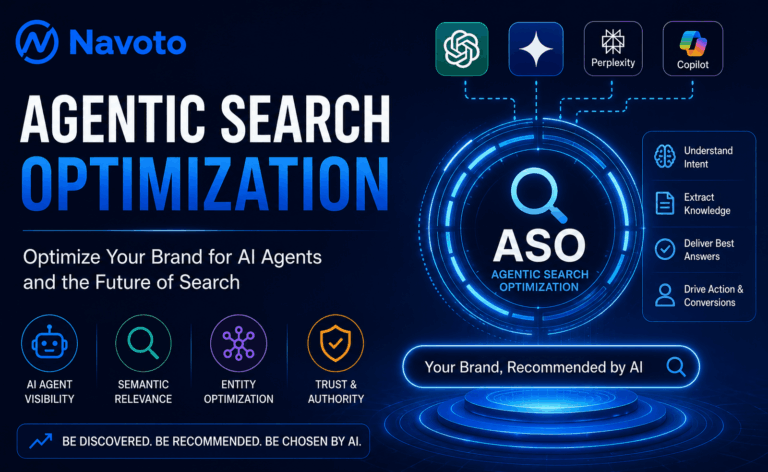
Agentic Search Optimization (ASO) is the practice of making your brand discoverable, evaluable, and actionable by autonomous AI agents that compare options and act on a user’s behalf — without the user needing to read any result, click any link, or make any decision themselves.
Official Definition — Navoto.com
Agentic Search Optimization = optimizing your brand’s content, data structure, technical infrastructure, and trust signals so that autonomous AI agents acting on a user’s behalf can discover, evaluate, and select your brand during comparison tasks, vendor shortlisting, and transaction completion — without human involvement at each step.
The critical distinction is who is “reading” your website. In traditional SEO, a human reads your page and decides whether to engage. In GEO, an AI generates an answer citing your content and a human reads the answer. In ASO, an AI agent reads your page, evaluates it against competing options, and makes a selection — and the human may never read anything at all. The agent is the customer in the evaluation stage.
This is not a future scenario. It is already happening. Google’s Project Mariner visits websites because a real person asked an AI to complete a task: compare prices, find a vendor, book a service. ChatGPT’s in-chat purchasing opened to US users in February 2026. Wayfair and Etsy are already completing transactions inside Google AI Mode via UCP. The agent economy is live infrastructure — and it is growing faster than mobile did a decade ago.
ASO works alongside — not instead of — traditional SEO ranking and LLM SEO strategy. Strong SEO is the floor. AI citation optimization builds the walls. ASO is the roof that completes the visibility structure for the full modern search landscape.
The Modern Visibility Stack: SEO → GEO → ASO
The optimization stack has added a critical new layer roughly every two years since 2022. Understanding how these layers relate — and how they depend on each other — is essential for building a coherent strategy:
LAYER 1
SEO — Search Engine Optimization
Target: Human searchers on Google/Bing
Goal: Rank in organic search results so humans click your link. Unit of visibility: Ranking position. Status in 2026: Table stakes — if you don’t have this, nothing else matters. Traditional SEO remains essential because AI agents use search indexes to discover candidate websites. If you’re not indexed, you’re invisible to agents too. Every layer above depends on the foundation of strong technical SEO, clean crawlability, and indexed content.
LAYER 2
GEO — Generative Engine Optimization
Target: AI answer engines (ChatGPT, Gemini, Perplexity)
Goal: Get cited inside AI-generated answers. Unit of visibility: Citation count. Status in 2026: Critical — 1.13 billion AI search referral visits in June 2025. This is the discipline of AI citation building: structured content, entity authority, FAQPage schema, answer-first writing. GEO matured fast through 2025 and is now a distinct, well-defined practice. The user still reads the AI answer — they just don’t click to your site as often.
LAYER 3
ASO — Agentic Search Optimization
Target: Autonomous AI agents acting for users
Goal: Be selected by AI agents during comparison and transaction tasks. Unit of visibility: Consideration set inclusion. Status in 2026: Emerging but rapidly operationalizing — Google-Agent live since March 2026, WebMCP in Chrome origin trial, UCP processing live purchases. The user doesn’t read the answer anymore. The agent reads, evaluates, and acts. You’re either in the shortlist or you’re not — and the agent decides, not the user.
The key insight: these layers don’t compete — they build on each other. A site that ranks well in Google is more likely to be found by AI agents. A site that earns AI citations builds the trust signals that agents use to evaluate shortlist candidates. ASO is the third floor of the same building — but you can’t build it without the two floors below. Everything in this guide assumes your SEO foundation is solid. If it isn’t, start with our complete SEO ranking guide first.
Why Agentic Search Optimization Is Urgent in 2026
The “it’s early, I’ll wait” argument has closed. Here are the hard numbers and real infrastructure events that make ASO an immediate priority:
“90% of human traffic will go away as consumers outsource browsing to AI agents. Brands must adapt from targeting ‘best pages’ to providing ‘best answers’ — and ultimately, ‘best agent experiences.'”
— Chris Andrew, CEO of Scrunch AI, 2026
The schema.org adoption precedent is instructive. From 2011–2013, schema markup was dismissed as niche, future-proofing, with weak direct ranking value. Most SEOs ignored it. By 2017, it was table stakes for technical SEO. By 2025, early adopters had built entity foundations that large language models inherited at scale through the Knowledge Graph. Agentic protocols in 2026 are at the same 2012 moment. Not guaranteed to follow the same path — but the precedent is real and the infrastructure is built by Google, Microsoft, and the W3C together.
The window for early-adopter advantage is open right now. The brands that build agent-ready infrastructure in H2 2026 will have structural advantages — compounding over years — that late movers cannot close with ad spend alone. Our AI marketing strategy guide covers the broader commercial context for this shift.
How AI Agents Actually Find & Select Brands
Understanding the agent decision process is the most important foundation for ASO strategy. AI agents evaluating brands for a user don’t work like human shoppers and they don’t work like traditional search crawlers. Here is what actually happens when an agent is tasked with “find the best [product/service] for me”:
Index-Based Discovery
The agent queries a search index (Google, Bing) to generate a candidate list of websites relevant to the task. Sites not indexed, or indexed with poor relevance signals for the query topic, never enter the evaluation pool. This is why traditional SEO remains the non-negotiable foundation of ASO — and why search visibility tracking must now include agent-accessible content as a separate measurement dimension.
Parallel Multi-Site Evaluation
Unlike a human who reads sites one-by-one, an AI agent evaluates multiple candidate sites simultaneously — extracting and comparing structured data at machine speed. This changes the optimization target fundamentally: you’re no longer competing for attention duration (keeping a human on your page) — you’re competing for evaluation clarity (making it easiest for a machine to confirm you match the criteria). The sites that make evaluation easiest win. Sites that hide pricing behind “Contact Sales,” require JavaScript to render key specs, or bury comparison data in PDFs are eliminated before any human sees them.
Trust Signal Cross-Referencing
Before placing a brand in a shortlist, agents cross-reference external trust signals: third-party reviews (G2, Trustpilot, Capterra), press mentions, entity consistency across Wikipedia and Wikidata, social proof signals, and industry authority indicators. A brand with excellent on-site content but weak off-site trust signals gets penalized at this stage. Trustpilot and G2 specifically appear as frequently cited and trusted sources across most major LLMs — making review platform presence a direct agentic selection factor.
Task Execution Capability Check
If the agent needs to take an action (add to cart, request a demo, make a booking), it checks whether your site supports machine-executable actions. Sites implementing WebMCP tools allow agents to complete tasks as native function calls. Sites without WebMCP require the agent to visually navigate the DOM — slower, error-prone, and more likely to result in task abandonment and redirection to a competitor whose site does support programmatic interaction.
Shortlist Generation & User Presentation
The agent synthesizes its evaluation into a shortlist — typically 2–4 options — presented to the user with a recommended selection. The user either approves, asks for refinement, or approves the agent’s top pick directly. Your position in this shortlist is the ASO equivalent of ranking #1 in Google: it determines 80%+ of where the user ends up. The brands not in the shortlist may as well not exist for that query.
The 3-Layer ASO Framework: Discoverability → Evaluability → Actionability
The most useful framework for organizing your ASO work comes from the agent’s own decision process: agents must first find you, then evaluate you, then be able to act through you. Each layer has distinct technical and content requirements.
LAYER 1
DISCOVERABILITY
Can the agent find you?
Discoverability is pure technical SEO applied to agent crawling requirements. Agents rely on search indexes to discover candidates. If you’re not in the index — or if agent-specific crawlers are blocked — you’re invisible before the evaluation even begins.
Discoverability Checklist:
- Allow
Google-Agent,GPTBot,OAI-SearchBot,PerplexityBot,ClaudeBotin robots.txt - XML sitemap with lastmod timestamps submitted to Google Search Console and Bing Webmaster Tools
- No noindex tags on important content pages
- Core content present in raw HTML — not dependent on JavaScript rendering
- Page load speed: LCP under 2.5s (slow pages cause agents to move on before content loads)
- Verified entity in Google Knowledge Graph and Wikidata (agents reference knowledge graphs for brand verification)
- Create and publish
llms.txtat domain root (supported by non-Google AI agents; Google treats it as informational only)
LAYER 2
EVALUABILITY
Can the agent accurately assess your offering?
Evaluability is where most brands fail. An agent visiting your website needs to extract — quickly and accurately — what you offer, who it’s for, what it costs, how it compares to alternatives, and what real customers say. If any of these are missing, unclear, or hidden behind friction, the agent marks you as low-confidence and moves to a competitor with clearer data.
Evaluability Checklist:
- Transparent pricing: Agents eliminate “Contact Sales for pricing” options from shortlists. Display pricing ranges, tiers, or clear signals that pricing is available immediately
- Comprehensive schema markup: Product, Service, Review, FAQ, Organization — structured data makes attributes machine-readable without DOM parsing
- Comparison-friendly content: “X vs. Y” content, feature comparison tables, “best for” labels, and explicit differentiators help agents match your offering to user criteria
- Visible social proof: Review counts, ratings, customer logos, case study metrics — agents read these as trust confirmation signals
- CLS under 0.1: Cumulative Layout Shift (layout instability) causes interaction target shifts that break agent DOM navigation. Google’s new Lighthouse Agentic Browsing audit specifically checks this
- Clean accessibility tree: Every interactive element must have an explicit, programmatic name that agents can read from the accessibility API — not just a visual label
- Conversational attribute data: Product Q&As, compatibility information, substitutes/alternatives — the “conversational” data layer UCP prioritizes
LAYER 3
ACTIONABILITY
Can the agent complete tasks on your site?
Actionability is the frontier of ASO in 2026 — not fully mature yet, but developing rapidly. An actionable website is one where AI agents can complete tasks (search products, request demos, add to cart, check availability, book appointments) without visual DOM manipulation. Sites that implement WebMCP tools go from being evaluated to being actively used by agents — a fundamentally stronger position.
Actionability Checklist (2026 Status):
- WebMCP origin trial: Register at Chrome Origin Trials (Chrome 149+) to expose structured tools to Gemini in Chrome. Google’s John Mueller endorses this over llms.txt as of June 2026
- agent.json: Publish
/.well-known/agent.jsonto declare your WebMCP endpoint as your site’s agent interface - OpenAPI spec: Publish an OpenAPI 3.0 specification for any API endpoints that agents might query (product search, availability, pricing) at
/api/openapi.json - UCP + Merchant Center: For ecommerce, join the UCP waitlist, prepare Merchant Center with return policies and
native_commerceattribute — this enables direct checkout in Google AI Mode - Shopify Agentic Storefronts: For Shopify merchants, enable Agentic Storefronts — automatically syndicates product data to ChatGPT, Copilot, and Google AI Mode
- MCP server for your platform: If your product has an API, publish an MCP server so agents can interact with your system directly. See our Meta MCP Integrations guide for how this works at scale
Agentic Protocols You Must Know: WebMCP, UCP, ACP, MCP, A2A
Five protocols are consolidating as the infrastructure layer for agent-website interaction in 2026. You don’t need to implement all of them immediately — but you need to understand what each does and where to start:
| Protocol | Owner | Status (Jun 2026) | What It Does | Who Should Act Now |
|---|---|---|---|---|
| WebMCP | Google + Microsoft (W3C) | Chrome 149 Origin Trial | Exposes structured tools to in-browser AI agents. Agents call functions your site declares (search, checkout, book) as API calls — no DOM scraping needed | All websites — register for Chrome origin trial now. John Mueller endorses this over llms.txt |
| UCP | Google (NRF, Jan 2026) | Live — select US merchants | Standardizes agent access to product data, pricing, availability — enables direct checkout inside Google AI Mode. Wayfair + Etsy already live | All ecommerce brands — join UCP waitlist, prepare Merchant Center immediately |
| MCP | Anthropic (Nov 2024) | Production — 97M+ downloads/mo | Server-side protocol for AI agents to connect to external systems. Agents query your data, inventory, APIs directly via structured tool calls | SaaS products + platforms with APIs — publish an MCP server for your platform today |
| ACP | OpenAI + Stripe (Sep 2025) | Live — select US merchants | Agentic Commerce Protocol — powers checkout inside ChatGPT since Sep 2025. Structured product data + purchase completion via ChatGPT interface | Ecommerce + service bookings — apply for ACP access via OpenAI/Stripe partnership page |
| A2A | Google (with Linux Foundation) | Emerging — H2 2026 | Agent-to-Agent protocol — enables AI agents to coordinate with other AI agents for complex multi-step tasks. The infrastructure for multi-agent workflows | Enterprise tech stacks — monitor for H2 2026 release; design your agent architecture to be A2A-compatible from the start |
Technical ASO Setup: The Agent-Ready Website Checklist
This is the practical implementation guide. Run through this checklist in sequence — each item builds on the previous. Start with the foundation and add protocol layers as they mature.
🔧 FOUNDATION LAYER — IMPLEMENT IMMEDIATELY
1A
User-agent: Google-Agent ↵ Allow: / ↵ User-agent: GPTBot ↵ Allow: / ↵ User-agent: OAI-SearchBot ↵ Allow: / ↵ User-agent: PerplexityBot ↵ Allow: / ↵ User-agent: ClaudeBot ↵ Allow: /1B
Homepage: Organization + WebSite. All content: Article + Person (author). All pages: FAQPage. Products: Product + Offer + AggregateRating. Services: Service + Offer. These four schema types cover 90% of what AI agents extract when evaluating candidates.
1C
Target CLS < 0.1. Chrome Lighthouse now includes an “Agentic Browsing” audit category that specifically measures CLS as an agent interaction stability signal. Layout shifts during page load break agent DOM navigation and cause task failures.
1D
Every button, form field, and link must have an explicit, programmatic name accessible via the A11y API. Agents use the accessibility tree — not visual rendering — to identify and interact with page elements. Run Chrome’s Accessibility audit to find unlabeled elements.
1E
# /llms.txt — Brand description + important page index

# /.well-known/agent.json — Declares WebMCP endpoint

# /.well-known/mcp/server-card.json — MCP Server Card

# /api/openapi.json — OpenAPI spec for your endpoints
⚡ PROTOCOL LAYER — IMPLEMENT IN H2 2026
2A
Register your origin at Chrome Origin Trials (chrome.com/origintrials). Implement a minimum viable WebMCP tool for your most important agent action (product search for ecommerce, contact form for services, documentation search for SaaS). Even one working WebMCP tool puts you ahead of 99% of competitors in 2026.
2B
Join Google’s UCP waitlist at merchants.google.com. Ensure Merchant Center feed includes: return policies, shipping data, native_commerce attribute, conversational Q&A attributes (question, answer, compatibility, substitutes). Shopify merchants: enable Agentic Storefronts in your Shopify admin for automatic multi-platform syndication.
2C
# Server log filter (Nginx):

grep -i "Google-Agent" /var/log/nginx/access.log
# Volume will be low in 2026 — baseline now for context as traffic scales
Content Strategy for Agentic Search: Writing for Machine Evaluation
The content changes required for agentic search optimization are distinct from traditional SEO copywriting and even from GEO content principles. You’re no longer writing to persuade a human reader over time — you’re writing to make a machine-evaluation fast, accurate, and unambiguous.
Expose Your Pricing (No Hidden Fees)
Agents eliminate “Contact Sales for pricing” from shortlists before comparing other attributes. Display pricing ranges, starting prices, or tier structures visibly on every relevant page. If pricing is genuinely custom, show what influences it and provide a calculator or estimator. The goal: give agents something to work with so they don’t mark you as low-information and move on.
Write “Best For” Labels and Comparison Tables
Agents evaluate fit against user criteria — “best for small business,” “ideal if you need [X],” “compared to [competitor], we offer [difference].” Making this evaluation explicit saves the agent inference work and increases your probability of being correctly matched to the right queries. Include structured comparison tables, clearly labeled “best for” sections, and explicit competitor differentiation content.
Product/Service Q&A Sections
Google’s UCP prioritizes “conversational attributes” — question-answer pairs about product compatibility, use cases, substitutes, and edge cases. These map directly to the questions agents ask when evaluating fit. Add a structured Q&A section to every product and service page with FAQPage schema markup. This is simultaneously a GEO citation signal and an ASO evaluation signal. Our AI citation building guide covers this in full.
Avoid JavaScript-Gated Key Information
Prices, specifications, availability, and core value propositions hidden behind JavaScript renders are invisible to many AI agents. Render-dependent content requires agents to execute JavaScript — not all do this reliably. Critical decision information must be in raw HTML. Test this by viewing your page source directly: if your key specs and pricing aren’t visible there, agents can’t reliably see them either.
Machine-Readable Specifications and Attributes
Product and service specifications should be structured as definition lists, attribute tables, or schema-marked data — not buried in prose paragraphs. An agent evaluating “does this product support X integration?” needs to find that answer in one extraction, not parse three paragraphs of marketing copy. Clean, labeled, structured attribute data is the highest-value content investment for ASO.
Consistent Data Across All Touchpoints
When agents cross-reference your website data against your Google Business Profile, your Merchant Center feed, your LinkedIn company page, and third-party review sites — inconsistencies signal low reliability and reduce shortlist probability. Canonical brand data, consistent pricing, and consistent product descriptions across every platform is an ASO signal. This connects directly to the entity consistency work in our LLM SEO strategy.
Trust & Brand Signals: What AI Agents Use to Shortlist Brands
Trust is the deciding factor when agents evaluate near-equivalent options. Research shows Trustpilot and G2 are frequently cited and trusted across major LLMs — making review platform presence a direct agentic selection factor, not just a human persuasion tool. Here are the five most important trust signals for ASO:
⭐
Third-Party Review Platform Presence
Maintain active, high-rated profiles on G2, Trustpilot, Capterra, or the dominant review platform in your vertical. Agents treat these as independent trust verification — they can’t be gamed by the brand and they signal real customer satisfaction. A brand with 500+ reviews at 4.5★ on Trustpilot passes the trust threshold faster than one with better on-site content but no reviews. Collect reviews actively. Respond to all reviews — agents read response patterns as a proxy for customer care quality.
🏗️
Entity Verification (Wikidata + Knowledge Graph)
Agents cross-reference brand information against structured knowledge bases. A complete Wikidata entry with your brand’s name, description, founding date, industry, URL, and sameAs links to your social profiles provides the machine-readable entity verification agents need. Without it, agents operating from parametric knowledge may mischaracterize your brand or assign lower confidence to your shortlist inclusion. See our full framework in the AI citation building guide.
📰
Earned Media & Third-Party Citations
The “consideration set inclusion” signal that ASO optimizes for is built substantially off-site. Guest posts in industry publications, press coverage in news outlets, podcast appearances, industry awards, and analyst mentions all contribute to the citation portfolio that agents consult when building shortlists. Brands consistently cited by authoritative third-party sources pass the trust threshold more reliably than those with excellent owned content but thin external presence. Three earned media placements per month is the minimum cadence for competitive ASO trust building.
🔐
Transaction Safety Signals
For any brand where an AI agent may complete a transaction, safety signals become ASO ranking factors. HTTPS is the baseline. Clearly stated return policies (now a Merchant Center required attribute for UCP), purchase protection statements, privacy policy accessibility, and data handling transparency all factor into whether agents recommend your brand for transactional tasks. Visa’s Trusted Agent Protocol and Mastercard’s Agent Pay are building formal agent authorization layers — brands registered on these have a trust advantage in agentic commerce flows.
👤
Author Entity Credentials (E-E-A-T)
For content-driven brands and service businesses, the credentials of the people behind the content remain a key trust signal. Named authors with verifiable LinkedIn profiles, published works, industry credentials, and linked author pages signal genuine expertise that agents recognize as a quality indicator. Anonymous content from faceless brands scores lower across all AI evaluation frameworks. Every important page on your site should have a named, credentialed author.
Measuring Your Agentic Search Visibility
Measuring ASO performance is harder than measuring traditional SEO because there are no fixed “rankings” to track — only consideration set inclusion rates and brand selection frequency. Here is how to build a measurement system today using available tools. For the full analytics setup, see our AI search analytics guide.
Monthly Consideration Set Audit
For 20 comparison-intent queries in your category (“best X for Y”, “alternatives to Z”, “top vendors for W”), test ChatGPT, Gemini, and Perplexity. Record whether your brand appears in the shortlist. Track this monthly — your “Consideration Set Inclusion Rate” is the core ASO KPI. A brand in the shortlist for 30% of category queries has measurably stronger ASO than one appearing in 5%. Tools like Peec AI and Profound automate this at scale.
Google-Agent Log Monitoring
Filter your server logs for Google-Agent user agent strings. Volume will be low in 2026 — but establishing a baseline now means you’ll detect trend changes as agentic browsing scales. Also monitor for bot traffic patterns from data center IP ranges, very high new-visitor percentages (85–95%), and short or very long session durations — all indicators of AI agent visits misclassified as human traffic in GA4.
Branded Search Volume as ASO Proxy
When AI agents recommend your brand in shortlists, users who don’t click directly often then search Google for your brand name. Branded query impression growth in Google Search Console is one of the most reliable proxies for increasing agentic consideration set inclusion — the dark ASO equivalent of dark AI traffic. Correlate branded search spikes with changes in your ASO optimization or earned media placements.
Bing Webmaster AI Performance Report
Microsoft’s February 2026 AI Performance reporting in Bing Webmaster Tools shows impressions and clicks from Copilot and Bing AI answers — a first-party proxy for agentic visibility in the Microsoft ecosystem (including ChatGPT, which uses Bing’s index). Check this monthly alongside your standard search visibility tool data.
ASO by Industry: Ecommerce, SaaS, Services & Local
| Industry | Primary Agent Task | Highest-Impact ASO Action | Key Protocol to Implement |
|---|---|---|---|
| Ecommerce | Product search, price comparison, purchase completion | Product + Offer + AggregateRating schema on all product pages; transparent pricing; complete Merchant Center feed | UCP waitlist (Google) + ACP (OpenAI/Stripe) + Shopify Agentic Storefronts — this is your top priority |
| SaaS/Tech | Vendor shortlisting, feature comparison, demo booking, integration checking | Transparent pricing tiers; explicit “best for” labels; integration directory listing; G2 profile with 50+ reviews | MCP server for your API (agents can query your platform directly) + WebMCP for demo booking form |
| Services/B2B | Agency/provider selection, quote comparison, availability checking | Service + Offer schema with pricing ranges; case study data with measurable outcomes; Trustpilot/Clutch presence | WebMCP contact/quote form; OpenAPI spec for any availability or pricing API |
| Local/Hospitality | Venue search, availability checking, booking completion | Google Business Profile completeness (agents read GBP); LocalBusiness schema with hours + pricing; Google Reviews 4.5★+ | ACP for direct booking (if applicable); WebMCP for reservation form; UCP (hospitality vertical announced in UCP roadmap) |
The 90-Day Agentic Search Optimization Action Plan
This roadmap is designed to build the complete ASO infrastructure in 90 days — starting with zero-cost, immediate wins and building toward full protocol integration by end of Q3 2026.
- Audit and update robots.txt — allow Google-Agent, GPTBot, OAI-SearchBot, PerplexityBot, ClaudeBot
- Run Chrome Lighthouse Agentic Browsing audit — fix CLS issues, label all interactive elements
- Implement Organization + WebSite schema on homepage, FAQPage on top 10 pages
- Create or complete Wikidata entity entry with all attributes and sameAs links
- Audit pricing visibility — ensure no key pricing data is hidden behind “Contact Sales”
- Publish llms.txt at domain root with brand description and page index
- Set up Google-Agent log monitoring baseline in server logs
- Create agent.json at /.well-known/agent.json declaring your site’s agent interface
- Run baseline ASO audit: test 20 comparison queries across ChatGPT, Gemini, Perplexity
- Add structured comparison tables to top 5 product/service pages with “best for” labels
- Add Q&A sections (with FAQPage schema) covering compatibility, substitutes, use cases
- Audit all product/service pages for JavaScript-gated key information — move to raw HTML
- Publish or activate profile on your industry’s dominant review platform (G2/Trustpilot/Capterra)
- Launch review acquisition campaign — target 20+ new reviews in 30 days
- Build or update author pages with credential links for all key content contributors
- Audit data consistency across website, Google Business Profile, LinkedIn, and Merchant Center
- Publish OpenAPI spec for any queryable API endpoints your platform exposes
- Ecommerce: join UCP waitlist + prepare Merchant Center with required attributes
- Register for Chrome Origin Trial (WebMCP) — implement minimum viable tool for your core agent action
- SaaS brands: publish MCP server for your platform API (see our Meta MCP Integrations guide for the pattern)
- Run 30-day citation audit repeat — compare to baseline, identify queries with improved consideration set inclusion
- Set up monthly Consideration Set Inclusion Report (20 queries × 3 platforms = 60 data points)
- Run 3 earned media placements in industry publications this month
- Check Bing Webmaster AI Performance Report — establish baseline agentic impression data
- Document your ASO baseline metrics and build 90-day forward roadmap for Q4 2026
- Shopify brands: enable Agentic Storefronts for automatic multi-platform agent syndication