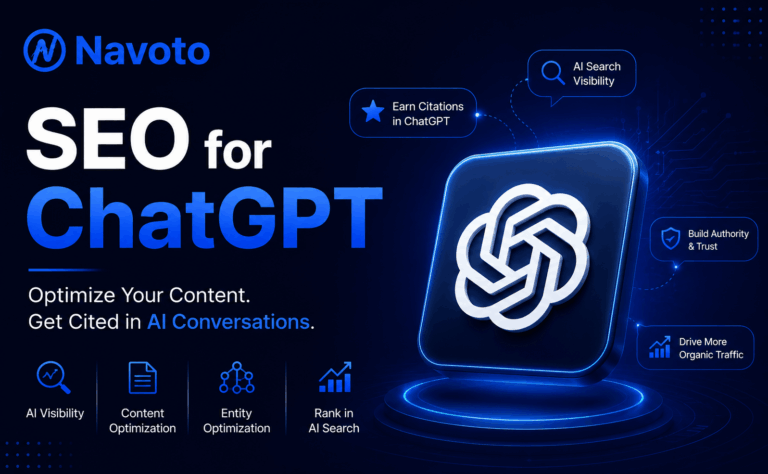
Only 12% of URLs cited by ChatGPT rank in Google’s top 10 results. That single statistic — from a 2026 Status Labs analysis — destroys the assumption that traditional SEO automatically earns you ChatGPT visibility. ChatGPT follows a different set of rules, rewards different signals, and requires a dedicated optimization strategy. That strategy is ChatGPT SEO.
ChatGPT now generates 5.72 billion monthly visits. Its weekly active user base has crossed 800 million. When any one of those users asks “What is the best [your service]?” or “Who are the top experts in [your industry]?” — your brand either appears in the answer, or it doesn’t exist to that user. There is no middle ground. No page 2. No second chance.
This complete guide from Navoto is the most comprehensive ChatGPT SEO optimization resource available in 2026. It covers every layer — technical setup, content architecture, entity signals, off-site authority, platform-specific strategy, and measurement. Every tactic is backed by published research from Princeton, Semrush, Status Labs, Profound, and Surfer SEO. Nothing theoretical. Everything actionable.
📊
Key Research Facts You Need to Know Before You Start
- ChatGPT cites branded domains 11.1 points higher than Google does (Wellows, 2026)
- Wikipedia accounts for 47.9% of ChatGPT’s top cited sources — factual, definitional content wins
- Proper ChatGPT SEO optimization can boost AI visibility by up to 40% (Princeton GEO Study)
- 68% of pages cited in AI Overviews were NOT in the top 10 organic results (Surfer SEO, 173,902 URLs)
- ChatGPT’s live search uses Bing as its primary index — Bing ranking directly drives ChatGPT citations
What Is SEO for ChatGPT?
SEO for ChatGPT (also called ChatGPT SEO, ChatGPT SEO optimization, or GEO for ChatGPT) is the practice of structuring your content, technical infrastructure, and brand authority signals so that ChatGPT selects your website as a cited source when generating answers to user queries.
Official Definition — Navoto.com
ChatGPT SEO = the systematic optimization of your content, entity signals, and technical setup so that ChatGPT chooses your brand as the expert source in its generated answers — turning 800 million weekly AI searches into a direct brand visibility and traffic channel.
Unlike traditional SEO — where success means appearing in a list of blue links at a specific ranking position — ChatGPT SEO success means being woven into the answer itself. ChatGPT doesn’t show users 10 results to choose from. It synthesizes a single response, draws on its most trusted sources, and either cites your brand or doesn’t. The winner takes vastly more than the runner-up.
ChatGPT SEO sits within the broader discipline of LLM SEO strategy — optimizing for all large language model search engines. But ChatGPT requires specific, platform-native tactics because it uses a unique combination of training data and Bing-powered real-time search that differs fundamentally from how Gemini or Perplexity retrieve sources.
The phrase “ChatGPT SEO optimization” is also increasingly used to describe the process of using ChatGPT as an SEO tool — for keyword research, content briefs, and on-page optimization. This guide covers both: how to optimize for ChatGPT citations AND how to use ChatGPT as an SEO tool. Both are part of a complete chat GPT SEO strategy in 2026. For the full AI marketing context, see our AI marketing guide.
ChatGPT SEO vs Google SEO: Key Differences
ChatGPT SEO and Google SEO share foundational principles but diverge significantly in what actually drives results. Understanding these differences is the most important first step in any chat GPT SEO strategy. Here is a comprehensive breakdown:
| Signal | Google SEO | ChatGPT SEO |
|---|---|---|
| Goal | Rank in positions 1–10 on SERP | Be cited inside the AI-generated answer |
| Crawl Index | Google’s own index (Googlebot) | Bing index for live queries (OAI-SearchBot) + training data |
| Backlinks | Strongest ranking signal — quantity & quality matter enormously | Useful but secondary — semantic clarity and entity authority outweigh raw backlinks |
| Keywords | Keyword placement (title, H1, URL, body) is critical | Conversational phrasing, question-answer format, and semantic coverage matter more |
| Content Format | Long-form, well-structured, keyword-dense pages | Answer-first writing, Q&A headings, definitive statements, statistics-rich |
| Authority Signal | Domain Authority, PageRank, link equity | Entity authority — Wikipedia, Wikidata, Crunchbase, consistent brand entity signals |
| Schema | Helpful for rich snippets and featured snippets | Critical — FAQPage, Article, Organization schema directly increase citation rate by 3.2x |
| Freshness | Matters for time-sensitive queries, less so for evergreen | ChatGPT explicitly cites 2025/2026 sources for time-sensitive queries — freshness is a stronger signal |
| Success Metric | Ranking position, organic click-through rate | Citation frequency in AI responses, brand mention rate, AI-referred traffic in GA4 |
The most important insight from this comparison: ChatGPT SEO doesn’t replace traditional SEO — it requires it. Because ChatGPT’s live search runs on Bing’s index, you must rank well in Bing to have a realistic chance of ChatGPT citations for real-time queries. Traditional SEO is the foundation; ChatGPT SEO optimization is the additional layer built on top.
As Search Engine Land put it in 2026: “SEO feeds AI.” Your Google and Bing rankings create the index that ChatGPT searches. Your content quality determines whether ChatGPT extracts and cites you. Your entity authority determines whether ChatGPT trusts you enough to name you by brand. To understand the full SEO ranking foundation that underpins ChatGPT visibility, start there.
How ChatGPT Finds & Cites Sources: The Technical Reality
To do ChatGPT SEO correctly, you need to understand the exact mechanics of how ChatGPT retrieves information — because there are actually two completely different systems at work, and they require different optimization strategies:
Parametric Knowledge
(Training Data — Static)
This is everything ChatGPT “knows” from its training dataset. GPT-5.2 (current as of June 2026) has a training cutoff of August 31, 2025. For queries that don’t require fresh data, ChatGPT draws entirely from this pre-learned knowledge.
GPTBot — scrapes web content to update training dataReal-Time Retrieval
(Live Web Search — Dynamic)
When ChatGPT’s web search mode is active, it queries Bing’s index in real time, retrieves the top-ranked pages for the query, and uses those as sources for its response. This is where ChatGPT SEO optimization has the most direct, measurable impact.
OAI-SearchBot + ChatGPT-User — live retrieval for cited responsesThe critical implication: Most users accessing ChatGPT for research-oriented, commercial, or time-sensitive queries will trigger System 2 — the live Bing search. For these queries, your Bing ranking position is the single most direct predictor of whether ChatGPT cites you. Ranking in Bing’s top 3 for a target query gives you the highest probability of being surfaced and cited.
For queries that ChatGPT handles from parametric memory (definitions, evergreen concepts, well-established brands), your visibility depends on whether your content and brand entity are well-represented in ChatGPT’s training data — which means having consistent, high-quality content that was indexed before the training cutoff, and a strong presence on authoritative third-party sites like Wikipedia, Wikidata, and major publications.
Profound’s analysis of 680 million citations (ChatGPT, Google AI Overviews, and Perplexity, Aug 2024–Jun 2025) found that ChatGPT cites “reference-style” sources heavily — factual, definitional, encyclopedic content far outperforms opinion-driven or promotional content. Structure your content to answer questions definitively, not to sell. This is the single most important content principle for ChatGPT SEO.
ChatGPT SEO Ranking Factors: What Actually Drives Citations
Based on analysis of millions of ChatGPT responses and multiple published research studies, here are the factors that most reliably increase your ChatGPT citation probability — ranked by impact:
HIGH IMPACT
Bing Ranking Position
Ranking in Bing’s top 1–3 for a target query gives the highest ChatGPT citation probability for live-search queries. Bing optimization = ChatGPT SEO for real-time responses. Submit your sitemap to Bing Webmaster Tools and verify your site if you haven’t.
HIGH IMPACT
E-E-A-T Signal Strength
ChatGPT cites branded domains 11.1 points higher than Google. Real author credentials, named contributors, linked LinkedIn profiles, and verifiable expertise displayed on your content pages significantly increase ChatGPT’s trust in your content as a citeable source.
HIGH IMPACT
Statistical & Factual Density
ChatGPT’s preference for reference-style sources means content packed with verified statistics, data points, named studies, and specific facts is dramatically more likely to be cited than opinion-driven or vague content. Every major claim should be supported by a specific number.
MEDIUM IMPACT
Entity Authority & Verification
ChatGPT cross-references your brand across Wikipedia, LinkedIn, Crunchbase, Wikidata, and podcast appearances when deciding whether to mention your brand by name. Brands with verified, consistent entity signals are cited far more often than anonymous or inconsistently-described brands.
MEDIUM IMPACT
Schema Markup Implementation
Pages with advanced structured data (FAQPage, Article, Organization schemas) receive 3.2x more AI citations than pages with basic or missing markup. Schema tells ChatGPT exactly what your content covers, who wrote it, and what questions it answers — removing ambiguity from the citation decision.
MEDIUM IMPACT
Content Freshness
ChatGPT explicitly prioritizes 2025/2026 sources for time-sensitive queries. Add visible “Last Updated” dates to cornerstone pages. Refresh statistics, examples, and case studies quarterly. The traditional 6–12 month refresh cadence is insufficient — quarterly updates are the ChatGPT SEO standard.
SUPPORTING
Answer-First Content Structure
44.2% of AI citations extract from the first 30% of a page. ChatGPT scans for the most direct, extractable answer to a query. Your primary answer must appear within the first 200 words — stated clearly before any supporting explanation. Write the conclusion first, then justify it.
SUPPORTING
Tier-1 & Tier-2 Backlinks
While backlinks explain a smaller share of ChatGPT citation outcomes than in Google SEO, links from .gov, .edu, and major Tier-1 publications carry significant weight. A single link from a top-tier source contributes more to ChatGPT visibility than dozens of low-quality links.
Technical ChatGPT SEO: robots.txt, llms.txt & Schema Setup
Technical ChatGPT SEO is the first thing to fix — and the fastest to implement. Before any content strategy can work, ChatGPT must be able to access, read, and understand your pages. Many sites are accidentally invisible to ChatGPT due to technical misconfigurations that take less than 30 minutes to fix.
Step 1 — Configure Your robots.txt for ChatGPT Crawlers
ChatGPT uses two distinct types of bots — and each serves a different purpose. Confusing them (or blocking both “just in case”) is the #1 technical mistake in ChatGPT SEO:
GPTBot (Training Crawler)
Scrapes your content to train future ChatGPT models. Allowing this builds ChatGPT’s parametric knowledge of your brand. Some brands block it for IP reasons — this is a valid editorial choice, but it reduces your presence in ChatGPT’s base knowledge.
User-agent: GPTBot

Allow: /
OAI-SearchBot + ChatGPT-User (Citation Crawlers)
These crawl your site in real-time when a user asks ChatGPT a question and it searches the web. Blocking these removes you from ChatGPT citations entirely — the world’s second-largest search engine. Never block these in 2026.
User-agent: OAI-SearchBot

Allow: /
User-agent: ChatGPT-User
Allow: /
✅ Complete 2026 robots.txt Configuration for Maximum AI Visibility
# === AI SEARCH CRAWLERS (citation / real-time retrieval) ===
# Allow these — blocking them removes you from AI citations

User-agent: OAI-SearchBot
Allow: /

User-agent: ChatGPT-User
Allow: /

User-agent: PerplexityBot
Allow: /

User-agent: Perplexity-User
Allow: /

User-agent: Claude-SearchBot
Allow: /

User-agent: Claude-User
Allow: /

User-agent: BingBot
Allow: /

User-agent: Google-Extended
Allow: /

# === AI TRAINING CRAWLERS (optional — editorial decision) ===
# Allow to build parametric brand knowledge in AI models

User-agent: GPTBot
Allow: /

User-agent: ClaudeBot
Allow: /

# === STANDARD SEARCH BOTS ===
User-agent: Googlebot
Allow: /

Sitemap: https://yourdomain.com/sitemap.xml
Step 2 — Create Your llms.txt File
llms.txt is a plain-text file placed at yoursite.com/llms.txt (like robots.txt but for AI models). Proposed by Jeremy Howard in late 2024 and increasingly respected by OpenAI, Anthropic, and Perplexity in 2026, it tells AI systems which pages are most authoritative, what your brand covers, and where to go first. It’s a cheap, fast competitive edge that most sites still haven’t implemented.
✅ Example llms.txt File Structure
# llms.txt — navoto.com
# AI-readable content index for Large Language Models

## About This Site
Navoto is an SEO and AI search optimization agency helping
brands achieve visibility in Google, ChatGPT, Gemini, and
Perplexity through LLM SEO, AI citation building, and
generative engine optimization (GEO).

## Core Topics
- LLM SEO and AI search optimization
- ChatGPT SEO strategy
- AI citation building
- Search visibility tools and measurement
- SEO ranking strategies
- AI marketing

## Most Important Pages (start here)
- https://navoto.com/llm-seo (What is LLM SEO)
- https://navoto.com/seo-for-chatgpt (ChatGPT SEO guide)
- https://navoto.com/ai-citation-building (AI citation building)
- https://navoto.com/ranking-in-seo (SEO ranking complete guide)
- https://navoto.com/search-visibility-tool (Best visibility tools)

## Contact & Entity
Website: https://navoto.com
Founded: 2022
Location: Remote / Global
LinkedIn: https://linkedin.com/company/navoto
Step 3 — Implement the Right Schema Markup
Pages with proper schema markup receive 3.2x more AI citations. For ChatGPT SEO, these are the four schema types you must implement:
01
Establishes your brand as a verifiable entity with name, description, URL, logo, sameAs links (LinkedIn, Wikidata, Wikipedia, social profiles), and contact info. This is ChatGPT’s primary signal for brand entity verification.
02
Article schema with datePublished, dateModified, and linked author Person entity. Connect each article to its author’s credential page. This is the fastest E-E-A-T win in ChatGPT SEO — anonymous content reads as low-trust to LLMs.
03
FAQPage JSON-LD markup maps your content directly to the question formats ChatGPT processes. It is the single most direct structural signal that your page answers specific queries — dramatically increasing the probability of extraction and citation. Add 5–8 Q&A pairs per page.
04
For any content explaining a step-by-step process, HowTo schema gives ChatGPT a clean, structured sequence it can reference when answering “how do I” queries. Combined with FAQPage, it covers the two most common ChatGPT query formats.
ChatGPT SEO Content Strategy: How to Write to Get Cited
Technical setup is necessary but not sufficient. The majority of ChatGPT SEO optimization happens at the content level. Here is the complete content framework for ChatGPT citations, based on what the research actually shows works:
Write “Definitional” Content That ChatGPT Can Extract Verbatim
Wikipedia accounts for 47.9% of ChatGPT’s top citations because it writes in a definitional, encyclopedic style — direct, factual, citable. Every important page on your site should include a clear, quotable definition of its primary topic in the first 200 words. Write as if writing an encyclopedia entry: authoritative, concise, complete. Avoid building to your point. State the definition, then support it.
Use Question-Based H2 and H3 Headings Throughout
ChatGPT processes queries in conversational, question-based format. Your headings should mirror that format. Instead of “Benefits of ChatGPT SEO” write “What are the benefits of ChatGPT SEO?” — the question form maps directly to how users phrase queries. Each question heading with a direct 2–4 sentence answer below it creates a self-contained citable passage that ChatGPT can extract without needing to understand the surrounding context.
Saturate Content With Specific, Verifiable Statistics
The Princeton GEO study identified statistical enrichment as one of the highest-impact content optimizations for AI citation probability — improving source visibility by up to 40% in tested conditions. ChatGPT strongly prefers content with specific numbers because they are harder to hallucinate and easier to verify. Every section of your content should include at least one specific statistic, percentage, or data point. Where possible, publish original research — data that only exists on your site creates a unique citation obligation for ChatGPT.
Build Comprehensive Topic Clusters, Not Isolated Posts
ChatGPT rewards topical authority — sites that cover a subject comprehensively from multiple angles. A site with 15 deeply researched, interlinked articles all on the same subject signals genuine expertise to both ChatGPT’s training data pipeline and its real-time retrieval system. Build one pillar page (comprehensive overview) + 8–12 supporting articles (subtopics) + 1 dedicated FAQ page for each of your core topics. See how this connects to our broader AI citation building strategy.
Publish a Quarterly Content Freshness Update
ChatGPT explicitly cites 2025/2026 sources for time-sensitive queries. Implement a quarterly content audit for your top 10 pages: update all statistics with current data, add a “Last Updated: [Month Year]” timestamp visibly on the page (not just in metadata), replace outdated examples with current ones, and add any new developments since the last update. This freshness maintenance is not optional in a chat GPT SEO strategy — it’s what separates brands that maintain consistent ChatGPT citations from those that get briefly cited then fade from AI responses.
Off-Site ChatGPT SEO: Authority Signals That Move the Needle
Research shows brand websites account for only 5–10% of AI citations. ChatGPT draws most of its brand knowledge from the rest of the web — third-party publications, reference databases, reviews, forums, and social platforms. These are the off-site signals that drive ChatGPT brand mentions:
Wikipedia & Wikidata Presence
With Wikipedia at 47.9% of ChatGPT’s top citations, even a Wikidata entry (no Wikipedia article required) gives ChatGPT a machine-readable entity record to reference. Create a Wikidata entry for your brand with complete attributes: name, description, URL, founding date, industry, key people, social profiles, and sameAs links.
HIGHEST IMPACT OFF-SITE ACTION
LinkedIn Brand & Author Pages
ChatGPT cross-references LinkedIn when verifying author credentials and brand entity signals. A complete, active LinkedIn company page with consistent brand description, plus detailed personal LinkedIn profiles for all content authors with listed credentials and expertise areas, directly improves E-E-A-T signals that ChatGPT evaluates before citing content.
AUTHOR ENTITY BUILDER
Earned Media & Press Coverage
61% of AI mentions come from earned media, not owned content. Press coverage in major publications, industry trade journals, and news sites provides the third-party validation that ChatGPT weights heavily when deciding whether to cite a brand. Develop a monthly PR calendar targeting 3–5 earned placements — these compound in ChatGPT’s training data over time.
CITATION VELOCITY DRIVER
Podcast Appearances & Expert Interviews
ChatGPT cross-references podcast appearances when verifying author authority. Being featured on industry podcasts generates multiple citation signals simultaneously: the podcast episode page mentions your brand, the transcript mentions your name and credentials, and the show notes often include a link to your site. Each appearance builds author entity strength that feeds directly into ChatGPT’s credibility assessment.
UNDERUTILIZED SIGNAL
G2, Capterra & Review Platforms
Review platforms carry heavy weight in ChatGPT responses to “what is the best X” queries — exactly the high-intent commercial queries where ChatGPT citations deliver the most business value. Maintain a strong, active presence on the review platform(s) most relevant to your industry, with consistent responses to reviews and a steady cadence of new ratings.
COMMERCIAL QUERY WINNER
Reddit & Quora Participation
Semrush’s analysis of 100 million AI citations found Reddit appearing in nearly 10% of responses across major AI platforms. Authentic expert participation in relevant subreddits and Quora threads — not promotional, genuine expertise — builds the community-verified authority signal that ChatGPT treats as third-party social proof. Build a credible participation history over 90+ days.
10% OF ALL AI CITATIONS
The 10-Step ChatGPT SEO Optimization Strategy
This is the complete, sequential chat GPT SEO strategy used by Navoto. Execute these steps in order — each one builds on the last, and skipping steps undermines the whole system. For the full technical context underlying this strategy, read our AI citation building guide.
Run a ChatGPT Baseline Citation Audit
Select 20 queries your target customers would ask ChatGPT about your industry. Test each in ChatGPT (web search mode on), Gemini, and Perplexity. Record who gets cited for each query — your brand, competitors, or neither. This baseline reveals your current ChatGPT visibility score and identifies the exact queries where competitors are winning citations you should own. Document it in a spreadsheet. This is your measurement foundation for everything that follows.
Fix robots.txt — Allow OAI-SearchBot & ChatGPT-User Immediately
Check your robots.txt file right now. If OAI-SearchBot or ChatGPT-User are blocked (or not explicitly allowed), fix it immediately using the configuration shown in Section 5 above. This is a zero-cost, 10-minute change that can produce visible ChatGPT citation improvements within 2–4 weeks. Verify your fix at yoursite.com/robots.txt in a browser.
Submit Your Site to Bing Webmaster Tools
Because ChatGPT’s live search runs on Bing, Bing visibility directly determines ChatGPT citation probability for real-time queries. If your site isn’t verified in Bing Webmaster Tools, do it now. Submit your XML sitemap. Use Bing’s URL Inspection tool to check indexing. Run Bing’s SEO analyser on your top 5 pages and fix any issues flagged. Improving your Bing ranking for target queries is one of the highest-leverage ChatGPT SEO actions available.
Create or Complete Your Wikidata Entity
Go to wikidata.org and search for your brand. If an entry exists, verify it’s complete and accurate. If not, create one — it takes 30 minutes and significantly improves ChatGPT’s entity recognition for your brand. Include all available attributes: name, description, URL, founding date, industry classification, key people (linked to their Wikidata entries), and sameAs links to your LinkedIn, Crunchbase, and website. This single action can produce measurable ChatGPT brand mention increases within 60–90 days.
Add Schema Markup to Your Top 10 Pages
Deploy Organization schema on homepage, Article + Person schema on all blog posts, and FAQPage schema on every major content page. Use Google’s Structured Data Markup Helper if you need a visual interface. Validate every implementation with Google’s Rich Results Test. This structured data layer directly increases ChatGPT citation probability by up to 3.2x for the pages where it’s implemented. Pages without schema are at a significant disadvantage in the ChatGPT citation competition.
Rewrite Your Top 5 Pages With Answer-First Structure
For each page, rewrite the opening 200 words to front-load the definitive answer. Convert at least 5 subheadings to question format. Add a FAQ section with 6–8 Q&A pairs addressing the specific questions users ask ChatGPT about your topic. Add your current year to titles and visible page text. Add or update a “Last Updated” timestamp. Enrich each major point with a specific statistic. These six changes on five pages represent 30 hours of work that can produce measurable ChatGPT visibility improvement within 60 days.
Publish Your llms.txt File
Create your llms.txt file using the template in Section 5 above. Customize it with your specific topic coverage, canonical brand description, and links to your most important pages. Place it at yoursite.com/llms.txt. This takes 20 minutes and signals AI-forward optimization intent to OpenAI, Anthropic, and Perplexity crawlers. While not a standalone ranking factor, it complements schema and robots.txt as part of a complete ChatGPT SEO technical infrastructure.
Build Off-Site Entity Signals — PR + Reviews + LinkedIn
Launch a monthly earned media campaign targeting 3 editorial placements per month. Establish or optimize your brand on the top review platform in your industry. Complete your LinkedIn company page with your canonical brand description. Add all key team members with full credential-linked profiles. Set up HARO (Help a Reporter Out) or Qwoted for expert quote opportunities. These off-site signals compound monthly — each new placement increases ChatGPT’s confidence in your brand as a citable authority.
Set Up GA4 ChatGPT Traffic Tracking
Create a custom Channel Group in GA4 that captures traffic from chatgpt.com, chat.openai.com, and related ChatGPT domains. Since June 2025, ChatGPT appends utm_source=chatgpt.com to citation links — set up a filter for this UTM parameter to track ChatGPT-referred sessions, pages visited, conversion rate, and session depth. This gives you the hard revenue attribution data that proves ChatGPT SEO ROI to stakeholders. Use our search visibility tool guide for additional measurement approaches.
Run Monthly Citation Tests & Iterate
Every 30 days, re-run your 20-query citation audit across ChatGPT, Gemini, and Perplexity. Compare results to your baseline. For queries where competitors are consistently cited and you are not, analyze their content: Is it more statistical? More definitional? Better structured? Do they have stronger Wikidata/Wikipedia presence? Use those insights to update your content. ChatGPT SEO is an iterative discipline — the brands that improve their citation rate most rapidly are those with the tightest measurement-to-action loop.
How to Measure Your ChatGPT SEO Performance
ChatGPT doesn’t expose traditional ranking positions — you can’t log into a dashboard and see “you rank #3 for X on ChatGPT.” Citation performance requires a combination of manual testing, GA4 custom tracking, and dedicated AI visibility tools:
METRIC 1
METRIC 2
METRIC 3
METRIC 4
TOOL
8 ChatGPT SEO Mistakes Killing Your Visibility
01
02
03
04
05
06
07
08