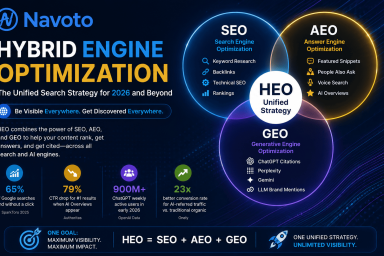
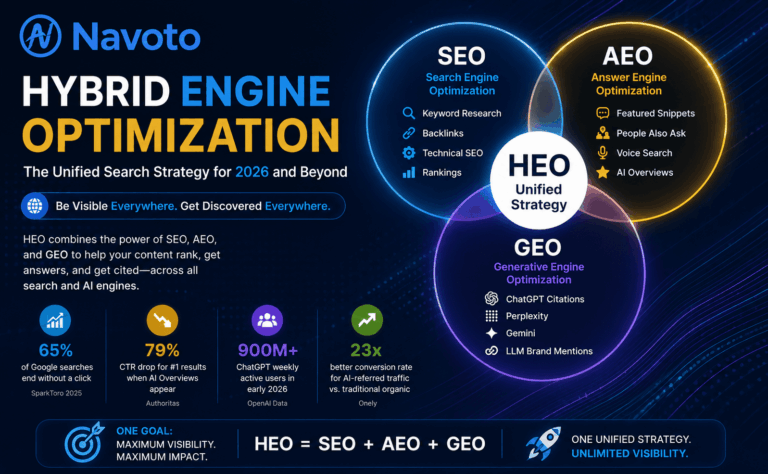
Quick Answer — What is Hybrid Engine Optimization? Hybrid Engine Optimization (HEO) is a unified search strategy that combines traditional SEO, Answer Engine Optimization (AEO), and Generative Engine Optimization (GEO) into one framework. The goal: make your content visible everywhere users now search — Google’s blue links, AI Overviews, featured snippets, voice search, and AI tools like ChatGPT, Perplexity, and Gemini — through a single, coordinated approach. The term was coined by Jori Ford at SEO Week 2025 in New York City.
For two decades, the goal of search optimization was simple: rank as high as possible on Google’s results page. That goal has not gone away. But in 2026, it is no longer enough. 65% of all Google searches now end without a single click — users get their answer from an AI Overview, a featured snippet, or a voice result and move on. ChatGPT has surpassed 900 million weekly active users. Perplexity processes 780 million queries per month. A significant and fast-growing share of your audience is getting answers from AI tools, not from a list of blue links. If your current SEO strategy was built for 2020, you are optimizing for only one of the two search worlds your audience now lives in. Hybrid Engine Optimization — HEO — is the framework that covers both worlds at once.
This guide covers HEO from first principles: where it came from, why it emerged when it did, what makes it different from traditional SEO, what its three pillars actually mean in practice, and the step-by-step implementation process that any business or marketing team can follow. By the end, you will have a clear, actionable understanding of the most important shift in search optimization since Google’s Panda algorithm in 2011.
|
65%
Of all Google searches end with zero clicks (SparkToro 2025)
|
79%
CTR drop for #1 results when AI Overviews appear (Authoritas)
|
900M
ChatGPT weekly active users in early 2026 — more than doubled in 12 months
|
23×
Better conversion rate for AI-referred traffic vs traditional organic (Onely)
|
What Is Hybrid Engine Optimization (HEO)?
Hybrid Engine Optimization is a search strategy that optimizes content for both ranking-based and answer-based discovery systems at the same time. It does not ask you to choose between traditional SEO and AI optimization. It does both, through one unified approach — because in 2026, users search in both environments, and your content needs to be present in both to capture your full potential audience.
The word “hybrid” was chosen deliberately by its creator, Jori Ford. As she explained at SEO Week 2025: “Hybrid just means it doesn’t have to be that hard. We can figure out how to create balance.” Ford’s point was that the SEO industry had created an overwhelming number of new acronyms — AEO, GEO, LLMO, AIO, SGE — each one real and valid, but treating them as entirely separate strategies was making the task unnecessarily complicated. HEO was her answer to that fragmentation: one unified framework that covers all of it.
In practical terms, HEO brings three existing optimization disciplines together:
|
🔵
SEO
Traditional Search Engine Optimization
Keyword research · Backlinks · Technical health · Rankings on Google & Bing |
🟡
AEO
Answer Engine Optimization
Featured snippets · People Also Ask · Voice search · AI Overviews |
🟣
GEO
Generative Engine Optimization
ChatGPT citations · Perplexity · Gemini · LLM brand mentions |
|
HEO = SEO + AEO + GEO → One unified strategy
|
||
Where HEO Came From: The Origin and Why It Matters
Hybrid Engine Optimization was coined by Jori Ford, Chief Marketing and Product Officer at FoodBoss, during her talk titled “Hybrid Engine Optimization: A Crawler Driven Approach to Maximizing Search & AI Visibility” at SEO Week 2025 in New York City. Ford is a veteran SEO consultant with deep expertise in organic search, crawl strategy, and site architecture.
Ford’s talk addressed a problem that was frustrating the entire SEO industry: the proliferation of new optimization acronyms. Every few months, a new framework appeared — AEO, GEO, LLMO, AIO, SGE optimization. Each one was legitimate. Each one addressed a real shift in how search worked. But treating them as entirely separate disciplines — with separate strategies, separate teams, and separate KPIs — was creating unnecessary complexity and inefficiency.
Her insight was that all of these frameworks were pointing at the same underlying challenge: search had become hybrid. Users were now discovering content across both traditional search engines and AI-powered answer engines simultaneously. The correct strategic response was not five separate tactics — it was one integrated approach that covered all of them. HEO was that approach.
In her own words at SEO Week 2025: “It’s a new phase where we have to do a blended approach as Search Engine Optimization specialists, but also as marketers. Brand is key. AI taking over is absorbing data from so many different places.”
Within months of SEO Week 2025, HEO had spread across industry blogs, podcasts, and agency playbooks. By early 2026, it was widely recognized as the working framework for modern search marketing — the most practical and complete answer to the question: how do you stay visible in an era where search happens in multiple places at once?
Why HEO Is Necessary Now: The Search Landscape That Demands It
Understanding why HEO emerged requires understanding the specific changes that made traditional SEO insufficient on its own. These are not theoretical future scenarios — they are current conditions that are already affecting traffic, visibility, and revenue for businesses globally.
The Zero-Click Crisis
According to SparkToro’s Zero-Click Study, only 360 out of every 1,000 Google searches in the US result in a click to a website. 65% of all Google searches end without any click at all. Users are getting answers from AI Overviews, featured snippets, and knowledge panels directly on the results page — without visiting any site. A July 2025 Pew Research study analysed actual browsing data from 900 US adults and found only 8% of users clicked a traditional result when an AI summary appeared, compared to 15% without one. Ranking #1 can now deliver a fraction of the traffic it delivered three years ago.
AI Overviews Are Everywhere
The share of Google queries triggering AI Overviews jumped from 6.49% in January 2025 to 13.14% in March 2025 — a 102% increase in just two months (Semrush data, analyzed by Neotype). The trend has accelerated since. When an AI-generated answer sits above your organic result, Authoritas research shows organic CTR drops by 79% — even for the #1 ranking page. The implication is stark: you can invest years earning a #1 ranking and still see your traffic halved because an AI Overview now occupies the attention space above your result.
AI Tools Are Now Mainstream Search Destinations
ChatGPT surpassed 900 million weekly active users in early 2026 — more than double the 400 million it had in February 2025. Perplexity reached a $20 billion valuation in 2025 and processes around 780 million queries per month. These are not niche tools used by early adopters. They are mainstream discovery platforms used by a massive, fast-growing share of your audience every day — and most brands have no visibility strategy for them whatsoever.
AI Traffic Converts at Dramatically Higher Rates
Here is the piece of data that makes HEO commercially urgent, not just strategically interesting: AI-referred visitors convert at 23 times the rate of traditional organic search visitors (Onely’s analysis). A visitor who arrives from a ChatGPT or Perplexity citation has already had their question answered by AI and is arriving at your website ready to act. The traffic volume is still smaller than organic — Google sends 345x more traffic than all major AI tools combined. But AI traffic converts so much better that even modest AI citation rates can produce meaningful revenue impact. Understanding the implications of this shift is covered in more depth in our guide to generative engine optimization and how to get cited by AI.
HEO vs Traditional SEO vs GEO: How They Compare
Understanding how HEO differs from — and relates to — the strategies it unifies is essential before implementing it. This comparison clarifies the relationships clearly.
| Factor | Traditional SEO | AEO | GEO | HEO (All Three) |
|---|---|---|---|---|
| Primary goal | Rank high in Google organic results | Become the direct answer in featured snippets and AI Overviews | Get cited by generative AI tools | Be visible everywhere users search |
| Platforms targeted | Google, Bing (blue link results) | Google snippets, voice search, AI Overviews | ChatGPT, Perplexity, Gemini, Claude | All of the above simultaneously |
| Key metric | Keyword rankings, organic traffic | Featured snippet ownership, voice answer rate | AI citation rate, share of voice | Total search presence across all surfaces |
| Content format priority | Comprehensive long-form pages | BLUF structure, FAQ schema, question headings | Chunked answers, entity-rich content, original data | All formats combined in every piece |
| Off-site priority | Backlinks from high-DA domains | Structured data, schema implementation | Brand mentions on AI-trusted platforms | Links + schema + multi-platform brand presence |
| Born | Mid-1990s | ~2018 (rise of voice search) | 2023–2024 (rise of ChatGPT) | April–May 2025 (SEO Week, Jori Ford) |
As this table shows, neither traditional SEO alone nor GEO alone covers the full search landscape in 2026. Only HEO addresses all channels — which is why it has become the standard framework for marketers who want sustainable, compounding visibility rather than optimizing for one channel while neglecting others.
The 7 Pillars of Hybrid Engine Optimization
These seven pillars are the complete HEO implementation checklist. Think of them as the framework every important page on your website should be evaluated against. They are sequential — each one builds on the one before it. Skip any of them and the whole structure loses stability.
Pillar 1 — Technical SEO Foundation
Nothing in HEO works without this. Both Google’s crawlers and AI bots — GPTBot (ChatGPT), ClaudeBot (Anthropic), PerplexityBot, and Google’s own crawlers — need to access and read your site without hitting obstacles. If these bots cannot reach your pages, your content cannot be indexed, ranked, or cited by anyone.
The technical foundation covers:
- Robots.txt audit: This single file can accidentally block every AI crawler from your site. Check right now: open yourdomain.com/robots.txt and verify that GPTBot, ClaudeBot, PerplexityBot, and Google-Extended are not disallowed. This is the most commonly missed and highest-impact technical issue in HEO.
- Page speed: Aim for LCP (Largest Contentful Paint) under 2.5 seconds. Slow pages rank lower in Google and are crawled less frequently by AI bots. Both penalties apply simultaneously.
- Mobile usability: Most searches — including AI searches — happen on mobile. Google uses mobile-first indexing. Pages with mobile usability issues rank below mobile-optimised competitors.
- Clean crawlability: No broken internal links, no orphaned pages, logical site structure, XML sitemap submitted to both Google Search Console and Bing Webmaster Tools.
- HTTPS: A secure site is both a trust signal and a confirmed Google ranking factor. Sites without HTTPS display “Not Secure” warnings to every visitor.
Pillar 2 — Topical Authority and Content Depth
AI tools do not look at a single page in isolation. They evaluate your entire website to decide whether you are a trustworthy, authoritative source on a topic. A website with three shallow blog posts about SEO will not be cited. A website with twenty comprehensive, interlinked, expert-level pieces covering every dimension of SEO will be.
Building topical authority for HEO requires:
- Topic cluster architecture: One comprehensive pillar page per core topic, surrounded by 5–10 cluster articles covering specific subtopics in depth — all internally linked. Read our guide to building a complete SEO content strategy for the full content cluster framework.
- Content breadth and depth: Cover topics comprehensively — not just the headline question but the sub-questions, comparisons, objections, and follow-up queries. Content with 2,900+ words averages 60% more AI citations than content under 800 words.
- Quality over quantity: In the HEO era, quality has replaced quantity as the dominant content signal. Ten excellent articles outperform fifty thin ones — for Google rankings, featured snippets, and AI citations.
Pillar 3 — AEO: Structuring Content for Direct Answers
Answer Engine Optimization is the middle layer of HEO — the bridge between traditional SEO (ranking on a results page) and GEO (being cited by AI tools). AEO focuses on structuring your content so that both Google’s featured snippet system and AI extraction processes can pull clean, accurate answers directly from your pages.
The core AEO techniques within HEO:
Pillar 4 — GEO: Getting Cited by Generative AI Tools
Generative Engine Optimization is the third pillar of HEO — and the newest. It focuses specifically on getting your content cited inside AI-generated answers from ChatGPT, Perplexity, Gemini, and other LLM-powered tools. While AEO targets Google’s own answer features, GEO targets the third-party AI platforms that now handle hundreds of millions of queries that never reach Google at all.
The most powerful GEO signals, identified through academic research at Princeton University and confirmed in multiple 2025–2026 studies:
- Original statistics and data (+33.9% visibility boost): AI cannot generate original data, so it gravitates toward sources that provide it. Include specific, verifiable statistics with named sources in your content. Example: “ChatGPT surpassed 900 million weekly active users in early 2026 (OpenAI, February 2026).”
- Expert quotations (+32% visibility boost): Direct quotations from named authorities give AI something specific and attributable to extract. Named author credentials on articles significantly improve GEO citation rates.
- Citations to authoritative sources (+30.3% visibility boost): When you link to and reference academic research, government data, and established publications, AI models recognize this as a credibility signal. LLMs check whether you back up your claims.
- Content freshness: 85% of AI Overview citations come from content published in the last two years. Update your cornerstone content every 60–90 days with fresh statistics and examples. Always display an updated date on key articles.
- Page speed and technical accessibility: Pages with FCP under 0.4 seconds average 6.7 AI citations versus 2.1 citations for slower pages — a 3x gap purely from load speed.
For the complete GEO implementation guide — including how to get cited specifically by ChatGPT, Perplexity, and Google AI Overviews — see our full deep-dive on Generative Engine Optimization.
Pillar 5 — Brand Entity Authority
AI systems understand and cite brands as entities — not just as web pages. Your brand’s “entity authority” — how clearly and consistently AI systems understand what your brand is, what it does, who it serves, and why it is trustworthy — directly determines how often it appears in AI-generated answers.
Building entity authority for HEO:
- Consistent NAP data everywhere: Name, Address, Phone number — and your brand description — should be identical across your website, Google Business Profile, Wikipedia (if eligible), Wikidata, Crunchbase, LinkedIn, and all directories.
- Organization schema markup: Add Organization (or LocalBusiness) schema to your homepage and About page. This explicitly tells Google and AI crawlers your brand’s official name, description, founding date, products/services, and social profiles.
- Third-party brand presence: 85% of AI brand mentions come from third-party sources, not your own website. Build authentic presence on platforms AI trusts: Reddit, LinkedIn, YouTube, G2, Trustpilot, Clutch, and industry-specific directories. Brands are 6.5x more likely to be cited by AI through third-party sources than through their own domain.
- Branded search volume: Brand search volume — people actively searching for your brand name — is the single strongest predictor of AI citation rates, showing a 0.334 correlation in independent research. Brand building is now simultaneously a marketing strategy and an SEO strategy.
Pillar 6 — Link Building and Off-Page Authority
In the HEO framework, backlinks and brand mentions serve a dual purpose they never had in traditional SEO. They still improve your Google rankings — their original function. But they also directly improve your AI visibility: AI tools retrieve content from pages that Google’s index has already authenticated as authoritative. A strong backlink profile is not just an SEO signal; it is an AI citation eligibility signal.
52% of AI Overview sources already rank in the top 10 organic results. You cannot separate Google authority from AI visibility — they feed each other. The link building strategies that work best for HEO:
- Original research, data studies, and benchmarks — content that earns natural citations from other publishers
- Guest articles on respected industry publications — builds both backlinks and third-party brand mentions
- Authentic community participation on Reddit, Quora, and industry forums
- PR and media coverage for company announcements and community initiatives
- Partner and client websites linking to case studies and results pages
Pillar 7 — Measurement and Iteration
HEO requires a measurement approach that goes beyond traditional keyword rank tracking. Traditional SEO metrics — keyword positions, organic traffic, CTR — remain important. But they only capture performance in one of the two search environments HEO covers. You need a blended measurement system that monitors both.
| Metric | What It Covers | Tool |
|---|---|---|
| Keyword rankings + organic traffic | Traditional SEO performance | Google Search Console, Semrush |
| AI Overview inclusion | Presence in Google’s AI Overviews for target keywords | SE Ranking AI Tracker, Semrush AI Toolkit |
| AI referral traffic | Sessions from ChatGPT, Perplexity, Gemini | GA4 referral filter (chat.openai.com etc.) |
| AI brand citation rate | How often your brand appears in AI answers | Rankscale, Otterly AI, Profound, manual testing |
| Featured snippet ownership | AEO performance — how many snippets you hold | Semrush, Ahrefs |
| Branded search volume | Brand entity strength — strongest AI citation predictor | Google Search Console (branded queries) |
For a deep comparison of the best AI rank tracking tools — platforms that monitor your brand’s citation rates across ChatGPT, Perplexity, Copilot, and Google AI Mode — see our detailed guide covering Rankscale, Otterly AI, Profound, Semrush AI Toolkit, and more.
How to Implement HEO: The Step-by-Step Process
These steps follow the natural implementation sequence. Complete them in order — each one prepares the ground for the next.
Run a full technical audit: Check crawlability, AI bot access in robots.txt, page speed (Screaming Frog, Ahrefs, PageSpeed Insights), mobile usability, and internal linking gaps. Fix critical issues before creating new content. A technically broken site cannot benefit from any other HEO investment.
Check your crawl logs: This is Jori Ford’s central HEO recommendation. Identify which AI bots (GPTBot, ClaudeBot, PerplexityBot) are visiting your site and which pages they are crawling. This data reveals your actual AI indexation status — not a theoretical estimate.
Build your topic cluster architecture: For each core topic your business targets, create a pillar page and 5–8 cluster articles covering specific subtopics. All cluster articles should internally link back to the pillar page. This structure signals topical authority to both Google and AI indexers. Read our complete guide to keyword strategy for building your cluster keyword maps.
Reformat existing content for HEO: For your top-performing pages, add BLUF openings (60-word direct answers at the start of each section), convert prose-heavy sections into bullet points or tables, add FAQ sections with schema markup, and ensure each H2 and H3 is phrased as a question. This retrofitting process typically shows AI Overview and featured snippet improvements within 60–90 days.
Implement schema markup comprehensively: Article, FAQPage, HowTo, Organization, LocalBusiness, and BreadcrumbList schema should be present across your site. Schema is the structured data layer that explicitly signals to both Google and AI crawlers what type of content each page contains and how it should be interpreted.
Build third-party brand presence: Claim and optimize your Google Business Profile, LinkedIn company page, Wikidata entry (if eligible), and relevant review platform profiles. Participate authentically in Reddit communities relevant to your industry. Contribute guest articles to respected industry publications. These off-site signals feed AI entity recognition and directly improve citation rates.
Set up HEO measurement dashboard: Connect Google Search Console and GA4. Set up GA4 referral segments for AI platforms (chat.openai.com, perplexity.ai, gemini.google.com, copilot.microsoft.com). Subscribe to an AI rank tracking tool to monitor citation rates. Review this dashboard monthly alongside your traditional SEO metrics. Use the best AI SEO tools for ongoing optimization and monitoring.
Refresh content every 60–90 days: 85% of AI Overview citations reference content published in the last two years. 50% of Perplexity citations reference 2025 content specifically. Freshness is a first-order ranking signal for AI platforms. Add new statistics, update examples, refresh your published/updated date, and re-submit pages to Google Search Console after significant updates.
The 6 Biggest HEO Mistakes to Avoid
Some people hear about HEO and assume they should pivot entirely to AI visibility. This is wrong and costly. Strong Google rankings still heavily influence whether AI tools cite your content — 52% of AI Overview sources already rank in the top 10 organic results. Keep doing keyword research, technical maintenance, content depth, and link building. HEO adds layers; it does not replace layers.
The single most common HEO implementation error. A misplaced line in robots.txt can block GPTBot, ClaudeBot, PerplexityBot, and Google-Extended simultaneously — meaning all AI indexation for your site stops immediately. Check your robots.txt today. This five-minute audit could unlock significant AI visibility you are currently blocking by accident.
Over-optimising for AI tools produces content that sounds unnatural and robotic. AI systems are trained on human language — they recognise and penalise content that reads like it was made for a machine. Write for humans first. Clear, precise, genuinely useful content outperforms keyword-stuffed, artificially structured content in both traditional rankings and AI citation rates.
In HEO, backlinks and brand mentions serve a dual purpose: they improve Google rankings AND they improve AI citation eligibility. Brands that deprioritise link building in the belief that “AI changes everything” are weakening both their traditional and AI visibility simultaneously. Consistent link building remains one of the two most important ranking signals for both Google and AI retrieval systems.
If your monthly SEO report shows only keyword rankings and organic traffic, you are measuring less than half of your actual search performance in 2026. Add AI referral traffic segments to GA4, track AI Overview inclusion for target keywords, and monitor AI brand citation rates with a dedicated LLM rank tracker. Without the full measurement picture, you cannot make informed HEO strategy decisions.
Content freshness is a first-order AI citation signal in a way it was never quite so critical for traditional SEO. AI platforms strongly prefer recent sources. A comprehensive article published in 2023 and never updated will be progressively outcompeted by fresher content on the same topic. Build a refresh schedule into your editorial calendar — cornerstone pages reviewed every 60–90 days, other posts annually.
HEO Timeline: When to Expect Results
| Timeline | What to Expect | Actions to Take |
|---|---|---|
| Weeks 1–4 | Technical fixes take effect; AI bots begin accessing previously blocked pages; crawl frequency starts improving | Technical audit, robots.txt fix, crawl log setup, schema implementation |
| Months 1–3 | Content reformatted with BLUF structure and FAQ schema begins earning featured snippets; first AI Overview appearances | Reformat top pages, add FAQ sections, implement question-format headings |
| Months 3–6 | Topic cluster authority builds; keyword rankings improve; AI citation rates for core topics become consistent | Publish cluster articles, build backlinks, expand third-party brand presence |
| Months 6–12+ | Full compounding effect: strong Google rankings feeding AI citations, brand entity recognition across all major AI platforms, measurable AI referral traffic | Maintain, refresh, expand clusters, and monitor across all channels |
Related Guides on Navoto
Build your complete HEO strategy with these related Navoto guides:
- Generative Engine Optimization (GEO): The Complete 2026 Guide — the deep-dive on GEO, the third pillar of HEO and the fastest-growing search visibility channel.
- The Best AI-Powered SEO Tools in 2026 — the tools that support every layer of HEO implementation, from content optimization to AI visibility tracking.
- The Best AI Rank Tracking Tools in 2026 — how to measure your HEO results across ChatGPT, Perplexity, Google AI Mode, and Copilot.
- SEO Content Strategy: The Complete Step-by-Step Framework — how to plan and build the content clusters that are the heart of every HEO program.
- How Many Keywords for SEO? The Complete Evidence-Based Guide — keyword strategy fundamentals that apply equally to traditional SEO and HEO content creation.
Frequently Asked Questions About Hybrid Engine Optimization
Conclusion: Search Has Gone Hybrid. Your Strategy Should Too.
Hybrid Engine Optimization is not a prediction about the future of search. It is a description of the present. Search is already hybrid. Users already split their discovery behavior between Google’s results pages and AI tools like ChatGPT and Perplexity. The only question is whether your content strategy has caught up with that reality.
HEO’s core insight — that you do not need five separate strategies for SEO, AEO, GEO, voice search, and AI visibility — is both practically true and strategically liberating. One unified approach, applied consistently across your content and technical infrastructure, covers all of them. The content that is well-structured, technically accessible, genuinely authoritative, and regularly refreshed performs better everywhere — on Google, in featured snippets, and in AI-generated answers — than content optimised narrowly for any single channel.
As Jori Ford put it at SEO Week 2025: “Hybrid just means it doesn’t have to be that hard. We can figure out how to create balance.” Start with the technical foundation. Add the content structure. Build the brand presence. Measure across all channels. The framework is clear. The opportunity is real.
Ready to Build a Hybrid Engine Optimization Strategy for Your Business?
Navoto builds HEO strategies that rank on Google and get cited by ChatGPT, Perplexity, and Gemini — one unified approach that covers every search surface your audience uses. Get a free visibility audit and find out where your content stands across traditional and AI search today.