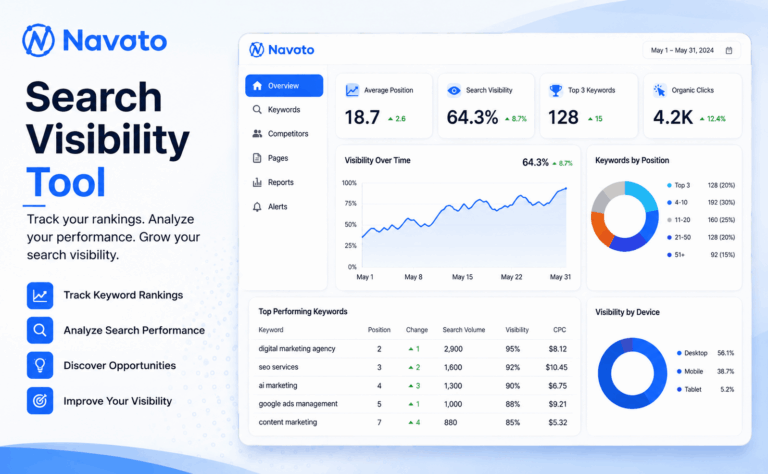
Your website could be ranking for 500 keywords — but if you can’t see exactly where you appear, for which queries, on which devices, and across which search engines and AI platforms, you’re making every marketing decision in the dark. That’s the problem a search visibility tool solves.
In 2026, the definition of “search visibility” has fundamentally expanded. It’s no longer just about your position on Google’s page one. 50% of consumers now use AI-powered search for buying decisions (McKinsey, 2025). Google’s AI Overviews appear on 86.83% of all searches. Zero-click searches now account for 58.5% of US queries. Your brand’s true visibility spans Google rankings, SERP features, local listings, AI Overviews, ChatGPT citations, Perplexity answers, and Gemini responses — simultaneously.
This complete guide from Navoto covers everything: what search visibility tools actually measure, how the metrics work, the 12 best tools available in 2026, a head-to-head comparison, and the exact strategies to improve your visibility score — across both traditional and AI search.
What Is a Search Visibility Tool?
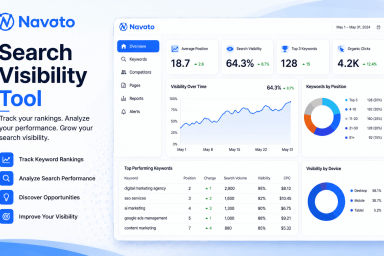
A search visibility tool is software that measures how prominently and how frequently a website or brand appears across search engine results pages (SERPs), SERP features, and increasingly, AI-generated answers — for a defined set of target keywords.
Official Definition — Navoto.com
Search visibility tool = software that aggregates your keyword ranking positions, SERP feature presence, click-through share, and AI citation frequency into a single measurable visibility score — so you can track, benchmark, and improve how often your brand is found across all modern search surfaces.
At their core, search visibility tools do five things: they crawl SERPs for your tracked keywords on a scheduled basis; they calculate a visibility score — typically a weighted metric combining rank position and estimated click-through rate for each keyword; they track changes over time so you can see the impact of your SEO actions; they benchmark you against competitors tracking the same keyword set; and in 2026, the best tools also track your presence in AI-generated answers across ChatGPT, Gemini, and Perplexity.
The tools range from free, single-purpose website visibility checkers to enterprise-grade platforms tracking millions of keywords across hundreds of markets, devices, and languages simultaneously. Understanding which category you need — and which specific tool within that category — is exactly what this guide will help you determine.
Search visibility tools are a core component of any serious SEO ranking strategy. Without one, you cannot measure whether your SEO efforts are working, identify opportunities before competitors do, or defend your positions when Google rolls out an algorithm update.
What Is Search Visibility and How Is It Measured?
Search visibility is a percentage metric that represents the share of potential organic traffic your website captures for a given set of tracked keywords, based on your current ranking positions and the click-through rate (CTR) typically associated with those positions.
The Search Visibility Formula
A visibility score of 10% means your site captures an estimated 10% of the total possible clicks for all tracked keywords. Improving from 10% to 20% means doubling your share of organic search traffic for that keyword set.
Different tools calculate visibility slightly differently — Semrush, Ahrefs, and Moz each have their own proprietary weighting formulas — which is why your visibility score may vary between platforms. What matters most is consistency within one tool over time and your score relative to competitors on the same platform.
In 2026, leading search visibility tools track visibility across multiple dimensions simultaneously:
Organic Rankings
Position 1–100 in Google (desktop & mobile), Bing, and Yahoo for each tracked keyword. The foundation of every visibility score.
SERP Features
Featured snippets, People Also Ask boxes, image carousels, local packs, knowledge panels — each drives significant visibility independent of organic rank.
AI Overviews
Presence in Google’s AI Overview responses — appearing in 86.83% of all searches in 2026. Sources cited in AI Overviews receive significant brand exposure regardless of click-through.
AI Search Citations
Brand mentions and citations in ChatGPT, Perplexity, Claude, and Gemini responses — the newest and fastest-growing visibility surface. Tracked by dedicated AI citation building tools.
Local Visibility
Presence in Google’s local pack, Google Maps, and location-specific SERP results. Critical for businesses serving specific geographic markets.
Why Search Visibility Matters More Than Rankings in 2026
Rankings tell you where you appear. Visibility tells you how much of the available traffic you’re actually capturing. Here’s why this distinction has become critical in 2026:
Consider this scenario: your website ranks #1 for a high-volume keyword. In 2020, that would mean roughly 33% of searchers click your result. In 2026, Google’s AI Overview answers that same question directly above all organic results — so many users never scroll down to click anything. Your ranking hasn’t changed, but your visibility and the traffic it delivers has been cut dramatically.
A search visibility tool that only tracks organic ranking positions is giving you an incomplete — and increasingly misleading — picture. The tools that matter in 2026 measure your presence across the entire modern search surface: organic rankings, SERP features, AI Overviews, and AI chatbot citations.
This is why visibility strategy and LLM SEO strategy must work together. The brands winning in 2026 are those that optimized for both Google’s traditional ranking signals and AI-powered answer engines — using search visibility tools that can track both dimensions simultaneously.
4 Types of Search Visibility Tools (And When to Use Each)
Not all search visibility tools do the same job. Understanding the categories helps you build a focused, non-redundant tool stack. Here are the four distinct types and exactly when each is the right choice:
TYPE 01
All-in-One SEO Suites with Visibility Tracking
Examples: Semrush, Ahrefs, Moz Pro, SE Ranking
These platforms combine keyword rank tracking, site auditing, backlink analysis, competitor intelligence, and content research in a single subscription. Their visibility scores aggregate rankings across your entire keyword portfolio and benchmark you against competitors. Best for: Marketing teams and agencies managing ongoing SEO campaigns who need a single source of truth for organic performance across all dimensions.
TYPE 02
Dedicated AI Visibility & GEO Tracking Tools
Examples: Peec AI, Profound, KIME, Ahrefs Brand Radar, Semrush AI Toolkit
A new category of tools built specifically to measure your presence in AI-generated responses from ChatGPT, Gemini, Perplexity, Claude, Copilot, Grok, and others. They track citation frequency, sentiment, and competitive share of AI-generated answers. Best for: Brands actively building an AI citation strategy who need data on their AI visibility score independent of traditional rankings.
TYPE 03
Free Search Visibility Checkers
Examples: Google Search Console, Bing Webmaster Tools, MozBar, Ubersuggest Free
Free tools provide limited but valuable visibility data — primarily keyword impressions, average position, and click-through rates from first-party Google and Bing data. Google Search Console is the most important free visibility tool available: it shows exactly which queries your site appears for, your average position, and how your visibility has changed over time. Best for: Businesses just starting SEO who need a cost-free baseline before investing in paid tools.
TYPE 04
Enterprise Search Visibility Platforms
Examples: Conductor, seoClarity, BrightEdge, Adobe Search Discovery
Enterprise-grade platforms designed for large organizations tracking thousands of keywords across multiple domains, languages, markets, and teams. They integrate with enterprise data ecosystems (Adobe, Salesforce, Google Analytics 4) and provide custom reporting, team collaboration workflows, and dedicated support. Adobe’s Search Discovery solution notably integrates AI search strategy into enterprise data infrastructure without requiring restructuring. Best for: Enterprise marketing teams managing SEO at scale across multiple brands, markets, or international domains.
The 12 Best Search Visibility Tools in 2026 (Compared)
These are the tools that actually deliver results based on 2026 testing, user data, and independent third-party analysis. Each includes what it does best, what it doesn’t do well, and pricing so you can make an informed decision for your specific situation.
Semrush
Best for: All-in-one SEO teams needing keyword research, rank tracking, site audits, content optimization, and PPC intelligence in one platform. Semrush leads the market in breadth — its Position Tracking tool monitors keyword visibility daily across desktop and mobile in 140+ countries. The Visibility Score dashboard gives you a clear percentage metric showing your share of voice for your tracked keyword set. In 2026, Semrush added its AI Toolkit for tracking AI Overview presence, making it one of the first major platforms to bridge traditional and AI search visibility.
✅ Strengths
- Largest keyword database (over 21 billion keywords)
- Daily rank tracking with email alerts
- Competitor visibility benchmarking
- AI Overview tracking (2026 update)
- Best local SEO visibility tools
⚠️ Weaknesses
- More expensive than most alternatives
- Can be overwhelming for beginners
- AI visibility tracking still maturing
Ahrefs
Best for: Backlink-focused teams and those prioritizing data accuracy over breadth. Ahrefs holds a 14.83% market share in the SEO tools category (6sense, 2026) — the highest of any SEO platform. Its Rank Tracker delivers accurate visibility scoring across desktop and mobile in 170+ countries. The standout 2026 addition is Ahrefs Brand Radar ($199/month add-on) — the largest AI visibility tracking database with 286M+ prompts — which tracks how your brand appears in LLM responses across ChatGPT, Gemini, and others. Independent studies consistently rank Ahrefs as the most accurate tool for organic traffic estimates.
✅ Strengths
- Most accurate traffic and ranking estimates
- World’s largest, freshest backlink index
- Brand Radar for LLM visibility (286M+ prompts)
- Best for content gap and competitor analysis
⚠️ Weaknesses
- AI visibility requires paid Brand Radar add-on
- No local SEO tool (unlike Semrush)
- Steeper learning curve for non-SEOs
Google Search Console
Best for: Every website, every budget — this is non-negotiable. Google Search Console is the only tool that provides first-party Google data: the exact queries your site appears for, your precise average position, your click-through rates, and your total impressions. No sampling, no estimation. 2026 updates brought enhanced AI Overview reporting, showing which pages are being cited in AI Overviews and the impressions they generate. Every serious SEO ranking strategy must start here.
Moz Pro
Best for: Beginners and small businesses who want an approachable, well-documented tool with the industry-standard Domain Authority (DA) metric. Moz Pro’s Rank Tracker provides clean visibility reporting with straightforward percentage-based scores. Its keyword visibility tool shows share-of-voice clearly without requiring advanced SEO knowledge to interpret. Moz is the most affordable major tool and offers the best educational resources (Moz Academy, Whiteboard Friday) for teams building internal SEO expertise.
✅ Strengths
- Most affordable entry-level price ($49/mo)
- Best beginner-friendly interface
- Industry-standard Domain Authority metric
- Best educational resources and community
⚠️ Weaknesses
- Smaller database than Semrush/Ahrefs
- Limited AI visibility tracking in 2026
- Not ideal for advanced content operations
From $65/mo
Growing fast as a mid-market alternative to Semrush. Strong rank tracking, white-label reporting for agencies, and a user-friendly visibility dashboard. Has begun integrating AI visibility features for AI Overviews monitoring. Best for: Agencies needing white-label visibility reports without Semrush’s price tag.
BEST FOR AGENCIES
From $99/mo
Dedicated AI visibility platform tracking 10 AI engines daily including ChatGPT, Google AI Overviews, Perplexity, Gemini, Grok, Claude, Meta AI, and DeepSeek. Its “Actions” feature converts visibility data into a prioritized fix list. Built specifically for teams transitioning from traditional SEO to GEO. Best for: Brands prioritizing AI citation tracking above traditional rank tracking.
BEST AI VISIBILITY TOOL
From $79/mo
Primarily a content optimization platform but integrates rank tracking and AI visibility monitoring. Exceptional for improving the on-page signals that drive both traditional and AI search visibility. Its content editor shows real-time optimization scores as you write. Best for: Content teams wanting visibility tracking and on-page optimization in one workflow. Pair with our AI marketing guide for maximum impact.
BEST FOR CONTENT TEAMS
From $59/mo
All-in-one AI visibility tool launched in 2025, now with 200+ active users. Tracks, analyzes, and improves how your brand shows up in AI search results and LLMs. Praised for rapid product iteration based on user feedback. Growing fast in the AI visibility category. Best for: Brands wanting dedicated LLM visibility tracking at a lower price point than enterprise alternatives.
BEST VALUE AI TRACKER
From $167/mo
Broader digital intelligence platform excelling at traffic estimation and competitive benchmarking. While not purely an SEO visibility tool, SimilarWeb’s market intelligence capabilities — tracking total traffic share across channels, not just organic — give a wider view of search visibility in the context of total digital presence. Best for: Strategy and competitive intelligence teams needing cross-channel visibility data.
BEST FOR COMPETITIVE INTEL
From $29/mo
Neil Patel’s affordable platform covering keyword tracking, rank visibility, site audit, and competitor analysis. Not the deepest tool on any individual metric but excellent value for small businesses needing basic visibility tracking across all key dimensions. Best for: Startups and small businesses with limited SEO budget who need a single, affordable tool.
BEST BUDGET OPTION
Enterprise pricing
Enterprise-grade organic marketing platform with advanced AEO features. Conductor provides both traditional search visibility scoring and Answer Engine Optimization tracking — measuring how content performs in AI-generated answers across all major platforms. Integrates with enterprise data stacks. Best for: Enterprise marketing teams needing a platform-level solution with professional support.
BEST ENTERPRISE OPTION
FREE
Often overlooked but critical in 2026. Since ChatGPT and Microsoft Copilot both use Bing as their primary search index for live queries, your Bing visibility directly impacts your ChatGPT citation probability. Bing Webmaster Tools shows your keyword performance, impressions, and rankings on Bing — an indirect but powerful signal for AI search visibility. Best for: Any brand targeting ChatGPT or Copilot citations. Use alongside Google Search Console.
CRITICAL FOR CHATGPT VISIBILITY
Full Feature & Pricing Comparison Table
Use this at-a-glance reference to compare the top search visibility tools across every key dimension. Data verified as of June 2026.
| Tool | Starting Price | Rank Tracking | AI Visibility | Site Audit | Backlinks | Best For |
|---|---|---|---|---|---|---|
| Semrush | $139.95/mo | ⭐⭐⭐⭐⭐ | ⭐⭐⭐⭐ | ⭐⭐⭐⭐⭐ | ⭐⭐⭐⭐ | All-in-one teams |
| Ahrefs | $129/mo | ⭐⭐⭐⭐⭐ | ⭐⭐⭐⭐⭐ | ⭐⭐⭐⭐ | ⭐⭐⭐⭐⭐ | Accuracy + backlinks |
| Google Search Console | FREE | ⭐⭐⭐⭐ | ⭐⭐⭐ | ⭐⭐⭐ | ⭐ | Everyone — essential |
| Moz Pro | $49/mo | ⭐⭐⭐⭐ | ⭐⭐ | ⭐⭐⭐⭐ | ⭐⭐⭐ | Beginners, budget |
| SE Ranking | $65/mo | ⭐⭐⭐⭐ | ⭐⭐⭐ | ⭐⭐⭐⭐ | ⭐⭐⭐ | Agencies, white-label |
| Peec AI | $99/mo | ⭐⭐ | ⭐⭐⭐⭐⭐ | ⭐⭐ | ⭐ | AI/GEO tracking |
| Surfer SEO | $79/mo | ⭐⭐⭐ | ⭐⭐⭐ | ⭐⭐⭐ | ⭐⭐ | Content optimization |
| Ubersuggest | $29/mo | ⭐⭐⭐ | ⭐⭐ | ⭐⭐⭐ | ⭐⭐ | Small business, starter |
How to Improve Search Visibility: 8 Proven Strategies
Picking the right tool is step one. Using it to guide the right actions is where the real work — and the real results — happen. These are the eight highest-impact strategies for improving your search visibility score, based on what’s working in 2026:
Fix Technical Visibility Blockers First
Before investing in content or links, use your search visibility tool to identify and fix technical issues that are actively suppressing your visibility: crawl errors, duplicate content, broken internal links, missing canonical tags, accidental noindex directives, and pages excluded from your sitemap. Technical fixes deliver the fastest visibility improvements because they unlock pages that are already well-optimized but artificially invisible. A thorough SEO audit is the first step here.
Expand Your Tracked Keyword Set Strategically
Many brands track too few keywords and therefore see an artificially high (or low) visibility score that doesn’t reflect real opportunity. Use your tool’s keyword research features to identify long-tail variations, question-based queries, and semantic clusters related to your core topics. Adding 50–100 strategically chosen keywords to your tracking — especially those with clear purchase intent — often reveals significant ranking gaps that represent your fastest path to visibility growth.
Target SERP Features, Not Just Organic Positions
Featured snippets, People Also Ask boxes, and image packs often deliver more visibility than a standard #5 organic ranking. Use your tool’s SERP feature tracking to identify which features your competitors are winning for keywords where you already rank on page one. Optimizing specifically for featured snippets (using direct question-answer formatting, concise definitions, ordered lists) can dramatically increase your visibility score without moving your organic ranking at all. Build these into your AI citation building strategy too.
Update High-Position, Low-CTR Pages
Your visibility tool will reveal pages ranking in positions 4–10 that receive fewer clicks than expected. These are your highest-leverage optimization targets — they already have Google’s trust, they just need better title tags and meta descriptions to earn more clicks. Use Search Console’s performance report to find pages with impressions but low CTR. Rewrite title tags to be more compelling and specific. Test different formats — numbers, questions, “year” modifiers — and track CTR improvements monthly.
05 — Build Topical Authority Clusters
Use your tool’s keyword gap analysis to identify all topics in your domain where you have limited content coverage. Build topic clusters — one pillar page covering the broad topic, supported by 8–12 detailed articles on subtopics — all interlinked. This systematically expands your tracked keyword set while building the topical authority that Google’s 2026 algorithm rewards most heavily. Our LLM SEO guide covers how clusters also drive AI visibility.
06 — Track & Defend Position Changes Weekly
Set up automated alerts in your visibility tool for any keyword that drops more than 3 positions in a week. A sudden drop often signals a competitor published better content, a technical issue emerged, or Google rolled out an algorithm update targeting your content type. Weekly monitoring and rapid response is what separates brands that maintain top-5 visibility from those that see their hard-won positions gradually erode without noticing until revenue drops.
07 — Core Web Vitals & Mobile Optimization
Google’s Page Experience signals — LCP, INP, CLS — directly affect ranking positions and therefore visibility scores. Use your search visibility tool’s site audit features to identify Core Web Vitals failures. Target LCP under 2.5s, INP under 200ms, CLS under 0.1. Mobile-First Indexing means Google ranks the mobile version of your pages — any mobile performance issues directly suppress your visibility score across all devices.
08 — Add AI Search Visibility to Your Dashboard
In 2026, a search visibility strategy that only tracks Google organic positions is incomplete. Set up a dedicated AI Traffic channel in GA4 (tracking chatgpt.com, perplexity.ai, claude.ai, gemini.google.com referrals). Use Ahrefs Brand Radar or Peec AI to track LLM citation frequency. Run weekly manual tests on your top 20 target queries across ChatGPT, Gemini, and Perplexity. Report on AI visibility alongside traditional search visibility every month.
AI Search Visibility: The New Frontier You Can’t Ignore
Traditional search visibility tools measure your presence on results pages. But as AI Overviews now appear on 86.83% of Google searches, and as 800 million weekly ChatGPT users get answers without visiting any website, a new visibility category has emerged that no traditional tool was built to measure: AI search visibility.
AI search visibility measures how prominently your brand appears within AI-generated answers — not just as a ranked result, but as a cited source within the answer itself. AI-referred visitors engage at measurably higher quality: they browse 12% more pages per visit and show a 23% lower bounce rate than non-AI referrals (Adobe Business, 2026). This is the highest-intent traffic on the internet.
The brands winning AI search visibility in 2026 are combining three elements that work together:
Entity Authority
A verified, consistent brand entity across Wikidata, directories, and the knowledge graph that AI systems trust as a legitimate source
AI-Optimized Content
Structured, front-loaded, data-rich content that AI crawlers can extract and cite as a direct answer to user queries
Technical Access
Robots.txt that allows all AI crawlers, schema markup, fast page load, and llms.txt so AI systems can discover and process your best content
To build this AI visibility layer fully, read our complete guides on AI citation building, LLM SEO strategy, and our GEO guide. These three resources together give you the complete system for both traditional and AI search visibility.
How to Choose the Right Search Visibility Tool for Your Business
With 12+ tools compared above, the right choice depends on your specific situation. Use this decision framework:
| Your Situation | Recommended Tool | Why |
|---|---|---|
| Just starting SEO, zero budget | Google Search Console + Bing Webmaster | Free, first-party data, covers both Google and Bing (ChatGPT) visibility |
| Small business, limited budget | Moz Pro ($49/mo) | Most affordable paid tool with all core visibility features and the best learning resources |
| Growing business, all-in-one needs | Semrush ($139.95/mo) | Best breadth across keyword research, rank tracking, site audit, content, and AI Overviews |
| SEO agency managing multiple clients | SE Ranking ($65/mo) | White-label reporting, multi-client management, strong rank tracking at agency-friendly pricing |
| Brand focused on AI search visibility | Peec AI + GSC | Peec AI for LLM citation tracking (10 AI engines), GSC for traditional visibility baseline |
| Data-driven SEO team, backlinks matter | Ahrefs ($129/mo) | Most accurate data, best backlink index, Brand Radar for AI visibility, best for competitive research |
| Content team creating SEO content | Surfer SEO + Semrush | Surfer for on-page optimization scoring, Semrush for tracking if the content is moving the visibility needle |
| Enterprise marketing team | Conductor or BrightEdge | Enterprise-grade platform, integrates with Adobe/Salesforce, multi-team collaboration, dedicated support |