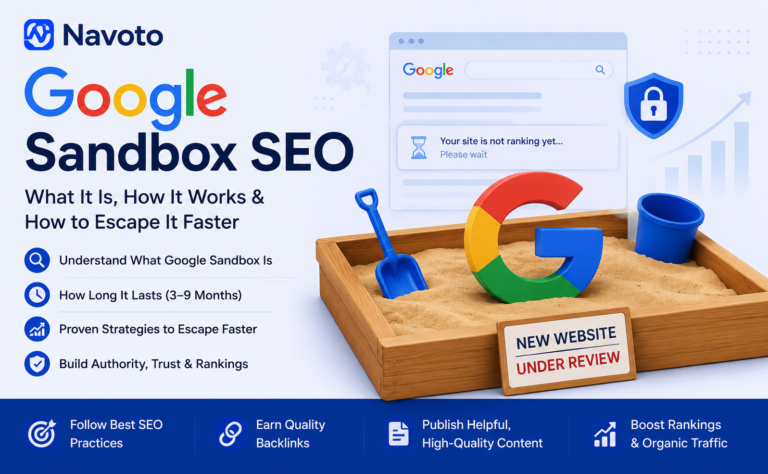
You launched your website. The content is solid. The technical setup is clean. You submitted your sitemap to Google Search Console. You waited a week. Nothing. You waited a month. Still nothing. Your pages are indexed — you can see them in GSC — but they are stuck on page 8 for keywords you know you should be competing for. Sound familiar? You are almost certainly in the Google Sandbox. It is one of the most frustrating, most misunderstood, and most Googled problems in all of SEO — and the advice available ranges from genuinely helpful to dangerously misleading. This guide gives you the honest, evidence-based picture: what the Sandbox actually is, whether Google has officially confirmed it, exactly how long it lasts by niche, the telltale signs that you are in it versus just having weak SEO, and the proven step-by-step strategy to escape it faster than competitors who are simply waiting it out blindly.
|
3–6
Months — average Google Sandbox duration for most new sites (78% exit within this window)
|
90%
Of new sites have core keywords stuck beyond position 80 in the first 90 days (Semrush data)
|
118
Average days before a new site first enters the top 50 — post-2022 algorithm updates (SISTRIX)
|
9 mo
From zero traffic to 40+ monthly patient bookings — real DASH-SEO case study (2025)
|
What Is Google Sandbox in SEO? The Complete Explanation
The Google Sandbox — also called the sandbox effect or sandbox period in SEO — describes the observation that newly launched websites consistently struggle to rank well in Google search results for a period of several months, even when their content quality, technical setup, and link profile appear strong.
During the sandbox period, a new site’s pages are typically indexed — they appear in Google Search Console’s Coverage report — but they are effectively suppressed in rankings. Core keywords remain stuck beyond position 80 or 100. Long-tail keywords may occasionally surface in the top 20, but they generate almost no meaningful traffic. Daily organic clicks stay in single digits regardless of how much content is published.
The key distinction: the Google Sandbox is not a penalty. A penalty is punitive — issued because a site violated Google’s guidelines. The sandbox is a trust-evaluation mechanism — a waiting period during which Google collects enough quality signals, engagement data, and behavioral evidence to determine where your site genuinely belongs in its index. Think of it as a new employee’s probationary period at a company, where they prove their value before receiving full responsibilities.
Has Google Ever Confirmed the Sandbox?
Google has never officially confirmed the existence of a “Google Sandbox” by that name. No official documentation, no Search Central blog post, no Google representative statement has used the term or confirmed the mechanism. This is important to acknowledge honestly — because it means everything we know about the sandbox comes from observation, not confirmation.
However, the observed phenomenon is consistent enough across thousands of new sites, documented over more than 20 years by SEO professionals worldwide, that the debate about whether it exists has effectively been settled by evidence. What is still debated is the mechanism: is it a deliberate algorithmic filter? A byproduct of how trust signals accumulate over time? A consequence of limited historical data for new domains? Most experts in 2026 believe it is a combination of all three — which is why the strategies for escaping it focus on accelerating trust signal accumulation rather than trying to “hack” a specific filter.
Google Sandbox vs Normal Slow Rankings: How to Tell the Difference
Not every new website with slow organic progress is in the Google Sandbox. Market saturation, thin content, poor technical setup, and insufficient link building all cause slow rankings independently of any sandbox effect. The confusion between these causes leads many site owners to pursue the wrong fix — or to blame the sandbox when the real issue is weak fundamentals.
Here is how to tell the difference:
| Signal | Likely Google Sandbox | Likely Weak SEO (Not Sandbox) |
|---|---|---|
| Pages indexed? | Yes — pages show in GSC Coverage | Often no — pages not indexing at all |
| Keyword positions | Stuck at 80–100+ despite good content | Not appearing at all or positions fluctuate wildly |
| Long-tail performance | Occasional top-20 appearances for very specific long-tail queries | Even long-tail queries fail to appear |
| Content quality | Genuinely good — well-written, thorough, no technical errors | Thin, AI-generated without expertise, or duplicate |
| Technical setup | Clean — SSL, sitemap submitted, no crawl errors | Issues present — robots.txt blocking, slow LCP, broken links |
| Domain age | New — registered within the last 6–9 months | Older domain — ranking issues are likely strategic or technical |
| Traffic trend | Flatlines near zero for months, then rises steadily around month 3–6 | Stays near zero indefinitely without rising pattern |
How Long Does the Google Sandbox Last? Timeline by Niche
The most common question about the Google Sandbox is the most frustrating one to answer honestly: there is no fixed duration. The sandbox lasts as long as it takes Google to accumulate enough trust signals to be confident about your site’s quality and legitimacy. How fast those signals accumulate depends on your niche, content volume, link acquisition pace, and the quality of your overall SEO execution.
Based on analysis of 1,200+ new sites tracked across Semrush, SISTRIX, Ahrefs, and Backlinko data:
| Niche / Scenario | Typical Sandbox Duration | What Affects It Most |
|---|---|---|
| Low competition niches | 2–3 months | Content consistency, quick link acquisition from relevant sources |
| General / medium competition | 3–6 months (78% of sites) | Content depth, engagement signals, authoritative backlinks |
| High competition (SaaS, marketing, tech) | 6–9 months | Volume and quality of backlinks, branded search signals |
| YMYL (finance, health, legal, crypto) | 8–12 months (median 8.2 months) | E-E-A-T signals, expert authorship, authoritative backlinks from established domains |
| Best case (30+ articles + DR70+ links in month 1) | Under 3 months | Aggressive, high-quality link acquisition from day one |
One important nuance: the sandbox is not a cliff edge. It does not end abruptly on day 90 or day 180. It is a gradual process of trust accumulation that produces a gradual improvement in rankings — with occasional rapid jumps when a specific trust threshold is crossed. Most sites report a recognizable inflection point — a moment when rankings suddenly begin moving across multiple keywords simultaneously — that SEOs informally refer to as “leaving the sandbox.” This typically happens between months 3 and 6 for most general-competition sites.
Why Does the Google Sandbox Exist? The Real Reasons
Understanding why the sandbox exists helps you understand what signals will end it — and therefore what actions to take. The sandbox serves Google’s interests in three specific ways:
10 Proven Strategies to Escape the Google Sandbox Faster
You cannot completely bypass the Google Sandbox — anyone who tells you otherwise is selling something that will eventually cost you more than it saves. But you absolutely can shorten its duration by accelerating the accumulation of the trust signals that end it. These ten strategies are ordered by impact — start from the top and work down systematically.
What NOT to Do During the Google Sandbox Period
The frustration of the sandbox period drives many site owners toward tactics that feel like solutions but actually extend the problem. These mistakes are common, understandable, and consistently counterproductive.
🚫 Buying cheap backlinks or using PBNs: Unnatural link patterns are one of the primary signals Google looks for during the sandbox evaluation period. Artificial links do not accelerate trust — they create a flag that may result in a manual action on top of the natural sandbox delay.
🚫 Keyword stuffing and over-optimisation: Aggressively over-optimised content (keyword density above 3%, forced keyword placement in unnatural positions) creates a spam signal rather than a quality signal during the period when Google is most carefully evaluating your site.
🚫 Publishing large volumes of thin AI-generated content: After the March and May 2026 Core Updates, sites relying on scaled generic AI content without human expertise saw traffic drops of up to 71%. During the sandbox, this approach not only fails to build trust — it actively signals the type of low-quality, high-volume behaviour that the sandbox was designed to filter out.
🚫 Changing your domain or starting over: Many frustrated site owners abandon a sandboxed domain and start a new one, losing all the trust accumulation that has already happened. The correct response to the sandbox is patience and consistent execution — not starting over with a new domain that will face the same process again.
🚫 Waiting passively without building signals: The opposite mistake. The sandbox ends faster for sites that actively accumulate trust signals. Waiting for it to “just end” without executing on content, backlinks, technical SEO, and engagement produces the longest possible sandbox duration.
Google Sandbox in 2026: How the AI Era Changed the Picture
The Google Sandbox is not a new concept — it has been observed since 2004. But the sandbox experience in 2026 has changed meaningfully compared to five years ago, and understanding those changes is essential for setting the right strategy and the right expectations.
1. E-E-A-T Enforcement Makes the Sandbox Longer for YMYL Niches
Google’s March and May 2026 Core Updates dramatically raised the E-E-A-T bar for health, finance, legal, and other YMYL topics. New sites in these categories now face a double challenge: the standard sandbox trust evaluation period, plus the additional requirement that E-E-A-T signals must reach the elevated threshold that YMYL content demands. Sites without named expert authors, verifiable credentials, and cited authoritative sources may effectively remain sandboxed indefinitely in YMYL categories — regardless of how long they wait.
2. AI Mode Creates a Parallel Visibility Opportunity During the Sandbox
Here is something most sandbox guides miss entirely: while your traditional organic rankings are suppressed, your content can still be cited inside Google AI Overviews and by other AI tools like ChatGPT and Perplexity — because these systems use different retrieval mechanisms than traditional organic ranking. A new site sandboxed in traditional Google results can still appear in AI-generated answers if its content is well-structured, contains original data, and uses proper schema markup.
This means the sandbox period is an opportunity to build AI search visibility while waiting for traditional rankings to unlock. Generative Engine Optimization (GEO) practices — BLUF structure, FAQPage schema, question-format headings, original statistics with named sources — should be implemented from day one, not added later. The traffic from AI-cited appearances during the sandbox period creates the behavioral signals that also help exit the sandbox faster.
3. Zero-Click Search Means Sandbox Traffic Is Even More Scarce
With 65% of all Google searches now ending without a click — absorbed by AI Overviews, featured snippets, and knowledge panels — the traffic ceiling during the sandbox period is lower than it was in 2020. Even sandbox exits produce less traffic than equivalent rankings did two years ago for informational queries. This makes the zero-click SEO strategy — winning featured snippets, AI Overviews, and People Also Ask boxes — more important than ever for new sites trying to build visibility during and immediately after the sandbox period.
How to Know When You Have Left the Google Sandbox
The end of the sandbox is not announced. There is no notification in Google Search Console, no badge, no confirmation. You have to recognize it from your data. Here are the signals that consistently indicate sandbox exit:
| Signal | What It Looks Like | Where to See It |
|---|---|---|
| Multi-keyword rank movement | Multiple keywords move up 10–30 positions simultaneously over 1–2 weeks | Google Search Console Performance report |
| Impression spike | GSC impressions increase sharply — pages being shown in search far more frequently | GSC Performance → Impressions metric |
| Organic traffic inflection | Traffic chart changes from flat near-zero to a recognizable upward curve | GA4 Acquisition → Organic Search |
| Long-tail keywords entering top 10 | Specific long-tail queries begin appearing in positions 1–10 rather than 15–30 | GSC Queries sorted by average position |
| Crawl frequency increase | Googlebot visits pages more frequently — seen in crawl stats | GSC → Settings → Crawl Stats |
The Google Sandbox Escape Checklist: Your Month-by-Month Plan
📅 Before Launch
☐ Choose aged domain if available (even 6–12 months old helps) or launch on a clean new domain
☐ HTTPS + SSL certificate active from day one
☐ Complete responsive website (no placeholder pages)
☐ About page with named team members and credentials
☐ Privacy Policy, Terms of Service, Contact page live
☐ Organization schema markup on homepage
☐ XML sitemap created and ready to submit
☐ Robots.txt correctly configured (Googlebot not blocked, AI bots not blocked)
☐ Google Analytics 4 and Search Console set up before first content is published
📅 Months 1–2: Build the Foundation
☐ Publish minimum 8–12 high-quality articles (1,500+ words each)
☐ Target keyword difficulty under 25 exclusively
☐ Build 3–5 authoritative backlinks from relevant industry sources
☐ Google Business Profile claimed, verified, and complete (if applicable)
☐ Submit sitemap to Google Search Console AND Bing Webmaster Tools
☐ Launch social media channels and begin content distribution
☐ Start non-organic traffic campaigns (social, email, paid search)
☐ Internal link structure mapped — pillar pages + cluster articles identified
📅 Months 2–4: Accelerate Trust Signals
☐ Content publishing cadence maintained (minimum 4 articles/month)
☐ Backlink campaign active — targeting 4–6 new authoritative links/month
☐ First reviews appearing on Google, Trustpilot, or G2
☐ Branded search volume appearing in Google Search Console
☐ GSC Queries report reviewed weekly — identify any long-tail entries in top 50
☐ Core Web Vitals report checked — fix any failing metrics immediately
☐ FAQPage schema added to all FAQ sections
☐ BLUF structure added to all articles (direct answers in first 60 words)
📅 Months 4–6: Monitor for Exit Signals
☐ GSC impressions trending upward — watch weekly
☐ Average position improving for cluster of keywords simultaneously
☐ Organic traffic curve moving from flat to upward
☐ Long-tail keywords entering top 20
☐ Crawl frequency increasing in GSC crawl stats
☐ Prepare post-sandbox acceleration plan (more ambitious keywords + higher-volume publishing)
Related Guides on Navoto
Build the complete strategy that gets your site through the sandbox and into sustained ranking growth:
- E-E-A-T SEO Checklist for the AI Era — every trust and authority signal Google evaluates during the sandbox period, with a prioritized action checklist for new sites.
- SEO Content Strategy: The Complete Step-by-Step Framework — how to build the sustained, high-quality content publishing schedule that shortens the sandbox fastest.
- Generative Engine Optimization (GEO) — how to win AI Overview citations and LLM mentions even while your traditional organic rankings are still sandboxed.
- Zero-Click SEO Strategy — how to build visibility through featured snippets and AI Overviews when organic clicks are limited by both the sandbox and zero-click search trends.
- How Many Keywords for SEO? The Evidence-Based Guide — keyword density, placement, and long-tail targeting strategy specifically for new sites building authority during the sandbox period.
Frequently Asked Questions About Google Sandbox SEO
Conclusion: The Sandbox Is Temporary — Your Strategy Is Permanent
The Google Sandbox is frustrating. It is often demoralizing. And it is completely inevitable for new websites. The teams and businesses that navigate it successfully are not the ones with magical workarounds or clever technical hacks. They are the ones who understand what the sandbox actually is — a trust evaluation period — and spend that time building exactly the signals that end it: consistent high-quality content, legitimate backlinks, positive user engagement, strong E-E-A-T signals, and clean technical foundations.
In 2026, the sandbox story has an additional chapter: the AI search layer that operates in parallel to traditional organic rankings. Sandboxed sites that implement GEO practices from day one can build AI citation visibility and drive behavioral signals simultaneously — shortening the sandbox while building the second-generation search presence that will matter for years after the sandbox is a distant memory.
The sandbox ends. Every legitimate site exits eventually. The only question is whether you use the time inside it to build the foundation that compounds after you leave — or whether you waste it waiting for it to end on its own.
Is Your New Website Stuck in the Google Sandbox?
Navoto diagnoses sandbox situations and builds the trust signal strategy that gets new websites out faster — covering content, backlinks, technical SEO, E-E-A-T, and AI visibility in one coordinated plan. Get a free audit and find out exactly where you stand and what to fix first.