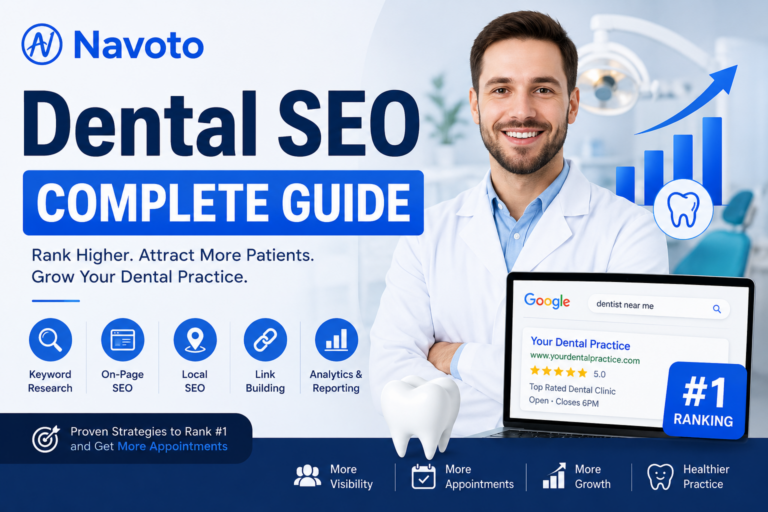
When a person needs a dentist, they open Google and type three words: “dentist near me.” The three practices that appear in the map pack at the top of that page will capture the overwhelming majority of those calls. Every practice below them gets almost nothing. Dental SEO is what decides which side of that line your practice sits on. This is the most complete dental SEO guide available in 2026 — written for practice owners and dental marketers who want to understand exactly what drives rankings, what a winning strategy looks like from start to finish, and how to measure results that actually matter.
More than 70% of patients now use Google to find a dentist before booking an appointment. Searches for “dentist near me” have grown over 200% in the last five years. Nearly 46% of all Google searches have local intent — and dental searches are among the most local, most urgent, and highest-converting in any industry. Dental SEO optimization is not optional for a growing practice. It is the foundation that every other marketing channel is built on.
|
70%+
Patients Google a dentist before booking
|
200%
Growth in “dentist near me” searches, 5 years
|
76%
Local mobile searches → visit within 24 hours
|
3×
More calls for practices with 4+ star ratings
|
What Is Dental SEO and Why Does It Matter for Your Practice?
Dental SEO is the specialized practice of improving a dental website’s visibility in search engines — primarily Google — so that potential patients find your practice before they find your competitors. It combines technical website optimization, locally-targeted content, Google Business Profile management, link building, and online reputation into one continuous growth strategy.
Unlike paid advertising, where visibility stops the moment your budget runs out, dental search engine optimization builds compounding authority over time. The rankings you earn through SEO continue working 24 hours a day, 7 days a week, at no cost per click. A well-optimized dental practice website can generate 30, 50, or even 100+ new patient enquiries per month from organic search alone — with no recurring ad spend required.
Dental content falls under what Google classifies as YMYL — Your Money or Your Life — meaning Google applies its highest standards of evaluation to dental websites. This makes dental SEO marketing more nuanced than SEO in most other industries. Expertise, authoritativeness, and trustworthiness (E-E-A-T) are not nice-to-haves for dental practices — they are the core currency of dental search rankings.
How Google Ranks Dental Practices: The 3 Core Signals
Understanding how Google decides which dental practices rank at the top — both in the local map pack and in organic results — is the foundation of every effective dental SEO strategy. Google uses three primary signals for local search, plus a broader set of on-site and off-site factors for organic rankings.
The 3 Local Map Pack Ranking Signals
Google checks whether your Google Business Profile and website clearly signal what services you offer and for whom. A dental practice that has clearly listed “pediatric dentist,” “cosmetic dentistry,” “dental implants,” and “emergency dentist” as services will rank for those specific searches. Vague or incomplete listings get passed over for more clearly defined competitors.
Distance is one of the strongest local ranking signals. Google prioritizes practices geographically close to where the patient is searching from. While you cannot change your location, you can expand your effective proximity reach by creating location-specific content, optimizing for neighborhood-level keywords, and building citations that confirm your service area boundaries.
Prominence reflects your practice’s overall online authority — measured through Google reviews, citation consistency, backlinks, website authority, and online mentions. This is the most directly improvable of the three signals, and it is where consistent dental SEO work pays the biggest dividends over time.
Complete Dental SEO Ranking Factor Overview
| Ranking Factor | Weight in Local Rankings | Primarily Affects |
|---|---|---|
| Google Business Profile signals | Very High | Local map pack (3-pack) |
| Review signals (quantity, rating, velocity, responses) | ~15% of local ranking factors | Map pack + organic trust |
| On-page SEO (keywords, structure, schema) | High | Organic search rankings |
| NAP citation consistency | High | Map pack + trust signals |
| Backlinks from local / dental authority sites | Medium-High | Organic + prominence |
| Website technical health (speed, mobile, Core Web Vitals) | Medium-High | Organic rankings |
| Content quality and E-E-A-T signals | High (YMYL category) | Organic rankings + AI citation |
| Behavioral signals (CTR, engagement, calls) | Growing | Map pack + organic |
Dental Keyword Research: The Foundation of Every SEO Strategy
Effective dental search engine marketing begins with understanding exactly how your patients search. The biggest keyword mistake dental practices make is targeting only the broadest terms — “dentist,” “dental clinic” — while ignoring the highly specific, high-converting phrases that actually drive bookings. A complete dental SEO guide to keyword strategy organizes searches into four clear categories.
The 4 Dental Keyword Categories
| Category | Examples | Patient Intent | Priority |
|---|---|---|---|
| Transactional Local | “dentist near me,” “dentist in [city],” “emergency dentist open now” | Ready to book immediately | Highest |
| Service-Specific | “dental implants [city],” “teeth whitening near me,” “Invisalign dentist” | Specific treatment research | Very High |
| Specialty-Specific | “cosmetic dentist near me,” “pediatric dentist [city],” “orthodontist” | Specific type of dentist | High |
| Informational | “how much do dental implants cost,” “are veneers painful” | Research, not yet booking | Medium (blog content) |
Dental Service Keywords: The Full Targeting Map
Each dental service should have its own dedicated, optimized page on your website — not a paragraph on a general “services” page. This is one of the most consistently underused tactics in dental SEO optimization. Here is the service-by-service keyword targeting map every dental practice needs:
| Service | Primary Keywords | Page Type |
|---|---|---|
| General Dentistry | dentist near me, family dentist [city], dental check-up | Homepage + core service page |
| Dental Implants | dental implants [city], dental implant cost, same-day implants — dental implant SEO is high-value | Dedicated implants page |
| Cosmetic Dentistry | cosmetic dentist near me, teeth whitening, veneers — SEO for cosmetic dentists targets high-value patients | Dedicated cosmetic page |
| Orthodontics | Invisalign dentist [city], braces near me, clear aligners | Dedicated orthodontics page |
| Emergency Dentistry | emergency dentist near me, emergency tooth extraction, dentist open now | Emergency page (converts at 89% higher rate) |
| Pediatric Dentistry | pediatric dentist [city], kids dentist near me, children’s dentist | Dedicated pediatric page |
| Teeth Whitening | teeth whitening near me, professional teeth whitening [city], laser whitening | Dedicated whitening page |
Google Business Profile: The #1 Driver of Dental Local SEO
Your Google Business Profile (GBP) is the single most powerful asset in your entire dental digital marketing SEO strategy. It is often the first thing a patient sees — and it frequently converts better than your website. A fully optimized, actively managed GBP is the difference between appearing in the coveted local 3-pack and being invisible to patients searching nearby.
Complete GBP Optimization Checklist for Dental Practices
✅ Google Business Profile Dental SEO Checklist:
☑ Business Name: Use your exact legal practice name — no keyword stuffing
☑ Primary Category: Set to “Dentist” — this is critical for map pack relevance
☑ Secondary Categories: Add only categories that match services you actually provide (Cosmetic Dentist, Pediatric Dentist, Emergency Dental Service, Dental Implants Provider)
☑ Address and Phone: Exactly match your website and all directory listings (NAP consistency)
☑ Business Hours: Complete, accurate, and updated for holidays — emergency hours especially
☑ Website URL: Link directly to your practice website
☑ Services: List every service with full descriptions including relevant keywords
☑ Description: 750-character keyword-rich description covering your specialties and location
☑ Photos: Minimum 20 high-quality photos — exterior, interior, team, treatment rooms, before/after (where compliant)
☑ GBP Posts: Publish weekly posts — promotions, oral health tips, service highlights
☑ Q&A Section: Add 10+ common patient questions and answers yourself before patients ask
☑ Review Responses: Respond to every review within 24 hours — responses are indexed by Google
☑ WhatsApp Integration: Enable (added in 2025) for direct patient messaging
☑ Appointments Link: Connect your online booking system directly
Why GBP Posts Matter for Dental Website SEO
Frequent GBP updates signal to Google that your practice is active and engaged. Dormant profiles — even well-optimized ones — gradually lose local ranking positions to actively maintained competitors. A simple weekly posting schedule — alternating between oral health tips, service spotlights, and seasonal promotions — keeps your profile fresh and reinforces the behavioral signals that feed into local prominence rankings.
Review Strategy: The Most Underestimated Factor in Dentist SEO Marketing
Online reviews contribute approximately 15% to Google’s local ranking factors — making them one of the highest-impact levers in all of dentist SEO marketing. But the impact goes beyond rankings. Practices averaging 4+ stars receive 3x more calls than lower-rated competitors. And a practice with 200 reviews but none in the last 6 months is at a disadvantage against a practice with 80 reviews and 10 this month — because review velocity matters as much as volume.
The 48-Hour Review System
Ask at the right moment: The highest review conversion happens within 48 hours of a positive patient experience — while the appointment is still fresh. Train your front desk to ask verbally before the patient leaves, and follow up with a direct review link via SMS or email within 24 hours.
Make it one click: A patient who has to find your Google listing themselves will almost never leave a review. Send a direct link that opens the Google review form immediately. Remove every friction point between the ask and the submitted review.
Respond to every review within 24 hours: Google indexes your review responses as SEO content. Responding to reviews within 24 hours consistently outranks practices with higher ratings but poor response rates. Include your practice name, the service mentioned, and your city naturally in responses.
Diversify beyond Google: Build reviews on Healthgrades, Zocdoc, Yelp, and Facebook in addition to Google. Multi-platform review presence signals broader community trust and also captures patients who use other platforms to research dentists before searching Google.
On-Page SEO for Dental Websites: Every Optimization That Matters
Dental website SEO — the optimization of what’s on your actual website — is the second major pillar of dental rankings after your GBP. Every page on your dental website optimization checklist should be approached as a standalone patient acquisition asset: one specific service or topic, optimized for one specific set of keywords, with one clear call to action.
On-Page SEO Checklist for Every Dental Service Page
| Element | Best Practice for Dental SEO |
|---|---|
| Title Tag | Include primary keyword + location. 50–60 chars. Example: “Dental Implants in Manchester | Navoto Dental” |
| Meta Description | 150–160 chars. Include keyword + CTA. “Award-winning dental implants in Manchester. Permanent teeth replacement from £X. Book your free consultation today.” |
| H1 Heading | One per page. Contains primary keyword + location. Matches (or closely mirrors) the title tag. |
| H2 Subheadings | Use question-format where possible. Include secondary and LSI keywords naturally. Min. 3–5 H2s per service page. |
| First 100 Words | Introduce your primary keyword naturally in the opening paragraph. Establish location context early. |
| URL Slug | Short, keyword-rich, hyphenated. Example: /dental-implants-manchester/ — not /services/page-1/ |
| Image Alt Text | Describe the image accurately + include keyword where relevant. “Dental implant procedure at Navoto Dental Manchester” |
| Internal Links | 3–5 links to related service pages, blog content, and your booking page from each service page. |
| Schema Markup | Add LocalBusiness + Dentist schema. FAQPage schema for FAQ sections. MedicalProcedure schema for treatment pages. |
| Call to Action | Prominent booking CTA above the fold. Phone number clickable on mobile. Online booking button visible without scrolling. |
E-E-A-T Signals: The YMYL Standard Every Dental Page Must Meet
Dental content is YMYL (Your Money or Your Life) content — Google evaluates it with the highest standards of E-E-A-T: Experience, Expertise, Authoritativeness, and Trustworthiness. Your dental SEO digital marketing efforts will underperform if your pages don’t demonstrate these signals clearly. Here is what every dental page needs:
- Author bio on blog posts: Named dental professional with credentials, qualification, and a headshot — not “admin” or “team”
- Credentials and certifications: Prominently displayed on the homepage, about page, and service pages
- Treatment content reviewed by a dentist: Medical accuracy signals are increasingly important for AI and Google
- Patient testimonials with full names and photos: Social proof from real, identifiable patients
- Transparent pricing information: Practices that display price ranges rank better for commercial keywords
- Active GBP with recent reviews: Off-site authority that validates on-site claims
Technical SEO for Dental Websites: The Backend That Determines Rankings
Even the best content and strongest GBP cannot overcome a technically broken dental website. SEO for dental websites requires a technical foundation that allows Google to efficiently crawl, index, and rank every page. Here are the technical factors that most frequently hold dental practices back in search:
Mobile Speed: Non-Negotiable for Dental Site SEO
More than 60% of dental searches happen on mobile. Google uses mobile-first indexing — meaning your mobile site is the version Google primarily evaluates for rankings. If your dental website takes more than 3 seconds to load on mobile, you are losing patients before they even read your first word. Target a First Contentful Paint (FCP) of under 1.5 seconds and a Largest Contentful Paint (LCP) of under 2.5 seconds. Test every page with Google’s PageSpeed Insights monthly.
Emergency Dental Mobile UX
Emergency dental searches convert at 89% higher rates than general dental searches — because they represent immediate need. When a patient searches “emergency dentist near me” at 10pm on a mobile phone, they need a visible phone number and one-tap call functionality within the first second of loading your page. Burying your contact information below the fold on an emergency page is one of the most costly UX mistakes in dental SEO and marketing.
✅ Technical SEO Checklist for Dental Offices:
☑ SSL certificate active (https://) — ranking signal AND patient trust signal
☑ Mobile page speed under 3 seconds (test with PageSpeed Insights)
☑ Core Web Vitals passing (LCP, FID/INP, CLS — check in Google Search Console)
☑ XML sitemap submitted to Google Search Console and Bing Webmaster Tools
☑ Canonical tags set correctly on all pages — no duplicate content
☑ LocalBusiness + Dentist schema markup on homepage and contact page
☑ FAQPage schema on all FAQ sections
☑ No broken links (internal or external) — run monthly audit
☑ Images compressed and served in WebP format — major speed gain
☑ Click-to-call phone number implemented on every mobile page
☑ Clickable address linking to Google Maps on every page
☑ HIPAA-compliant contact and booking forms
Content Marketing for Dental SEO: Building the Authority That Ranks
A complete dental SEO marketing strategy extends far beyond service pages and a GBP listing. Content marketing builds the topical authority that makes your practice the go-to dental resource in your area — for both Google and your patients. Practices that publish consistent, expert-level dental content rank for exponentially more keyword variations than those with only service pages.
The Dental Content Cluster Model
The most effective dental SEO strategies use a content cluster architecture: one comprehensive pillar page covering a broad topic, supported by 4–8 cluster articles covering specific subtopics — all internally linked together. This structure builds topical authority faster than standalone articles and gives Google a clear map of your expertise.
| Pillar Page | Supporting Cluster Articles |
|---|---|
| Dental Implants Guide | How much do dental implants cost? | Am I a good candidate? | Implants vs bridges | Recovery timeline | Same-day implants |
| Teeth Whitening Guide | Professional vs at-home whitening | How long does whitening last? | Whitening with sensitive teeth | Zoom whitening explained |
| Invisalign Complete Guide | Invisalign cost | Invisalign vs braces | How long does Invisalign take? | Invisalign for adults | Invisalign retainers |
| Emergency Dental Care | Broken tooth emergency | Toothache relief | Lost filling | Dental abscess symptoms | After-hours dentist |
Content Types That Drive Dental SEO Results
- Service Pages: One page per service, fully optimized with local keywords, FAQs, pricing context, and booking CTA
- Location Pages: If you serve multiple neighborhoods or run multiple locations, dedicated location pages for each
- Educational Blog Posts: Answering common patient questions builds E-E-A-T and captures informational search traffic that converts later
- Before and After Pages: Visual case studies that target high-value cosmetic and implant keywords
- FAQ Pages: Target “People Also Ask” boxes in Google and AI Overview citations simultaneously
- Dental Health Guides: Comprehensive resources (oral hygiene, children’s dental care, gum disease prevention) that earn backlinks naturally
Citation Building and NAP Consistency: The Trust Infrastructure of Local Dental SEO
A citation is any online mention of your practice’s Name, Address, and Phone number (NAP). Citation consistency — having identical NAP information across all platforms — is a foundational trust signal for both Google and AI-powered search tools. Even small inconsistencies (e.g., “St.” vs “Street,” different phone number formats) can fragment your local authority and suppress rankings.
Priority Directory List for Dental Practices
| Tier | Directory | Priority |
|---|---|---|
| Tier 1 — Core | Google Business Profile, Bing Places, Apple Maps, Facebook, Yelp | Complete First |
| Tier 2 — Healthcare | Healthgrades, Zocdoc, WebMD, Vitals, RateMDs, 1-800-Dentist | High Priority |
| Tier 3 — General Local | Yellow Pages, Foursquare, Better Business Bureau, Chamber of Commerce | Important |
| Tier 4 — Dental-Specific | DentistFind, Authority Dental, Opencare, local dental association directories | Valuable |
Aim for a minimum of 50 consistent citations across Tier 1–3 directories. Use a citation audit tool (BrightLocal, Whitespark, or Semrush) every 6 months to identify and fix any inconsistencies that have crept in — address changes, phone number updates, or practice name variations are common culprits that quietly erode local authority.
Link Building for Dental Practices: Earning Authority That Compounds
Backlinks — other websites linking to yours — remain one of the most powerful organic ranking signals in dental SEO. But in healthcare, quality matters far more than quantity. One backlink from a respected local news website is worth more than 50 links from irrelevant directories. The most effective dental SEO and digital marketing link strategies focus on earning links that reinforce your local authority and medical credibility simultaneously.
The Best Link Sources for Dental Practices
Dental SEO for Specific Practice Types
SEO for Cosmetic Dentists
SEO for cosmetic dentists targets high-value, high-intent patients who are actively researching elective procedures. These patients do more research than general dental patients — comparing providers, reading reviews, and looking at before/after galleries before making a decision. Your dental SEO digital marketing strategy for cosmetic services should include detailed service pages for each procedure (veneers, teeth whitening, composite bonding, smile makeovers), a before/after gallery with optimized image alt text, transparent pricing ranges, and patient testimonials. Cosmetic dental keywords typically have lower search volume but significantly higher patient lifetime value — a smile makeover patient can be worth £3,000–£15,000+ in a single treatment plan.
Dental Implant SEO
Dental implant SEO is one of the highest-ROI content investments any dental practice can make. implant searches (“dental implants near me,” “how much do dental implants cost,” “same-day dental implants”) have very high commercial intent and very high patient value — with single implant treatments commonly costing £1,500–£3,000. A dedicated, comprehensive dental implants page covering the procedure, candidacy criteria, cost, recovery, and FAQs — supported by a cluster of related content — can generate 10–30 high-value consultations per month from organic search alone in moderately competitive markets.
SEO for Dental Clinics with Multiple Locations
SEO for dental clinics running two or more locations requires a location page strategy: a dedicated, unique page for each location — with its own unique content, specific team members, local citations, and locally-relevant reviews. Never duplicate content between location pages. Each location must have its own verified Google Business Profile. Multi-location dental groups that handle this correctly compound their SEO advantage because they dominate local search across multiple geographic areas simultaneously.
SEO for Dental Offices on a Limited Budget
For an SEO for dental office strategy with a limited budget, prioritize in this order: (1) Fully optimize your Google Business Profile — free and highest-impact, (2) Fix any technical issues on your website — especially mobile speed, (3) Build your core service pages, one at a time, (4) Systematize review generation, (5) Build your Tier 1 citations. These five steps alone, done well, will outperform most dental practices in low-to-moderate competition markets — without any paid budget.
2026 Dental SEO Trends: AI Search, Voice, and What’s Changing Now
AI Overviews and Generative Engine Optimization
Nearly 80% of AI Overview results contain a link to one of the top 3 organic results — meaning traditional SEO rankings still gate AI visibility for dental searches. However, dental practices that go further and optimize for AI citation (structured answer blocks, FAQ schema, original statistics, BLUF intros) increase their chances of appearing directly in the AI Overview — which earns 91% more paid clicks for that brand from the same search page. AI tools now account for approximately 10% of dental practice online search traffic, growing monthly.
Voice Search Optimization for Dentists
Voice search is becoming increasingly common for local dental searches — patients asking “Hey Google, find an emergency dentist near me” or “What’s the best dentist in [neighbourhood]?” Voice search optimization requires content written in natural, conversational language, FAQ sections that answer questions exactly as patients would ask them, and strong local SEO foundations that surface your practice for implicit location queries.
The Entity-First Approach to Dental SEO Online Marketing
In 2026, dental SEO online marketing must treat your practice as a brand entity — not just a collection of web pages. Before Google or AI platforms will rank or cite your practice, they must recognize it as a trusted, consistent entity. Build this entity through: consistent NAP everywhere, a complete knowledge panel, Wikipedia presence (if applicable), active GBP, dental association directory presence, and consistent brand mentions across healthcare and local platforms.
Measuring Dental SEO Success: The KPIs That Actually Matter
Ranking reports are a vanity metric if they don’t connect to patient volume. True dental marketing SEO measurement connects search performance directly to bookings. Here are the KPIs every dental practice should track monthly:
| KPI | What It Measures | Target Direction |
|---|---|---|
| GBP Calls per Month | Phone calls initiated directly from your Google Business Profile listing | ↑ MoM growth |
| GBP Direction Requests | Patients actively seeking directions to your practice — high-intent signal | ↑ MoM growth |
| Organic Website Clicks (Search Console) | Clicks from Google to your website via organic search results | ↑ MoM growth |
| Local Pack Keyword Rankings | Position in Google Maps 3-pack for target keywords | ↑ Toward top 3 |
| Review Count + Star Rating | Total Google reviews and average rating — must maintain 4.0+ to maximize calls | ↑ More reviews, 4.0+ rating |
| Organic Appointment Enquiries | Form submissions from organic traffic (tracked via GA4 + goal conversions) | ↑ The ultimate KPI |
| Citation Consistency Score | % of directory listings with correct NAP (BrightLocal or Semrush) | → 95%+ consistency |
Should You Hire a Dental SEO Agency or Do It In-House?
This is the most common question in dental SEO and marketing discussions. The answer depends on three factors: your budget, the competitiveness of your market, and how much of your own time you can realistically allocate to digital marketing.
| Approach | When It Makes Sense | Realistic Monthly Investment |
|---|---|---|
| DIY / In-House | Solo practice, low-competition market, practice manager with 5–8 hrs/week for SEO tasks | Time cost only + £100–£300/month for tools |
| Freelance Dental SEO Specialist | Small practice, single location, moderate competition, limited budget | £500–£1,500/month |
| Dental SEO Agency | Competitive market, multi-location, growth targets, practice owner wants to focus on clinical work | £1,000–£4,000+/month |
When evaluating any dental SEO marketing provider, look specifically for: healthcare SEO experience (not just generic SEO), transparent monthly reporting with real rankings and traffic data, proven local pack results with verifiable case studies, and a clear methodology for GBP management and citation building. Avoid any provider that guarantees “position #1 in Google” — no ethical agency can guarantee specific positions because Google’s algorithm is not controllable.
Related Guides on Navoto
Deepen your dental marketing strategy with these related Navoto guides:
- Google Ads for Doctors: The Complete Patient Growth Strategy — how to combine paid advertising with dental SEO for maximum patient acquisition.
- Generative Engine Optimization: Get Your Brand Cited by AI Search — the next frontier of search visibility for dental practices in 2026.
- How Many Keywords for SEO? The Complete 2025 Guide — keyword density and placement fundamentals for all dental website content.
Frequently Asked Questions About Dental SEO
Conclusion: Your Dental SEO Roadmap for 2026
Dental SEO is the most powerful long-term patient acquisition channel available to any dental practice. With 70%+ of patients starting their search for a dentist on Google, and 76% of those local mobile searches converting to an in-person visit within 24 hours, the practices that own local search own their market.
The complete dental SEO marketing strategy is a system of interconnected components: a fully optimized Google Business Profile, consistent NAP citations across 50+ directories, service-specific pages with proper on-page SEO and schema, a systematic review generation process, technically sound dental website SEO, locally-targeted content that builds E-E-A-T, and authoritative local backlinks that compound over time. Each element reinforces every other element — and the compound effect over 12–24 months is what separates the practices ranking at the top from those perpetually invisible to the patients they want to serve.
Start with the fundamentals — GBP, reviews, technical health, service pages — and build consistently. SEO for dental practices does not reward shortcuts or bursts of activity. It rewards consistent, expert-level execution maintained over time. The practices that begin now build a compounding advantage that becomes harder for competitors to close with every passing month.
Ready to Get More Patients Through Dental SEO?
Navoto builds data-driven dental SEO strategies that get practices ranking in the local map pack, earning more patient calls, and growing appointment volumes month over month. Get a free dental SEO audit and find out exactly where your practice stands today.