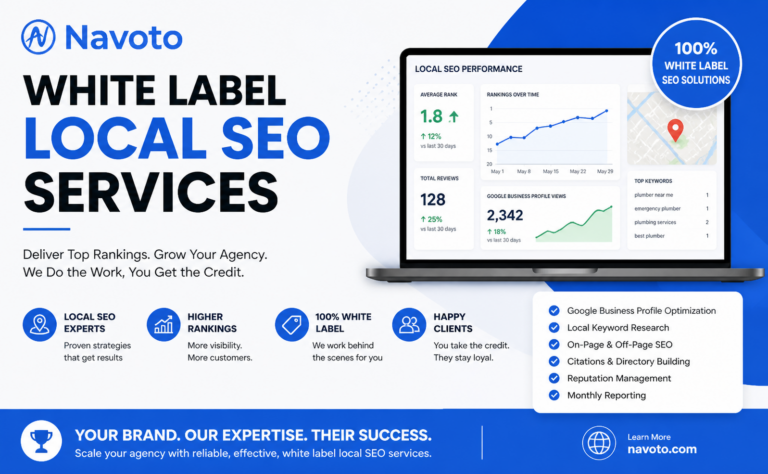
⚡ Quick Answer: White label local SEO services let agencies sell expert local SEO under their own brand — while a specialist provider does the technical work behind the scenes. Agencies typically earn 40–60% gross margins and scale to any number of clients without hiring in-house teams.
You’re a marketing agency. A client asks if you offer local SEO. You want to say yes — confidently. But you don’t have the team, the tools, or the time to build a local SEO operation from scratch. White label local SEO services solve this problem exactly. This guide gives you everything: what it is, how it works, what it costs, how to choose a provider, and how to build a profitable, scalable local SEO offering your clients will never want to leave.
The local SEO services market is projected to grow from $74.9 billion in 2025 to $127.3 billion by 2030 — expanding faster than almost any other digital marketing category. Agencies that build a credible local SEO offering now are positioning themselves to capture an enormous share of that demand. Those that don’t will keep turning clients away to competitors.
|
40–60%
Avg gross margin for agencies
|
$150K+
Saved vs. building in-house team
|
60–120
Days to first local pack movement
|
$127B
Local SEO market size by 2030
|
What Are White Label Local SEO Services?
White label local SEO services are a delivery model where a specialist provider performs all local SEO work for an agency, and the agency presents that work to its clients under its own brand. The end client never knows a third party is involved — all reports, audits, communications, and campaign updates appear to come from the agency they hired.
Think of it as a silent partnership. The white label provider supplies the specialist labor, systems, tools, and execution. The agency supplies the client relationship, the trust, the strategy conversations, and the brand. Together they deliver something neither could easily deliver alone, as profitably, as fast.
How the Three-Party Model Works
| Party | Role | What They Do |
|---|---|---|
| Your Client | Local Business | Pays for local SEO, sees only your agency’s branding. Unaware of the white label arrangement. |
| Your Agency | Reseller | Manages the client relationship, sets pricing, handles communication, delivers branded reports, earns the margin. |
| White Label Provider | Silent Fulfillment Partner | Executes all SEO work: GBP optimization, local citations, content, links, technical fixes, reports — all under your brand. |
Local SEO vs. National SEO: Why Local Is Different
Before diving deeper, it’s critical to understand that local SEO and national SEO are fundamentally different disciplines — not just scaled versions of each other. White label local SEO services are specifically built around the unique signals, platforms, and behaviors that drive local search rankings.
| Factor | Local SEO | National SEO |
|---|---|---|
| Primary Goal | Rank in a specific city, area, or neighborhood | Rank across an entire country or global market |
| Key Platform | Google Business Profile (GBP) + Local Pack | Organic search results |
| Citations Matter | Critical — NAP consistency across directories | Less emphasis on citations |
| Review Signals | Major ranking factor | Minor indirect factor |
| Best For | Restaurants, plumbers, dentists, law firms, retailers | E-commerce, SaaS, publishers, national brands |
A local business — whether it’s a dentist in Delhi, a plumber in Mumbai, or a bakery in Bangalore — needs local SEO, not national. They want to dominate the map pack for searches like “dentist near me” or “emergency plumber [city name]” — not compete globally. White label local SEO services are precisely engineered for this outcome.
What’s Included in White Label Local SEO Services?
A quality white label local SEO provider doesn’t just do one or two things. They deliver a full, multi-layered campaign covering every signal Google uses to rank local businesses. Here’s exactly what should be included:
1. Google Business Profile (GBP) Optimization
GBP is the #1 local ranking factor. A proper white label provider handles complete profile setup, category optimization, service area configuration, keyword-rich descriptions, Q&A management, photo uploads, and regular GBP posts. Behavioral engagement signals — clicks, calls, direction requests — directly influence local rankings, making active GBP management non-negotiable.
2. Citation Building and NAP Consistency
Citations are online mentions of a business’s Name, Address, and Phone number (NAP). The provider should build consistent citations across 50+ relevant directories — Yelp, Yellow Pages, Bing Places, Apple Maps, and industry-specific sites. Duplicate or incorrect listings are found and fixed. Inconsistent NAP data confuses Google and suppresses rankings.
3. Local Keyword Research
Identifying the right local keywords — including service + city combinations, “near me” phrases, and long-tail geo-targeted terms — is the foundation of every campaign. The provider researches what local customers actually search for and builds the strategy around real demand, not guesswork.
4. On-Page Optimization for Local
This includes optimizing title tags, meta descriptions, H1 headings, and page content with local keywords. Location pages are created or optimized for each service area. Local business schema markup (structured data) is added so Google can better understand the business’s location, hours, and services.
5. Locally-Focused Content Creation
Blog posts, service area landing pages, and locally-relevant content that targets geographic keywords and establishes topical authority in the client’s niche and city. Good content creation is what separates competitive rankings from stagnant ones over the long term.
6. Local Link Building
Building backlinks from local news sites, community organizations, local business directories, industry associations, and neighborhood websites. Local links are among the most powerful ranking signals and among the hardest to acquire — making specialist execution essential.
7. Review Generation and Management
Managing reviews across Google, Yelp, and industry platforms. This includes response templates, review generation outreach strategies, and monitoring for new reviews. Review signals — quantity, recency, sentiment, and response rate — are proven local ranking factors that compound in value over time.
8. Technical SEO Fixes
Addressing site speed issues, mobile usability problems, crawl errors, duplicate content, and Core Web Vitals — all of which affect both local and organic rankings. Many local businesses neglect technical SEO, making this a significant area of early improvement.
9. Branded Reporting and Dashboard
Monthly reports delivered under your agency’s logo and colors. Good providers offer white-labeled dashboards that clients can log into using your domain, seeing real-time rankings, traffic, calls, and citation data — all branded as coming from your agency.
✅ Complete White Label Local SEO Service Checklist:
☑ Google Business Profile setup + ongoing management
☑ NAP citation building (50+ directories)
☑ Duplicate listing detection and cleanup
☑ Local keyword research and mapping
☑ On-page optimization + location pages
☑ Local schema markup implementation
☑ Localized content creation
☑ Local link acquisition
☑ Review generation + response management
☑ Technical SEO audit + fixes
☑ Monthly branded white-label reporting
☑ Rank tracking for local pack + organic
The Real Business Case: Why Agencies Choose White Label
The math behind white label local SEO is compelling — but most agencies only discover the full picture when they compare it honestly against building an in-house team.
In-House Local SEO Team: What It Actually Costs
| In-House Cost | Annual Estimate |
|---|---|
| Senior Local SEO Specialist (salary + benefits) | $75,000–$95,000 |
| Content Writer / Local Content Specialist | $50,000–$65,000 |
| SEO Tools (Ahrefs, SEMrush, BrightLocal, etc.) | $5,000–$10,000 |
| Training, certifications, conferences | $3,000–$6,000 |
| Total Minimum Annual Cost | $133,000–$176,000+ |
White Label: What You Pay vs. What You Earn
| Scenario | Provider Cost/Month | You Charge Client | Gross Margin |
|---|---|---|---|
| Starter local SEO | $200–$300 | $400–$600 | ~50% |
| Standard local campaign | $400–$600 | $800–$1,200 | ~50% |
| Competitive / multi-location | $700–$1,000 | $1,500–$2,500 | 50–60% |
7 Core Benefits of White Label Local SEO Services
Add local SEO to your service menu immediately — no recruiting, no training, no months of ramp-up time. You can sell local SEO to your next client conversation without having a single in-house specialist on staff.
White label agencies routinely achieve 40–60% gross margins on local SEO services. These are monthly recurring margins — not one-time project fees — making this one of the most profitable service lines in digital marketing.
Scale from 1 client to 100+ without adding headcount or infrastructure. The white label provider absorbs all the operational complexity. You scale sales — they scale delivery.
Quality white label providers are local SEO specialists. Their entire operation is built around delivering local results. Your clients get better work than most generalist in-house teams could deliver — delivered by people who do this all day, every day.
Local SEO compounds over time — unlike paid advertising, which stops the moment you stop spending. Clients who see rankings improving month over month have strong reasons to stay. Local SEO produces one of the highest client retention rates of any agency service.
All reports, dashboards, audits, and deliverables carry your agency’s logo, colors, and domain. Your clients build loyalty to your brand — not to the fulfillment partner working behind the scenes.
When execution is handled, your team can focus on client acquisition, retention, strategy, and growth. The division of labor is what makes white label the smartest operational model for most agencies offering SEO services.
White Label Local SEO Pricing: What to Expect in 2026
Pricing varies significantly based on market competitiveness, service scope, and provider quality. Understanding the cost structure helps you set correct client expectations and build healthy margins from day one.
Typical White Label Provider Pricing (Wholesale)
| Service Tier | Monthly Provider Cost | What’s Included | Best For |
|---|---|---|---|
| Starter | $150–$300/mo | GBP optimization, basic citations, monthly report | Low-competition local markets |
| Standard | $300–$600/mo | Full citations, on-page, content, review mgmt, links | Most local businesses |
| Competitive | $600–$1,000/mo | Everything in Standard + advanced link building, more content | Competitive industries, larger cities |
| Enterprise / Multi-Location | $1,000+/mo | Full local domination strategy across multiple locations | Franchise businesses, chains |
How to Price White Label Local SEO for Your Clients
The standard agency markup is 50–100% on the wholesale provider rate. But savvy agencies use a loaded cost formula to ensure they’re actually profitable after internal time is factored in:
Loaded Cost = Provider Fee + Tool Allocation + Account Management Time + Reporting Time
Retail Price = Loaded Cost ÷ (1 – Target Gross Margin)
Example: ($400 + $50 + $80) ÷ (1 – 0.50) = $1,060/month to client
How to Choose the Right White Label Local SEO Provider
The white label local SEO market is crowded. Quality varies wildly. Agencies that evaluate providers on price alone end up with client churn, reputation damage, and the exhausting work of cleaning up bad SEO. These are the criteria that genuinely separate capable providers from the rest.
Red Flags: Bad White Label SEO Practices to Avoid
⚠️ Walk away immediately from any provider that does:
🚫 Fake reviews — Google actively detects and removes fake reviews, and accounts can be suspended
🚫 Keyword stuffing in GBP descriptions — violates Google guidelines and risks profile suspension
🚫 Spammy backlinks from link farms — toxic links harm rankings and are difficult to clean up
🚫 Citation spam — submitting to hundreds of irrelevant or low-quality directories does more harm than good
🚫 Guaranteed #1 rankings — no ethical agency can guarantee specific positions; this is a classic scam signal
🚫 No reporting or vague metrics — if you can’t see exactly what they do each month, assume they’re doing very little
KPIs to Track: How to Measure White Label Local SEO Success
Your clients need to see proof that the investment is working. Set up these KPIs from day one and review them monthly. Clear reporting is one of the biggest drivers of client retention in local SEO.
| KPI | What It Measures | Target Direction |
|---|---|---|
| Local Pack Rankings | Position in the Google Maps 3-pack for target keywords | ↑ Improving rank |
| GBP Impressions | How often the GBP listing appears in search | ↑ Growing monthly |
| Calls from GBP | Phone calls initiated via the Google Business Profile | ↑ More calls = more revenue |
| Direction Requests | Users requesting directions to the physical location | ↑ Signals local intent |
| Website Clicks from GBP | Traffic from the GBP listing to the website | ↑ More qualified traffic |
| Citation Count | Number of consistent NAP mentions across the web | ↑ Growing monthly |
| Review Count and Rating | Total reviews and average star rating on Google | ↑ More reviews, higher rating |
| Organic Traffic | Visitors from Google’s organic (non-map) results | ↑ Month-over-month growth |
The 2026 Local SEO Trends Your Provider Must Know
Local SEO is not static. Agencies that are working from a 2022 playbook are delivering 2022 results. These are the shifts actively reshaping local rankings today that your white label provider must have strategies for.
Behavioral Engagement Signals Are Growing
Click-through rate from the local pack, calls made through Google, direction requests, and website visits from the GBP listing all feed back into Google’s relevance signals. A listing chosen frequently signals quality. Profile optimization — photos, compelling descriptions, regular posts, and review responses — directly influences these engagement signals.
AI Search and Answer Engine Optimization (AEO)
AI-powered search experiences — including Google’s AI Overviews and tools like Perplexity — are changing how some local queries are answered. White label providers in 2026 that incorporate AEO into their methodology — structuring content as clear, entity-aligned answers with FAQ sections — are delivering materially more complete service than those focused exclusively on traditional ranking factors alone.
Review Velocity and Recency Matter More
A business with 200 reviews but none in the past 6 months is at a disadvantage versus a business with 80 reviews and 10 this month. Review generation needs to be an active, ongoing part of every local SEO campaign — not a one-time effort.
Voice Search and Near-Me Queries
An increasing share of local searches are voice-based: “Hey Google, find a dentist near me.” These queries are conversational and intent-heavy. Content optimized for natural language, FAQ-style answers, and featured snippet positioning is increasingly important for local businesses.
Frequently Asked Questions
Conclusion: Is White Label Local SEO Right for Your Agency?
There are two kinds of agencies operating in local markets right now. The first kind turns away local SEO work because they don’t have the team to deliver it properly. The second kind offers it confidently, delivers strong results, retains clients longer, and charges more — all because they’ve built the right white label partnership.
The difference between those two agencies is not talent. It’s structure. White label local SEO services are the structure that gives you the leverage to compete, scale, and win — without building an entire SEO department from scratch.
With the local SEO market growing to $127 billion by 2030, and local businesses actively looking for agencies they can trust with their online visibility, the question isn’t whether to offer local SEO. The question is whether you’ll deliver it in-house at huge cost and risk — or through a white label partnership that lets you focus on what your agency actually does best.
The math is clear. The model is proven. The opportunity is now.
🚀 Ready to Add White Label Local SEO to Your Agency?
Navoto helps agencies launch, scale, and profit from local SEO services — without the overhead of building in-house. Get a free consultation and see exactly how the model works for your agency.