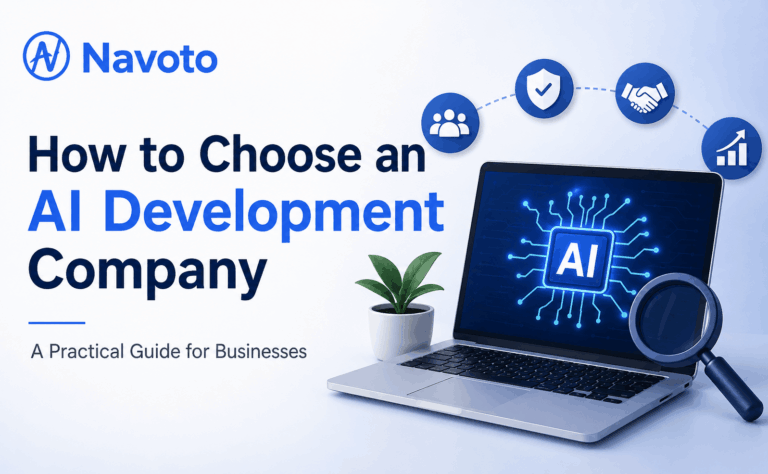
Knowing what an AI development company does is one thing. Actually picking one — without wasting three months and a chunk of budget on the wrong partner — is a different problem. This is the process we’d walk a friend through: ten steps, in order, from figuring out your real problem to signing the contract.
Quick answer: Choosing an AI development company isn’t about finding “the best one” in the abstract — it’s about matching a partner’s size, specialty, and pricing model to your specific project, verifying what they claim, and testing them with a small paid pilot before committing a bigger budget. Walk through the ten steps below in order.
STEP 1
Get Clear on the Problem, Not the Technology
Before you talk to anyone, write the actual business problem down in one sentence — not “we need AI,” but “our support team spends four hours a day answering the same twenty questions.” A company that asks about that problem before pitching a solution is one worth continuing with. One that jumps straight to “here’s what we’d build” without asking anything is a warning sign.
STEP 2
Decide: Are You Testing an Idea, or Building Something You Already Know You Need?
This one decision changes which companies are worth talking to. A small pilot needs a team that can move fast and cheap. A full, mission-critical build needs a team with the depth to support it long-term. Most successful projects start with the former even when the end goal is the latter — see our breakdown of typical project timelines by phase if you’re not sure which stage you’re at.
STEP 3
Build a Shortlist of 3–5 Companies
Pull names from directories, ask for referrals from people who’ve actually shipped an AI project, and notice who’s publishing genuinely useful content about the technology rather than just selling it — that’s usually a sign they understand it, not just market it. If you want a starting point, our breakdown of real AI development companies worth knowing profiles firms across different sizes, specialties, and budgets.
STEP 4
Score Each Candidate on Fit for YOUR Use Case
A team that’s excellent at chatbots may have zero real experience with forecasting or computer vision — “AI experience” isn’t one skill. Ask each company on your shortlist to point to a project matching your specific need, whether that’s an AI agent that completes tasks, a generative AI tool, or something that needs to plug into systems you already run.
STEP 5
Verify Their Evidence — Not Their Logos
A logo wall proves they had a client. A case study with a real, specific outcome proves they delivered one. Ask for a live product you can actually see, and a reference you can actually call. For the full list of technical red flags to check at this stage — data handling, code ownership, testing practices — see our detailed 12-point hiring checklist.
STEP 6
Compare Pricing Apples-to-Apples
Get a written quote from every company on your shortlist for the exact same scope of work — a specific deliverable, not a vague range. If a quote comes back suspiciously low, ask what’s excluded; that’s usually where the real cost hides later. For typical price ranges by project size, see our cost breakdown.
STEP 7
Run a Small, Paid Pilot Before the Big Commitment
Even if the end goal is a large system, start with a few weeks of limited-scope, paid work. It tells you more about how a company communicates, estimates, and handles a surprise than any sales call ever will — and it caps your risk if the fit turns out to be wrong.
STEP 8
Lock Down Data Ownership & IP — In Writing
Before the pilot even starts, get written confirmation that you own the code, the data, and the trained model when the engagement ends. This is a five-minute conversation before you sign, and a much longer, more expensive one if you skip it and need to switch partners later.
STEP 9
Confirm the Post-Launch Support Plan
Ask exactly what happens the week after launch: who’s watching performance, what triggers a retrain, and what it costs. AI systems can quietly get less accurate as real-world data shifts — the difference between a good partner and a disappearing one shows up here, not on launch day.
STEP 10
Make the Call
By this point the decision is usually obvious — one company will have been clearer, more specific, and more honest at every step above. If it’s still close, pick the team you understood the most easily. That clarity tends to carry through the entire project.
Common Mistakes People Make When Choosing
- Picking the flashiest demo instead of the clearest process — a good demo is easy to fake; a clear process is harder to.
- Skipping the pilot and jumping straight into a six-month contract on a first impression.
- Never asking who owns the code until after the contract is signed.
- Choosing on price alone, then paying far more later through change orders and “extras.”
- Assuming a big-name client story means a company can handle your specific, much smaller problem just as well.
Which Type of Company Fits Your Situation?
| Your Situation | Look For |
|---|---|
| Small budget, need something fast | A boutique specialist shop |
| Deep integration into existing enterprise systems | A large-scale systems integrator |
| Need your website, marketing, and AI handled together | A full-stack partner covering both |
| Highly regulated industry (health, finance, legal) | A company with proven compliance experience |
| Ongoing, evolving AI needs, not a one-off build | A partner offering long-term support, not just delivery |
Where Navoto Fits Into This Process
Navoto tends to fit the “website, marketing, and AI together” row above — most of our AI projects plug directly into software or a website we already build and maintain for the client, rather than sitting as a separate system someone else has to manage.
- One point of contact through the whole process instead of juggling multiple vendors
- Honest scoping calls — we’ll tell you if a small pilot is the smarter first move
- 20+ years in business, with a real, checkable portfolio and client testimonials
Ready to run Step 1 with us?
Tell us the actual problem you’re trying to solve, and we’ll tell you honestly whether AI is the right fix and what a sensible first step looks like.
FAQs
Q: How many companies should I actually shortlist before deciding?
A: Three to five is usually enough to compare fairly without dragging the process out for months. Fewer than that and you can’t tell if a quote is reasonable; more than that and decision fatigue sets in.
Q: Is it a red flag if a company wants to skip the pilot and go straight to a full build?
A: Generally, yes. A confident, experienced partner is usually comfortable proving themselves on a smaller scope first. Reluctance to do that is worth asking about directly.
Q: Should I choose based on which company gave the best demo?
A: Not on its own. A demo shows what’s possible; it doesn’t show how the company handles a real deadline, a data problem, or a scope change. Weigh it alongside the process, not instead of it.
Q: What if two companies seem equally good after going through all the steps?
A: Pick the one you understood most easily during the process. Clear communication during a sales conversation is usually a preview of clear communication during the actual project.
Q: Is it normal for the scope to change after the first call?
A: Yes — an experienced company often refines the scope once they understand your problem better. It’s normal as long as the changes are documented in writing before any work starts.