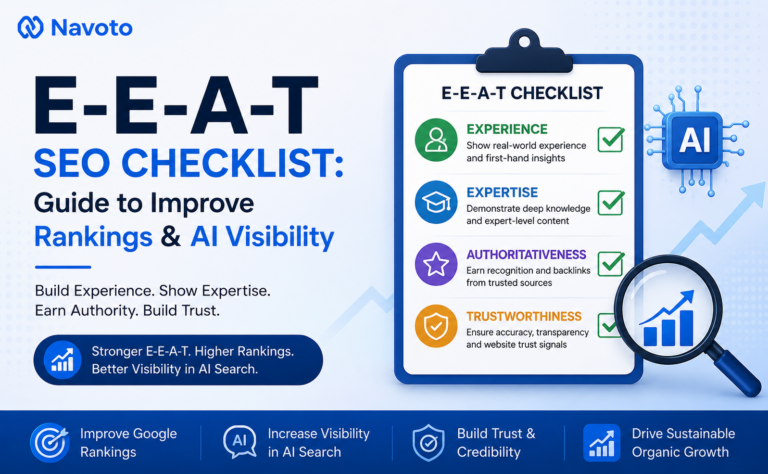
Quick Answer — What is an E-E-A-T SEO Checklist? An E-E-A-T SEO checklist is a structured set of optimizations that signal to Google that your content demonstrates Experience, Expertise, Authoritativeness, and Trustworthiness. In the AI era, E-E-A-T is no longer just a content quality guideline — it is the primary differentiator between content that survives algorithm updates and content that loses ranking in them. Sites with strong E-E-A-T signals gained 22% visibility in the March 2026 Core Update. Sites without them lost up to 71%.
The March 2026 Core Update sent a message that no SEO professional can afford to ignore: 86.5% of top-ranking pages use AI assistance to create content — but only those that also demonstrate genuine human expertise, original data, and verifiable authority held their positions. Sites relying on generic AI output without human editorial oversight saw traffic drops between 60% and 80%. Sites with original data and real experience saw visibility gains of 22%. E-E-A-T — Experience, Expertise, Authoritativeness, and Trustworthiness — is no longer a soft guideline for quality editors. It is the hardest signal in modern SEO, and it has never mattered more than it does right now. This checklist tells you exactly what to do about it.
This guide covers every E-E-A-T signal that matters in 2026 — not the theoretical framework, but the specific, implementable actions you can take today to strengthen each pillar. We have organized them as a working checklist so you can audit your site, identify gaps, and prioritize fixes based on what Google’s latest algorithm behavior actually rewards.
|
71%
Traffic drop for sites with thin AI content — March 2026 Core Update (JetDigitalPro)
|
+22%
Visibility gain for sites with original data — March 2026 Core Update (SE Ranking)
|
86.5%
Of top-ranking pages use AI assistance — but only with expert human oversight
|
55%
Of tracked sites registered measurable ranking changes from the March 2026 update
|
What Is E-E-A-T in SEO? The Foundation Explained
E-E-A-T stands for Experience, Expertise, Authoritativeness, and Trustworthiness. It is the quality framework embedded in Google’s Search Quality Rater Guidelines — a 176-page document that thousands of human evaluators use to assess whether pages deserve to rank for their target queries.
The critical thing to understand about E-E-A-T is what it is not: it is not a direct ranking factor. There is no E-E-A-T score in Google’s algorithm. What it is: a quality compass that describes the characteristics Google’s algorithms are trained to reward. Human raters evaluate pages against E-E-A-T criteria, their assessments train the algorithms, and the algorithms then replicate those quality judgments at scale across billions of queries. Think of it as the signal that Google’s machine learning eventually learns to detect automatically — because the human raters taught it what good looks like.
E-E-A-T was originally introduced as E-A-T in 2014. Google added the first “E” for Experience in December 2022 — a direct response to the explosion of AI-generated content that could mimic expertise without possessing real-world experience. In 2026, with AI content flooding the web at unprecedented scale, the Experience dimension has become the most valuable and hardest-to-fake element in the entire framework.
✅ The key 2026 insight from Google’s own guidelines: Trust is the most critical component — it is the central pillar that validates all three others. Experience, Expertise, and Authority are all inputs that feed into Trust. Without Trust, the other three collapse. This means your E-E-A-T checklist should work outward from Trust, not treat all four dimensions as equally weighted.
The Four E-E-A-T Dimensions Defined Precisely
| Dimension |
What It Means |
How Google Detects It |
2026 AI Context |
| Experience |
Firsthand, real-world interaction with the topic — doing it, not just knowing about it |
Original photos, case studies, personal results, specific details AI could not fabricate |
Most impacted by AI content — AI cannot genuinely “experience” anything |
| Expertise |
Demonstrated mastery through competence, sound reasoning, and reliable sourcing |
Author credentials, cited sources, depth of explanation, limitations acknowledged |
Named expert authors are now mandatory for high-performing content |
| Authoritativeness |
Recognition by others — being cited, referenced, and recommended across the ecosystem |
Backlinks, brand mentions, PR coverage, third-party platform presence |
AI citation rates correlate 0.664 with branded web mentions — off-site authority feeds AI |
| Trustworthiness |
Factual accuracy, transparency, security, honest disclosure — the central pillar |
HTTPS, correct facts, clear authorship, accurate citations, transparent policies |
Most important overall — without it all three others are irrelevant |
E-E-A-T and the AI Era: What the March 2026 Core Update Proved
No amount of theoretical E-E-A-T discussion matters as much as the real-world data from the most significant algorithm event of 2026. The March 2026 Core Update — which began rolling out on March 6 and affected 55% of tracked sites across Ahrefs and Semrush datasets within two weeks — operationalised E-E-A-T enforcement at a scale never seen before.
Here is what the data showed, specifically:
- Websites offering original data saw visibility increases of around 22%, while sites relying heavily on scaled or templated AI-generated content experienced traffic declines of up to 71%.
- 86.5% of top-ranking pages use AI assistance, but only those providing unique insights maintained their positions.
- Sites that replaced experience with AI-generated generalities were penalized most severely. Recovery requires adding experience layers, not just editing text.
- Pages with original data, specially collected case studies, proprietary insights, or genuine expert commentary gained an average of 22% in visibility.
- The update was described as enforcing Google’s “Information Gain” patent (US20200349181A1) — which rewards pages that introduce new insights over pages that simply rephrase existing information.
- The March 2026 core update is not an aberration. It is the logical next step in Google’s multi-year effort to prioritize genuine expertise over content volume.
The most important takeaway: The March 2026 update did not penalize AI-assisted content. It penalized AI-generated content without human expertise layered on top. Content assisted by AI and substantially edited by a named human expert, grounded in original perspective and attributed with verifiable credentials, performed well. Content that was AI-generated end-to-end without genuine editorial oversight lost visibility dramatically.
💡
The new equation for 2026: AI + Human Expertise = Ranking Survival. AI alone = Visibility Risk. Human alone = Unsustainable at scale. The brands and agencies winning right now use AI as a production accelerator while investing in the genuine expertise, original data, and named authority that no AI tool can fabricate. Understanding how to build that combination is the entire point of this checklist. For context on how AI tools fit into an ethical, expert-led workflow, see our guide to the
best AI SEO tools and how to use them without losing the human quality Google rewards.
The Complete E-E-A-T SEO Checklist for 2026
This checklist is organized by E-E-A-T pillar. Work through each section as an audit: check each item against your current site and content, mark what is already in place, and prioritize the gaps. The items marked as Critical should be addressed first — they have the highest impact on Google’s quality assessment and are the most commonly missing from underperforming sites.
📋 Pillar 1: Experience Checklist
Experience signals demonstrate that content was created by someone who has actually done the thing they are writing about — not merely researched it. This is the hardest signal for AI to fake and the one Google has most aggressively elevated since December 2022. Experience proves you did it, Expertise proves you understand it, Authoritativeness proves others recognize it.
CRITICAL
Include first-person experience markers in relevant content — “When we tested this with a client in 2025…,” “In our audit of 47 websites, we found…,” “Having run this campaign for three years, the pattern we consistently see is…” These signals are ones AI cannot genuinely provide and Google’s systems are increasingly trained to detect.
CRITICAL
Publish original data, studies, or proprietary benchmarks — A single piece of original research can earn more ranking authority than fifty republished articles. Original data is a first-order Information Gain signal and one of the three actions Google’s March 2026 guidance specifically recommends for recovery and growth.
CRITICAL
Use real screenshots, original photos, and proprietary visuals — Stock images and AI-generated graphics carry no experience signal. Original screenshots of actual work, real before/after data visualizations, genuine team photos, and client result screenshots all demonstrate that you have personally engaged with the topic.
HIGH
Publish genuine case studies with specific client outcomes — Not generic “a client saw improvement” — specific: “a dental practice in Birmingham increased map pack calls by 47% over 90 days by implementing [specific tactic].” Specificity is the experience signal. Vagueness is the absence of it.
HIGH
Add “last reviewed” dates with the reviewing expert’s name — Freshness is both a content quality signal and an AI citation signal. 85% of AI Overview citations come from content published or updated in the last two years. Update cornerstone content every 60–90 days and mark the update date visibly. This is part of the broader
content strategy that keeps your site competitive over time.
MEDIUM
Include honest assessments — limitations, trade-offs, and what does not work — AI-generated content tends toward positivity bias. Real experience includes acknowledging when something is complicated, when results vary, or when a tactic does not work in certain conditions. Balanced, nuanced analysis is a credibility signal that flatness and boosterism are not.
💻 Pillar 2: Expertise Checklist
Expertise means demonstrated competence — sound explanations, limitations stated, reliable sources. In the AI era, expertise signals are what distinguish your content from AI-generated text that sounds authoritative but lacks the depth of genuine mastery. The key word is “demonstrated” — expertise must be visible and verifiable, not just claimed.
CRITICAL
Every article must have a named, credentialed author — Publishing content attributed to “Admin,” “Team,” or no author at all is one of the most commonly penalized E-E-A-T failures. Every article needs a named person with a visible author bio, credentials, years of experience, and links to their professional profiles (LinkedIn minimum). This is non-negotiable for YMYL topics and strongly recommended for all content.
CRITICAL
Create comprehensive, topic-depth-demonstrating author pages — Each author should have a dedicated page listing their qualifications, publications, industry appearances, certifications, and body of work on your site. This page becomes a trust anchor that Google uses to evaluate whether the person behind the content is genuinely qualified.
CRITICAL
Cite authoritative sources inline with source names and dates — For YMYL topics (health, finance, legal, safety),
Google recommends at least 5–7 authoritative sources. For any topic, every specific statistic or factual claim should be attributed with source name and year directly in the text — not just a hyperlink at the bottom. Example: “According to SparkToro’s 2025 Zero-Click Study…” not just a footnote number.
HIGH
Build topical depth through content clusters, not isolated articles — A site with one 3,000-word SEO guide is less authoritative than a site with thirty interlinked articles covering every dimension of SEO. Topic cluster architecture — pillar pages plus cluster articles — signals subject matter depth that isolated content cannot. Our guide to building a complete
SEO content strategy using topic clusters covers the full framework.
HIGH
Have expert authors contribute to external publications — Author authority is not built only on your own site. Encouraging subject matter experts to contribute guest articles to industry publications, speak at conferences, and maintain active professional presences creates a credibility trail that Google uses to validate on-site authorship claims. External visibility reinforces internal expertise.
MEDIUM
Write about what you genuinely know — align topics to actual expertise areas — Publishing content about topics outside your verifiable expertise area is a credibility dilution risk. Google’s systems can detect topical mismatch between author credentials and article subject matter. If your team does not have expertise in a topic, either develop it or do not publish.
🏆 Pillar 3: Authoritativeness Checklist
Authoritativeness comes from backlinks from topically relevant authoritative sites, brand mentions in industry publications, being cited as a source by others, and consistent recognition across your niche. In the AI era, authoritativeness has gained a second dimension: it now also determines whether AI tools like ChatGPT and Perplexity cite your brand in their generated answers. Generative Engine Optimization (GEO) is the discipline of building this AI citation authority systematically.
CRITICAL
Earn backlinks from topically relevant, authoritative domains — A backlink from a respected industry publication is worth more than 50 links from unrelated directories. Relevance matters more than raw domain authority in 2026. Build your link strategy around being cited by the sources your audience trusts — industry associations, established trade publications, respected practitioners in your field.
CRITICAL
Build multi-platform brand presence for AI citation authority — Branded web mentions correlate with AI Overview appearances at 0.664 — the strongest predictor identified in independent research. Claim and actively maintain profiles on LinkedIn, YouTube, Trustpilot, G2, Clutch, and industry-specific directories. 85% of AI brand mentions come from third-party sources, not your own website. These platforms are where authority is built for the AI search environment.
CRITICAL
Earn and actively manage reviews across multiple platforms — Reviews are simultaneously a Google ranking signal, a local map pack factor, and an AI citation source. Businesses that respond to at least 25% of reviews earn 35% more revenue. Systematic review generation — asking at the moment of highest satisfaction, providing direct review links, responding to every review within 24 hours — is an authoritative signal that compounds monthly.
HIGH
Build branded search volume — the most underrated authority signal — Brand search volume shows a 0.334 correlation with AI citation rates — the strongest predictor of LLM mentions. When people actively search for your brand by name, it signals to both Google and AI systems that your brand has genuine recognition in the market. Build it through content quality, PR, community participation, and any activity that makes your brand worth searching for directly.
HIGH
Participate authentically on Reddit, LinkedIn, and industry forums — Reddit is one of the most-cited sources by major LLMs. LinkedIn thought leadership articles rank in Google. Community participation builds the unlinked brand mentions and topical association signals that feed authority in both traditional and AI search environments. Quality participation in 3–5 relevant communities consistently outperforms generic link building.
MEDIUM
Create linkable assets — original research, tools, and comprehensive resources — The most efficient link building strategy in 2026 is publishing content that naturally attracts links without outreach: original surveys, benchmark studies, free tools, comprehensive reference guides. Content that other publishers want to cite as a source is the highest-authority link type available.
🔒 Pillar 4: Trustworthiness Checklist (The Most Critical Pillar)
Google’s guidelines position Trust as the most critical component — the foundation that makes the other three meaningful. Trustworthiness covers factual accuracy, transparency, security, honest disclosure, and correction policies. Without it, all the experience, expertise, and authority in the world cannot compensate for the trust signals users and Google’s systems need before ranking and recommending your content.
CRITICAL
HTTPS — active SSL certificate on every page — Sites without HTTPS display a “Not Secure” warning to every visitor. HTTPS is a confirmed Google ranking signal and a first-line trust signal. Any HTTP page on your domain is actively eroding both user trust and search performance simultaneously.
CRITICAL
Create a comprehensive, accurate About page with real team members — Google’s quality raters specifically check whether they can identify who is behind a website and whether those people are credibly connected to the content topics. A thorough About page with real names, photos, credentials, company history, and contact information is a foundational trust document.
CRITICAL
Verify every factual claim — especially AI-assisted content — The most important clarification for 2026 is that Google evaluates content quality regardless of whether it was written by a human or AI. AI tools hallucinate statistics, misattribute quotes, and reference studies that do not exist. Every specific figure, date, and attribution in any piece of content must be traced to its original source before publication. A single provably false claim undermines the trustworthiness of an entire page.
CRITICAL
Publish clear Privacy Policy, Terms of Service, and Contact page — These pages are basic trust infrastructure that quality raters check. Their absence signals that a site may not be operated by a legitimate business. Make sure contact information includes a real physical address or at minimum a working contact form and email address.
CRITICAL
Disclose AI assistance in content production transparently — Transparent disclosure of AI involvement in content creation, combined with clear human editorial oversight documentation, is increasingly becoming a trust positive rather than a trust risk. Hiding AI involvement while claiming human expertise is the scenario that creates real trust problems — not disclosure itself.
HIGH
Claim and optimize your Google Business Profile and Knowledge Panel — Your Knowledge Panel is Google’s public trust document for your brand. Inaccurate or incomplete information in it creates a visible trust discrepancy between what you claim and what Google displays. Claim your GBP, verify your knowledge panel information, add Organization schema markup to anchor it with structured data.
HIGH
Publish and maintain a corrections policy — Trust includes acknowledging when you are wrong. A visible corrections policy — explaining how you handle and update factual errors when they are identified — is a trust signal that most sites skip entirely. For content-heavy sites, it is a meaningful differentiator that quality raters specifically look for in Google’s guidelines.
MEDIUM
Disclose conflicts of interest and affiliate relationships clearly — Undisclosed commercial relationships in content are a trust violation. If you are reviewing products you sell, receiving compensation for recommendations, or have any financial relationship with entities mentioned in your content, disclose it clearly at the top of the page — not in small print at the bottom.
⚙ Technical E-E-A-T Checklist
Beyond content signals, E-E-A-T has a technical dimension — the structural and schema signals that help Google verify and display your authority accurately. In the AI era, these technical signals also determine whether your content is accessible to AI crawlers and structured for extraction into AI Overviews and LLM citations. This aligns directly with the Hybrid Engine Optimization (HEO) framework — the unified approach to traditional and AI search visibility.
CRITICAL
Implement Organization schema markup on your homepage and About page — This structured data explicitly tells Google your brand’s name, description, founding date, services, and social profiles. It powers your Knowledge Panel and signals that you are a real, verifiable entity — not an anonymous content site.
CRITICAL
Add Article schema with author information to every blog post — Article schema links your content to named authors with verifiable external profiles. This gives Google a structured signal of authorship that it uses in E-E-A-T evaluation, separate from the visible on-page author bio.
CRITICAL
Verify AI bots are not blocked in your robots.txt — GPTBot (ChatGPT), ClaudeBot (Anthropic), PerplexityBot, and Google-Extended are the primary AI crawlers that determine whether your content is eligible for AI Overview citation and LLM training inclusion. Check yourdomain.com/robots.txt right now. This five-minute audit is one of the highest-impact E-E-A-T and
zero-click SEO actions available.
CRITICAL
FAQPage schema on all FAQ sections — FAQPage schema signals to both Google and AI crawlers which parts of your content contain direct Q&A answers. Content with FAQ schema earns 3x more AI citations than paragraph-only content. It also increases People Also Ask box inclusion and featured snippet eligibility simultaneously.
HIGH
Core Web Vitals passing — LCP under 2.5 seconds — Page speed is both a ranking factor and an E-E-A-T-adjacent trust signal. Slow-loading pages reduce user confidence in the quality of the source. Pages with FCP under 0.4 seconds average 6.7 AI citations versus 2.1 for slower pages — a 3x gap. Run PageSpeed Insights on your top 10 pages monthly and fix critical issues.
HIGH
Ensure consistent NAP across all directories and platforms — Name, Address, Phone number — and brand description — must be identical across your website, Google Business Profile, Wikidata, LinkedIn, and all directories. NAP inconsistency creates an entity ambiguity signal that weakens both local SEO and AI entity recognition simultaneously.
MEDIUM
Add HowTo schema to step-by-step content and Person schema to executive profiles — HowTo schema surfaces rich results for tutorial content and increases AI extraction of step-by-step instructions. Person schema on individual author pages links the human credentials to both Google’s entity graph and AI retrieval systems.
E-E-A-T for YMYL Topics: The Highest Standard
YMYL — Your Money or Your Life — is Google’s designation for topics where inaccurate information could cause real harm: health, medicine, finance, legal advice, safety, and similar fields. For YMYL content, Google applies its highest E-E-A-T standards and there is essentially no margin for the trust signals being weak or absent.
The March 2026 Core Update was particularly aggressive in YMYL categories. Volatility was particularly pronounced in YMYL categories — health, finance, law — as Google applies the highest E-E-A-T standards here, and the consequences of misinformation for users are especially severe.
If any of your content falls into YMYL categories, apply these additional requirements on top of the full checklist above:
- Authors must have formal, verifiable qualifications in the specific field — For medical content, this means named medical professionals with license numbers or board certifications. For financial content, named professionals with regulated financial qualifications. Claimed expertise without verifiable credentials is insufficient for YMYL topics.
- All content should be reviewed or approved by a qualified professional — Add a “Medically reviewed by” or “Financially reviewed by” line with the reviewer’s name, credentials, and a link to their professional profile.
- Cite 5–7 authoritative sources per article — Academic journals, government health agencies, official regulatory bodies, and peer-reviewed research. Avoid citing other SEO blogs or secondary sources as your primary evidence for YMYL claims.
- Include a clear disclaimer stating the content is informational, not professional advice — This transparency signal protects users and demonstrates awareness of the responsibility YMYL topics carry.
- Maintain aggressive update schedules — YMYL content that becomes outdated is not just an SEO problem — it is a user safety risk. Google penalises outdated YMYL content more severely than outdated content in lower-stakes categories.
The Master E-E-A-T SEO Checklist: Quick Audit Reference
Use this condensed checklist for quick site audits. Each item maps to the detailed section above. Mark each as Complete, Partial, or Missing to prioritize your E-E-A-T improvement roadmap.
◆ EXPERIENCE
☐ First-person experience markers in relevant content
☐ Original data, research, or proprietary benchmarks published
☐ Real screenshots, original photos, genuine visuals used
☐ Specific case studies with verifiable outcomes
☐ “Last reviewed” dates with expert name visible
☐ Honest limitations and trade-offs acknowledged
◆ EXPERTISE
☐ Every article has a named, credentialed author
☐ Comprehensive author bio pages exist for all contributors
☐ Sources cited inline with name and date
☐ Topic cluster architecture in place (pillar + cluster articles)
☐ Authors have external publication/speaking presence
☐ Content only covers areas of genuine expertise
◆ AUTHORITATIVENESS
☐ Backlinks from topically relevant authoritative domains
☐ Active profiles on LinkedIn, YouTube, G2, Trustpilot, Clutch
☐ Review generation system in place (multi-platform)
☐ Branded search volume growing month-over-month
☐ Active Reddit / LinkedIn / forum community participation
☐ Linkable assets published (original research, tools, guides)
◆ TRUSTWORTHINESS
☐ HTTPS active on all pages (SSL certificate valid)
☐ Accurate, comprehensive About page with real team members
☐ All factual claims verified — especially AI-assisted content
☐ Privacy Policy, Terms, and Contact page published
☐ AI assistance disclosure policy in place
☐ Google Business Profile claimed and complete
☐ Corrections policy published
☐ Affiliate/commercial relationships disclosed clearly
◆ TECHNICAL E-E-A-T
☐ Organization schema on homepage and About page
☐ Article schema with author data on all blog posts
☐ AI crawlers not blocked in robots.txt
☐ FAQPage schema on all FAQ sections
☐ Core Web Vitals passing (LCP under 2.5s)
☐ NAP data consistent across all platforms
☐ HowTo schema on step-by-step content
Related Guides on Navoto
Build every layer of your search strategy with these connected Navoto guides:
- Hybrid Engine Optimization (HEO): The Complete 2026 Framework — the unified strategy that covers traditional SEO, AEO, and GEO together — and how E-E-A-T signals power all three layers simultaneously.
- Generative Engine Optimization (GEO): Get Cited by ChatGPT and AI Search — how E-E-A-T signals translate into AI citation authority across ChatGPT, Perplexity, and Gemini.
- SEO Content Strategy: The Complete 2026 Framework — how to build the content architecture — topic clusters, pillar pages, and editorial calendars — that demonstrates topical depth and expertise to Google.
- Zero-Click SEO: How to Win Visibility When Google Shows No Results — how E-E-A-T signals feed featured snippet ownership, AI Overview citations, and the full zero-click landscape.
- The Best AI-Powered SEO Tools in 2026 — tools for auditing E-E-A-T gaps, monitoring AI visibility, and tracking brand authority signals across traditional and AI search.
Frequently Asked Questions About E-E-A-T SEO
❓ What is E-E-A-T in SEO?
E-E-A-T stands for Experience, Expertise, Authoritativeness, and Trustworthiness — Google’s framework for evaluating content quality, embedded in its Search Quality Rater Guidelines. It is not a direct ranking factor with a numerical score. It describes the qualities Google’s algorithms are trained to detect and reward. Trust is the central pillar; the other three contribute to it. In 2026, with AI content flooding the web, E-E-A-T is the single most reliable long-term differentiator between content that ranks and content that does not.
❓ Is AI-generated content a problem for E-E-A-T?
AI-generated content is not inherently an E-E-A-T problem. The March 2026 Core Update showed that 86.5% of top-ranking pages use AI assistance. The problem is AI content without human expertise layered on top. Generic AI output without editorial oversight, original perspective, verifiable author credentials, or real-world experience signals is what Google penalized — not AI assistance itself. The winning formula is AI for production efficiency + human expertise for quality, accuracy, and experience signals.
❓ How do I improve E-E-A-T quickly?
The highest-impact quick wins in order: (1) Add named, credentialed authors with comprehensive bio pages to all existing articles — this is the single most commonly missing and highest-impact fix. (2) Verify your site is HTTPS with a valid SSL certificate. (3) Add Organization schema markup to your homepage. (4) Check your robots.txt for accidental AI crawler blocks. (5) Add FAQPage schema to existing FAQ sections. These five actions can produce measurable improvement within 30–60 days for sites where they are currently absent.
❓ What is the difference between E-A-T and E-E-A-T?
E-A-T (Expertise, Authoritativeness, Trustworthiness) was Google’s original framework, introduced in 2014. E-E-A-T added a first “E” for Experience in December 2022, specifically in response to AI-generated content that could mimic expertise without possessing real-world experience. Experience is now the dimension most emphasised in algorithm enforcement — because it is the hardest signal for AI to fake authentically. If you did not personally do the thing you are writing about, you cannot genuinely demonstrate experience, regardless of how authoritative the writing sounds.
❓ How does E-E-A-T affect AI search visibility?
E-E-A-T signals are now dual-purpose: they improve Google traditional rankings and they determine whether AI tools like ChatGPT, Perplexity, and Gemini cite your content. Branded web mentions (an Authoritativeness signal) correlate with AI Overview appearances at 0.664 — the strongest predictor identified in independent research. Original data (an Experience signal) provides content AI tools cannot generate themselves, making it highly citation-worthy. Trust signals determine whether AI systems treat your domain as a reliable source. Every item on the E-E-A-T checklist now has both a traditional SEO and an AI search visibility dimension.
❓ What is YMYL and why does it require stronger E-E-A-T?
YMYL stands for “Your Money or Your Life” — Google’s designation for content topics where inaccurate information could cause real-world harm: health, medicine, finance, legal advice, safety, and similar fields. For YMYL content, Google applies its highest E-E-A-T evaluation standards because the stakes of getting it wrong are higher than for other topics. YMYL content requires formally qualified authors, professional review, multiple authoritative citations per article, clear disclaimers, and aggressive update schedules. The March 2026 Core Update was particularly punishing for low-quality YMYL content.
❓ Does E-E-A-T apply to small websites and new sites?
Yes — E-E-A-T applies to all sites, but the benchmarks are relative to the competitive context. A small local business does not need Wikipedia coverage to demonstrate E-E-A-T. It needs: a real, identified owner with visible credentials, accurate business information, positive reviews, a complete Google Business Profile, and honest, accurate content within its area of actual expertise. New sites can build E-E-A-T from day one by starting with genuine author credentials, correct technical setup, and content only within verified expertise areas — before trying to compete for high-volume keywords.
Conclusion: E-E-A-T Is Not a Tactic — It Is the Strategy
The March 2026 Core Update removed any remaining ambiguity about where Google’s priorities lie. The era of ranking through sheer content production is ending. Sites that built their organic traffic on AI-generated volume without corresponding quality investment are facing the consequences.
E-E-A-T is not a list of boxes to check before publishing. It is the strategic orientation that determines whether your content creates genuine value — or just appears to. Every item on the checklist above maps to a real dimension of quality that Google’s systems are increasingly capable of detecting and rewarding. The sites that will grow in 2026 and beyond are those that have built genuine Experience into their content creation, demonstrated verifiable Expertise through credentialed authors, earned Authoritativeness through recognition across their ecosystem, and established Trust through accuracy, transparency, and technical integrity.
Start with the Critical items. Work systematically through High and then Medium priorities. Build E-E-A-T as an ongoing operational discipline — not a one-time project. The compounding advantage of consistently strong E-E-A-T signals is one of the most durable competitive advantages in organic search.
Want a Professional E-E-A-T Audit for Your Website?
Navoto audits websites against the complete E-E-A-T framework — identifying the specific gaps costing you rankings and AI visibility, and building a prioritized action plan to fix them. Get a free E-E-A-T audit and find out exactly where your site stands against Google’s 2026 quality standards.
Get Your Free E-E-A-T Audit →