Ask a basic RAG-powered chatbot a complex question — one that needs comparing numbers across two reports, or checking whether an answer is still current — and it often gives you a confident, half-right answer built from a single retrieval pass. It found something. It never checked whether that something was actually enough.
Agentic RAG is the fix for that exact failure mode. Instead of retrieving once and generating once, it wraps retrieval in a reasoning loop — plan, retrieve, judge, retrieve again if needed, then generate. This guide breaks down what agentic RAG is, how it differs from standard RAG, the architecture patterns behind it, where it’s used today, and why it matters for anyone trying to get their content found by AI.
Quick Answer
Agentic RAG is Retrieval-Augmented Generation with a reasoning layer added on top. Standard RAG retrieves once from one source and generates an answer. Agentic RAG uses an AI agent to plan the retrieval, choose which source or tool to query, judge whether what it found is actually good enough, retrieve again if it isn’t, and only then generate a response — adapting its strategy step by step instead of following one fixed path.
|
40%
of enterprise apps will embed task-specific AI agents by end of 2026 — see our AI Agents vs Agentic AI guide for the full breakdown
|
40%+
projected annual growth rate for the RAG market through 2030 — Grand View Research
|
2020
the year Meta AI researchers introduced the original RAG technique — Lewis et al.
|
What Is RAG? A 60-Second Refresher
Retrieval-Augmented Generation is a technique that lets an LLM pull in information it wasn’t trained on — your product docs, a live database, this week’s news — and use it to ground its response. Introduced by Meta AI researchers in a 2020 paper, the core pipeline has three steps:
- Retrieve — search a knowledge base for content relevant to the query.
- Augment — insert that content into the prompt as context.
- Generate — have the LLM write an answer using that context.
It’s fast, and it works well for simple, single-source questions. It struggles the moment a question needs more than one lookup, a judgment call about whether the retrieved content is actually relevant, or an action beyond just answering.
What Is Agentic RAG?
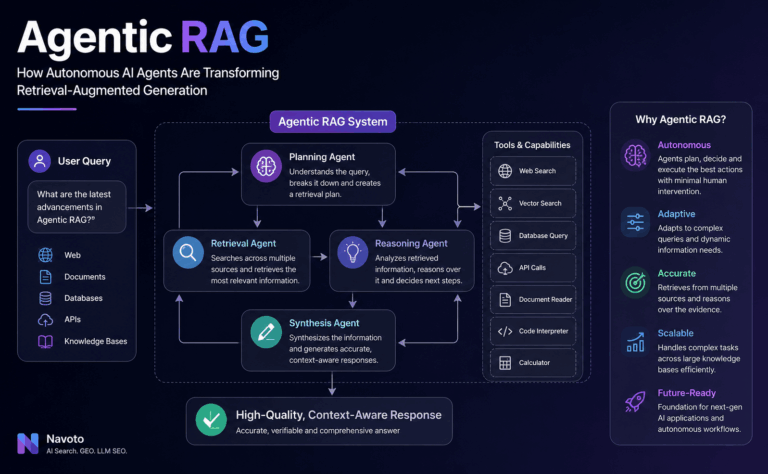
Agentic RAG puts an AI agent in charge of that pipeline instead of running it as a fixed script. The agent decides whether retrieval is even necessary, which source or tool to query, whether the results are good enough to answer with, and what to do next if they aren’t.
Four things distinguish it from standard RAG:
- Planning — it breaks a complex question into smaller retrieval steps.
- Tool use — it can call a web search, an API, or a second database, not just one fixed index.
- Self-critique — it grades its own retrieved context before generating, and retries if the results are thin.
- Iteration — it loops through retrieve → judge → retrieve-again as many times as the question requires, instead of stopping after one pass.
Traditional RAG vs Agentic RAG
| Aspect | Traditional RAG | Agentic RAG |
|---|---|---|
| Core function | Retrieve once, generate once. | Plan, retrieve, judge, and act across multiple steps. |
| Retrieval flow | Fixed, single-pass pipeline. | Dynamic loop that can retrieve multiple times. |
| Source access | One knowledge base, set in advance. | Multiple sources and tools, chosen at run time. |
| Irrelevant results | Generates anyway, often producing a shaky answer. | Detects low-quality retrieval and retries or escalates. |
| Multi-part questions | Struggles — treats them as one query. | Breaks them into sub-questions and answers each. |
| Latency & cost | Lower — one retrieval, one generation call. | Higher — multiple model calls per query. |
| Best for | FAQs, simple lookups, single-source Q&A. | Multi-hop research, cross-system tasks, high-stakes accuracy. |
How the Agentic RAG Loop Works
- Query understanding & planning — the agent parses intent and decides whether the question needs one lookup or several.
- Retrieval strategy selection — it picks the source: vector search, a structured database, a live web search, or an internal API.
- Retrieve — it pulls candidate context from the chosen source.
- Grade the context — a critique step scores whether the retrieved passages actually answer the question.
- Decide — if the context is sufficient, move to generation. If not, retrieve again from a different source, refine the query, or call a tool.
- Generate — produce the answer using the validated context.
- Verify — in more advanced setups, check the generated answer against the source material before returning it.
5 Agentic RAG Architecture Patterns You’ll Actually See
1. Single-Agent Router RAG
The simplest form: one agent decides which of several knowledge sources to query for a given question, then retrieves from just that one. A good starting point once you have more than one knowledge base but don’t yet need multi-step reasoning.
2. Corrective RAG (CRAG)
Adds an explicit grading step after retrieval — a lightweight classifier or LLM call scores the retrieved documents. If they’re weak, the system falls back to a broader search, often the open web, instead of generating from bad context.
3. Self-RAG
The model itself decides — using learned reflection signals — whether retrieval is needed at all, whether what it retrieved is relevant, and whether its own draft answer is actually supported by that evidence. The critique is built into generation rather than a separate module.
4. Adaptive RAG
Routes each incoming query to a different retrieval strategy based on how complex it predicts the question to be. A simple factual question might skip retrieval entirely, while a multi-hop question triggers several rounds.
5. Multi-Agent RAG
Splits the work across specialized agents: one retrieves from a document store, another queries a live API, a third validates and synthesizes the combined result. Worth the added complexity when a single request genuinely spans multiple, unrelated systems.
Common frameworks used to build these patterns include LangChain, LlamaIndex, LangGraph, and CrewAI. Most teams are better served starting with pattern 1 or 2 and only reaching for multi-agent RAG once they can point to specific queries the simpler version fails on.
Real-World Use Cases
IT & Employee Support
A troubleshooting request gets checked against multiple knowledge bases and live system status before the agent answers or triggers a fix.
Customer Support
A billing question that needs order history, policy documentation, and payment status pulled together from three different systems before a single, coherent answer is possible.
Legal & Compliance Research
Cross-referencing multiple contract clauses or regulatory sources before answering, with citations back to the exact passages used.
Finance & Analytics
Pulling numbers from a live database, comparing them against a static report, and flagging discrepancies before presenting a summary.
AI Search & Answer Engines
Tools like ChatGPT search, Perplexity, and Google’s AI Overviews run an agentic-RAG-style loop against the open web itself — deciding which pages to retrieve, judging relevance, and only then generating a cited answer. We cover this side of it in detail in our Agentic Search Optimization guide.
Why This Matters for Your Website’s AI Visibility
Here’s the part most technical explainers skip: agentic RAG isn’t just something enterprises build internally — it’s the same retrieval-and-judge loop that answer engines run against the open web every time someone asks ChatGPT, Perplexity, or Google’s AI Mode a question. When one of those systems decides whether to retrieve, cite, and recommend your page, it’s running a version of the exact pipeline described above: plan the query, choose sources, grade what it finds, and only cite what passes.
That has a direct, practical implication. The same qualities that make content easy for a well-built agentic RAG pipeline to retrieve and trust — clear, structured answers, unambiguous claims, up-to-date information, credible sourcing — are exactly what we cover in our guides to Answer Engine Optimization and Generative Engine Optimization. If you want the fuller picture of how autonomous agents evaluate and select your site specifically, our Agentic Search Optimization guide walks through it end to end. And if you haven’t yet, our AI Agents vs Agentic AI guide is the right place to start for the broader distinction this article builds on.
Want to know if AI search engines can actually retrieve and cite your content?
Navoto runs AI visibility audits that show exactly where your site stands with ChatGPT, Perplexity, and Google AI Overviews — and what to fix first.
Benefits of Agentic RAG
- Handles multi-hop and multi-part questions a single retrieval pass can’t.
- Fewer hallucinations, because weak or irrelevant context gets caught and re-queried instead of used.
- Can pull from multiple live sources instead of one static index.
- Adapts its strategy per query instead of running the same fixed pipeline for every question.
- More transparent — because it grades its own retrieval, it’s easier to see why an answer was or wasn’t trustworthy.
Challenges & Limitations
- Latency & cost — every extra retrieval or critique step is another model call; multi-agent setups can be meaningfully slower and more expensive than single-pass RAG.
- Harder to evaluate — a system that takes a different path every time is harder to test deterministically than a fixed pipeline.
- Compounding errors — a bad early decision, like the wrong source chosen or a misread intent, can propagate through several steps before anything catches it.
- Infrastructure complexity — orchestration, memory, and tool permissions all need to be built and maintained, not just a retriever and a prompt.
- Governance — once an agent can call tools or multiple data sources, access control and auditability matter more, not less.
How to Choose: Do You Need Agentic RAG?
- Simple, single-source lookups? Standard RAG is faster, cheaper, and easier to debug — don’t add agentic complexity you don’t need.
- Users regularly ask multi-part or cross-source questions? Agentic RAG, starting with a router or CRAG pattern, will meaningfully outperform standard RAG.
- Wrong answers carry real cost — compliance, finance, healthcare? The self-critique step in Self-RAG or CRAG earns its latency cost.
- A single request genuinely spans multiple unrelated systems? Multi-agent RAG is worth it — but only once simpler patterns have proven insufficient.
Where This Is Headed
Expect tighter integration between agentic RAG and evaluation tooling, more standardized orchestration protocols like WebMCP, and growing overlap between “agentic RAG for internal knowledge” and “agentic RAG for the open web” — the same techniques powering enterprise search are increasingly shaping how AI answer engines retrieve and cite content in the first place.
FAQ
What’s the difference between RAG and agentic RAG?
Standard RAG retrieves once and generates once, following a fixed pipeline. Agentic RAG wraps that pipeline in a reasoning loop — an agent plans the retrieval, judges what comes back, and can retrieve again or call a different tool before generating. It’s RAG with a decision-maker added on top, not a separate technology.
Is agentic RAG the same as a multi-agent system?
Not necessarily. The simplest agentic RAG pattern, a single-agent router, uses just one agent deciding which source to query. Multi-agent RAG, where several specialized agents each handle a piece of the task, is one specific architecture within agentic RAG, not a requirement of it.
Which is better: Self-RAG or Corrective RAG?
Neither is universally better. Self-RAG builds the critique into the model’s own generation step, which keeps the architecture simpler. Corrective RAG adds an explicit, separate grading step and a fallback search when retrieval quality is low, which tends to be more transparent and easier to debug. Many production systems combine ideas from both.
Does agentic RAG eliminate hallucinations?
No system eliminates hallucination entirely, but the self-checking loop in patterns like CRAG and Self-RAG catches a meaningful share of cases where the model would otherwise have generated confidently from weak or irrelevant context. Published benchmarks report solid reductions compared to a single-pass RAG pipeline, though exact numbers vary by study.
What frameworks are used to build agentic RAG?
LangChain, LlamaIndex, LangGraph, and CrewAI are the most commonly used frameworks today, each offering different levels of abstraction for planning, tool use, and multi-agent orchestration.
Is agentic RAG worth the extra cost and latency?
It depends on your query mix. If most questions are simple, single-source lookups, the extra latency and cost isn’t worth it. It becomes worth it once a meaningful share of real questions are multi-part, cross-source, or high-stakes enough that a wrong answer is expensive.
How does agentic RAG relate to how ChatGPT or Google AI Overviews cite websites?
The same way. When these systems decide what to retrieve and cite for a query, they’re running a version of the same retrieve-judge-generate loop, applied to the open web instead of an internal knowledge base — which is why content structured for internal agentic RAG systems tends to be easy for AI search engines to cite too.
Do I need agentic RAG or just better prompting?
If your model already knows the answer and just needs clearer instructions, that’s a prompting problem. If it needs facts it wasn’t trained on, or needs to check multiple sources before answering reliably, that’s a retrieval problem — and agentic RAG is the version of retrieval built for exactly that second case.
The short version: agentic RAG doesn’t replace retrieval, it makes retrieval accountable to itself — checking its own results before handing them to the model. Start with the simplest pattern that solves your actual query mix, and only add planning, critique loops, or multiple agents once you can point to specific questions the simpler version gets wrong.