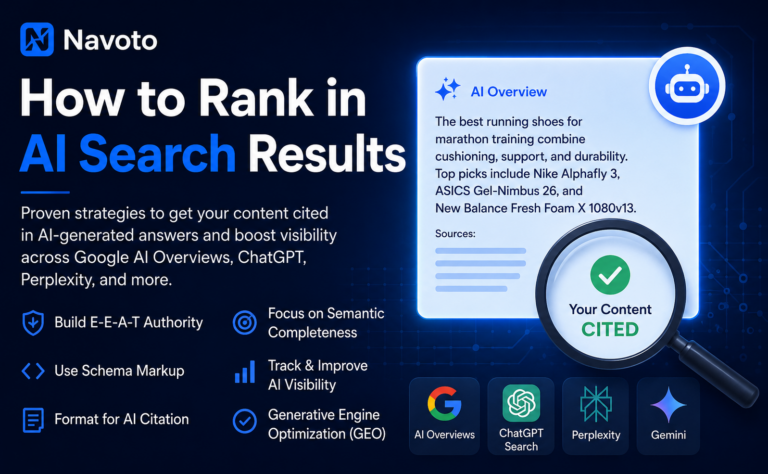
AI search engines — Google AI Overviews, ChatGPT Search, Perplexity, and Gemini — now answer millions of queries directly. Here is everything you need to know to get your content cited, not skipped.
AI search optimization is fundamentally different from traditional SEO. Instead of chasing click-through rates, your goal is to get cited inside AI-generated answers. This requires semantic completeness, E-E-A-T authority, structured data, and content formatted so AI can extract your answer instantly.
1. What Is AI Search and How Does It Work?
When you type a question into Google today, there is a good chance you see a paragraph-style answer at the top — before any links. That is a Google AI Overview. Similarly, ChatGPT Search, Perplexity AI, and Microsoft Copilot all synthesize answers from multiple web sources rather than returning a list of links.
This is a seismic shift. Traditional search engines rank web pages by keyword relevance and backlink authority. AI search engines process your content differently — they extract facts, synthesize answers, and cite sources based on trust, authority, and structural clarity.
Understanding this distinction is the first step toward learning how to rank in AI search results. Your page does not need to be in position #1. It needs to be the most credible, clearly structured, and contextually complete answer available.
2. Traditional SEO vs. AI Search Optimization
To rank in AI search results, you must understand how the rules have changed. The table below captures the most important differences between classic SEO and what is now called Generative Engine Optimization (GEO).
| Factor | Traditional SEO | AI Search Optimization |
|---|---|---|
| Primary Goal | Rank #1 for clicks | Get cited in AI-generated answers |
| Key Signal | Backlinks & keyword density | E-E-A-T, entity clarity, structured data |
| Content Format | Long-form prose with keyword variations | Answer-first, FAQ blocks, clear headings |
| Success Metric | Keyword ranking position + CTR | Citation frequency in AI answers |
| Schema Markup | Nice to have | Critical |
| Domain Authority | High correlation (r=0.45) | Weak correlation (r=0.18) |
| Position Dependency | Top 3 results get ~70% of clicks | 47% of AI citations come from outside top 5 |
| Voice & Conversational Queries | Partial | Core to strategy |
3. Build E-E-A-T Authority (The Biggest Ranking Factor)
If there is one concept that dominates AI search ranking in 2025–2026, it is E-E-A-T: Experience, Expertise, Authoritativeness, and Trustworthiness. Research shows that 96% of content cited in AI Overviews displays strong E-E-A-T signals. Here is what each pillar means and how to resolve gaps.
What Is E-E-A-T?
Experience
First-hand, real-world experience with the topic. Case studies, personal accounts, and original data demonstrate lived experience that AI highly values.
Expertise
Demonstrated knowledge depth. This includes author credentials, detailed technical explanations, and original research that goes beyond surface-level coverage.
Authoritativeness
External recognition — mentions, citations, and backlinks from reputable sources in your industry. AI search engines read your off-page reputation.
Trustworthiness
Accuracy, transparency, and honesty. Include clear author bios, cited sources, publication dates, and factual accuracy throughout your content.
How to Build E-E-A-T (and Fix It)
- Add detailed author bios with credentials, LinkedIn profiles, and relevant experience to every article
- Include first-hand case studies, original data, or proprietary research that competitors cannot copy
- Cite authoritative external sources (government sites, peer-reviewed papers, industry reports)
- Build backlinks from credible publications in your niche — each mention increases AI citation probability
- Add an “About” page, privacy policy, and clear contact information to establish trust signals
- Encourage detailed customer reviews — AI reads the context of reviews, not just the star rating
- Keep content up to date with clear “Last Updated” dates visible on every page
The Complete E-E-A-T Guide: How to Build Authority Google and AI Trust
4. Format Your Content for AI Citation
Content structure and format are among the highest-impact changes you can make. Listicles, how-to guides, and Q&A formats receive up to 35% more AI citations than unstructured prose. AI systems extract information best when your content tells them exactly what to take and where to find it.
Answer-First Writing (The Inverted Pyramid)
AI systems reward content that answers the core question in the first 1–2 sentences of a section — before any background context. This mirrors how a journalist writes: the most important information comes first. If your content buries the answer in paragraph 4, AI will often skip your page entirely.
Ask yourself for every heading: “If this paragraph were extracted and shown alone, would a reader fully understand the answer?” If not, rewrite it.
Content Formats That Get Cited Most
Structured question-and-answer sections. Add real FAQPage schema markup alongside them (covered in Section 5). These are highly extractable by AI.
Step-by-step numbered instructions with clear action items. Use HowTo schema markup to signal the structure to AI crawlers.
Clear “What Is X?” sections with inline mini-definitions for technical terms. Avoid pronouns that refer to earlier content.
Concise summary boxes at the top or bottom of sections. AI models use these as quick-extract zones when generating overviews.
Side-by-side comparisons of products, strategies, or concepts. Structured table data is machine-readable and citation-friendly.
Original or cited statistics with sources. AI models treat quantitative data from authoritative sources as high-confidence citation candidates.
Conversational and Long-Tail Keywords
Voice search and AI search both reward natural, conversational language. Instead of optimizing for “AI SEO tips,” target “how do I get my website to show up in AI search results?” — that is how people actually ask questions. Map out every variation of user intent around your topic: informational (“what is”), how-to, comparison, and problem/solution queries.
Content Formatting for SEO: How Structure Drives Rankings and Citations
5. Schema Markup & Structured Data for AI Search
Schema markup is the single most actionable technical change you can make to improve AI search visibility. A 2025 controlled experiment by Search Engine Land found that only the page with proper JSON-LD schema appeared in a Google AI Overview — the identical page without schema was not even indexed.
Structured data helps AI engines understand the meaning of your content — not just the words. When AI processes a query, it parses schema markup, maps entities to knowledge graph nodes, and ranks sources by confidence. Schema directly improves how confidently AI cites your content.
What Is Schema Markup? (Plain English Definition)
Schema markup is a standardized vocabulary of code (defined at Schema.org by Google, Microsoft, Yahoo, and Yandex) that you add to your web pages. It does not change how your page looks to visitors — it adds a hidden layer of meaning that machines can read. Think of it as labeling every piece of information on your page so AI knows exactly what it is.
The Most Important Schema Types for AI Search (2025–2026)
| Schema Type | Use Case | AI Citation Boost |
|---|---|---|
| Article / BlogPosting | Blog posts, guides, news articles | High — Tier 1 |
| FAQPage | Questions and answers on any page | High — Tier 1 |
| HowTo | Step-by-step instructional content | High — Tier 1 |
| Organisation | Company info, founding details, team | High — Tier 1 |
| Product | Product name, price, reviews | High — Tier 1 |
| BreadcrumbList | Site structure and navigation hierarchy | Medium — Tier 2 |
| Speakable | Flags the best passage for AI citation | Medium — Tier 2 |
| LocalBusiness | Local business name, address, hours | High for local AI results |
How to Implement Schema Markup (JSON-LD Format)
Always use JSON-LD format — it is preferred by every major AI engine because it is cleanly separated from your HTML and easier to parse. Add it inside a <script type="application/ld+json"> tag in the <head> section of your page.
Below is a practical example of FAQPage schema — one of the highest-impact schema types for AI search ranking:
// Add inside <script type=”application/ld+json”> in your <head>
{
“@context”: “https://schema.org”,
“@type”: “FAQPage”,
“mainEntity”: [
{
“@type”: “Question”,
“name”: “How do I rank in AI search results?”,
“acceptedAnswer”: {
“@type”: “Answer”,
“text”: “Focus on E-E-A-T, use JSON-LD schema markup,
format content with answer-first structure,
build topical authority, and ensure your
content is semantically complete.”
}
}
]
}
6. Semantic Completeness: The #1 Correlation Factor
Among all AI Overview ranking factors, semantic completeness shows the highest correlation (r=0.87) with being cited. A semantically complete page can answer a query fully without the user needing to consult another source.
This means your content must not only answer the primary question — it must address every related angle, sub-question, and implication that a reader would naturally have. AI systems test this by asking: “Does this page answer the question completely, or does it leave gaps that would require clicking elsewhere?”
How to Achieve Semantic Completeness
- Map all related questions around your keyword: “what is,” “how to,” “why,” “when,” “best,” “vs,” and “example” variations
- Cover your topic from multiple angles: use data, examples, case studies, and “why it matters” explanations
- Include inline mini-definitions for every technical term (do not make readers search for definitions elsewhere)
- Avoid using pronouns that reference earlier content (“this,” “that approach”) — every section should be independently understandable
- Include a FAQ section addressing the top 5–10 questions your readers would ask
- Build entity density — aim for 15+ connected, named entities (people, places, concepts, organizations) that AI can map to its knowledge graph
7. Generative Engine Optimization (GEO): The New SEO Frontier
Generative Engine Optimization (GEO) is the emerging discipline of optimizing content specifically for citation in AI-generated answers — rather than for traditional blue-link rankings. It is, in many ways, the evolution of classic SEO for the AI era.
GEO is particularly important because AI search operates on fundamentally different logic from traditional search. A page ranking 5th in organic results can be cited first in an AI Overview. Domain authority now has only an r=0.18 correlation with AI citations — down from r=0.45 in traditional search. Authority, relevance, and structure now matter far more than link count.
Core GEO Strategies
Get covered by credible industry publications. Each brand mention signals to AI that your content is a trusted source worth citing.
Publish comprehensive content across all subtopics in your niche. AI rewards sites that cover a subject deeply and consistently over time.
Cite verifiable sources and include publication dates. AI systems reward content with traceable facts — this increases citation probability by up to 89%.
Combine text with images, infographics, and video. Multi-modal content sees a +156% boost in AI selection rates compared to text-only pages.
Each AI engine (Google, ChatGPT, Perplexity, Gemini) has unique preferences. Core principles apply everywhere, but tailor content depth and format per platform.
Build your brand’s presence in Google’s Knowledge Graph using Organization schema, Wikipedia entries, and Wikidata. Knowledge Graph entities get 4.8× more AI citations.
Generative Engine Optimization (GEO): The Complete Navoto Playbook
8. Tools to Track and Improve AI Search Visibility
You cannot improve what you cannot measure. Fortunately, a growing ecosystem of tools now tracks AI search citations, schema validation, and brand mentions across AI platforms.
| Tool | What It Does | Best For |
|---|---|---|
| Google Search Console | Tracks rich result impressions, schema errors, and AI Overview performance | All websites — free baseline |
| Semrush AI Toolkit | Monitors AI Overview appearances and citation frequency for your keywords | Keyword-level AI tracking |
| Ahrefs | Content gap analysis, backlink monitoring, keyword intent mapping | E-E-A-T and topical authority building |
| Peec.ai | Tracks brand citations across generative search engines (ChatGPT, Gemini, Perplexity) | Cross-platform AI citation monitoring |
| SERanking AI Results Tracker | Monitors your visibility specifically in AI Overviews and generative results | Dedicated AI SERP tracking |
| Google Rich Results Test | Validates your schema markup and previews rich result eligibility | Schema troubleshooting — free |
| Bing Webmaster Tools | Schema validation and Copilot visibility signals | Microsoft Copilot optimization |
Best AI SEO Tools in 2026: Full Comparison and Pricing
9. The Complete AI Search Ranking Checklist
Use this checklist as your ongoing audit framework. Every item is actionable today.
Content & Structure
- Answer the primary question in the first 1–2 sentences of each section (answer-first structure)
- Include a FAQ section with at least 5 questions using natural, conversational phrasing
- Use proper heading hierarchy: H1 → H2 → H3 with keyword-rich, descriptive headings
- Write every section to be independently understandable (no orphan pronouns)
- Add a “Key Takeaway” or “TL;DR” summary box at the top of long articles
- Include relevant statistics with citations to authoritative sources
- Use tables, lists, and how-to steps to structure information clearly
Technical & Schema
- Implement Article or BlogPosting schema on every content page (JSON-LD format)
- Add FAQPage schema alongside every FAQ section
- Add Organisation schema on your homepage or About page
- Implement BreadcrumbList schema for site structure clarity
- Validate all schema using Google’s Rich Results Test — zero errors allowed
- Ensure fast page speed (Core Web Vitals: LCP under 2.5s, CLS under 0.1)
- Use semantic HTML (proper header tags, not styled divs)
E-E-A-T & Authority
- Add detailed author bio with credentials to every article
- Display a clear “Last Updated” date on all content pages
- Earn at least 3 citations or backlinks from credible industry sites per month
- Publish original research, data, or case studies regularly
- Build brand presence on Wikipedia, Wikidata, and Google Knowledge Panel
- Respond to and encourage detailed customer reviews (quality over quantity)
Monitoring & Iteration
- Set up Google Search Console and Semrush AI Toolkit for ongoing tracking
- Monitor AI citation frequency using Peec.ai or equivalent tool monthly
- Audit and refresh all content older than 12 months with updated data and examples
- Test your top pages manually in ChatGPT, Perplexity, and Google AI Overviews quarterly
FAQs
How do AI search engines decide what to cite?
AI search engines prioritize semantic completeness, E-E-A-T, structured data, factual accuracy, and clear content formatting. Content that fully answers a question is more likely to be cited.
Is traditional SEO still important?
Yes. Traditional SEO remains the foundation, but AI search also rewards schema markup, E-E-A-T, and well-structured content.
What is Generative Engine Optimization (GEO)?
GEO focuses on optimizing content to get cited in AI-generated answers instead of only ranking in traditional search results.
Does schema markup help AI rankings?
Yes. Schema helps AI understand content better and can improve visibility and citation opportunities.
How long does AI visibility take?
Most websites begin seeing improvements within 4–12 weeks after implementing structured data and improving content quality.
Do all AI search engines work the same?
No. Each platform uses different signals, but structured data, E-E-A-T, and semantic completeness matter across all.
Final Thoughts: The New Rules of AI Search Visibility
Learning how to rank in AI search results is no longer optional for brands that want to remain visible online. AI search engines are rewriting the rules of discovery — and the sites that adapt earliest will capture the most visibility in this new landscape.
The good news: the fundamentals are clear. Build genuine E-E-A-T authority. Format content so AI can extract your answers instantly. Implement schema markup in JSON-LD. Achieve semantic completeness. Track your citations — not just your rankings.
The brands that succeed in generative engine optimization are not the ones gaming the system. They are the ones creating the clearest, most trustworthy, and most useful answers on the internet. That has always been what great SEO looks like — AI just makes it non-negotiable.