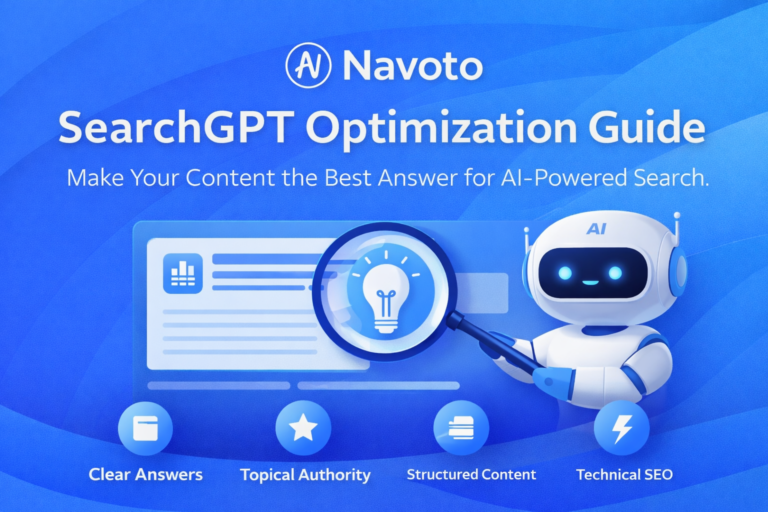
SearchGPT Optimization focuses on making your content easy for AI (like ChatGPT, Google AI) to understand, trust, and recommend.
What Is SearchGPT — And Why It Changes Everything
SearchGPT is OpenAI’s AI-powered search engine that delivers direct, conversational answers by synthesising information across the web. Unlike traditional Google results that serve a list of blue links, SearchGPT reads your content, understands intent, and cites sources inline — much like a highly confident research assistant.
For brands, bloggers, and SEO professionals, this is a seismic shift. Appearing in SearchGPT answers can drive significant referral traffic and brand authority. Not appearing means invisibility in an era where millions of searchers skip the traditional SERP entirely.
🔍 Key Stat: SearchGPT is currently integrated into ChatGPT and served to 300 million+ monthly users. Optimising for it is no longer optional — it is foundational to any modern SEO strategy.
Why SearchGPT Optimisation Matters for Your Brand
Traditional SEO gets you ranked. SearchGPT optimisation gets you cited. The distinction matters:
🏅
AI Citations Feel Authoritative
Users trust AI-cited sources more than a list of links. Being cited confers automatic credibility.
📈
No #1 Rank Required
Fresh, precise, well-structured content can be cited even without a top Google position.
🔗
The AI Answer IS the Click
Zero-click searches are rising. Appearing in an AI answer is the visibility that matters.
🔗 Related: How an AI Search Monitoring Platform Can Improve Your SEO Strategy — navoto.com
How SearchGPT Ranks and Cites Content
SearchGPT uses a retrieval-augmented generation (RAG) pipeline:
Searches the live web for relevant URLs using Bing’s index — making Bing crawlability critical.
Retrieves and reads the content from those pages in real-time.
Synthesises an answer using an LLM, citing the most relevant sources inline.
Key Ranking Signals for SearchGPT
| Signal | What It Means | Priority |
|---|---|---|
| Topical Authority | Does your site comprehensively own a subject area? | Critical |
| Content Freshness | When was the page last meaningfully updated? | Critical |
| Structured Clarity | Can the LLM extract a clean answer from your content easily? | High |
| E-E-A-T Signals | Experience, Expertise, Authoritativeness, Trust | Critical |
| Citation Worthiness | Data, original research, expert quotes, unique insight | High |
1. Content Strategy for SearchGPT
Write for Answers, Not Just Keywords
SearchGPT rewards content that directly answers specific questions. Every piece of content should have a crystal-clear primary question it answers — stated in the headline, repeated in the opening paragraph, and resolved completely within the article.
Think in terms of question clusters rather than individual keywords. A page targeting “SearchGPT optimisation” should also answer: What is SearchGPT? How does SearchGPT rank content? How do I get cited? This topical completeness is what earns citations.
Content Formats Most Frequently Cited by SearchGPT
- ✓Definitive guides with clear H2/H3 structure
- ✓Step-by-step how-to articles with numbered lists
- ✓Comparison articles (X vs Y) with structured verdicts
- ✓Data-led articles citing original research or named studies
- ✓FAQ-format content that mirrors natural question phrasing
💡 Content Length Target: Aim for 1,000–2,500 words for most guides. SearchGPT rewards completeness, not length. A focused 1,200-word article that fully answers one question outperforms a 4,000-word article that half-answers five.
2. On-Page SEO for SearchGPT
Title & Meta Description
Your title tag is the first signal SearchGPT uses to understand your page’s scope. Keep titles under 60 characters, front-load the primary keyword, and make the topic unambiguous. Avoid clickbait — SearchGPT’s retrieval layer favours descriptive accuracy over curiosity gaps.
Write meta descriptions as a one-sentence answer to your page’s primary question. If someone read only the meta description, they should know exactly what they’d learn on the page.
Heading Structure (H1 → H2 → H3)
Heading hierarchy is critical for AI parsing. Follow these rules:
- One H1 per page — your primary topic statement
- H2s for major subtopics — each should be independently answerable as a standalone chunk
- H3s for supporting detail within each H2 section
- Never skip levels (H1 → H3 without H2) — this confuses AI parsing
Schema Markup — Your Most Powerful SearchGPT Signal
Schema markup is one of the most underused SearchGPT tactics. Implement these schema types:
🔗 Related: How to Optimise for Google AI Mode — Complete Guide — navoto.com
3. Technical SEO for SearchGPT
Crawlability — GPTBot & Bingbot
SearchGPT uses Bing’s index as its primary data source, making Bing crawlability non-negotiable. Audit your Bing Webmaster Tools regularly and ensure your robots.txt is not blocking Bingbot.
Critically, make sure GPTBot (OpenAI’s crawler) is allowed in your robots.txt. Add this if you want to be indexed:
robots.txt
User-agent: GPTBot
Allow: /
User-agent: Bingbot
Allow: /
Core Web Vitals Targets
LCP
Under 2.5s
Largest Contentful Paint
INP
Under 200ms
Interaction to Next Paint
CLS
Under 0.1
Cumulative Layout Shift
4. Building Authority for AI Citation (E-E-A-T)
Experience, Expertise, Authoritativeness, and Trustworthiness (E-E-A-T) are as important for SearchGPT as for Google. AI retrieval layers are tuned to detect and prefer credible sources.
✍️ Author Credibility
- Named author on every article
- Author bio with credentials and social links
- Person schema on author pages
- External publications and guest posts
🌐 Domain Authority
- Editorial backlinks from established publications
- Consistent publishing cadence
- Brand mentions (linked and unlinked)
- Industry engagement: podcasts, events, forums
5. Query-Level Optimisation
Target Conversational Queries
SearchGPT users ask questions conversationally. Optimise for natural language queries like:
Example conversational queries to target:
“What is the best way to optimise for SearchGPT?”
“How does SearchGPT decide which sources to cite?”
“What makes content appear in ChatGPT search results?”
“How do I rank on SearchGPT without a top Google position?”
Build Topical Clusters
SearchGPT rewards domains that comprehensively own a topic. Build content clusters where a pillar page links to multiple detailed sub-pages, and each sub-page links back to the pillar and to sibling pages. This internal link architecture signals topical authority to the retrieval layer.
🔗 Related: How to Rank on ChatGPT — The Complete 2026 Guide — navoto.com
6. Content Freshness & Update Strategy
SearchGPT has a strong preference for recent content, especially on fast-moving topics. Establish a regular content audit cycle:
| Cadence | Action |
|---|---|
| Monthly | Update statistics, data points, and examples |
| Quarterly | Review conclusions; add new sections as the topic evolves |
| Annually | Full rewrite if the core framing has become outdated |
💡 Pro Tip: Always update the dateModified field in your Article schema when you refresh a page. SearchGPT reads this field to determine content freshness. Also add a visible “Last Updated: [date]” notice at the top of each article.
7. Monitoring Your SearchGPT Visibility
You cannot improve what you cannot measure. Traditional rank tracking tools do not capture AI search visibility. You need dedicated AI search monitoring to track:
- 📊Which queries trigger citations of your content in SearchGPT answers
- 📊How often your domain is cited versus competitors
- 📊Which pages earn the most AI citations — and which topics you’re invisible on
- 📊Citation sentiment — how your brand is framed in AI-generated answers
🔗 Related: How an AI Search Monitoring Platform Improves SEO Strategy — navoto.com
8. Common SearchGPT Optimisation Mistakes to Avoid
✗
Blocking GPTBot in robots.txt
Makes you completely invisible to OpenAI’s crawler.
✗
Ignoring Bing in favour of Google-only SEO
SearchGPT uses Bing’s index. Bing invisibility = SearchGPT invisibility.
✗
Thin content that answers only surface-level questions
AI citations reward completeness. Shallow answers don’t get cited.
✗
No schema markup
Missing out on the clearest structured signal you can send to AI retrievers.
✗
Anonymous content with no author attribution
Destroys E-E-A-T signals. Every article must have a named, credentialled author.
✗
Never updating published content
Stale pages are deprioritised in freshness-weighted retrieval. Update regularly.
9. Implementing This Guide in WordPress (Classic Editor)
Here is a step-by-step implementation plan for WordPress sites running the Classic Editor:
Use Heading Tags via the Paragraph Dropdown
In the Classic Editor toolbar, use the Paragraph dropdown to assign Heading 2 and Heading 3 tags to your subheadings. Never use Bold as a substitute — AI parsers read HTML heading hierarchy, not visual styling.
Add Schema via Yoast SEO or Rank Math
In the SEO meta box beneath your editor, select the appropriate schema type (Article, HowTo, FAQPage) and complete the required fields. Both plugins are fully compatible with the Classic Editor.
Optimise Your Post Excerpt
The WordPress excerpt is used as your meta description by crawlers. Write it as a one-sentence answer to your page’s primary question — this is often the first thing SearchGPT reads as a page summary.
Insert Custom JSON-LD Schema via HTML Tab
For advanced schema not covered by your plugin, switch to the Text (HTML) tab in the Classic Editor and insert your JSON-LD script block. Use the “Insert Headers and Footers” plugin to add it site-wide if needed.
10. SearchGPT in the Broader AI Search Landscape
SearchGPT does not exist in isolation. The AI search landscape in 2026 includes ChatGPT Search, Google AI Mode, Perplexity, Bing Copilot, and emerging players. The good news: content optimised for one tends to perform well across all of them, because the underlying principles — structured clarity, topical authority, E-E-A-T, and freshness — are universal.
🔗 Related: How AI Is Changing SEO in 2026 — The Full Picture — navoto.com
SearchGPT Optimisation Checklist
Use this checklist for every piece of content you publish or update:
Technical Foundation
☐ GPTBot not blocked in robots.txt
☐ Bingbot allowed and Bing Webmaster Tools configured
☐ XML sitemap submitted to Bing
☐ Core Web Vitals passing (LCP <2.5s, INP <200ms, CLS <0.1)
On-Page & Content
☐ Single clear H1 that states the primary topic/question
☐ Logical H2/H3 heading hierarchy — no skipped levels
☐ Meta description written as a direct one-sentence answer
☐ Named author with bio, credentials, and social links
Schema & Structure
☐ Article, HowTo, or FAQPage schema implemented and validated
☐ Person schema on author page
☐ dateModified updated in schema whenever content is refreshed
Links & Authority
☐ Internal links to topically related content on navoto.com
☐ External citations to authoritative sources included
☐ Monitored for AI search visibility via tracking tool
More from navoto.com
Explore Our AI Search SEO Resource Hub
© 2026 navoto.com — All rights reserved