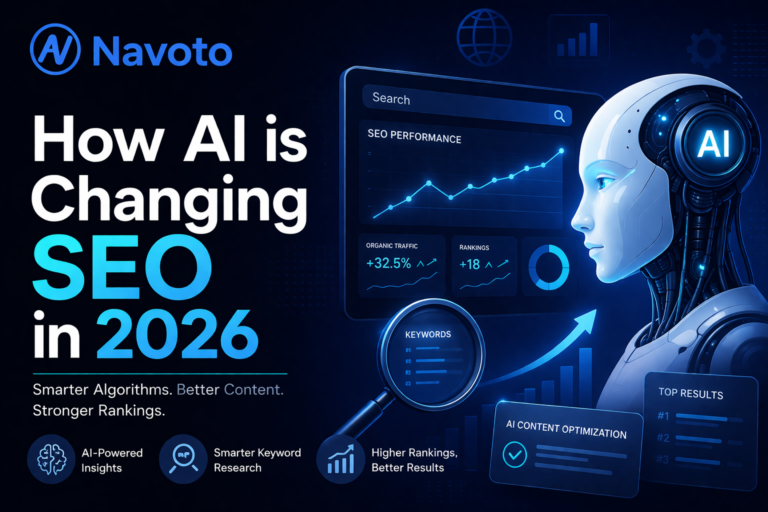
AI has rewritten the rules of search — and most brands haven’t caught up yet. This is Navoto’s complete guide to understanding exactly how artificial intelligence is changing SEO in 2026, what it means for your organic visibility, and the precise strategies you need to stay ranked, cited, and found.
The Biggest Shift in Search Since Google Was Invented
Something fundamental changed in search over the last 18 months — and it wasn’t another algorithm update. For the first time in 25 years, the model itself changed. Google no longer just ranks pages and points users to them. It reads those pages, synthesizes the information, and answers the question directly — right at the top of the results page, before a single blue link appears.
We are living through what industry researchers are calling “the biggest upheaval in search since Google’s founding.” The question for every business, marketer, and content team is not whether AI is changing SEO — it clearly is. The question is whether your strategy has changed with it.
The uncomfortable truth: most haven’t. According to a 2026 industry audit of 1,000 top enterprise domains, 62% of brands that invest heavily in traditional SEO are completely invisible to generative AI models. When AI is asked unbranded questions about their core services, those brands fail to appear in 81% of test cases.
💡 The new SEO reality: In 2026, SEO success is no longer just about ranking #1. It’s about being cited inside an AI-generated answer that appears before any ranked result. These are two different games — and you need to play both.
AI hasn’t killed SEO. It has split it into two parallel tracks: traditional search (the ten blue links, still heavily used) and AI-generated answers (AI Overviews, ChatGPT Search, Perplexity, Gemini). The brands that win in 2026 are the ones optimizing for both simultaneously.
This guide is your complete playbook for doing exactly that.
AI & SEO in 2026: The Numbers You Need to Know
Before strategy, context. These are the data points shaping every SEO decision in 2026:
| 48% of all Google searches now show an AI Overview (up from 34.5% in Dec 2025) |
61% drop in organic CTR when an AI Overview appears on the page |
23× higher conversion rate for visitors who click through from AI citations |
60% of searches now end without a click — the “zero-click” threshold has been crossed |
| 2B monthly users engage with Google AI Overviews globally |
40% visibility increase when content is optimized for GEO, per Princeton research |
4.4× more qualified traffic from AI referrals vs. traditional organic search |
$7.3B projected GEO market size by 2031 — from $886M in 2024 (34% CAGR) |
The picture these numbers paint is nuanced. Traditional search isn’t dying — total search volume (Google + AI combined) has actually grown 26% worldwide. But the mechanics of how users interact with results have fundamentally changed. Fewer clicks. Higher intent. Greater reward for the brands that get cited.
⚠️ The hidden danger: Only 38% of pages cited in AI Overviews also rank in the top 10 of traditional search — down from 76% just seven months prior. This means SEO rank no longer guarantees AI visibility. You need both strategies running in parallel.
Google AI Overviews: What Changed and What It Means for Clicks
Google’s AI Overviews (formerly Search Generative Experience) are the single most disruptive change in organic search since PageRank. They appear as large AI-generated answer blocks at the very top of search results — above all ranked pages — for an estimated 48% of all queries as of early 2026, with coverage exceeding 70% for informational and how-to searches.
Here’s what that means in practice for your traffic:
The Click-Through Rate Collapse
When an AI Overview appears, organic position 1 CTR drops from an average of 1.76% to 0.61% — a 61% decline. For brands whose revenue depends on organic informational traffic, this is a structural threat to their model. But there’s a crucial flip side: users who do click through from AI citations convert at up to 23 times the rate of standard search visitors. The traffic is smaller. The intent is dramatically higher.
Being Cited vs. Being Ranked
AI Overviews don’t just pull from top-ranked pages. They have their own citation logic. Research shows that only 38% of pages cited in AI Overviews also rank in the top 10 — a metric that has dropped sharply over the past year. This is the core strategic insight of 2026: ranking and being cited are two different outcomes that require two different optimization approaches.
The AI Mode Frontier
Google is testing “AI Mode” — a full AI-generated answer interface that replaces traditional SERPs entirely. Early data shows this mode generates even higher zero-click behavior than standard AI Overviews, with 93% of sessions ending without a single click. As AI Mode expands, GEO brand visibility — not just traffic — becomes the primary metric of success.
📌 Key insight: Google’s AI Overviews link to an average of 13.3 sources per response. If your content is one of those 13, you receive visibility regardless of your standard ranking position — and the visitors who arrive convert at dramatically higher rates.
How Google Decides What to Cite
Google’s AI doesn’t select sources randomly. Research into structural feature engineering for AI citations reveals a three-tier framework that influences citation probability:
- Macro-structure — overall document architecture (does the page have clear, logical sections?)
- Meso-structure — how information is chunked and organized within sections
- Micro-structure — visual emphasis, formatting, and extractability of individual facts
Pages that score well across all three levels — and answer the primary query completely in the first 200 words — are consistently more likely to be cited. This is a content structure problem as much as it is a content quality problem.
What Is GEO? Generative Engine Optimization Explained
GEO — Generative Engine Optimization — is the practice of making your content easier for AI search systems to find, trust, and cite in generated answers. The term was formalized in a peer-reviewed paper from Princeton University, Georgia Tech, the Allen Institute for AI, and IIT Delhi, and has rapidly become the defining strategic framework for SEO in the AI era.
The simplest way to understand it: SEO gets you ranked. GEO helps you get cited.
SEO vs. GEO: What’s Different
Scroll right on mobile ↗
That last row is critical. GEO does not replace traditional SEO — it requires it. Research shows that 99% of citations in Google AI Overviews come from the organic top 10, and 87% of ChatGPT citations correspond to the Bing top results. You must rank well first to even be considered as a citation source. Traditional SEO is the prerequisite; GEO is the extension.
The 5 Core GEO Principles
Principle 1
Authoritative, Extractable Content
Write paragraphs that can stand alone — called the “Island Test.” Each paragraph should make complete sense without the surrounding context, because AI systems chunk and vectorize content independently. Paragraphs that are semantically complete produce clearer embeddings and match user queries more reliably. This is the single most commonly neglected GEO signal.
Principle 2
Front-Load the Answer
AI systems that use real-time retrieval evaluate a page’s relevance primarily on its opening content. The first 200 words of any article should directly and completely answer the primary query. Think of it as a compressed version of your entire article — if someone read only your first two paragraphs, they should understand the core argument, the key data point, and the primary recommendation.
Principle 3
Build Topical Authority Through Content Clusters
AI knowledge models are organized around entities — concepts, people, organizations, products. Pages that clearly define their topic and connect to related entities through structured internal linking are easier for AI systems to categorize and reference. A well-linked pillar-cluster architecture is not just an SEO strategy in 2026 — it is a GEO signal that tells AI your domain has established, connected expertise.
Principle 4
Credibility Signals and Brand Presence
AI platforms are risk-averse. They trust recognized experts over anonymous sources. Author bios with real credentials, case studies with specific outcomes, sourced statistics, and consistent brand mentions across the web (LinkedIn, Reddit, YouTube, industry publications) all strengthen your AI citation probability. Unlinked brand mentions now matter as much as backlinks for GEO.
Principle 5
Content Depth Over Content Volume
Pages above 20,000 characters average approximately 10 AI citations each, versus 2.4 for pages under 500 characters. Depth and comprehensiveness signal authority. The top 4.8% of URLs cited in ChatGPT answers are comprehensive pages that answer “what is it,” “who uses it,” “how to choose,” and “pricing” — all in a single URL. Thin content is essentially invisible to AI citation engines.
E-E-A-T and AI: Why Trust Signals Matter More Than Ever
Google’s E-E-A-T framework — Experience, Expertise, Authoritativeness, and Trustworthiness — has been a ranking factor for years. In the AI era, it has become the single most important structural signal for both traditional rankings and AI citations. AI systems are fundamentally trust machines: they select sources they consider authoritative and avoid sources they can’t verify.
Experience
Demonstrate first-hand experience with your subject. This means original data, case studies from actual client work, specific outcomes with real numbers, and first-person insights that couldn’t have come from secondary research alone. AI systems — and Google’s quality raters — have become highly effective at distinguishing genuine experience from aggregated surface-level content.
Expertise
Expertise is demonstrated, not claimed. Author credentials need to be explicit and verifiable: real names, professional titles, LinkedIn profiles, industry publications. Pages with explicit author bios and sourced statistics consistently outperform pages without them in AI citation tests. Don’t just claim to be an expert — show your work.
Authoritativeness
Authority in 2026 is cross-platform. It includes: your domain’s traditional backlink profile, your presence on authoritative platforms (LinkedIn, YouTube, industry publications, Reddit), brand mentions in news outlets and podcasts, and your Knowledge Graph entity presence. AI systems connect these dots across the web to assess whether a source is genuinely authoritative or just well-SEO’d.
Trustworthiness
Technical trust signals matter more than ever for AI crawlability. HTTPS, accurate schema markup, correct Organization and Product structured data linked to a Knowledge Graph ID, accessible robots.txt, and fast page load times all contribute to how reliably AI systems can parse and attribute your content. Only 12.4% of Fortune 1000 companies have valid Organization Schema linked to a Knowledge Graph ID — a significant missed opportunity.
✅ The E-E-A-T shortcut: Websites with strong brand signals and presence across multiple platforms are consistently more resilient to Google algorithm updates and more frequently cited in AI answers. Brand building is no longer a marketing nice-to-have — it is an SEO and GEO requirement.
How AI Changed Keyword Research Forever
Keyword density is dead. A study of over 1,500 search results found no correlation between keyword density and high rankings in AI-powered search. Top-ranking pages often have lower keyword density than their competitors — because AI algorithms no longer match words, they interpret intent.
From Keywords to Entities and Topics
Modern AI search engines use Natural Language Processing to understand the relationships between concepts, not just the presence of specific words. This is why a page about “comfortable shoes for running” can rank for “half marathon training footwear” — the entity relationships are clear, even without exact keyword match.
The practical shift for keyword research in 2026:
- Map topics, not keywords. Use tools like Semrush’s AI clustering or Ahrefs to group thousands of keywords by intent. Build content that covers the entire topic cluster, not just the head term.
- Optimize for intent signals, not match type. Ask what the user is actually trying to accomplish, not just what words they typed. A query like “why is my website not showing on Google” has the same intent as “fix Google indexing problem.”
- Use semantic variety. Incorporate related concepts, brands, and techniques naturally. Google’s NLP API and tools like Surfer SEO or NeuronWriter can identify the related entities AI expects to see in a comprehensive treatment of your topic.
- Prioritize predictive research. AI tools can now predict emerging user trends 2–4 weeks before they peak in search volume. Acting on these predictions before your competitors react is one of the highest-leverage activities in modern SEO.
Conversational and Long-Tail Queries
AI-powered search has accelerated the shift toward conversational queries. Users no longer type “best SEO tool 2026” — they ask “what SEO tool should I use if I’m a small ecommerce store with no developer?” These longer, more specific queries were previously difficult to rank for because they had low search volume. In the AI era, they are the highest-value queries to capture, because they signal high purchase intent and are more likely to be answered directly by an AI — with a citation to your content.
The practical implication: build content that explicitly answers specific, conversational questions — not just broad topic pages. FAQ sections, Q&A formats, and “how to choose” guides are among the most frequently cited formats by AI systems.
AI Content Strategy: What Ranks, What Gets Cited, What Gets Ignored
The rise of AI content tools has created a paradox: it has never been easier to produce content at scale, and it has never been harder to make that content stand out. Google does not penalize AI-generated content by default — but it does penalize thin, generic, undifferentiated content, regardless of how it was produced.
The Winning Formula: Human + AI
The AI content vs. human content debate is the wrong framing entirely. The winning approach in 2026 is human expertise + AI efficiency, working together. AI generates drafts, structures outlines, and handles research at scale. Human editors ensure brand voice, genuine insight, first-hand experience, and emotional resonance. Pages that combine both approaches consistently outperform purely AI-generated or purely manual content in both rankings and AI citation rates.
Content Formats That Get Cited
Research on what AI systems prefer to cite reveals consistent patterns:
Content Freshness as a GEO Signal
AI citation sources change significantly over time — 40–60% of cited sources change month-to-month across Google AI Mode and ChatGPT. This makes content freshness a critical ongoing investment. Brands that treat content as a living asset — continuously refreshed with new data, updated case studies, and current statistics — maintain stronger AI visibility than those that publish once and leave pages static.
Community Platform Presence
AI LLMs pull heavily from Reddit, YouTube, and Wikipedia. These three platforms ranked among the most-referenced domains by major LLMs in recent studies. Any brand that wants to be cited by AI systems must build meaningful presence on community platforms — not just their own website. This means genuine participation in industry subreddits, building YouTube content that answers your audience’s questions, and contributing to forums where your customers ask questions.
Technical SEO in the AI Era: Bots, Schema, and Crawlability
Technical SEO is simultaneously getting easier in some areas and dramatically more complex in others. The fundamentals — HTTPS, page speed, mobile optimization, clean architecture — are more stable than ever. The new complexity comes from AI bot management, structured data for AI systems, and the emerging question of how you configure your site for AI crawlers.
AI Bot Management
In 2026, SEOs are being pulled into bot management conversations that span marketing, technology, and security. The question “which bots should we allow?” now has real downstream effects on AI visibility. A striking 34% of B2B SaaS companies actively block AI crawlers via robots.txt — effectively removing themselves from the consideration set of modern AI-powered buyers. This is almost certainly unintentional, but the consequence is real: if AI systems can’t crawl you, they can’t cite you.
⚠️ Check your robots.txt: Audit whether your robots.txt file is blocking AI crawlers like GPTBot (OpenAI), Google-Extended, PerplexityBot, or ClaudeBot (Anthropic). Blocking these bots removes your content from AI citation eligibility entirely.
Schema Markup for AI Systems
Structured data has historically been about earning rich snippets in Google. In 2026, its importance extends to helping AI systems understand, categorize, and attribute your content accurately. The highest-priority schema types for AI SEO:
- Organization schema — links your brand to its Knowledge Graph ID, helping AI connect your content to your entity
- Article and BlogPosting schema — with explicit author, datePublished, and dateModified properties
- FAQPage schema — enables direct Q&A extraction by AI systems; growing rapidly as an AI search strategy signal
- Product schema — essential for ecommerce GEO, especially as AI shopping features expand
- HowTo schema — maps step-by-step content to AI answer formats precisely
Page Speed and AI Citation
Research reveals that faster-loading content is more likely to be cited by AI systems. Of ChatGPT bot visits, 46% begin in reading mode — a plain HTML version with no CSS, JavaScript, or images. And 63% of ChatGPT agents leave a page immediately after landing, with slow load times being a primary reason. Rendering speed and clean HTML structure are now GEO signals, not just UX considerations.
LLMs.txt: The Emerging Standard
A new aspiring web standard called llms.txt aims to guide AI crawler behavior — similar to robots.txt, but specifically for LLMs. Its adoption is still being debated and its efficacy contested, but it represents the emerging direction of AI-specific technical configuration. Monitoring its development is advisable for any SEO team taking AI visibility seriously.
Beyond Google: Optimizing for ChatGPT, Perplexity, and Gemini
Google still processes approximately 14 billion search queries daily — vastly more than any AI platform. But the AI search landscape is growing rapidly and attracting high-intent users that brands cannot afford to ignore. As of January 2026, AI search traffic share breaks down as follows:
ChatGPT-Specific Optimization
ChatGPT Search primarily cites pages ranking at position 21+ in about 90% of cases — meaning it often surfaces different pages than Google’s top 10. This creates a unique opportunity: pages that rank moderately on Google but score high on content quality and structure can achieve significant ChatGPT citation rates. Ensure GPTBot is not blocked in robots.txt, optimize for Bing rankings (not just Google), and structure content with clean, accessible HTML.
Gemini-Specific Optimization
Gemini sits on top of Google’s infrastructure and is natively multimodal — it processes text, images, and video together. Traditional SEO is the direct foundation for Gemini visibility: poor Google rankings mean poor Gemini visibility. Additionally, YouTube videos with proper VideoObject schema are frequently primary sources for how-to queries. If your brand produces video content, implementing complete video schema is a direct GEO lever.
Perplexity-Specific Optimization
Perplexity has positioned itself as an “answer engine” — its entire interface is built around AI-generated answers with citations. Getting cited in Perplexity requires strong domain authority, frequently updated content with explicit sourcing, and a clear, authoritative voice. Perplexity users are highly research-oriented; content that goes deeper than surface answers and cites primary research performs best.
Your 2026 AI SEO Action Plan
Knowing the landscape is one thing. Having a clear sequence of actions is another. Here is Navoto’s recommended 90-day AI SEO action plan, structured around the highest-leverage priorities first.
Days 1–30
Phase 1: Audit & Foundation
- ✓ AI brand perception audit — query ChatGPT, Perplexity, Gemini, and Copilot with your core service questions. Document where and how your brand is mentioned (or isn’t).
- ✓ Robots.txt audit — check whether GPTBot, Google-Extended, PerplexityBot, and ClaudeBot are being blocked. Remove any unintentional blocks.
- ✓ Schema markup audit — verify Organization, Article, FAQ, Product, and HowTo schema is implemented correctly and linked to your Knowledge Graph entity.
- ✓ Zero-click exposure mapping — identify your top-traffic informational queries. Determine which are now covered by AI Overviews and what CTR impact you’ve experienced.
- ✓ Content depth audit — flag all pages under 1,500 words on commercially important topics as candidates for expansion.
Days 31–60
Phase 2: Content Restructuring & GEO Optimization
- ✓ Pillar-cluster architecture — build or audit your content cluster around your 3–5 most important topic areas. Each pillar page should link to 8–12 supporting cluster posts.
- ✓ Front-load rewrites — update your top 20 pages so the first 200 words completely answer the primary query with a clear, direct, citable statement.
- ✓ Island Test edit — review your most important content paragraphs. Each should make complete sense without surrounding context. Rewrite paragraphs that can’t pass this test.
- ✓ FAQPage schema rollout — add structured FAQ sections to every major content page and implement FAQPage schema markup.
- ✓ Author credentialing — add complete author bios with real credentials, LinkedIn links, and experience summaries to all content pages.
Days 61–90
Phase 3: Brand Presence & AI Visibility Measurement
- ✓ Community platform investment — begin consistent participation in 2–3 relevant Reddit communities, LinkedIn, and/or YouTube. Prioritize answering questions that your target customers ask.
- ✓ Digital PR for AI mentions — seek coverage in industry publications, podcasts, and news outlets. Even unlinked brand mentions contribute to AI brand authority scoring.
- ✓ Set up AI visibility tracking — use Semrush’s AIO or equivalent tools to track your brand’s mention frequency and sentiment across ChatGPT, Perplexity, and Google AI Mode.
- ✓ Revenue attribution update — configure your to track AI referral traffic separately and measure its conversion rate vs. traditional organic.
- ✓ Monthly GEO review cadence — establish a recurring monthly review of AI citation rates, zero-result queries, and content freshness across your top pages.
📊 Recommended budget framework: One research-backed allocation dedicates 40% to core SEO (technical, on-page, link building), 25% to digital PR (brand authority and AI citation signals), 20% to data and reporting (AI visibility tracking, revenue attribution), 10% to training, and 5% to experimentation (emerging platforms, llms.txt, new schema types).
5 AI SEO Mistakes Killing Your Rankings Right Now
1. Optimizing for Rankings, Not Citations
The most common mistake in 2026: treating AI Overviews and GEO as an afterthought to your traditional keyword ranking strategy. With 48% of queries now showing AI Overviews and only 38% of cited pages overlapping with top-10 rankings, you can rank #1 and still be invisible in AI-generated answers — which now appear above your ranking anyway. Audit your citation rates alongside your rankings. They are not the same metric.
2. Blocking AI Crawlers Without Knowing It
One in three B2B SaaS companies is actively blocking AI crawlers in their robots.txt — most of them unintentionally. This is a direct self-removal from AI citation eligibility. Audit your robots.txt file immediately. Ensure GPTBot, Google-Extended, PerplexityBot, and ClaudeBot have crawl access to your most important content.
3. Producing Content at Scale Without Depth
AI tools make it trivially easy to produce content volume. The result is a web increasingly flooded with shallow, generic, interchangeable content. AI citation systems are specifically designed to deprioritize exactly this kind of content. Pages below 500 characters average just 2.4 AI citations; pages above 20,000 characters average 10. Depth, specificity, original data, and genuine expertise are the only things that differentiate content in an AI-saturated environment.
4. Ignoring Community Platforms as SEO Signals
LLMs pull heavily from Reddit, YouTube, and Wikipedia. Brands that focus exclusively on their own website and backlink profile are missing a growing share of the signals that AI systems use to assess brand authority. Building genuine community presence — answering questions, contributing to discussions, publishing on YouTube — is now an organic search strategy, not just a social media one.
5. Measuring the Wrong Things
Traditional SEO metrics — rankings, impressions, CTR — are insufficient for 2026. With 60% of searches ending without a click, high impressions and low CTR can actually indicate that AI Overviews are intercepting your traffic, not that your content is underperforming. Add AI-specific metrics to your reporting: AI citation frequency, AI referral traffic and its conversion rate, brand mention sentiment in AI responses, and share of voice in AI-generated answers for your key topic clusters.
Ready to see how visible your brand is in AI search?
Navoto offers a free AI visibility audit — we’ll show you exactly where your brand is being cited (and where it isn’t) across Google AI Overviews, ChatGPT, Perplexity, and Gemini. No obligation, delivered in 48 hours.
Frequently Asked Questions
Is AI killing SEO in 2026?
No — AI is transforming SEO, not killing it. Total search volume has actually increased 26% globally as AI search supplements traditional search rather than replacing it. What AI is killing is the old playbook: keyword stuffing, thin content, and ranking without brand authority. Traditional SEO fundamentals remain essential — in fact, 99% of AI Overview citations come from the organic top 10, meaning ranking well is still a prerequisite for AI visibility. The difference is that ranking is no longer sufficient on its own.
What is the difference between SEO and GEO?
Traditional SEO optimizes for Google rankings and clicks. GEO — Generative Engine Optimization — optimizes for being cited inside AI-generated answers on platforms like Google AI Overviews, ChatGPT, Perplexity, and Gemini. SEO success is measured in rankings and click-through rates. GEO success is measured in citation frequency, brand mention sentiment, and share of voice in AI responses. GEO doesn’t replace SEO — it extends it. You need both.
How does Google AI Overview decide which pages to cite?
Google AI Overviews pull primarily from pages that rank in the organic top 10 — 99% of citations come from this pool. Within that pool, AI systems favor content that is: well-structured with clear headings, answering the query directly in the first 200 words, written with explicit author credentials, supported by original data and sources, formatted with appropriate schema markup, and deep enough to demonstrate genuine topical authority. Content structure matters as much as content quality.
Does AI-generated content hurt your SEO rankings in 2026?
Google does not penalize AI-generated content by default. What it does penalize is thin, low-value, undifferentiated content — regardless of how it was produced. The winning approach is human + AI collaboration: AI tools for research, drafting, and structuring; human editors for expertise, brand voice, original insight, and E-E-A-T signals. Purely AI-generated content without human review and genuine expertise tends to produce the kind of generic output that both Google and AI citation systems actively deprioritize.
How do I track if my content is being cited by AI systems?
Track AI visibility through several methods: manually querying ChatGPT, Perplexity, Gemini, and Google AI Overviews with your target keywords and noting citations; using tools like Semrush’s Enterprise AIO for automated AI mention tracking across platforms; monitoring your Google Search Console for changes in impressions vs. CTR (a growing gap often signals AI Overview interception); and setting up Google Analytics segments for AI referral traffic (distinct from organic) to measure conversion rates from AI-driven clicks.
What percentage of searches now use AI Overviews?
As of early 2026, AI Overviews appear in approximately 48% of all Google searches — up from 34.5% in December 2025. Coverage is highest in informational and how-to queries, where AI Overviews now appear on more than 70% of results pages. Google AI Mode, which replaces the traditional SERP entirely with an AI interface, is in active testing and is expected to expand further through 2026.
Is Reddit actually important for SEO in 2026?
Yes — more than most brands realize. Reddit, YouTube, and Wikipedia are consistently among the most-referenced domains by major LLMs. Reddit alone has 100 million daily active users generating conversations about brands and products. Because AI systems pull knowledge from community platforms, brand presence and positive discussion in relevant subreddits directly influences how AI systems characterize your brand in generated answers. This makes authentic community participation a legitimate and growing SEO signal.
What is the ROI of GEO optimization?
Research-backed data shows that content optimized for GEO achieves 30–40% higher visibility in AI search results. Companies seeing positive GEO ROI report returns of 300–500% within 6–12 months, with an average ROI of $3.71 per $1 invested in GEO optimization. Critically, visitors arriving from AI citations convert at 4.4 times the rate of traditional organic visitors — meaning even lower AI traffic volumes can deliver outsized revenue impact. The ROI case for GEO investment is now stronger than many traditional link building activities.
The Bottom Line: What AI Means for Your SEO Strategy in 2026
AI has fundamentally changed the goal of SEO from “rank and get clicked” to “rank, get cited, and build brand authority across every platform where your customers search.” The brands that understand this shift are capturing a disproportionate share of high-intent, high-converting traffic. The ones still running 2022’s playbook are watching their organic revenue erode.
| Traditional SEO: Still required Rankings remain the entry ticket to AI citations. 99% of AI Overview sources are in the top 10. Don’t abandon the fundamentals. |
GEO: The new extension Optimize for AI citation through content depth, extractable structure, schema, and brand authority across the open web. |
|
| E-E-A-T: The non-negotiable AI systems trust recognized experts. Author credentials, original data, and brand mentions are now ranking signals, not just quality markers. |
Metrics: Update your dashboard Track AI citation rates, AI referral conversion, and brand mention sentiment alongside traditional rankings and CTR. |
|
The opportunity is significant for brands that act now. With 62% of enterprises currently invisible to AI systems, early movers in GEO are building citation authority that will be extremely difficult for late adopters to displace.