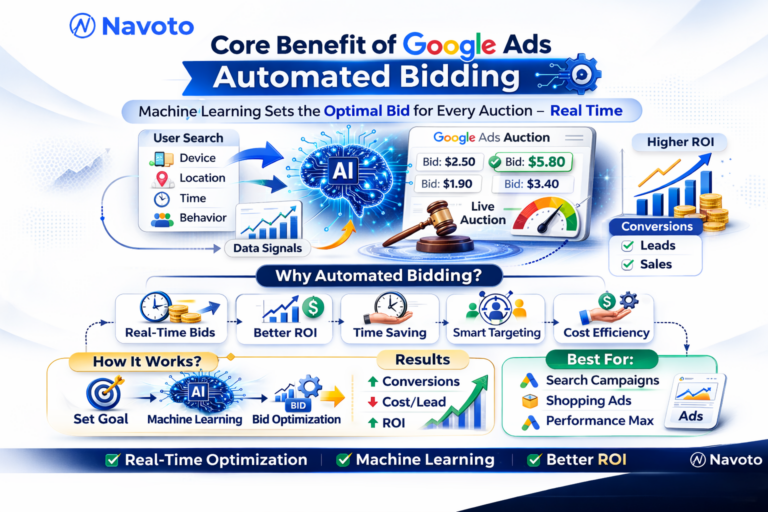
Automated bidding uses Google’s machine learning to adjust bids in real time for each auction, helping you get better results without managing bids manually. In real campaigns, this matters because every search is different. The core benefit of Google Ads automated bidding is its ability to use machine learning to adjust bids in real time for every auction. Instead of relying on fixed manual bids, Google analyzes signals such as device, location, time of day, user behavior, and conversion likelihood to set the optimal bid for each search.
This real-time optimization helps advertisers improve conversions, control costs, and scale campaigns more efficiently — making automated bidding one of the most powerful performance tools in Google Ads.
That ability to react to each individual auction is the true core benefit — and it’s what makes automated bidding outperform manual bidding once there’s enough data.
What is Google Ads Automated Bidding?
Every time someone searches on Google, an auction happens in milliseconds. Google looks at all the advertisers competing for that search and decides which ads to show and in what order.
To win a good position, you need to bid. With manual bidding, you set a fixed amount per keyword. With automated bidding, Google sets the bid for you based on a huge number of real-time signals — and it does this for every single auction, not just once a day.
Those signals include things like:
- The device someone is using (phone, tablet, laptop)
- The time of day and day of the week
- The user’s location and language
- Their recent search and browsing history
- Whether they have visited your site before
- How likely they are to convert based on past patterns
No person can process all of those signals fast enough to make good decisions. That is the whole point of machine learning — it does in milliseconds what would take a human hours. This is also directly connected to avoiding common Google Ads mistakes, like overbidding on low-intent traffic or wasting budget on the wrong audience.
What is the Core Benefit of Google Ads Automated Bidding?
The core benefit of Google Ads automated bidding is that it sets bids based on the unique context of each auction using machine learning — something no manual system can replicate.
But that single benefit unlocks several real-world advantages:
1. You Save a Huge Amount of Time
If you are running a campaign with 50 keywords across 10 locations on 3 devices, managing bids manually means hundreds of adjustments. Automated bidding handles all of that for you. You set your goal, and Google chases it.
2. Google Uses Data You Cannot Access
Google sees patterns across billions of searches every day. It knows which user behaviors tend to lead to conversions — not just in your account, but across the entire search ecosystem. Automated bidding taps into that data.
3. Bids Adjust in Real Time
A static manual bid treats every auction the same. Automated bidding raises your bid when someone is highly likely to convert and lowers it when they are not. That means your money goes where it is most likely to work.
4. Performance Improves Over Time
The longer your campaign runs, the more data Google collects. Automated bidding gets smarter with every conversion. This is why tracking the right metrics matters so much — check out our guide on Google Ads benchmarks to know what good performance actually looks like in your industry.
Every Automated Bidding Strategy, Explained Simply
Google offers several automated bidding strategies. Each one is designed for a different goal. Here is what each one does and when to use it:
Maximize Conversions
Google spends your full daily budget and tries to get you the highest number of conversions possible. This is a great starting point if you are new to automated bidding and do not yet have a cost-per-conversion target in mind.
Target CPA (Cost Per Acquisition)
You tell Google what you are willing to pay for one conversion. Google then tries to get you as many conversions as possible while staying at or below that target. Best for: lead generation, sign-ups, consultation bookings.
Maximize Conversion Value
Instead of chasing volume, this strategy focuses on getting you the highest total value from your conversions. If some purchases are worth more than others, this tells Google to prioritize the high-value ones.
Target ROAS (Return on Ad Spend)
You set a target return — for example, $5 back for every $1 spent. Google bids to hit that return across your campaign. This works best when you have strong conversion tracking in place. If your landing pages are converting well, Target ROAS can seriously amplify your results.
Maximize Clicks
Google tries to get you the highest number of clicks within your budget. This is not conversion-focused, so it works best when your main goal is traffic volume — for example, building brand awareness or getting users into a retargeting funnel.
Target Impression Share
You choose where you want your ad to appear — top of the page, anywhere on the page, or absolute top — and Google bids to hit that position. Best for branded campaigns where being visible is the priority.
Automated Bidding vs Manual Bidding: The Honest Comparison
Manual bidding is not dead — it still has a place. But for most accounts, automated bidding outperforms it once there is enough data. Here is a clear breakdown:
Where Manual Bidding Still Works:
- Very new accounts with zero conversion history
- Campaigns with fewer than 5 to 10 conversions per month
- Highly niche keywords where you know the value precisely
- When you need full control over individual bid adjustments
Where Automated Bidding Wins:
- Campaigns with consistent conversion volume
- Large accounts with many keywords and audiences
- When you want to scale without adding manual workload
- When you are optimizing for value, not just volume
One of the most common Google Ads mistakes is switching to automated bidding before the account has enough data, then blaming the strategy when it underperforms. Give it time — the learning period is real.
How to Make Automated Bidding Work Better
Knowing which of the following is a core benefit of Google Ads automated bidding is just the start. Making it work in practice takes a little more setup. Here is what actually moves the needle:
Fix Your Conversion Tracking First
Automated bidding is powered by conversion data. If your conversions are not tracked correctly, Google is flying blind. Before you turn on any automated strategy, verify that your conversion actions are firing properly and counting the right things.
Be Patient During the Learning Period
When you launch or switch to an automated bidding strategy, Google enters a learning phase that typically lasts 1 to 4 weeks. During this time, do not make big changes to your budget, targeting, or bids. Let the algorithm collect data.
Give It Enough Budget
Automated bidding needs room to experiment. A budget that is too tight limits the number of auctions Google can enter, which slows down learning. A good rule of thumb is to set your daily budget at least 10 times your target CPA to start.
Align Your Landing Pages
Automated bidding can win the auction and bring users to your page — but it cannot force them to convert. Your landing page has to do that job. If you need help, our guide on Google Ads landing page optimization walks through exactly what makes a high-converting page.
Use Audience Signals
Especially in Performance Max and Smart campaigns, audience signals help Google understand who your best customers are. Feed it your customer lists, remarketing audiences, and in-market segments to speed up learning.
Automated Bidding for Google Shopping Campaigns
Shopping campaigns work a little differently from Search, but automated bidding applies there too. For product-based businesses, strategies like Target ROAS and Maximize Conversion Value are especially powerful. Our full guide on Google Shopping Ads optimization covers how to structure your campaigns, optimize your feed, and layer in the right bidding strategy for maximum return.
And if you are not sure which products to focus on, our guide to Google Shopping Ads keyword research will help you find where your budget will have the most impact.
What About AI-Generated Ads and Automated Bidding?
Google has been rolling out more AI-powered ad features beyond just bidding — including automatically generated headlines, descriptions, and assets. These work alongside automated bidding strategies, not separately from them. If you are using or considering AI-generated assets, our guide to Google Ads text guidelines for AI-generated ad assets explains the rules and best practices for keeping your ads compliant and effective.
Also worth reading: our breakdown of Google Ads Demand Gen updates, which covers how Google is expanding its AI-powered campaign types and what that means for automated bidding going forward.
Measuring Whether Automated Bidding is Actually Working
One of the biggest mistakes advertisers make is not knowing what success looks like before they start. Before you run any automated strategy, set clear benchmarks for:
- Cost per conversion (CPA)
- Conversion rate
- Return on ad spend (ROAS)
- Click-through rate (CTR)
Not sure what numbers are realistic for your industry? Our Google Ads benchmarks guide breaks down average performance metrics across different verticals so you can set targets that are actually achievable.
Frequently Asked Questions
Which of the following is a core benefit of Google Ads automated bidding?
The core benefit is that automated bidding uses Google’s machine learning to set the optimal bid for each individual auction in real time, based on signals like device, location, time of day, and user behavior — something no manual bidding system can do.
How long does the learning period take?
Most automated strategies need 1 to 4 weeks to exit the learning period. During that time, you may see fluctuating results. Avoid making big changes to your campaign until learning is complete.
Can I use automated bidding with a small budget?
Yes, but it takes longer to learn. Start with Maximize Clicks or Maximize Conversions rather than a target-based strategy, and give it time before judging results.
Does automated bidding work for Shopping campaigns?
Yes. Target ROAS and Maximize Conversion Value are particularly effective for Shopping. See our Google Shopping Ads optimization guide for more details.
What is the difference between Target CPA and Maximize Conversions?
Maximize Conversions spends your full budget to get as many conversions as possible, regardless of cost. Target CPA also chases conversions but tries to hit a specific cost target. Start with Maximize Conversions, then move to Target CPA once you know your comfortable cost per lead or sale.
Conclusion
So — which of the following is a core benefit of Google Ads automated bidding? The answer is machine learning that sets the right bid for every auction in real time. But the real value goes beyond the exam answer. Automated bidding saves time, scales with your account, uses data no human can access, and gets smarter the longer you run it.
Use the right strategy for your goal, set up conversion tracking properly, give the algorithm time to learn, and keep your landing pages optimized. Do all of that, and automated bidding will outperform manual bidding in almost every scenario.