What Is Search Engine Marketing for Local Business?
Search engine marketing (SEM) for local business is a targeted digital strategy that combines paid advertising — such as Google Ads and Local Services Ads — with organic local SEO to help nearby customers find your business when they search on Google and other search engines.
Unlike broad national SEM campaigns, local SEM focuses on geographic relevance — making sure your business appears prominently when someone searches for products or services in your city, neighborhood, or region. Whether a customer types “plumber near me,” “best pizza in Austin,” or “HVAC repair Chicago,” local SEM ensures your business shows up first.
The strategy targets three critical areas of Google’s search results:
- The Local Pack (Map Pack): The 3 business listings shown with a map at the top of local search results
- Organic Results: Regular blue-link website rankings beneath the local pack
- Paid Ads: Google Ads and Local Services Ads appearing above all organic results
Key insight: Businesses that appear in both the local pack and organic results receive significantly more clicks. Appearing in multiple placements signals authority and dramatically increases the chance a searcher chooses your business over a competitor.
Local SEM vs. Local SEO: Understanding the Difference
Many local business owners use these terms interchangeably, but there’s a meaningful distinction. Understanding both helps you allocate budget and time more effectively.
The smartest local businesses don’t choose between SEO and paid SEM — they run both simultaneously. Paid ads capture immediate high-intent traffic while SEO builds a foundation of lasting organic authority.
Why Local Search Marketing Is Critical for Your Business
The numbers are hard to ignore. Local search has fundamentally changed how consumers find and choose local businesses. Here’s why investing in search engine marketing for your local business is no longer optional:
Consumers Search Before They Buy
Before visiting a local business or calling a service provider, the vast majority of consumers run a search first. They’re comparing options, reading reviews, and checking hours — all before you even know they exist. If your business doesn’t appear, you simply don’t exist to that potential customer.
Mobile Search Has Exploded
With more than 60% of Google searches now happening on mobile devices, location-based queries have skyrocketed. Searches like “open now,” “near me,” and “[service] + [city]” all signal buyers who are ready to act within hours — the highest-value leads in local marketing.
Local Results Get Preferential Placement
Google’s algorithm heavily favors local results for location-based queries. The local pack appears above organic results, meaning a well-optimized Google Business Profile can outrank large national websites — giving small local businesses a genuine competitive edge.
“Near me” mobile searches have grown by over 500% in the last few years, making local search the fastest-growing segment of digital marketing for brick-and-mortar and service-area businesses.
Trust Is Built Through Visibility
Consumers associate search ranking position with credibility. Appearing at the top of local search results — especially with positive reviews — builds instant trust before a customer ever contacts you.
🏆 The Local Search Advantage
- Local leads convert at 14.6% vs 1.7% for outbound marketing
- Businesses in the local 3-pack receive 700% more clicks than those just outside it
- 88% of consumers trust online reviews as much as personal recommendations
- “Near me” searches with “to buy” intent have grown 500%+ in recent years
7 Core Components of Local Search Engine Marketing
A comprehensive local SEM strategy isn’t a single tactic — it’s a system of interconnected components that reinforce each other. Here’s what every local business needs to master:
1. Google Business Profile Optimization
Your Google Business Profile (GBP) is the cornerstone of local search marketing. It’s the listing that appears in Google Maps and the local pack — and it’s completely free. Yet most local businesses leave their GBP severely under-optimized. Location visibility is also influenced by Google Maps signals such as pins and location markers. Learning how features like a dropped pin on Google Maps work can help businesses improve local discovery.
A fully optimized GBP includes:
- Accurate business name, address, and phone number (NAP)
- Complete business categories (primary + secondary)
- Detailed services and products with descriptions
- High-quality photos updated regularly (interior, exterior, team)
- Regular GBP posts (weekly promotions, events, updates)
- Q&A section populated with common customer questions
- Messaging and booking integrations enabled
Quick win: Businesses with complete GBP profiles receive on average 7× more clicks than incomplete profiles. Spend 2 hours fully completing yours this week — it’s the highest-ROI action in local SEM.
2. Local Citations & NAP Consistency
A local citation is any mention of your business name, address, and phone number on the web — in directories, review sites, social platforms, and local websites. Google uses citations as a trust signal when ranking local businesses.
Critical citation sources: Yelp, Bing Places, Apple Maps, Facebook Business, industry-specific directories, local Chamber of Commerce sites, and data aggregators. Consistency is everything — even small discrepancies in your NAP can confuse Google’s algorithm and suppress your local rankings.
3. On-Page Local SEO
A strong website structure and content strategy also play a critical role. Following a well-planned strategic SEO guide helps businesses build long-term authority and organic visibility. Your website needs to clearly communicate your location and service areas to Google. Essential on-page local SEO elements:
- Location-specific title tags & meta descriptions — e.g., “Best HVAC Repair in Denver, CO | [Business Name]”
- Location pages for each city or neighborhood you serve
- Embedded Google Map on your contact page
- Local schema markup (LocalBusiness structured data)
- NAP in footer on every page of your website
- Locally relevant content targeting your community
4. Review Management
Online reviews are one of Google’s top local ranking factors. Businesses with 4.5+ star ratings consistently outrank lower-rated competitors in the local pack. A winning review strategy: ask every satisfied customer for a Google review, respond to every review within 48 hours, and address negatives professionally with a resolution offer.
5. Local Keyword Research
Google Ads lets you place your business at the top of search results immediately — above both the local pack and organic results. Understanding industry Google Ads benchmarks can help local businesses estimate expected click-through rates, cost per click, and conversion performance before launching campaigns. Target these keyword types:
- Service + Location: “roofing contractor Phoenix AZ”
- Near Me: “emergency dentist near me”
- Best/Top: “best Italian restaurant downtown Chicago”
- Intent-based: “same day plumber open now”
- Neighborhood-specific: “dog grooming in Williamsburg Brooklyn”
6. Google Ads for Local Businesses
Google Ads lets you place your business at the top of search results immediately — above both the local pack and organic results. Local Google Ads formats to leverage:
Local Services Ads (LSAs)
Pay-per-lead ads for service businesses. Appear above all other ads. Include Google Guarantee badge for instant trust.
Search Campaigns
Target specific keywords with location and radius targeting. Show ads only to searchers near your business.
Maps Ads
Promoted pins on Google Maps alongside organic map results. Great for high foot-traffic businesses.
Retargeting Ads
Re-engage website visitors who didn’t convert. Show ads across Google’s Display Network to bring them back.
7. Local Content Marketing
Publishing locally relevant content builds topical authority and drives organic traffic from long-tail searches. Identifying SERP feature opportunities can help local businesses capture visibility in featured snippets, local packs, and other enhanced search results. High-value local content ideas: neighborhood guides, local how-to articles, case studies with local clients, local event coverage, and FAQ pages answering location-specific questions.
How to Start with Local SEM: A Step-by-Step Framework
Audit Your Current Local Presence
Before building anything new, understand where you stand. Search for your business on Google, check your GBP status, audit your website for local SEO signals, and review your citations.
Claim and Fully Optimize Your Google Business Profile
Claim at business.google.com and complete every section — categories, services, hours, photos, and description. This single action can produce ranking improvements within weeks.
Conduct Local Keyword Research
Identify 15–30 target keywords combining your services with your location. Segment by intent and use them to inform your website content, ad campaigns, and GBP descriptions.
Optimize Your Website for Local Search
Add location-specific title tags, meta descriptions, and headers. Create dedicated location pages if you serve multiple areas. Add LocalBusiness schema markup.
Build and Clean Your Local Citations
Claim your listing on the top 20 directories. Ensure your NAP is identical across all of them — Yelp, Facebook, Apple Maps, Bing Places, and industry-specific directories first.
Launch a Google Ads Campaign
Start with a targeted search campaign using your top 10 high-intent keywords. Set location targeting to a radius around your business. Even a $500/month budget can generate meaningful leads.
Implement a Review Generation System
Create a simple process for asking every customer for a Google review. A follow-up text with a direct GBP review link dramatically increases review volume and velocity.
Track, Measure, and Iterate
Set up Google Analytics 4 and Google Search Console. Track GBP calls, direction requests, and local organic traffic monthly and double down on what’s working.
Google’s 3 Local Ranking Factors Explained
1. Relevance
Does your business match what the searcher is looking for? Be specific and comprehensive in your GBP categories and descriptions — don’t just list “contractor,” list “kitchen remodeling contractor,” “bathroom renovation,” and “home additions.”
2. Distance
How close is your business to the searcher? While you can’t change your physical location, you can optimize for service-area keywords and create location-specific pages for neighboring cities to capture broader geographic searches.
3. Prominence
How well-known and reputable is your business? Prominence is built through reviews, backlinks from local websites, citation volume, and the overall quality of your online presence.
Pro tip: Most local businesses can’t control their distance ranking, but they have enormous room to improve on relevance and prominence. Focus your energy there first for the biggest ranking gains.
Measuring Local SEM Success: Key Metrics & KPIs
You can’t improve what you don’t measure. These are the critical metrics for tracking local SEM performance:
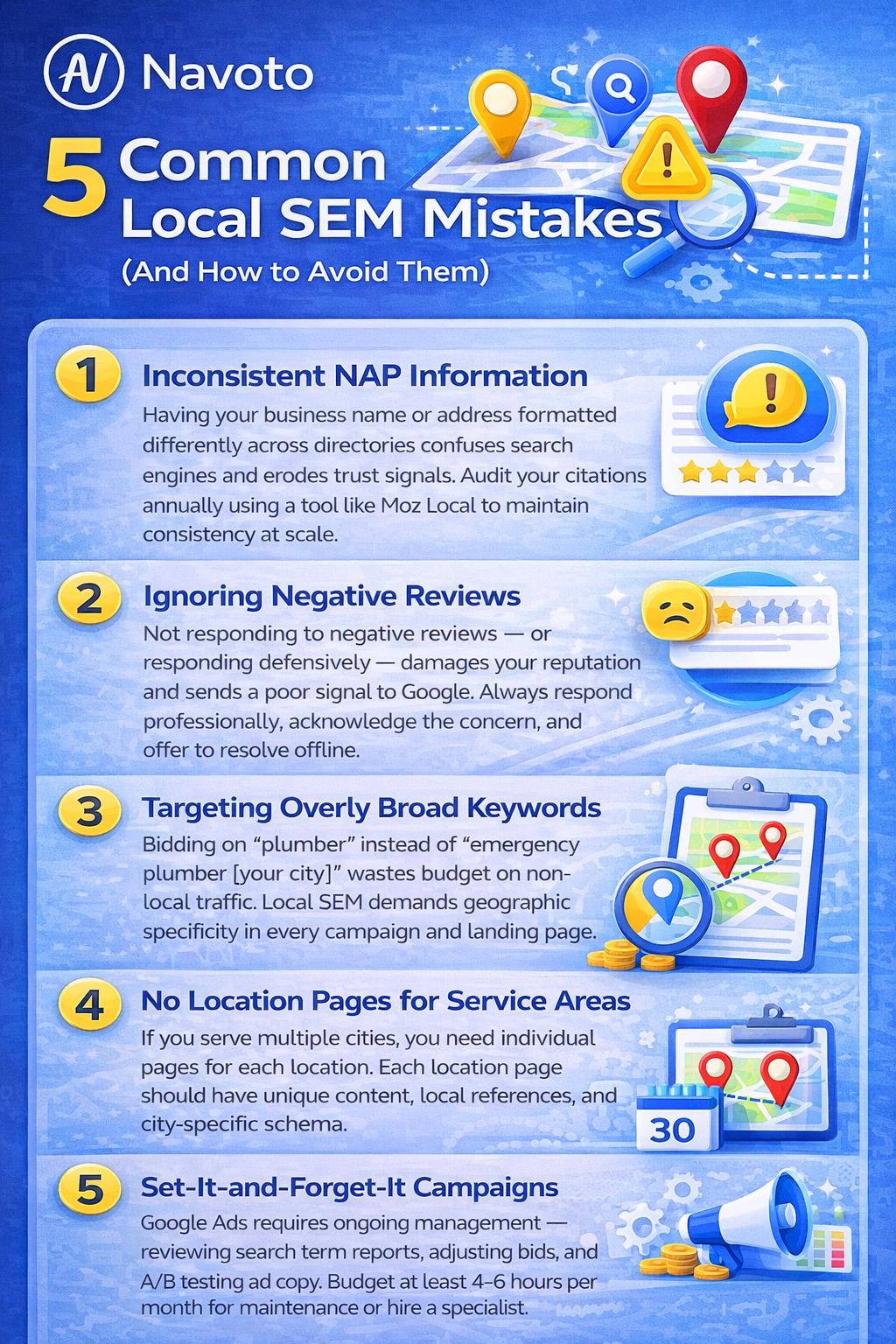
5 Common Local SEM Mistakes (And How to Avoid Them)
1. Inconsistent NAP Information
Having your business name or address formatted differently across directories confuses search engines and erodes trust signals. Audit your citations annually using a tool like Moz Local to maintain consistency at scale.
2. Ignoring Negative Reviews
Not responding to negative reviews — or responding defensively — damages your reputation and sends a poor signal to Google. Always respond professionally, acknowledge the concern, and offer to resolve offline.
3. Targeting Overly Broad Keywords
Bidding on “plumber” instead of “emergency plumber [your city]” wastes budget on non-local traffic. Local SEM demands geographic specificity in every campaign and landing page.
4. No Location Pages for Service Areas
If you serve multiple cities, you need individual pages for each location. Each location page should have unique content, local references, and city-specific schema.
5. Set-It-and-Forget-It Campaigns
Google Ads requires ongoing management — reviewing search term reports, adjusting bids, and A/B testing ad copy. Budget at least 4–6 hours per month for maintenance or hire a specialist.
How Much to Budget for Local SEM
Frequently Asked Questions
What is search engine marketing for local business?
Search engine marketing for local business is a digital strategy combining paid advertising (Google Ads, Local Services Ads) and organic local SEO to help nearby customers find your business on Google Search, Maps, and local pack results.
What is the difference between local SEO and local SEM?
Local SEO focuses on earning organic (free) rankings. Local SEM is broader and includes both organic SEO tactics and paid advertising campaigns working together for maximum visibility across all search placements.
How long does local search marketing take to show results?
Paid Google Ads campaigns can drive leads immediately after launch. Organic local SEO typically takes 3–6 months for noticeable improvements, though Google Business Profile optimizations can show results more quickly.
How much should a local business spend on SEM?
Small local businesses typically invest $700–$2,000 per month on combined local SEO and Google Ads. Established businesses in competitive markets may invest $2,000–$5,000/month. Start with your top 5–10 keywords and scale as you see positive ROI.
Is Google Business Profile enough for local SEM?
A fully optimized Google Business Profile is essential but not sufficient on its own. For comprehensive results, you also need an optimized website with location pages, consistent local citations, a steady flow of reviews, and paid ads for high-intent searches.
What are Local Services Ads and should I use them?
Local Services Ads (LSAs) are Google’s pay-per-lead format for service businesses like plumbers, lawyers, and electricians. They appear at the very top of search results with a Google Guarantee badge and typically offer strong ROI.
Conclusion: Your Local Market Is Waiting
Search engine marketing for local business is the most direct path to connecting with customers who are actively searching for what you offer — right now, right in your area. Every day without a strong local SEM presence is revenue going to your competitors.
The good news: most local businesses have barely scratched the surface of what’s possible. A fully optimized Google Business Profile, consistent citations, a well-structured website, and a focused Google Ads campaign can transform your local visibility within months.
The framework is clear. The tools exist. The only variable is execution — and that’s where Navoto comes in.
Ready to Dominate Local Search?
Get a free local SEM audit and discover exactly what’s holding your business back in local search results.