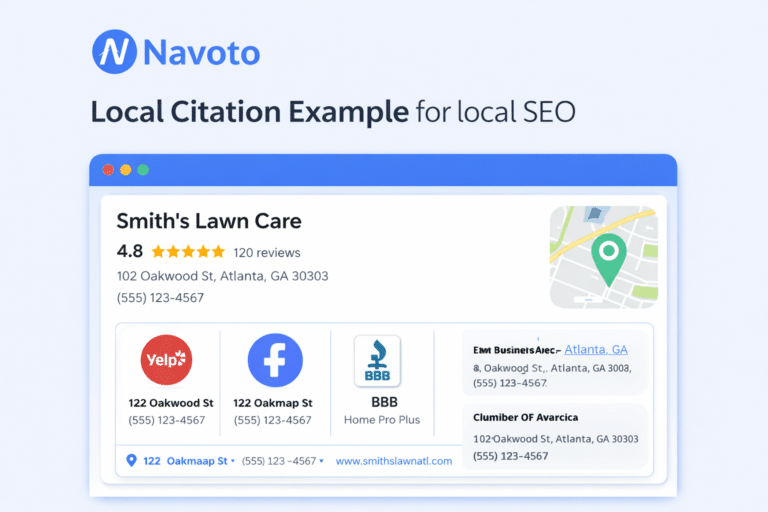
Local citations are online mentions of a business’s name, address, and phone number (NAP) on websites like directories, review platforms, and social media. They help search engines verify business information, confirm geographic relevance, and improve local SEO rankings — making them one of the most important off-page signals in Google’s local search algorithm.
Introduction: Why Local Citations Are Your Hidden SEO Asset
If you’ve been focused entirely on your website’s on-page SEO while neglecting what the rest of the internet says about your business — you’re leaving significant ranking power on the table.
Local citations are the backbone of local SEO authority. Every time your business name, address, and phone number appear consistently across directories, review platforms, and local websites, you send a powerful trust signal to Google: this business is real, established, and relevant to this location.
In 2026, with Google’s local algorithm incorporating AI entity verification, knowledge graph data, and multi-source consistency checks, the quality and accuracy of your citation profile matters more than ever. Businesses with clean, comprehensive citation profiles consistently outrank competitors with stronger websites but weaker citation foundations.
This guide walks you through exactly what local citations are, why they’re critical for your broader local search engine marketing strategy, and a proven step-by-step system for building a citation profile that moves your business to the top of Google Maps.
What Are Local Citations?
Definition
A local citation is any online mention of a business’s core identifying information — typically its Name, Address, and Phone number (NAP). Citations appear across business directories, review sites, social media platforms, local news sites, and anywhere else a business is referenced online.
Think of citations as the internet’s address book for your business. Every accurate, consistent entry reinforces to Google that your business exists at a specific location, offers specific services, and is a legitimate, established entity in your community.
Citations appear across a wide range of sources:
📂 Business Directories
Yelp, Yellow Pages, Bing Places, Apple Maps, Foursquare, BBB — structured platforms built specifically for business listings
⭐ Review Platforms
Google Business Profile, Trustpilot, Tripadvisor, Angi — review-driven sites where business information accompanies customer feedback
📱 Social Platforms
Facebook Business, Instagram, LinkedIn, Twitter/X — social profiles that display business NAP and are heavily indexed by Google
📰 Local Websites
Chamber of Commerce, local news, community blogs, event sites — unstructured mentions that build geographic relevance and earn local backlinks
The key metric that makes citations valuable isn’t just their presence — it’s their consistency. A business with 200 citations where 40% have wrong addresses is weaker than a competitor with 80 consistent, accurate citations across authoritative sources.
Types of Local Citations
Understanding the two fundamental types of citations helps you prioritize where to focus your citation building efforts:
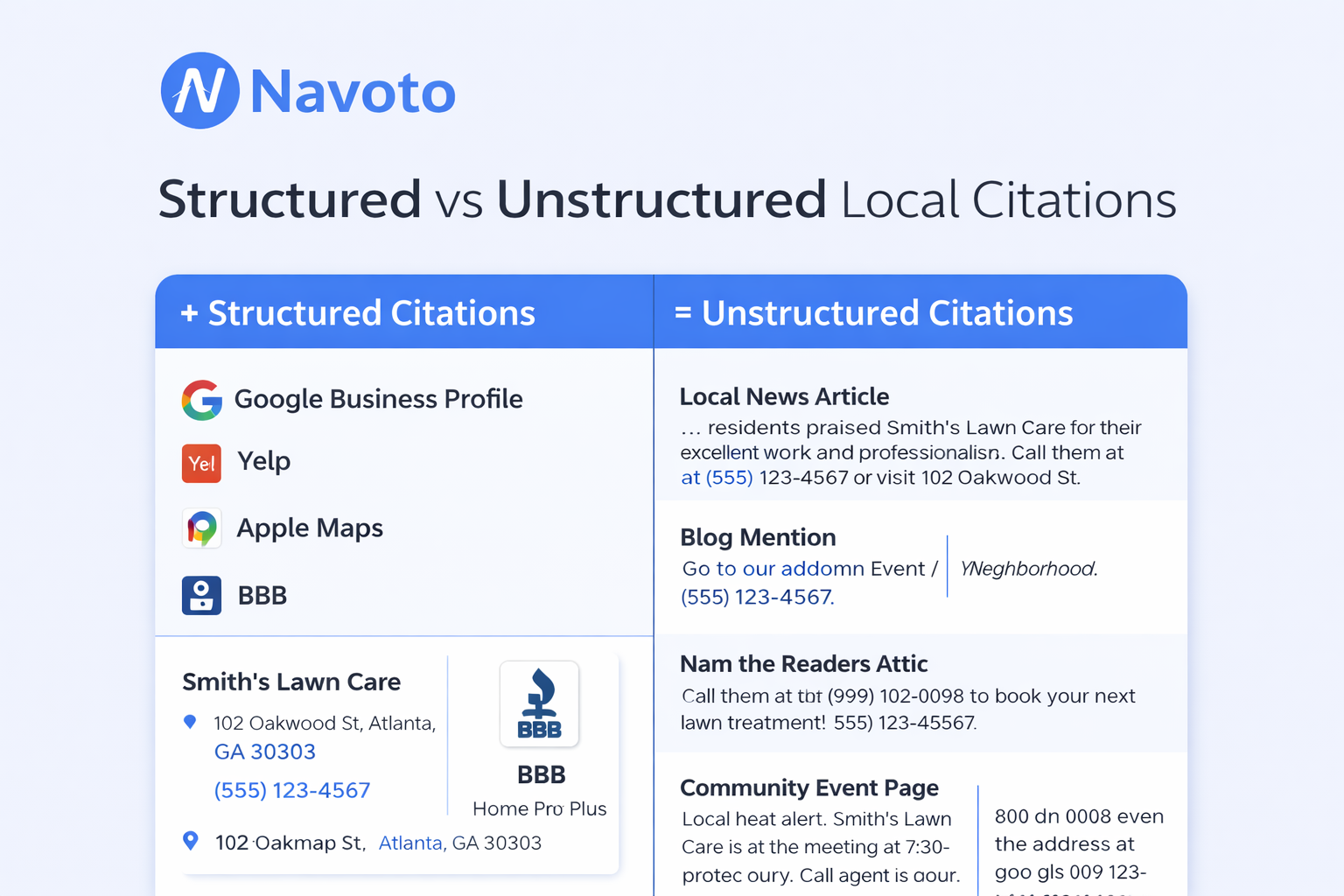
Structured Citations
Structured citations are formal business listings on platforms specifically designed to display business information in a consistent, organized format. These are the most powerful citation type for local SEO because search engines can reliably parse and cross-reference the data.
Structured citation sources include:
- Core data aggregators — Data Axle, Neustar Localeze, Foursquare — these feed data to hundreds of downstream directories
- General business directories — Yelp, Yellow Pages, BBB, Bing Places, Apple Maps
- Industry-specific directories — Healthgrades (healthcare), Avvo (legal), Houzz (home services), Zocdoc (medical)
- Local/regional directories — City-specific Chamber of Commerce, local business associations
Unstructured Citations
Unstructured citations are informal mentions of your business information on websites not designed as business directories. These are equally important for building a natural, diverse citation profile that signals genuine community presence.
Unstructured citation sources include:
- Local newspaper and news website articles mentioning your business
- Blog posts featuring your business as a recommendation or case study
- Community event pages listing your business as a sponsor
- Press releases distributed across news wire services
- Social media posts by customers or local accounts referencing your business
- Podcast show notes and YouTube video descriptions
Expert insight: A citation profile dominated entirely by structured directory listings looks unnatural to Google’s 2026 algorithm. The strongest citation profiles combine authoritative structured listings with a healthy mix of unstructured mentions from genuine local sources — community sites, local press, event sponsorships.
Why Local Citations Matter for Local SEO and Google Maps
Google’s local search algorithm uses three primary ranking factors: Relevance, Distance, and Prominence. Citations are the single most impactful lever for improving Prominence — the factor that represents how well-known and trusted your business is across the web. Understanding these Google Maps ranking factors is essential to building a citation strategy that actually moves the needle.
Here’s exactly how local citations for SEO influence your rankings:
✓
✓
✓
✓
✓
As part of a complete local content marketing strategy, citations provide the foundational trust layer that makes all your other SEO efforts more effective — your content ranks faster, your GBP performs better, and your ads convert at higher rates.
Top 25+ Local Citation Sites for 2026
Not all citation sources are equal. Priority should be given to directories with high domain authority, strong Google trust signals, and broad consumer usage. Here are the most impactful local SEO citation sites to target in 2026:
Tier 1 — Essential (Submit First)
Tier 2 — High Impact (Submit Within 30 Days)
Industry tip: Beyond universal directories, identify the top 10–15 industry-specific citation sources for your category. Home services businesses should prioritize Houzz, Angi, and HomeAdvisor. Healthcare providers need Healthgrades, Zocdoc, and WebMD. Legal firms need Avvo, Justia, and Martindale. Niche citations carry outsized weight for category relevance.
How to Check Your Current Local Citations
Before building new business citations for SEO, you need to understand your existing citation landscape. Running a proper citation audit reveals duplicate listings, NAP inconsistencies, and missing directories — the three issues that silently suppress your local rankings.
Method 1: Manual Google Search
The fastest free method. Open Google and search for each of these queries one by one:
"Your Business Name" + "Your City""Your Phone Number""Your Business Name" + "Your Address"
This surfaces directories and websites already mentioning your business. Note every listing — whether the NAP is correct, and whether there are any duplicates on the same platform.
Method 2: Citation Audit Tools
For a complete picture, manual searching isn’t enough. Use these dedicated local citation building tools to run a full audit:
BrightLocal Citation Tracker
Scans 300+ directories for your business NAP. Shows accuracy score, flags inconsistencies, and identifies missing high-value listings. Best overall citation audit tool.
Whitespark Citation Finder
Searches Google for existing citations and compares against competitor citation profiles. Excellent for finding citation gaps your competitors are exploiting.
Semrush Local Audit
Integrated citation audit within Semrush’s platform. Useful if you’re already running Semrush for keyword tracking — provides a combined SEO + citation health view.
Moz Local Check
Free listing check tool that instantly shows your presence and accuracy across major directories. Great for a quick first-pass audit before committing to a paid tool.
Method 3: Competitor Citation Analysis
One of the most valuable (and overlooked) citation audit techniques is analyzing where your top local competitors have local business listings. Use Whitespark’s Citation Finder or BrightLocal to input a competitor’s business name and city — the tool reveals every directory where they have a listing. Any citation source your competitors have that you don’t is a ranking gap you can close.
Pro tip: To check your existing citations quickly, search your business name and phone number in Google. This reveals directories and websites that mention your business. Then use BrightLocal, Whitespark, or Semrush Local to run a full citation audit and identify inconsistent or duplicate listings that need correction. Do this before building a single new citation.
Step-by-Step Local Citation Building Strategy
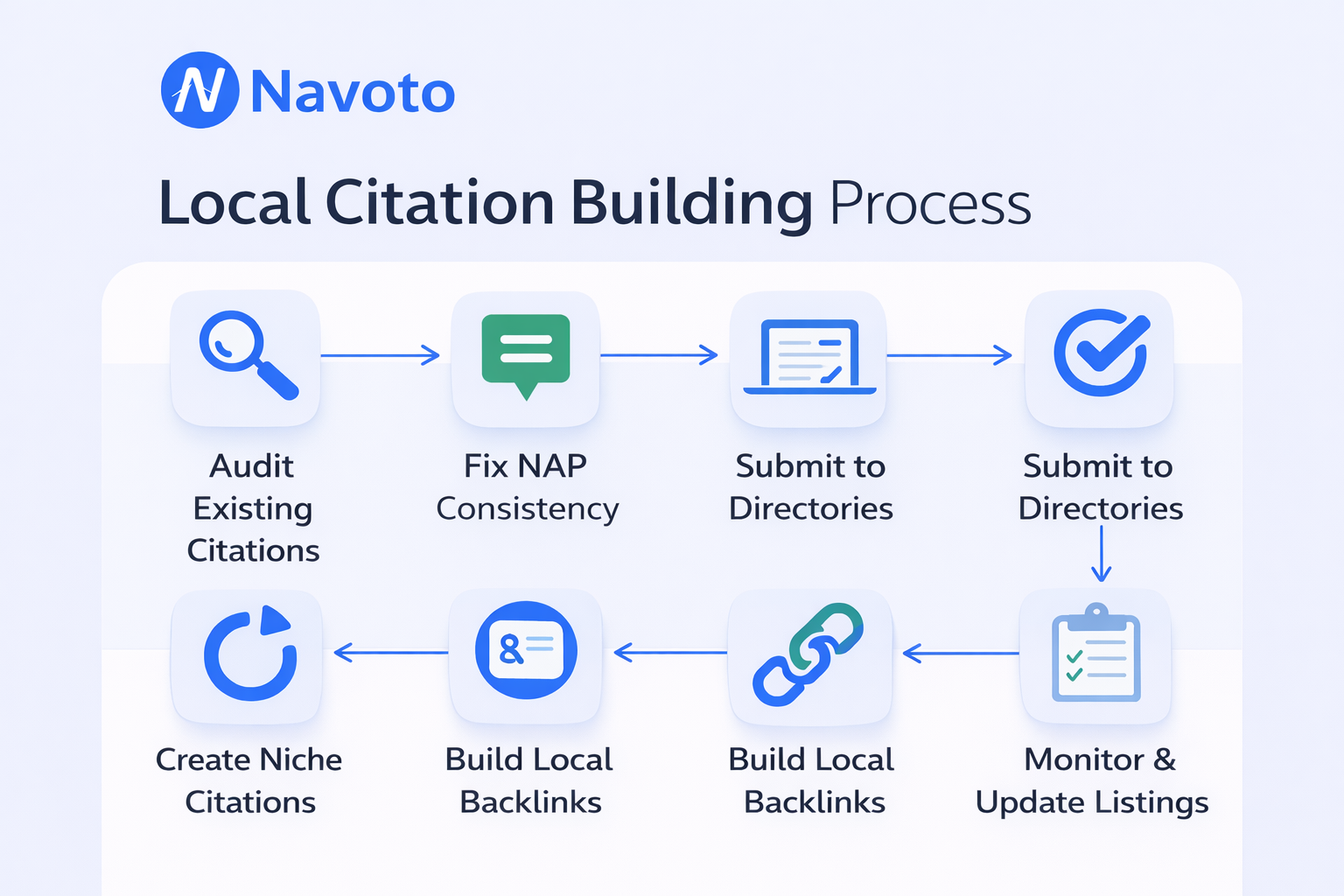
Building citations isn’t just about submitting your business to directories — it’s about building a systematic, accurate, and authoritative presence across the web. Here’s the exact framework used by professional local SEO agencies:
Audit Your Existing Citation Profile
Before building new citations, understand what already exists. Use BrightLocal’s Citation Tracker, Whitespark, or Moz Local to find all existing mentions of your business. Identify: (a) which top directories you’re already listed on, (b) which have incorrect NAP data, and (c) which have duplicate listings. This audit is the foundation — skipping it means building on a broken base.
Establish Your Master NAP Record
Define the single, canonical version of your business’s Name, Address, and Phone number that will be used everywhere. Decide on every detail: “Street” vs “St.”, suite number format, local vs. 1-800 phone number, business name with or without LLC/Inc. Write it down. Every citation submission from this point forward must match this master record exactly — character for character.
Fix All NAP Inconsistencies
Before adding new citations, clean up existing errors. Log in to each directory where you have a listing and correct any inaccurate NAP data. For platforms where you’ve lost access, use their support process to claim and correct the listing. For duplicate listings on the same platform, suppress or merge them. This cleanup phase often produces immediate ranking improvements — sometimes within 2–4 weeks.
Submit to Core Data Aggregators First
Data aggregators (Data Axle, Neustar Localeze, Foursquare) distribute your business information to hundreds of downstream directories, apps, and platforms automatically. Getting your data right at the aggregator level creates a cascade of accurate citations across the entire ecosystem — making it the highest-leverage citation action you can take.
Submit to Tier 1 & Tier 2 Directories
Work through the Tier 1 and Tier 2 directory lists above systematically. For each directory: claim or create your listing, enter your master NAP exactly, select the most accurate business categories, write a keyword-rich business description, upload high-quality photos, and add your website URL. Complete listings consistently outperform partial ones — don’t rush through submissions.
Build Industry & Local Niche Citations
After establishing your universal citation base, identify niche directories specific to your industry and geography. Local Chamber of Commerce listings, city-specific business directories, and industry association member directories carry high relevance weight for Google’s category-based ranking. Research where your top local competitors have listings — they’re showing you the exact citation sources that matter in your market.
Monitor & Maintain Your Citation Profile
Citations degrade over time. Directories update their data, platforms merge, and incorrect information can re-appear from old data sources. Set a quarterly reminder to audit your citation profile using your preferred tool. If your business moves, changes its phone number, or rebrands, updating citations must happen immediately — before your rankings suffer. Citation maintenance is an ongoing commitment, not a one-time task.
Local Citation Optimization Tips
Submitting your NAP is the minimum. Fully optimized citations perform dramatically better for both ranking and conversion. Here’s what separates a basic listing from one that actually generates business:
📝 Keyword-Rich Description
Write a unique business description for each major directory. Include your primary service keywords and location naturally. Don’t copy-paste the same description everywhere — unique content on each platform performs better.
📸 High-Quality Photos
Listings with photos receive 35% more clicks than those without. Upload exterior, interior, team, and product/service photos. Use descriptive, keyword-rich file names and alt text before uploading.
🏷️ Precise Business Categories
Select the most specific primary category available for your business. Add all applicable secondary categories. Category accuracy directly affects which local search queries your listing appears for.
⭐ Actively Collect Reviews
Citations on review platforms (Yelp, Google, BBB) are amplified significantly by review volume and rating. A 4.5-star listing with 50 reviews outranks a 5-star listing with 3 reviews in most competitive markets.
🔗 Website & Social Links
Include your exact website URL, not a redirect or shortened URL. Add social media profile links where the platform allows. Cross-linking between your citation profiles builds a cohesive entity network Google can map.
🕐 Accurate Hours & Attributes
Complete all available attributes: payment methods, accessibility features, parking, WiFi, etc. These attributes match your listing to specific filter-based searches and improve relevance scoring.
Strong citations also reinforce the impact of your broader SEO strategy — when your website authority and citation profile both signal the same entity information, Google’s confidence in your business increases across all ranking factors. Fully optimized local business listings and business citations for SEO are not a set-and-forget task — they’re a living asset that requires quarterly review to stay competitive as the citation audit landscape evolves.
Common Local Citation Mistakes to Avoid
✗
✗
✗
✗
✗
✗
Avoiding these mistakes is just as important as building new citations. Many local businesses discover that fixing existing citation errors improves their Google Maps position faster than adding dozens of new listings. Before expanding your citation footprint, always audit and clean up what exists.
Best Tools for Managing Local Citations
Managing citations manually across 50+ platforms is time-consuming and error-prone. These tools streamline the process significantly:
Agency recommendation: For most local businesses, start with BrightLocal’s citation audit (free trial available) to see your current state, then use Moz Local to automate aggregator distribution. Manual submission to the top 10 directories is worth doing yourself for quality control — use tools for the rest.
The Future of Local Citations in 2026 and Beyond
The role of local citations is evolving rapidly. Understanding where the landscape is heading lets you invest in citation strategies that remain effective long-term:
1. AI Search and Entity-Based Verification
Google’s AI Overviews and AI-powered local results in 2026 rely heavily on entity SEO — the ability to verify that a business is a distinct, real-world entity with consistent, cross-verified information. Citations have become entity verification signals. The more consistently your NAP, categories, and business attributes appear across authoritative sources, the more confidently Google’s AI can surface your business in AI-generated local answers.
2. Google Maps Algorithm Prioritizing Data Confidence
Google’s Maps algorithm is increasingly rewarding businesses whose data is confirmed by multiple independent sources. A GBP entry supported by matching data on Yelp, Foursquare, Apple Maps, and dozens of directories creates a “data confidence score” that single-source businesses cannot compete with. Citation building is now directly strengthening Google Maps algorithm performance.
3. Voice Search Demands Perfect NAP Accuracy
Voice searches like “Call the nearest HVAC company” or “Find a dentist near me open now” return results based on citation data quality. As smart speakers and AI assistants increasingly mediate local search, businesses with perfect NAP consistency across all platforms win these zero-click voice conversions. A single incorrect phone number on a major platform means missed calls from voice searchers.
4. Local Knowledge Graph Integration
Google’s Local Knowledge Graph now integrates citation data with review signals, website content, social proof, and GBP data to create a comprehensive entity profile for every local business. Businesses that appear consistently and completely across this entire data ecosystem earn stronger Knowledge Panel presence and higher local pack rankings than those with gaps.
🔮 The 2026 Citation Landscape
- Citations are evolving from directory listings into entity verification nodes in Google’s Knowledge Graph
- AI search tools pull structured business data directly from citation sources — incomplete citations mean invisible businesses in AI results
- The businesses that dominate local search in 2026–2028 will have built citation profiles that are both comprehensive and deeply consistent
- Quality over quantity is the permanent direction — 50 perfect citations will always outperform 200 inconsistent ones
As you build your citation strategy, integrate it with your local content marketing efforts and your overall local SEO strategy — citations and content work together to build the topical authority and geographic relevance that drives top local rankings.
Frequently Asked Questions About Local Citations
What are local citations in SEO?
Local citations are online mentions of a business’s Name, Address, and Phone number (NAP) across directories, review sites, social platforms, and websites. They help search engines verify business legitimacy, confirm location, and improve local SEO rankings.
Do local citations help Google Maps rankings?
Yes. Local citations are a confirmed Google local ranking factor. They improve your business prominence and influence where your business appears in Google Maps and the local 3-pack results.
How many citations does a local business need?
Most local businesses need around 50–100 high-quality citations. Start with the top universal directories and then add niche or industry-specific listings for stronger local SEO authority.
Are local citations still important in 2026?
Yes. Citations remain a core local SEO signal and help Google verify business entities across the web. Consistent citation profiles improve both traditional local search and AI-driven search results.
What is NAP consistency and why does it matter?
NAP consistency means your business Name, Address, and Phone number appear exactly the same across all listings. Consistent NAP helps search engines trust your business data and improves local search rankings.
Which citation sites are most important for local SEO?
Important citation sites include Google Business Profile, Yelp, Bing Places, Apple Maps, Facebook, Foursquare, BBB, and Yellow Pages. Industry-specific directories also help improve relevance and rankings.
Conclusion: Build Citations That Compound Your Local Authority
Local citations are the infrastructure of your local SEO presence. Without a clean, consistent, and comprehensive citation profile, every other local SEO effort — your website optimization, your content, your Google Business Profile — operates at reduced effectiveness.
The businesses dominating Google Maps in 2026 didn’t get there by chance. They built citation profiles that Google trusts absolutely: consistent NAP across every authoritative directory, complete and optimized listings that drive clicks and calls, and ongoing maintenance that keeps their data accurate as their business evolves.
The framework is clear. The directories are listed. The strategy is proven. Your competitive advantage in local search starts with citations — and it starts now.
Your Citation Action Plan — This Week
Run a free BrightLocal citation audit to see your current NAP consistency score
Define your master NAP record and document it somewhere your whole team can access
Fix any NAP errors on your Google Business Profile, Yelp, Bing Places, and Apple Maps first
Submit to the top 3 data aggregators to create a clean cascade of accurate citations
Set a quarterly calendar reminder for citation monitoring and maintenance
Want Navoto to Build & Clean Your Citation Profile?
Our local SEO team audits your existing citations, fixes inconsistencies, and builds a comprehensive citation profile that drives Google Maps rankings.
Free audit. No commitment. Real results for local businesses.