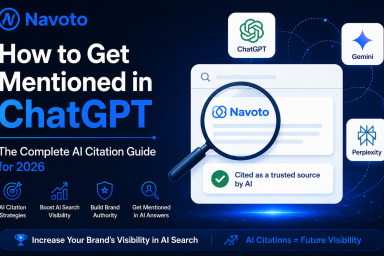
Quick Answer: To get mentioned in ChatGPT, Gemini, and Perplexity, you need to build entity authority, earn high-quality third-party mentions, implement structured data, publish original research, and create content structured for AI retrieval. This is no longer about ranking on Google alone — it is about becoming the source that AI systems trust, cite, and recommend. In this complete guide, Navoto walks you through the exact framework that makes brands visible across every major AI search platform in 2026.
📈 2026 AI Search: The Numbers You Need to Know
▸ Over 800 million people use ChatGPT weekly in 2026
▸ AI search platforms sent 1.13 billion referral visits to websites in June 2025 — up 357% year-over-year
▸ ChatGPT alone accounts for 78% of all AI referral traffic
▸ AI referral traffic converts 5x better than organic search traffic
▸ Only 12% overlap exists between AI citations and Google’s top 10 results
▸ Adding expert quotes boosts AI visibility by up to 41% (Princeton GEO Study)
▸ Google traffic to publishers dropped 33% as zero-click searches hit 69%
Something fundamental has changed in how people find information online. When your potential customers have a question today, millions of them no longer type it into Google and scan ten blue links. They ask ChatGPT. They query Gemini. They search on Perplexity. And they get a direct, synthesised answer — often without clicking a single website.
If your brand is cited in that answer, you win. If it is not, you are invisible to a rapidly growing segment of your market. This is not a future trend to prepare for — it is happening right now, at scale, and the gap between brands that understand how to get mentioned in ChatGPT and those that do not is already producing measurable differences in traffic, leads, and revenue.
This guide gives you the complete playbook. We cover how each major AI platform selects its sources, what signals matter most, and a step-by-step framework for building the kind of authority that makes AI systems naturally cite your brand. This is the same strategic SEO approach Navoto implements for clients who want to dominate both traditional search and the new AI answer landscape.
1. What Are AI Citations?
An AI citation occurs when an AI-powered search platform — such as ChatGPT, Gemini, Perplexity, Claude, or Microsoft Copilot — references your website, brand, or content as a source in its generated response to a user query.
Unlike traditional Google rankings, where your page appears as a link in a list of results, AI citations work differently. The AI reads, processes, and synthesises content from multiple sources, then presents a single coherent answer — sometimes with inline citations, sometimes without. Whether or not your URL appears as a clickable reference, being the source the AI drew from is what drives brand awareness, authority, and traffic.
AI Citations vs Google Rankings: Key Differences
| Factor | Google Rankings | AI Citations |
|---|---|---|
| Primary Signal | Backlinks + keywords | Entity authority + content structure |
| Overlap | Top 10 results | Only 12% overlap with Google top 10 |
| Result Format | List of links | Synthesised direct answer |
| Traffic Intent | Browse and compare | High intent, answer-seeking |
| Conversion Quality | Baseline | 5x higher conversion rate |
| Brand Mentions | Less critical | Critical entity signal |
💡 Critical Insight: Research tracking 15,000 prompts found that only 12% of AI citations overlap with Google’s top 10 results, and ChatGPT has only 8% overlap with Google and Bing results. This means ranking well on Google does not automatically translate to AI citations. You need a separate, complementary strategy.
2. How ChatGPT Selects Sources
Understanding how ChatGPT selects its sources is the foundation of any strategy to get mentioned in it. ChatGPT operates in two distinct modes — and the citation logic is different for each.
Mode 1: Base Knowledge (No Live Search)
In this mode, ChatGPT draws on information encoded during its training phase. To influence this, your brand needs to have been present in high-quality, authoritative sources that were part of the training data — Wikipedia, Wikidata, major industry publications, established directories, and widely-cited content. This is a long-term entity authority play.
Mode 2: ChatGPT Search (Live Web Retrieval)
ChatGPT uses Bing as its primary search index for web-enabled queries. When a user submits a question requiring real-time data, ChatGPT issues queries to Bing, retrieves the top results, and synthesises a response with inline citations. This is the mode where practical optimisation work delivers the fastest, most measurable results.
To get cited by ChatGPT Search, your page needs to:
- Be indexed by Bing — check your Bing Webmaster Tools, ensure GPTBot is not blocked in robots.txt
- Front-load direct answers within 200 words — ChatGPT extracts clean answer units from the top of your content
- Use clear, concrete headings — it selects pages using specific nouns as heading anchors, not clever or vague titles
- Write for claim-level reuse — each key claim should stand alone as a citation unit with its measurement, scope, and method in the same paragraph
- Deploy JSON-LD schema markup — structured data confirms entity identity and content type to the retrieval system
- Maintain high authority signals — Bing ranking signals closely mirror Google’s: domain authority, backlinks, E-E-A-T
⚡ ChatGPT Citation Rule
You get cited in ChatGPT most often when your page gets retrieved as a supporting document for a specific sub-question. Structure your content so that every heading-and-answer pair works as a standalone retrievable unit. A page with 10 clean Q&A pairs gives ChatGPT 10 separate citation opportunities, not just one.
3. How Gemini Selects Sources
Google’s Gemini has a direct and critical relationship with Google Search. It reviews 20 to 40 URLs per query before selecting the most authoritative options — a broader retrieval pool than ChatGPT. This makes both traditional SEO performance and entity authority essential for Gemini visibility.
What Gemini Prioritises
- Google Search rankings — Gemini pulls from Google’s index first. If you rank well organically, your citation probability increases significantly
- Knowledge Graph integration — Gemini is trained on the Knowledge Graph. Brands established as entities in the graph have a structural citation advantage
- E-E-A-T signals — Experience, Expertise, Authority, and Trust evaluation is built into Gemini’s source selection. Author credibility, schema, and third-party mentions all matter
- Topical authority — Gemini favours sources that demonstrate comprehensive, deep coverage of a topic rather than a single well-optimised page
- Multimodal content — Gemini analyses video and image content alongside text. YouTube presence and well-optimised images give an additional citation advantage
- Organisation schema with knowsAbout — declaring your topical expertise in structured data directly signals to Gemini which query categories your brand should be cited for
The strategic implication: Gemini rewards traditional SEO excellence plus entity infrastructure. Your best investment for Gemini visibility is building the same technical SEO foundation that serves organic rankings, then layering on entity and schema signals on top.
4. How Perplexity Selects Sources
Perplexity AI is the most citation-transparent of the major AI search platforms — it explicitly lists source URLs in nearly every response. This makes it the most trackable and in many ways the most optimisable platform for AI citation strategies.
Perplexity’s Source Selection Logic
- Strong bias toward primary sources — original research papers, official documentation, and first-party data are cited 3.1x more frequently than secondary summaries
- Real-time indexing — Perplexity crawls the web continuously. Fresh, recently published content has a significant advantage over dated articles
- Established industry domains — government sites (.gov), educational institutions (.edu), and recognised industry authorities receive priority
- Source diversity preference — Perplexity deliberately avoids citing only one domain. Appearing across multiple trusted platforms increases your overall citation probability
- Reddit and community presence — Perplexity frequently cites authoritative community discussions. Genuine participation in relevant forums builds citation exposure
- PerplexityBot access — ensure your robots.txt does not block PerplexityBot. Many websites inadvertently block AI crawlers, eliminating any chance of citation
⚡ Perplexity Quick Win
Publish original research with a specific, data-backed finding — even a small survey of your customers or a proprietary dataset analysis. Perplexity’s strong bias toward primary sources means a single original study can generate repeated citations across dozens of queries over months.
5. The 5-Step AI Citation Framework
After analysing what separates brands that consistently appear in AI responses from those that are invisible, Navoto has developed a proven 5-step framework for building sustainable AI citation authority:
STEP 1
Build Entity Authority
Before any AI system can cite your brand, it must first recognise it as a distinct, real-world entity. This means implementing entity SEO fundamentals: Organisation schema with sameAs properties, consistent NAP across 30+ directories, a Wikidata entry, a complete Google Business Profile, and an entity home page (your About page) with accurate, consistent information. AI systems use triangulation — when they see the same information about your brand across multiple authoritative platforms, they confirm your entity status and trust level.
STEP 2
Earn High-Authority Mentions
AI systems weight external mentions of your brand very heavily — especially from sources they already trust. Invest in digital PR campaigns targeting industry publications, contribute expert commentary to journalism platforms (HARO/Connectively), author guest posts on authoritative sites, and publish original research that other sources will naturally reference. Remember: AI systems treat brand mentions without links as entity confirmation signals, not just linked citations. Every unlinked mention on a trusted domain strengthens your entity profile.
STEP 3
Optimise Content for AI Retrieval
Structure every page for claim-level reuse. Each heading should use concrete, entity-rich nouns. Each answer should be self-contained within its section — including the measurement, scope, and context. Front-load your direct answer in the first 200 words. Add an FAQ section to every important page. Include precise statistics with sources. Make every claim independently verifiable. Add an llms.txt file to your website root (similar to robots.txt but for LLMs) to guide AI systems to your most important content.
STEP 4
Improve Citation Probability Through Content Structure
Build topical clusters around your core entities — comprehensive pillar pages supported by in-depth cluster articles. This signals topical authority to AI systems. Use semantic SEO principles: cover co-occurring entities, related concepts, and the full vocabulary of your topic area. Ensure your content provides demonstrably more depth, accuracy, and originality than competing sources on the same topic. AI systems select sources that can be trusted to give the most complete, verifiable answer.
STEP 5
Monitor and Improve AI Visibility
Manually run brand and category queries in ChatGPT, Perplexity, and Gemini at least once a month. Document which sources are being cited for your target queries. Set up a custom “AI Traffic” channel in GA4 to track referrals from AI platforms. Monitor your server logs for AI crawler user agents: GPTBot, ClaudeBot, PerplexityBot, and Google-Extended. Track four KPIs: Citation Rate (percentage of relevant responses citing you), Sentiment (how AI describes your brand), Competitive Share (your citations vs competitor citations), and Conversion Attribution (revenue from AI-referred traffic).
6. 12 Proven Strategies to Get Mentioned in ChatGPT
These are the specific, high-impact strategies that move the needle on AI citation rates across all major platforms:
Strategy 1: Become a Recognised Entity
Register your business on Wikidata (30-minute setup that feeds directly into all AI knowledge graphs). Create or update your Google Business Profile. Implement Organisation schema with sameAs, foundingDate, and knowsAbout properties. Build NAP consistency across 30+ directories. This is the prerequisite everything else builds on. Our SEO audit service includes a full entity footprint assessment to identify exactly what is missing.
Strategy 2: Publish Original Research
Original data, surveys, and studies are cited by AI systems at dramatically higher rates than summaries of existing information. Even a small survey of 100 customers produces original data points that other sources — and AI systems — will reference. Perplexity cites primary sources 3.1x more than secondary ones. One well-structured annual research report can generate AI citations for months.
Strategy 3: Create Citation-Worthy Statistics
The Princeton GEO study found that including statistics in content boosts AI visibility by approximately 30%. Create pages that are dense with specific, accurate, well-sourced statistics in your industry niche. These pages become reference material that AI systems return to repeatedly across multiple queries.
Strategy 4: Build Topical Authority Through Content Clusters
Create a comprehensive content cluster for every core entity and service you offer. A pillar page supported by 8–15 in-depth cluster articles signals topical authority to AI systems far more powerfully than isolated standalone posts. Interlink all cluster content using descriptive, entity-rich anchor text. See our SEO services for how we build these authority clusters for clients.
Strategy 5: Win Authoritative Third-Party Mentions
Use HARO (Help A Reporter Out) / Connectively to get quoted as an expert in major publications. Contribute to industry round-up posts and expert panels. Pitch original data to journalists. Every mention in Forbes, Business Insider, TechCrunch, or major industry publications dramatically increases the probability that AI systems include your brand in their trained entity data.
Strategy 6: Optimise Structured Data and Schema
Implement JSON-LD schema for Organisation (with sameAs and knowsAbout), Person (for all authors), Article/BlogPosting (for all content), FAQPage (for all FAQ sections), and LocalBusiness (if applicable). Validate everything with Google’s Rich Results Test. Schema is the machine-readable signal that tells AI systems what your brand is, what it covers, and why it should be cited for specific query types.
Strategy 7: Create Expert-Led Content With Author Entities
Every piece of content should be attributed to a named, credentialled person entity linked to a full author bio page. The Princeton GEO study found that expert quotes boost AI visibility by up to 41%. Anonymous or organisation-attributed content has significantly lower E-E-A-T signals and is cited less frequently by AI systems.
Strategy 8: Build Digital PR and Brand Mention Campaigns
AI systems measure brand mention velocity — the frequency and recency of your brand being mentioned across the web. A sustained digital PR campaign that generates new brand mentions in authoritative sources every month creates a compounding effect on AI citation rates. Even unlinked brand mentions count as entity confirmation signals.
Strategy 9: Build Semantic Content Clusters With Co-Occurring Entities
Use Google’s NLP API to identify which entities naturally co-occur with your target topics. Ensure your content mentions and contextualises these related entities naturally. AI systems understand meaning through entity relationships — content that covers the full semantic landscape of a topic is more trusted and more frequently cited than content that covers only the core keyword.
Strategy 10: Strengthen Trust Signals Across All Platforms
Accumulate verified Google reviews (aim for 50+). Maintain active, professional LinkedIn and social profiles. Ensure HTTPS, clean technical performance, and no security warnings. Trust signals are evaluated holistically by AI systems — a brand with strong trust signals across multiple channels receives a higher “entity confidence score” in AI knowledge graphs.
Strategy 11: Build a Strong YouTube and Video Presence
Gemini specifically analyses multimodal content (video, images) alongside text. Research shows AI systems heavily weight YouTube presence as an authority and entity signal. Tutorial videos, thought leadership content, and expert commentary published on YouTube build the video presence that Gemini uses in citation selection. Turn video transcripts into answer-first written content to extend reach across all platforms.
Strategy 12: Maintain Content Freshness
Perplexity and ChatGPT Search heavily favour freshly updated content. Review and update your most important pages every 3–6 months. Add new statistics, update outdated information, and refresh publication dates when substantive changes are made. AI systems use publication date and last-updated signals as part of source quality assessment — content last updated in 2023 is less likely to be cited in 2026 than an equivalent page updated this quarter.
7. SEO vs AEO vs GEO: Understanding the Three Disciplines
The complete formula for search visibility in 2026 is: SEO + AEO + GEO. Here is exactly what each discipline covers and why all three are necessary:
| Discipline | Full Name | Focus | Goal |
|---|---|---|---|
| SEO | Search Engine Optimisation | Traditional organic search rankings | Rank in Google top 10 |
| AEO | Answer Engine Optimisation | Featured snippets, voice, AI answer boxes | Be the direct answer selected |
| GEO | Generative Engine Optimisation | Citations in ChatGPT, Gemini, Perplexity | Be cited in AI-generated answers |
Traditional SEO is not being replaced — it is being expanded. The same authority signals (backlinks, E-E-A-T, technical excellence) that drive Google rankings also feed into AI citation probability. The key difference is that AI systems additionally weight entity authority, content structure, and brand consistency in ways that pure keyword SEO does not address.
At Navoto, our SEO services are now fully integrated across all three disciplines — because a strategy that ignores AI search visibility is leaving a growing and high-converting traffic channel completely unaddressed.
8. Common Mistakes That Prevent AI Citations
Even well-optimised websites are often invisible to AI systems because of these specific, avoidable mistakes:
- Blocking AI crawlers in robots.txt — if GPTBot, ClaudeBot, or PerplexityBot are blocked, those platforms literally cannot read your content. Check your robots.txt immediately.
- Thin content with no original value — AI systems ignore content that simply aggregates what is already available elsewhere. Without original data, expert perspectives, or unique analysis, your content has no citation value.
- No entity infrastructure — without Organisation schema, consistent NAP, and a Wikidata presence, AI systems cannot confidently identify your brand as a known entity. This is the most common and costly omission.
- Missing or incomplete schema — schema without the sameAs and knowsAbout properties provides minimal entity signal. Generic schema is better than none, but advanced properties are where the real citation advantage is built.
- No author entity pages — anonymous content lacks the E-E-A-T signals AI systems use to evaluate trustworthiness. Every article needs a named author with a full bio and Person schema.
- Content that is not structured for AI extraction — long blocks of prose without clear heading-answer pairs, FAQ sections, or standalone claim paragraphs are difficult for AI systems to extract cleanly. Restructure your content for claim-level reuse.
- Outdated content with stale statistics — AI systems treat last-updated date as a quality signal. Content with outdated statistics or dates loses citation priority to fresher sources on the same topic.
- No measurement system for AI citations — you cannot improve what you do not measure. Set up GA4 AI traffic tracking and run manual citation queries monthly.
9. AI SEO Checklist for 2026
Use this checklist to assess and improve your AI citation readiness across all major platforms:
| Task | Importance | Difficulty | AI Citation Impact |
|---|---|---|---|
| Check robots.txt — unblock GPTBot, ClaudeBot, PerplexityBot | Critical | Easy | ⭐⭐⭐⭐⭐ |
| Implement Organisation schema with sameAs + knowsAbout | Critical | Medium | ⭐⭐⭐⭐⭐ |
| Create or claim Wikidata entry | Critical | Easy | ⭐⭐⭐⭐⭐ |
| NAP consistency across 30+ directories | High | Medium | ⭐⭐⭐⭐ |
| Front-load direct answers in first 200 words per page | High | Easy | ⭐⭐⭐⭐ |
| Add FAQ section to every key page with FAQPage schema | High | Easy | ⭐⭐⭐⭐ |
| Publish original research with unique data | High | Hard | ⭐⭐⭐⭐⭐ |
| Create author bio pages with Person schema | High | Easy | ⭐⭐⭐⭐ |
| Build entity mentions via digital PR and HARO | High | Hard | ⭐⭐⭐⭐⭐ |
| Create and update llms.txt file in website root | Medium | Easy | ⭐⭐⭐ |
| Set up GA4 AI Traffic channel + AI citation monitoring | Medium | Medium | ⭐⭐⭐ |
| Refresh key pages with updated stats every quarter | Medium | Easy | ⭐⭐⭐⭐ |
10. The Future of AI Search Rankings
The AI search landscape is evolving faster than any previous shift in digital marketing. Here is what the next 12–24 months look like based on current trajectories:
Agentic Search
AI systems are moving from answering questions to completing tasks on behalf of users — booking travel, researching purchases, comparing services, and making recommendations. In agentic search, the AI does not just cite sources — it selects the brand to recommend. Entity authority will become the primary competitive differentiator in this environment.
Multi-Model Citation Ecosystems
By late 2026, a significant gap will emerge between brands with proactive AI visibility strategies and those without. Leading brands will consistently appear across ChatGPT, Gemini, Perplexity, Claude, and Copilot simultaneously — building a multi-model citation footprint that becomes self-reinforcing. The businesses starting this work today are building a compounding advantage over late movers.
Entity-First Ranking Systems
All major AI systems are moving toward entity-first understanding of the web. The transition is from “which pages match this query” to “which entities are the authoritative sources on this topic.” Brands that invest in entity SEO today are building the foundation that will determine their AI visibility for years.
The Death of “Ghost Equity”
Brands with strong Google rankings but no AI citation strategy are building Ghost Equity — rankings that look healthy in traditional metrics while becoming invisible to the 800+ million people using AI assistants weekly. SEO alone is no longer enough. The complete strategy for 2026 is SEO + AEO + GEO, and the businesses that implement all three today will define their category in the AI-driven search future.
Is Your Brand Visible in ChatGPT, Gemini & Perplexity?
Navoto’s AI citation audit assesses your entity footprint, schema implementation, content structure, and brand mention profile across all major AI search platforms — then builds you a step-by-step roadmap to AI visibility.
11. Frequently Asked Questions
How does ChatGPT choose which sources to cite?
When using web search, ChatGPT uses Bing as its primary index and retrieves top results for the user’s query. It then selects sources based on authority, crawlability, content structure, and entity trust signals. Pages that front-load direct answers, use clean heading-answer pairs, implement JSON-LD schema, and are not blocking GPTBot have the highest citation probability. For knowledge-based responses without live search, ChatGPT draws from its training data, which weighted authoritative entities recognised across Wikipedia, Wikidata, major publications, and high-quality web sources.
Can you optimise content specifically for ChatGPT?
Yes. Practical optimisation for ChatGPT citation includes: ensuring GPTBot is not blocked in robots.txt, structuring content with clear Q&A pairs, front-loading direct answers within 200 words, implementing structured data, publishing original data that other sources cite, and building entity authority through Wikidata, schema, and consistent brand mentions. Research shows proper AI SEO strategies can boost ChatGPT visibility by up to 40%.
What are AI search citations?
AI search citations are instances where AI-powered platforms like ChatGPT, Gemini, Perplexity, Claude, or Microsoft Copilot reference your website, brand, or content as a source in their generated responses. Unlike traditional Google rankings (a list of links), AI citations involve your content being read, processed, and used to construct a synthesised answer. Your URL may appear as an explicit inline reference or your content may be used without explicit attribution depending on the platform and query type.
How do brands appear in Perplexity answers?
Perplexity favours primary sources and original research (cited 3.1x more than secondary summaries), real-time crawled content (fresh content has a significant advantage), established industry domains, and source diversity. To improve Perplexity visibility: ensure PerplexityBot is not blocked in robots.txt, publish original research, maintain NAP consistency across directories, and build brand mentions across authoritative platforms. Perplexity explicitly lists source URLs, making it the most trackable AI citation platform for measurement purposes.
What is AI SEO?
AI SEO is the practice of optimising your content, technical infrastructure, and brand signals to be discovered and cited by AI systems like ChatGPT, Claude, Gemini, and Perplexity. It extends beyond traditional search engine optimisation to address the specific retrieval, entity recognition, and authority evaluation logic used by large language models. AI SEO encompasses entity authority building, structured data implementation, content formatting for AI extraction, and brand mention development.
What is Answer Engine Optimisation (AEO)?
Answer Engine Optimisation (AEO) is the process of structuring content so it is selected by AI-powered systems as the basis for direct answers to user queries. It focuses on the answer-retrieval layer: ensuring your content is the source chosen when an AI synthesises a response. AEO involves clear question-answer formatting, FAQ sections, featured snippet optimisation, and structured data. It is a component of the broader discipline of Generative Engine Optimisation (GEO).
How do entity signals affect AI visibility?
Entity signals are among the most powerful determinants of AI citation probability. When your brand is established as a recognised entity in Google’s Knowledge Graph (via Organisation schema, Wikidata, and consistent cross-platform presence), AI systems trained on the Knowledge Graph have a higher confidence score for your brand — meaning they are more likely to include it in responses about your topic area. Gemini’s AI, trained on the Knowledge Graph, demonstrates this link directly: strong entity representation creates a structural citation advantage.
How can I improve my AI search rankings?
The five highest-impact actions are: (1) Unblock AI crawlers in robots.txt, (2) Implement Organisation schema with sameAs and knowsAbout properties, (3) Create or claim a Wikidata entry, (4) Restructure key pages to front-load direct answers with clear heading-answer pairs, and (5) Publish original research that other sources cite. These changes can deliver first AI citations within 60–120 days.
What is the best AI citation strategy for a small business?
For small businesses, the highest-ROI AI citation strategy combines three actions: (1) Build entity infrastructure — Wikidata entry, Organisation schema, Google Business Profile, and 30+ consistent directory listings, (2) Add FAQ sections with schema markup to every service and blog page, and (3) Respond to HARO/Connectively queries to earn brand mentions in authoritative publications. These three actions build the foundation that enables all other AI citation work to compound over time.
How will AI search evolve in the future?
AI search is moving toward agentic systems that complete tasks rather than just answer questions, multi-model citation ecosystems where brand presence must span ChatGPT, Gemini, Perplexity, Claude, and Copilot simultaneously, and entity-first ranking that values brand identity over keyword density. By late 2026, a significant gap will exist between brands with proactive AI visibility strategies and those without. The businesses that build entity authority and content structure for AI retrieval today will have a compounding advantage that becomes increasingly difficult for competitors to close.
✅ Key Takeaways: How to Get Mentioned in ChatGPT
- AI citations and Google rankings have only a 12% overlap — you need a separate AI citation strategy
- ChatGPT uses Bing; Gemini uses Google Search; Perplexity crawls in real-time — each needs a platform-specific approach
- The fastest first step: unblock GPTBot, ClaudeBot, and PerplexityBot in your robots.txt
- Organisation schema + Wikidata + sameAs are the highest-leverage entity signals for all platforms
- Original research is cited by Perplexity 3.1x more than secondary summaries
- Expert quotes boost AI visibility by up to 41% (Princeton GEO Study)
- The complete 2026 formula: SEO + AEO + GEO
- First AI citations typically appear within 60–120 days of implementing the entity foundation
Conclusion: The AI Citation Era Has Already Started
The shift from keyword-matching search to entity-based, AI-generated answers is not a future scenario. It is the current reality for 800 million weekly ChatGPT users and the rapidly growing audiences on Gemini and Perplexity. Every month you wait to implement an AI citation strategy is a month your competitors are potentially capturing that high-converting, answer-seeking traffic.
The good news: the foundation of AI citation success — entity authority, structured data, original content, and consistent brand signals — is entirely within your control and delivers compounding returns over time. Start with the quick wins (robots.txt, schema, FAQ sections), build toward the longer plays (original research, digital PR, topical clusters), and measure your progress monthly.
At Navoto, we have built the complete SEO + AEO + GEO framework that positions brands for visibility across both traditional search and every major AI platform. Our SEO audit service includes a full AI citation readiness assessment, and our ongoing SEO services ensure your brand stays visible as AI search continues to evolve. Talk to the Navoto team today — let’s get your brand into the answers.