Google People Card, also known as “Add Me to Search,” was officially discontinued in August 2024 after struggling with spam, low engagement, and limited global availability. The feature allowed users in select countries to create virtual business cards in Google Search, but Google shut it down to focus on AI-powered search experiences. Today, professionals achieve superior visibility through personal websites, Google Business Profile optimization, LinkedIn SEO, Person schema markup, and comprehensive content marketing strategies that create lasting digital assets you actually control.
When Google launched People Card in August 2020, it promised to revolutionize personal branding by letting anyone create a searchable digital identity without building a website. Four years later, the feature vanished quietly, leaving thousands of users wondering what happened and scrambling for alternatives. If you invested time creating a People Card or you’re now searching for the best way to establish professional visibility in Google Search, this comprehensive guide reveals everything you need to know about why Google pulled the plug and which proven strategies deliver better long-term results.
What Was Google People Card?
Google People Card was an experimental search feature by Google that worked like a self-created knowledge panel. Instead of pulling data from trusted websites like traditional Knowledge Panels, it let users manually build and control their own profile directly in Google Search.
Launched as “Add Me to Search,” it was promoted as an easy personal branding tool for professionals, freelancers, entrepreneurs, and job seekers — especially in emerging markets — removing the need for websites or technical skills.
Creating a card was simple. Users searched “add me to search” on mobile while logged into Google and filled in details such as name, profession, location, short bio, profile photo, website, and social links including LinkedIn, Twitter, Facebook, Instagram, and YouTube.
After a quick automated review (usually 24–48 hours), the card appeared in search results when someone searched the person’s name, styled like a mini knowledge panel and clearly labeled as self-submitted information.
Google added basic protections like one card per account, phone verification, and reporting tools for fake profiles — but these were not enough to stop abuse.
The biggest limitation was availability. People Card launched in India first, later expanding to a few African countries, but never reached the US, UK, Europe, Canada, or Australia. This restricted growth, reduced adoption, and prevented it from becoming a widely used personal branding tool.
How People Card Appeared in Google Search Results
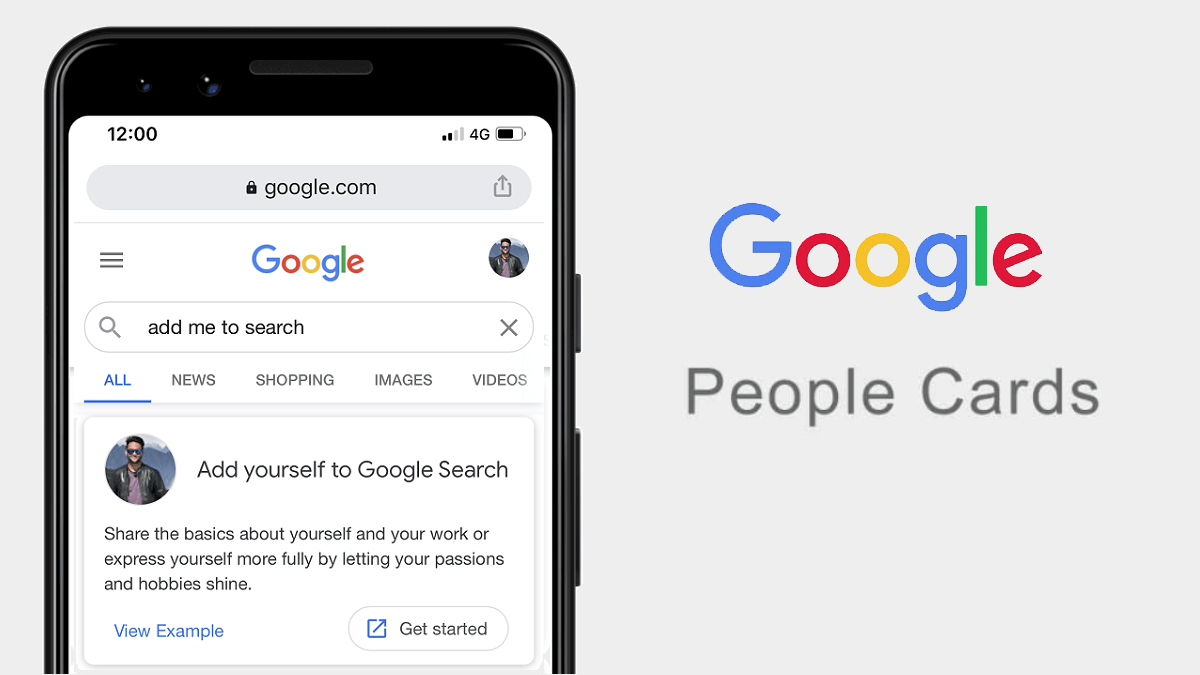
When someone searched for a person who had created a People Card, Google showed the card as a large, eye-catching result — especially on mobile.
The design was clean and similar to a knowledge panel, but clearly marked as self-submitted.
What the card displayed:
-
Circular profile photo at the top
-
Full name in bold text
-
Profession and location just below
-
Short professional bio (up to 750 characters)
-
Clickable website button
-
Social icons linking to platforms like LinkedIn, Twitter, Facebook, Instagram, and YouTube
Why it stood out:
-
Appeared near the top of search results
-
Took more visual space than normal links
-
Looked official but included an “About this result” label showing it was user-created
This strong visibility was what made People Card appealing — but also easy to misuse and spam.
Got it — same structure, just cleaner, shorter, with sub-headings + short paragraphs (not bullet overload).
Why Google Discontinued People Card: The Real Story
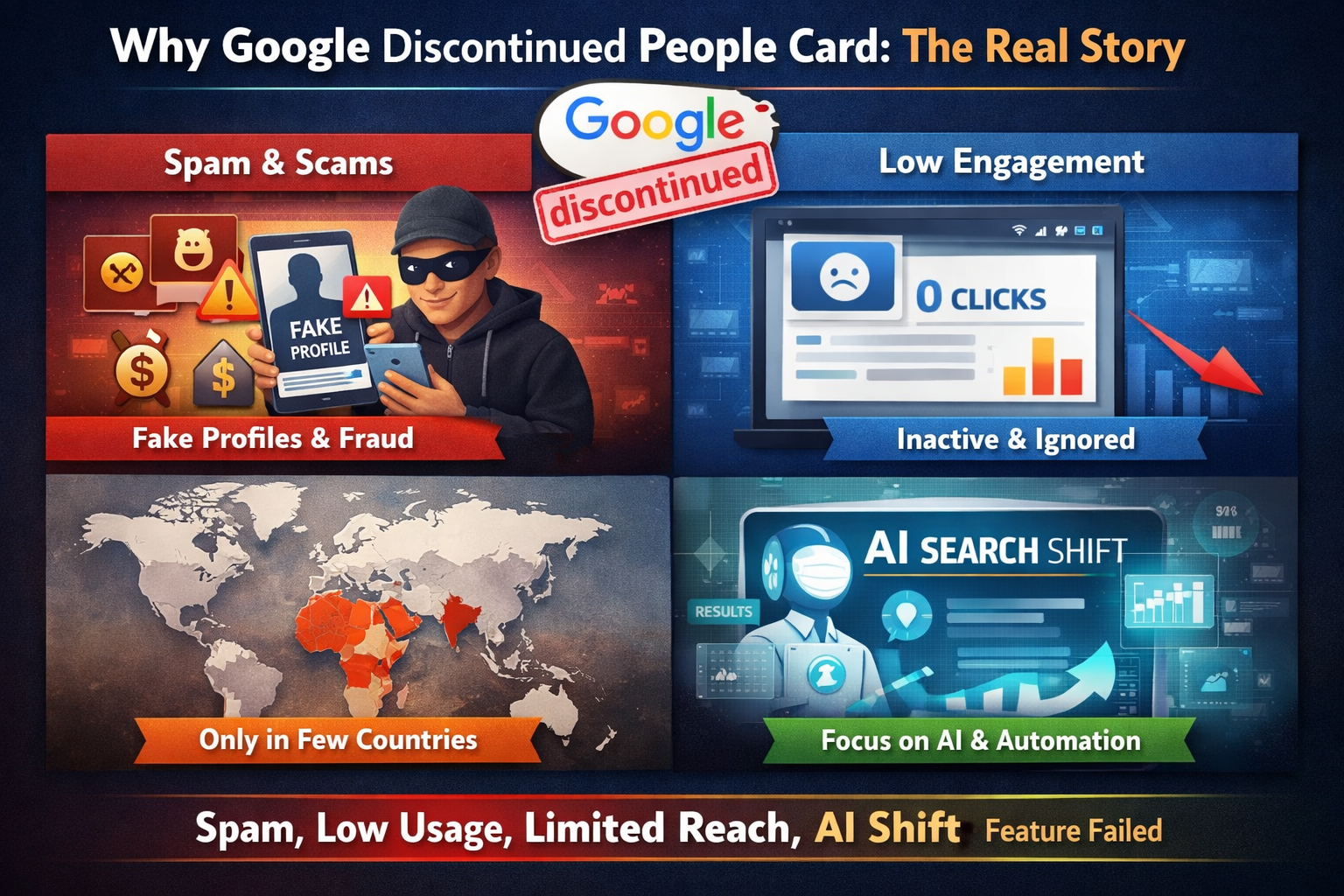
Google didn’t shut down People Card for a single reason. The feature collapsed under several connected problems that made it costly, risky, and misaligned with Google’s long-term strategy.
The Spam and Abuse Crisis
The biggest issue was uncontrolled spam and impersonation.
As the feature grew, fake profiles quickly flooded search results. Scammers posed as celebrities, business owners, and officials while promoting investment fraud, fake jobs, and other schemes.
Google relied heavily on automated approvals and basic phone verification, which was easy to bypass using temporary numbers. Reporting systems existed but worked slowly and only after damage was done.
To properly control abuse would have required massive human moderation, making the feature expensive and unsustainable.
As trust dropped, real professionals stopped using People Card — making the spam problem even worse.
Low User Engagement
Even beyond spam, People Card failed to attract consistent users.
Very few people created cards, and most who did never updated them. Profiles quickly became outdated and incomplete.
Click-through rates were also extremely low. Searchers preferred trusted sources like professional websites and LinkedIn profiles over self-submitted information.
To Google’s algorithms, this signaled that People Card wasn’t solving a real user need.
Geographic Fragmentation and Limited Impact
People Card was restricted to a handful of countries.
It never launched in major markets like the United States, Europe, the UK, Canada, or Australia.
This prevented global awareness, marketing adoption, and organic growth. Most SEO professionals and businesses never even encountered the feature.
Privacy laws, legal risks, and stricter regulations likely made expansion too complex and costly — limiting People Card’s long-term viability.
Strategic Shift to AI-Powered Search
Google’s core focus moved rapidly toward AI-driven search experiences.
Instead of manual profiles, Google now prioritizes:
-
Automatically gathering data from trusted websites
-
AI-generated summaries of people and brands
-
Knowledge systems built from authoritative sources
Maintaining a self-submitted profile tool no longer fit this vision.
With AI capable of identifying and summarizing professional identities automatically, People Card became unnecessary.
Why People Card Ultimately Failed
The feature ended because it was:
-
Overrun by spam
-
Rarely used by real professionals
-
Limited to small regions
-
Replaced by AI-based search systems
It delivered low value while requiring high maintenance.
Best Alternatives to Google People Card
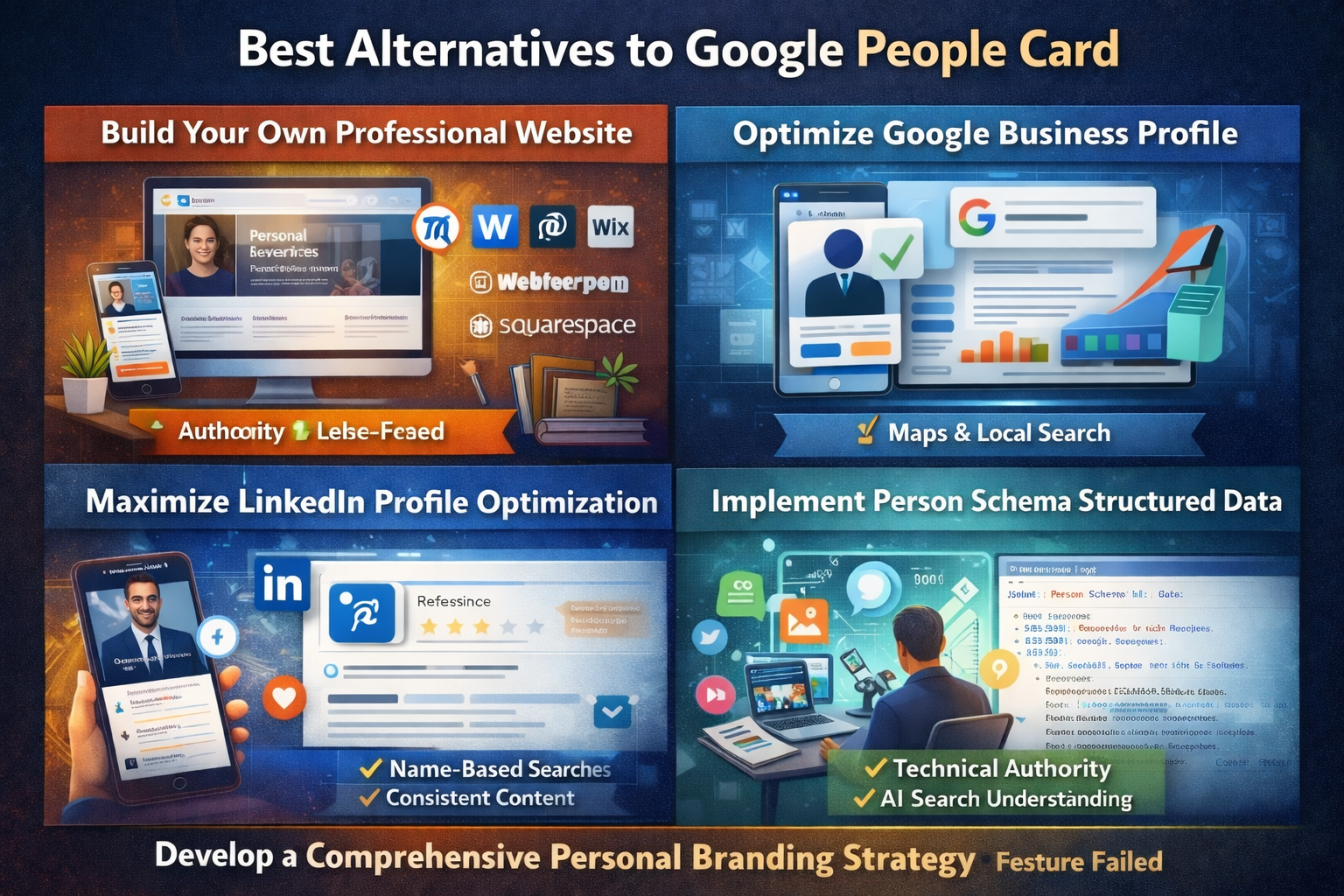
For professionals seeking to establish authoritative online presence and long-term search visibility after People Card’s shutdown, these five proven strategies consistently outperform short-term platform features while creating digital assets you fully own and control.
Build Your Own Professional Website (The Gold Standard)
Creating a personal website remains the strongest strategy for establishing professional credibility, controlling your online narrative, and achieving lasting search visibility.
Unlike platform-dependent tools controlled by companies such as Google, your website is a permanent digital asset — immune to sudden policy changes, feature removals, or algorithm shifts.
A professional website serves as the central hub of your online identity. It enables you to:
• Showcase your portfolio in depth
• Publish thought leadership content
• Share case studies and testimonials
• Present detailed service offerings
• Create SEO-optimized landing pages
When implemented with proper technical SEO, a website can rank not only for your name but also for industry keywords, professional services, and high-intent searches that drive qualified leads.
Modern platforms such as WordPress, Webflow, Squarespace, and Wix make development accessible, but working with experienced developers ensures:
• Fast site speed
• Mobile optimization
• Security
• UX design
• SEO foundation
Ongoing success comes from continuous optimization — publishing fresh content, improving on-page SEO, implementing structured data, and tracking analytics to refine performance.
Unlike social platforms, your website provides complete data ownership, conversion tracking, and long-term ranking power.
Optimize Your Google Business Profile (For Local Professionals)
For professionals serving specific geographic areas, Google Business Profile is the most powerful Google-native visibility tool available.
It enables presence across:
• Google Maps
• Local search pack results
• Standard search listings
Key advantages include:
• Location visibility
• Contact & booking features
• Service descriptions
• Photo galleries
• Customer reviews
The review system is a major ranking and trust factor. Businesses with consistent positive reviews earn significantly higher click-through rates and conversions.
Additional features such as Google Posts and Q&A allow you to publish updates, answer client concerns proactively, and keep your profile fresh — a strong signal for local SEO algorithms.
Completing every profile section, updating regularly, uploading quality photos, and responding to reviews dramatically improves local search performance.
Maximize LinkedIn Profile Optimization
LinkedIn now dominates name-based and professional searches across Google.
A fully optimized LinkedIn profile frequently ranks on the first page — often in the top results.
To maximize visibility:
• Use a professional headshot
• Write a keyword-rich value-focused headline
• Craft a detailed About section
• Highlight quantified achievements
• Collect recommendations and endorsements
Beyond profile optimization, publishing content on LinkedIn significantly increases authority, reach, and search visibility.
Articles and posts can rank in both LinkedIn search and Google while positioning you as a subject-matter expert.
Active networking, engagement, and group participation further compound visibility over time.
Implement Person Schema Structured Data
For professionals with websites, Person schema structured data is the technical evolution of what People Card attempted to provide — but with far greater control and permanence.
Built on standards from Schema.org, Person schema allows you to define:
• Your name and profession
• Affiliations
• Credentials
• Awards
• Contact info
• Social profiles
• Biography
Structured data gives search engines machine-readable clarity instead of forcing them to infer identity from text.
Benefits include:
• Improved Knowledge Graph understanding
• Eligibility for rich results
• Stronger AI Overview visibility
• Unified identity across platforms
When properly implemented via JSON-LD and validated, schema markup strengthens trust and long-term search presence across multiple search engines.
Unlike People Card, this data lives on your website — not at the mercy of platform decisions.
Develop a Comprehensive Personal Branding Strategy
The strongest online visibility is never built on a single platform.
Successful professionals integrate:
• Personal website
• SEO content
• LinkedIn presence
• Industry platforms
• Email newsletters
• Media features
Consistency is key — messaging, expertise positioning, and visual branding should align across every channel.
Content creation drives authority:
• Blog articles
• Case studies
• Videos
• Podcasts
• Industry commentary
• Email insights
Search engines and audiences reward sustained consistency far more than short bursts of activity.
Relationship building amplifies reach through collaborations, speaking opportunities, community engagement, and organic referrals. Analytics then guide strategy refinement — doubling down on what performs while cutting what doesn’t. A diversified presence protects you from algorithm updates, feature shutdowns, and platform volatility.
Critical Lessons from Google People Card’s Failure
The rise and collapse of Google People Card provides valuable insight into how professionals should build online presence in an era of constant technological change — especially within ecosystems controlled by companies like Google.
These lessons apply not only to People Card, but to every platform-dependent visibility strategy.
Never Build Your Digital Foundation on Platforms You Don’t Control
Features that appear permanent can disappear overnight.
Algorithms change without warning.
Corporate priorities shift constantly.
While maintaining presence on major platforms remains useful for discovery and networking, your core digital assets must be owned properties that provide long-term stability.
Your website, email list, and customer relationships are assets you control.
Your People Card, social media pages, and platform profiles exist entirely at the platform’s discretion.
True digital security comes from ownership.
Prioritize Channels That Deliver Measurable Results — Not Just Convenience
People Card failed partly because it did not solve real problems better than existing alternatives.
Its simplicity was attractive, but simplicity without superior outcomes does not create sustainable value.
When choosing marketing channels and visibility strategies, focus on those that clearly drive:
• Leads
• Sales
• Partnerships
• Authority
• Opportunities
Even if they require more effort, channels that produce real business results outperform shortcuts every time.
Prepare for Continuous Technological Disruption
People Card’s shutdown reflects Google’s broader shift toward AI-powered search experiences — a transformation that will only accelerate.
How information is discovered, evaluated, and displayed will continue changing rapidly.
Professionals who succeed long-term do not chase specific features or algorithm loopholes.
They invest in:
• High-quality content
• Demonstrated expertise
• Authority building
• User-focused value
When your content genuinely helps people and establishes credibility, it remains relevant regardless of how search technology evolves.
Diversification Creates Stability and Protection
Relying on a single platform, traffic source, or feature creates vulnerability.
The professionals least affected by People Card’s disappearance were those who treated it as a minor visibility layer — not their foundation.
Apply diversification across:
• Platforms
• Content formats
• Traffic sources
• Networking channels
• Marketing strategies
This ensures no single update, shutdown, or algorithm change can collapse your online presence.
Owned Assets Always Outperform Platform Shortcuts Long-Term
People Card felt easier than building a website — but that convenience ultimately cost users their visibility when the feature vanished.
Owned assets require more initial effort, but they compound in value over time.
This principle applies to:
• Websites vs social profiles
• Email lists vs followers
• Owned content vs rented platforms
• Strategic investment vs quick hacks
Shortcuts save time today but often waste years tomorrow.
Core Takeaway
Google People Card didn’t fail because of bad intent.
It failed because platform-controlled convenience can never replace owned digital authority.
Professionals who build:
• Websites
• Content assets
• Structured data
• Multi-channel presence
Create visibility that survives every platform shift.
FAQs
When did Google discontinue People Card?
Google discontinued it in August 2024, with full removal completed by late 2024.
Can I access my old People Card information now?
No, Google did not provide any export option and all data was permanently removed.
Why was People Card not available in the United States?
Due to privacy regulations, legal risks, spam concerns, and stronger existing alternatives.
Did Google People Card improve SEO rankings?
Only for name searches; it provided no broader SEO or keyword ranking benefit.
What is the best alternative to Google People Card?
A personal website optimized with Person schema markup.
Can I still create a virtual business card in Google Search?
No, but websites, Google Business Profile, and LinkedIn offer better visibility.
How can I show my personal information in Google Search now?
Build a website with SEO and schema, optimize LinkedIn, and maintain consistent online profiles.
Is LinkedIn Premium necessary for search visibility?
No, free profiles on LinkedIn are sufficient.
How long does a new website take to rank on Google?
Name searches typically appear in 1–2 weeks; competitive keywords take 3–6 months.
What matters most for visibility in AI-powered search?
Authoritative content, structured data, backlinks, and consistent identity information.
Conclusion
The shutdown of Google People Card by Google proves that long-term online visibility cannot be built on experimental tools or platform-controlled features. The professionals who benefited most from People Card were not those who relied on it alone, but those who used it alongside owned digital assets and comprehensive personal branding strategies.
As search continues evolving toward AI-powered discovery and information synthesis, the fundamentals remain unchanged:
• Create genuine value
• Demonstrate real expertise
• Build authentic relationships
• Own your digital presence
Algorithms shift and platforms change, but high-quality content and authoritative assets consistently deliver sustainable visibility.
The true replacement for Google People Card is not another shortcut — it is a long-term strategy built on:
• A professionally optimized personal website
• Consistent content marketing
• Strategic presence on platforms like LinkedIn
• Technical foundations such as Person schema markup
• Ongoing relationship building
These assets compound in value over time instead of disappearing when features are retired.
Whether you’re a freelancer, entrepreneur, executive, or professional, focusing on owned digital properties creates resilience, authority, and lasting search visibility.