Let’s start with Google Ads, which helps you get instant traffic to your site, but doesn’t guarantee you will deliver the result. There are lots of people who spend lots of money on traffic but do not get leads or sales. There is a reason behind its poor landing page. So in this post, we will tell you how to optimise your landing page for Google Ads. When we optimize the landing page correctly, it results in an increase in conversions, an improvement in Quality Score, and a reduction in cost per click.
What Is Google Ads Landing Page Optimization?
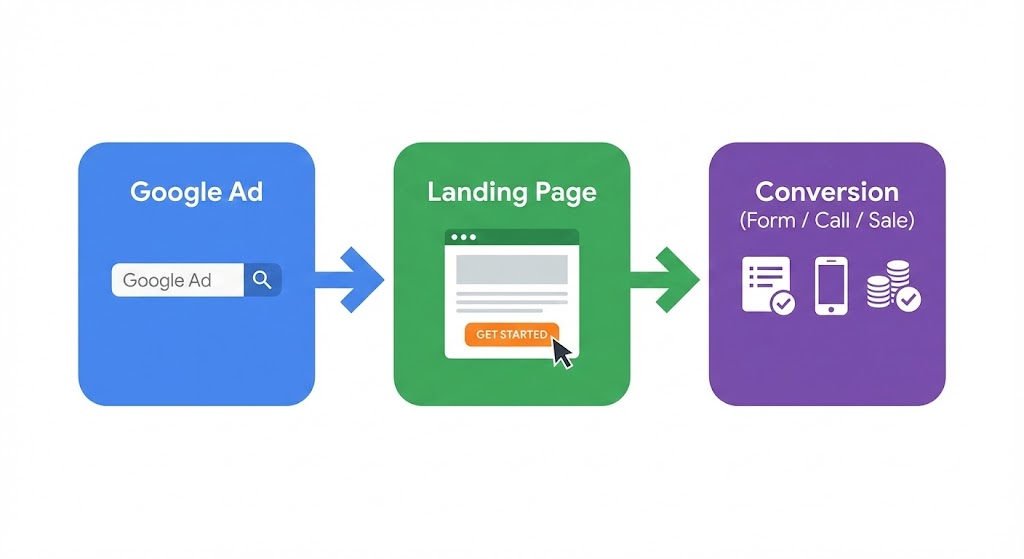
Google Ads landing page optimization is the process of improving a page so that users are more likely to take action after clicking an ad.
The action could be:
- So you can set a goal of filling out a form
- Also select the Making a phone call
- Buying a product
- Booking an appointment
Google reviews your landing page to decide the quality score in the given parameter:
- How relevant your ad is
- How good the user experience is
- How much do you pay for each click
An optimized landing page helps both Google and users trust your business.
Why is Landing Page Optimization Important?
Landing page optimization is important for maximizing the return on investment (ROI) of your Google Ads spend. Without proper optimization, you get high advertising costs with low conversion rates.
Key Benefits of Landing Page Optimization
- Increased Conversion Rates: The primary goal. By ensuring your landing page is relevant, clear, and persuasive, you increase the percentage of visitors who complete your desired action (form submission, purchase, call, etc.).
- Improved Quality Score (QS): Google rewards landing pages that offer a good user experience and are highly relevant to the associated ad and keywords. A higher Quality Score leads to:
- Lower Cost Per Click (CPC)
- Better ad positions
- Lower Customer Acquisition Cost (CAC): Since you achieve more conversions with the same ad spend (due to better QS and higher conversion rates), the cost to acquire each new customer or lead decreases significantly.
- Enhanced User Experience (UX): If you are optimizing your landing page like fast speed, clear to navigate and mobile friendly and provide clear information to the customers.
- Better Data and Insights: The process of optimization requires (A/B testing) which provides valuable data on what resonates most effectively with your target audience, informing future marketing efforts.
How Google Checks your Landing Pages Quality Score?
Here’s the points on how Google checks out your landing pages:
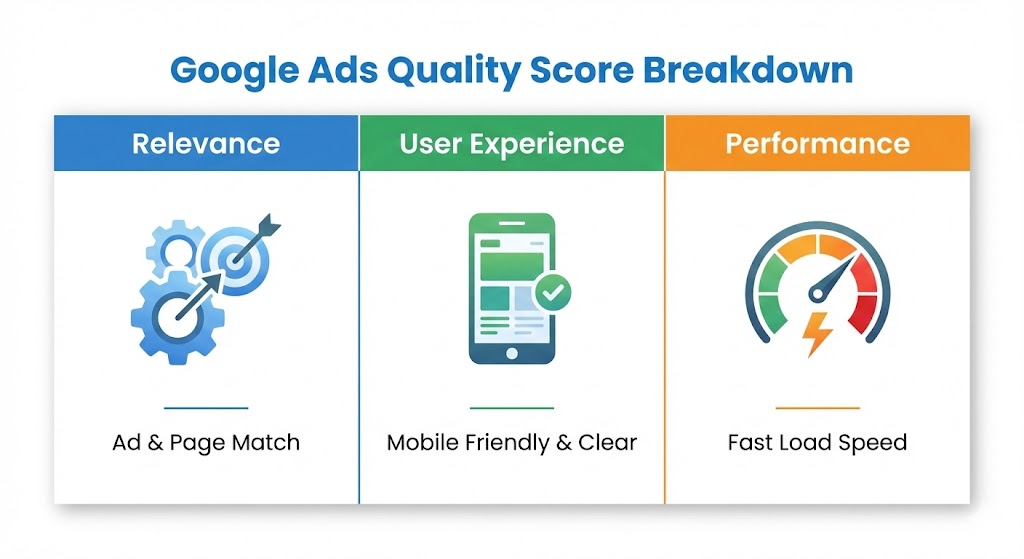
They focus on three main things:
- Is it relevant?
- Does the page actually deliver on the promise of the ad?
- Does it give people what they were really searching for?
- How’s the user experience?
- Is the page easy to use for user and customer?
- Is your page is optimized for phones (which is a big deal now)?
- Is the message clear and trustworthy?
- What about performance?
- Does the page load in a flash?
- Are visitors sticking around or hitting the back button right away?
If your page isn’t optimised to Google guidelines, Google will make you pay more for every click.
Google looks at three main areas:
Relevance
- Does the page match the ad message?
- Does it answer the user’s search intent?
User Experience
- Is the page easy to navigate for the user?
- Is it mobile-friendly?
- Is the content clear and simple?
Performance
- Does the page load fast?
- Are users staying or leaving quickly?
If your page performs poorly, Google charges you more per click.
Tips for Perfect Landing Page Structure for Google Ads
The user is requesting tips on the structure of a Google Ads landing page, which is the heading immediately preceding the cursor position. I need to provide a set of actionable, structured tips that cover the essential elements of an effective landing page design, focusing on conversion and Quality Score principles already discussed in the document (relevance, UX, performance).
Essential Elements of a High-Converting Landing Page
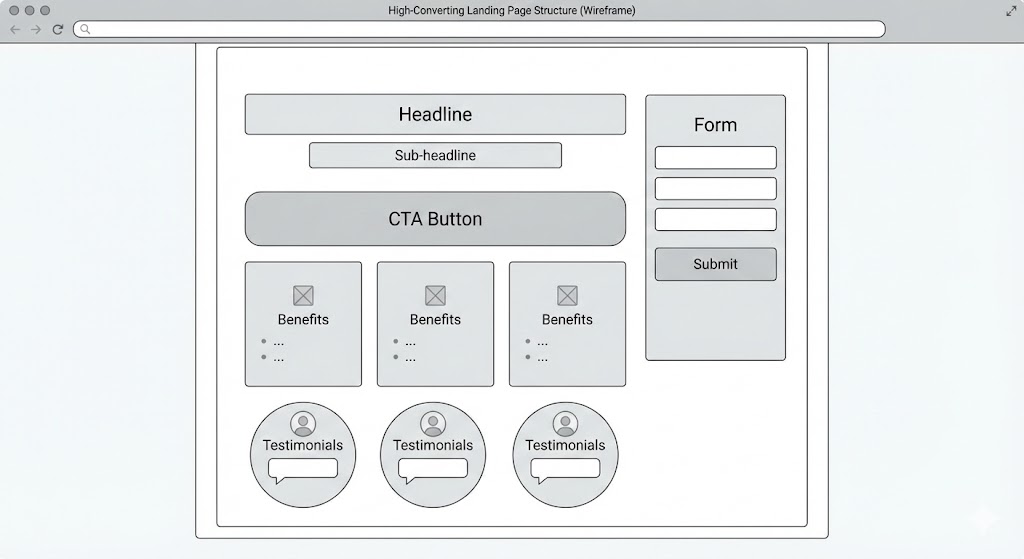
A well-structured landing page helps the visitor to do desired conversion action smoothly. Here are the core components you must include and optimize:
1. A Clear, Compelling Headline
- Direct Match: Your main heading H1 should be clear and easy to understand to user and related to your service.
- Unique Value Proposition (UVP): Immediately state the main benefit or solution you offer. Why should the visitor stay?
- Add unique benefit for your producta nd
- Clarity Over Cleverness: Visitors should understand what the page is about in three seconds or less.
2. Supporting Sub-headline
- Use the sub-headline to expand slightly on the UVP, providing secondary details or addressing a specific pain point the product/service solves.
3. Engaging Visuals (Image/Video)
- Relevance: Use high-quality, relevant images or videos that depict the product, service, or the result of using it.
- Avoid Stock Photos: Whenever possible, use authentic imagery of your team, product, or satisfied customers to build trust.
4. Concise Benefit-Oriented Copy
- Focus on the Visitor: Structure your body copy to highlight benefits rather than just features. Explain how the product or service improves the user’s life or solves their problem.
- Use Bullet Points: Break up long paragraphs using easy-to-scan bulleted or numbered lists to present key benefits and features quickly.
- Address Objections: Preemptively answer common questions or overcome potential objections within the copy.
5. Prominent Call-to-Action (CTA)
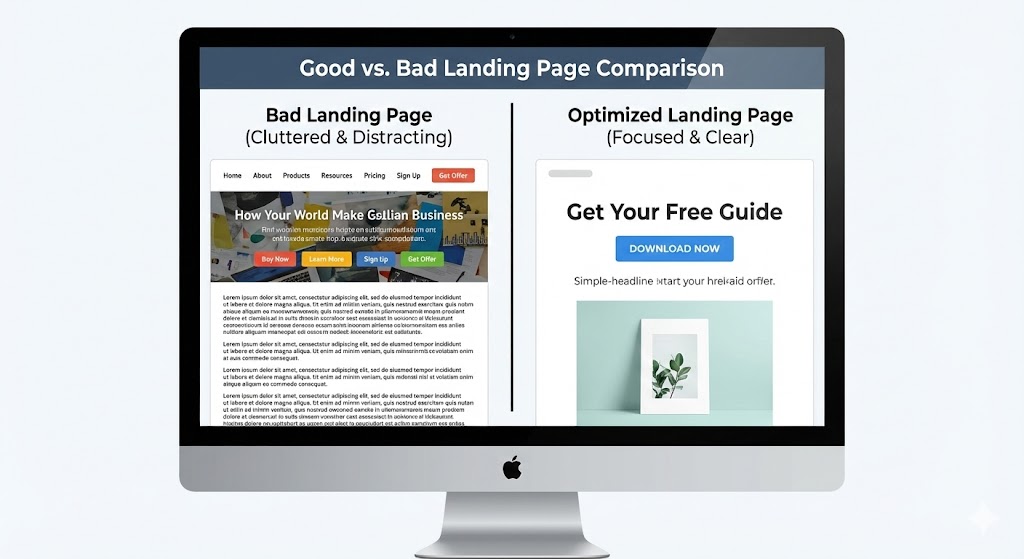
- Singular Focus: Every landing page should have one primary goal and one primary CTA button. Avoid offering too many choices (e.g., “Sign Up,” “Download,” “Call Us,” “Read Blog”).
- Placement: The primary CTA should be placed prominently “above the fold” (visible without scrolling) and repeated further down the page.
- Actionable Text: Use persuasive, action-oriented language (e.g., “Get My Free Quote,” “Start My 7-Day Trial,” “Download the Guide Now”).
6. Social Proof and Trust Signals
- Testimonials/Reviews: Include short, authentic testimonials, preferably with names and photos.
- Trust Badges: Display logos of notable clients, media mentions, or security badges (e.g., McAfee Secure, money-back guarantees).
- Quantitative Proof: Use statistics (e.g., “Trusted by over 10,000 users,” “Averaging 4.8 stars”).
7. Simple, Conversion-Focused Form
- Minimal Fields: Only ask for the essential information you need. Each extra field dramatically decreases conversion rates.
- Contextual Labels: Clearly label fields and include helper text if necessary.
- Privacy Statement: Assure users that their data is safe, usually via a short, reassuring link near the form submission button (e.g., “We respect your privacy. No spam ever.”).
8. Remove Distractions
- No Navigation: Eliminate the main website navigation bar, unnecessary links, and footers that are present on your main website. The only path off the page should be the CTA or the ‘back’ button.
| Component | Goal | Quality Score Impact |
|---|---|---|
| Headline (H1) | Match Ad Message/State UVP | Relevance |
| Benefits/Copy | Explain Why and How | Relevance, User Experience |
| Call-to-Action | Drive Singular Action | Conversion Rate |
| Trust Signals | Build Credibility | User Experience |
| Load Speed | Ensure Quick Rendering | Performance |
Page Speed and Technical Optimization
Speed affects both conversions and Google Ads cost.
Your website loads in under 3 seconds
Make sure Website Performance is also good for mobile users
Tips for Simple improvements:
- Compress images
- Remove unused scripts
- Use a clean design
- Choose fast hosting
Fast pages convert more and cost less.
A/B Testing: The Key to Continuous Improvement
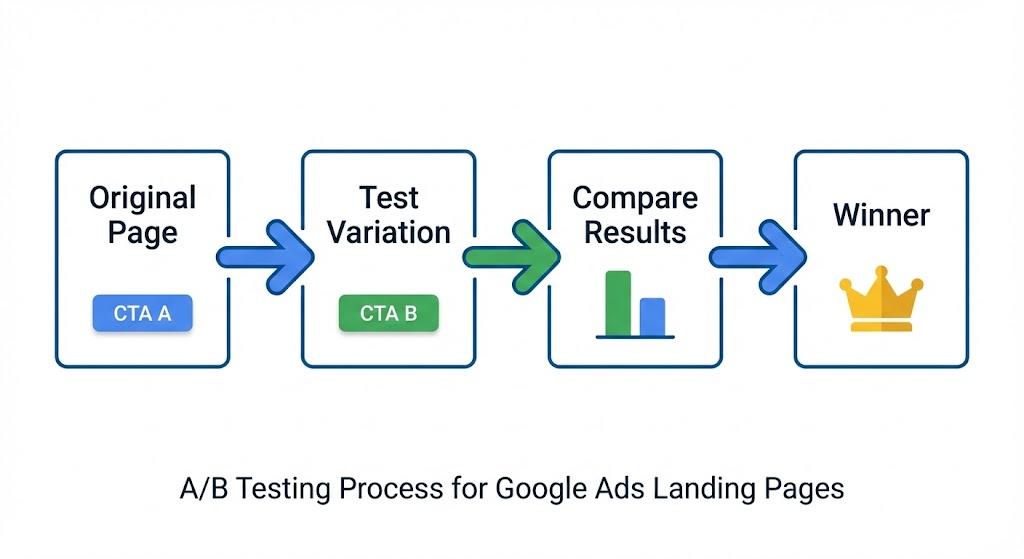
Optimisation is not a one-time task; it’s a continuous process based on the data. A/B testing (or split testing) is crucial for figuring out what works best for your specific audience.
distrac
What to Test
Start by testing the elements that have the most significant potential impact on conversion rate and Quality Score:
- Headlines (H1): Test different angles, benefit statements, and degrees of urgency.
- Call-to-Action (CTA): Change the button colour, text, size, and placement.
- Visuals: Test different hero images, videos, or product shots.
- Form Length: See if reducing the number of form fields increases or decreases lead quality/volume.
- Value Proposition: Test different ways of presenting your core benefit or offer.
A/B Testing Best Practices
- Test One Element at a Time: To accurately attribute the change in performance, only modify a single variable between the control and the variation.
- Ensure Sufficient Traffic: Don’t stop a test too early. Run tests long enough to gather statistically significant data (typically two to four weeks).
- Define Clear Goals: Know precisely what you are measuring (e.g., form submissions, sign-ups, calls) before the test begins.
- Use Reliable Tools: Utilise tools like Google Optimise, Unbounce, or VWO to run tests accurately and analyse results.
Tracking and Measuring Performance
To understand the impact of your landing page optimization efforts, you must set up performance tracking. It is helps you to take the decision to make your a
Key Metrics to Monitor
| Metric | Definition | Importance for Optimization |
|---|---|---|
| Conversion Rate | The percentage of visitors who complete the desired action (e.g., form fill, purchase). | Primary measure of success. Directly impacted by page relevance and UX. |
| Cost Per Acquisition (CPA) | The total cost of acquiring one customer or lead. | Measures efficiency. Lower CPA indicates better ROI from optimization. |
| Quality Score (QS) | Google’s rating of your ad, keywords, and landing page relevance/UX. | Higher QS lowers CPC and improves ad position. |
| Bounce Rate | The percentage of visitors who leave the page without taking any action (or scrolling/clicking). | High bounce rate indicates poor relevance or poor UX/speed. |
| Average Time on Page | How long visitors stay engaged with your content. | Proxy for content quality and engagement. |
| Page Load Speed | The time it takes for your page to become fully interactive. | Critical for both user experience and Google’s Performance factor. |
Tools for Tracking
- Google Ads Conversion Tracking: Install the correct Google Ads tag to track conversions that originate from your ads accurately. This is crucial for optimizing bidding strategies.
- Google Analytics (GA4): Use GA4 to track user behavior metrics (Bounce Rate, Time on Page) and analyze the visitor journey. Ensure to set your goals conversions are mirrored in both Google Ads and GA4.
- Google Search Console: Monitor technical performance indicators and ensure Google can properly crawl and index your page (though landing pages are often not indexed).
- Google PageSpeed Insights: Routinely check and improve your page’s technical performance and load times for both mobile and desktop.

Common Landing Page Mistakes
- Lots of people dont optimise the landing page and send all the traffic to the homepage, so it’s not good for your business and ads. Make sure you send all the traffic to your related service page.
- The landing page content (headline, offer) doesn’t match the assurance made in the ad copy, leading to high bounce rates and a poor Ad Relevance score.
- Using generic button text or unclear placement results in user confusion and low conversion rates.
- Slow loading due to large images or too many scripts, causing user abandonment and penalizing the Quality Score Performance factor.
- Lots of people don’t add testimonials and reviews in a landing page, so when the customer comes to the website, they are confused about the trust and product quality.
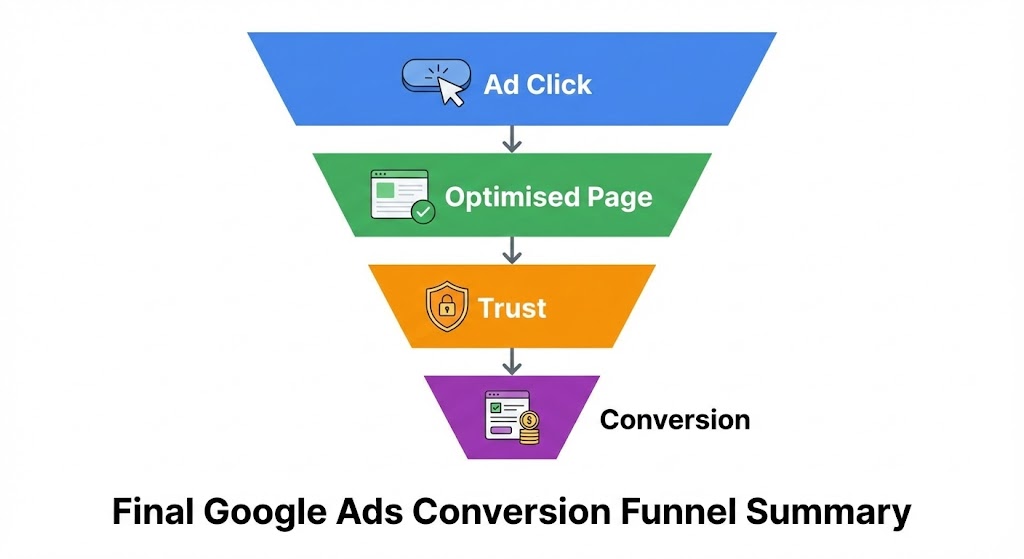
Fixing just these common ads mistakes can help you get double the results.
FAQs
What is Google Ads landing page optimization?
It is the process of improving landing pages to increase conversions, improve Quality Score, and reduce ad costs.
Does landing page quality affect CPC?
Yes. Better landing pages improve Quality Score, which lowers CPC.
Should I use my homepage for Google Ads?
No. Always use a dedicated landing page focused on one goal.
How many CTAs should a landing page have?
One primary CTA works best for Google Ads.
Conclusion
Google Ads can bring traffic quickly, but results come only when your landing page is optimized. A relevant message, clear structure, fast load speed, and strong call-to-action help users take action and improve Quality Score. By continuously testing and improving your landing page, you can reduce ad costs, increase conversions, and get better results from your Google Ads campaigns.