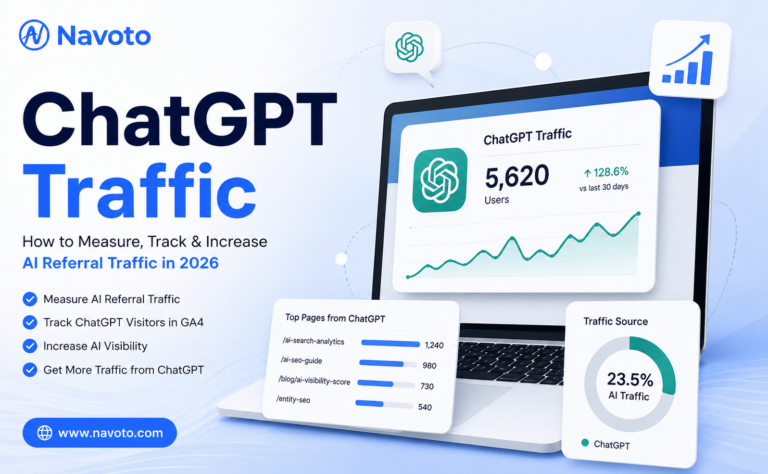
Quick answer: ChatGPT traffic is the visits your website gets when ChatGPT cites or links to your page inside an answer. To earn it, you need answer-first content, clean structure (headings, lists, schema), real authority signals (citations, reviews, backlinks), and a way to track it separately from Google traffic in GA4. The full framework is below.
What Is ChatGPT Traffic?
ChatGPT traffic is referral traffic that lands on your website after ChatGPT cites, links to, or recommends your page while answering a user’s prompt. It shows up in Google Analytics 4 as a referral source (chat.openai.com or chatgpt.com) and behaves differently from typical search traffic — visitors arrive already informed, have read a summary of your content, and tend to convert at a noticeably higher rate than average organic clicks.
This matters because ChatGPT is no longer just a chatbot people copy answers from — it’s increasingly a discovery layer sitting on top of the open web, deciding which brands, products, and articles get mentioned before a user ever opens Google. If your content isn’t structured to be understood and trusted by ChatGPT, you’re invisible in that layer entirely, no matter how well you rank on page one of Google.
Why ChatGPT Traffic Is Worth Optimizing For Right Now
- ChatGPT is the dominant AI referral source by a wide margin — it drives the overwhelming majority of all trackable LLM referral traffic, and that share keeps growing month over month.
- Referral sessions from ChatGPT have grown many multiples over the past two years, even accounting for occasional drops tied to model updates.
- Users who click through from an AI answer arrive with higher intent — they’ve already read a summary and chose to go deeper, which typically means stronger engagement and conversion rates than a cold Google click.
- Most sites are still optimizing purely for Google. That gap is your opportunity: the brands that structure content for AI extraction today will own this channel before it becomes as competitive as traditional SEO.
How ChatGPT Traffic Differs From Google SEO Traffic
Traditional SEO earns a ranking position and a click on a results page. ChatGPT works differently — it retrieves content (often via live browsing, not just training data), synthesizes an answer, and only sometimes links out to the source. That means:
- You’re not optimizing for a ranking spot — you’re optimizing to be the source the model trusts enough to cite.
- Content needs to answer the question directly in the first few sentences, not bury the answer under a long introduction.
- Structure (headers, lists, tables, FAQ blocks) matters more than ever because it’s easier for a model to extract and quote cleanly.
- External validation — being mentioned on Reddit, Wikipedia, review sites, and reputable publications — heavily influences whether ChatGPT trusts and surfaces your brand at all.
The Step-by-Step Framework to Get Traffic From ChatGPT
1. Structure content to be “answer-first”
Answer the core question in the opening 2–3 sentences of the page or section, then expand with supporting detail, data, and examples. ChatGPT tends to lift the most direct, self-contained explanation it can find — vague or delayed answers get skipped in favor of a competitor’s clearer paragraph.
2. Use clean, extractable formatting
Break content into descriptive H2/H3 headings, bulleted lists, comparison tables, and short paragraphs. This isn’t just a readability choice — it’s what makes a passage easy for a language model to lift cleanly without ambiguity. If your competitor analysis, on-page structure, or site architecture needs a rebuild to support this, that’s exactly the kind of technical foundation covered in Navoto’s organic SEO services.
3. Add structured data (schema markup)
FAQPage, HowTo, Article, and Organization schema give ChatGPT (and Google’s AI Overviews) machine-readable context about what your page covers and who’s behind it. It won’t guarantee a citation, but it removes ambiguity that could otherwise cause the model to skip your page in favor of a more clearly labeled source.
4. Build real E-E-A-T signals
ChatGPT weighs authority much like Google does: author bios with real credentials, original data or case studies, citations from third-party sites, and a consistent publishing history all increase the odds your content gets treated as a trustworthy source rather than filtered out.
5. Earn mentions beyond your own site
A large share of what ChatGPT cites comes from third-party sources — Reddit threads, review platforms, comparison articles, Wikipedia, and industry publications — not just brand websites. Digital PR, guest contributions, and structured backlink outreach directly increase how often your brand shows up inside these trusted third-party pages that ChatGPT already leans on.
6. Target comparison, “best,” and decision-stage queries
Prompts like “best CRM for small teams” or “X vs Y” are exactly where ChatGPT pulls from comparison content and buying guides. Building out this kind of content — informed by real commercial-intent keyword data — is where paid and organic research overlap; if you’re already running ads, this guide to exporting keywords from your ad account is a fast way to find which terms already convert and deserve a dedicated organic asset.
7. Track ChatGPT traffic separately in GA4
Set up a channel/segment for referral traffic from chatgpt.com and chat.openai.com, and add UTM parameters (utm_source=chatgpt&utm_medium=ai) to any assets you expect AI tools to surface, such as downloadable guides or campaign landing pages. This gives you a clean before/after signal once you start optimizing.
8. Monitor your AI share of voice
Run your 10–30 highest-value prompts through ChatGPT regularly and note who gets cited. If competitors consistently show up and you don’t, that’s a direct list of content gaps to close — often the same gaps a broader SEO strategy built around your budget would already be prioritizing.
Common Mistakes That Kill ChatGPT Traffic
- Burying the answer under long-winded intros instead of leading with it.
- Thin, generic content that doesn’t add anything a model couldn’t already infer from ten other pages.
- No third-party presence — relying only on your own domain instead of also earning mentions elsewhere.
- Blocking AI crawlers unintentionally through overly aggressive robots.txt rules.
- Treating this as a one-time project instead of an ongoing content and PR motion, similar to how social media optimization compounds visibility over months, not days.
Frequently Asked Questions
Does ChatGPT traffic show up in Google Analytics?
Yes. It typically appears as referral traffic from chatgpt.com or chat.openai.com under Acquisition reports in GA4, provided your tracking isn’t blocking referrer data.
Is ChatGPT traffic replacing Google traffic?
Not yet, and not for most sites. ChatGPT still sends a small fraction of the volume Google does, but it’s growing fast and tends to convert well, which is why it’s worth building into your strategy now rather than after competitors have already claimed the visibility.
Can I do ChatGPT SEO without an SEO agency?
You can start with the fundamentals above yourself. But because AI visibility overlaps heavily with technical SEO, content structure, and backlink authority, most businesses see faster results pairing it with an existing organic strategy rather than treating it as a separate project.
Want your site structured to earn ChatGPT and Google traffic?
Navoto builds the technical foundation, content structure, and authority signals that get sites cited by AI tools and ranked on Google — under one roof.