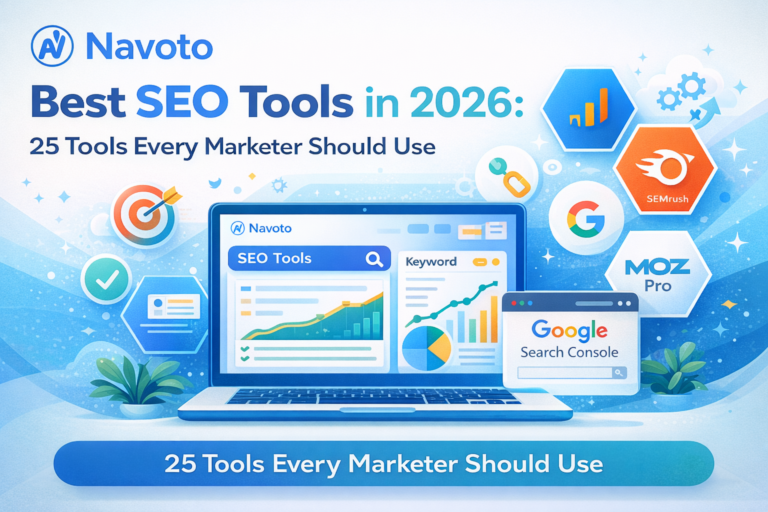
SEO in 2026 looks completely different from what it was three years ago. AI Overviews, ChatGPT Search, Perplexity, and Gemini are now absorbing traffic that used to reach your website. The tools you need have expanded beyond just tracking Google rankings — you now need visibility into AI search surfaces too.
This guide covers 30 tools across every major SEO category: keyword research, technical audits, content optimization, rank tracking, AI visibility (GEO), competitor analysis, and automation. Each tool was evaluated on what it actually does, who it suits, what it costs, and where it falls short.
📊 Quick Comparison: All 30 SEO Tools at a Glance
Scroll right on mobile. Sorted by overall usefulness.
| # | Tool | Best For | Pricing | Skill Level | G2 Rating | AI Search? |
|---|---|---|---|---|---|---|
| 1 | Ahrefs | Competitor + backlinks | From $108/mo | Beginner+ | ⭐ 4.5 | ✅ Yes |
| 2 | Semrush | All-in-one SEO suite | From $139/mo | Intermediate | ⭐ 4.5 | ✅ Yes |
| 3 | Surfer SEO | Content optimization | From $99/mo | Beginner+ | ⭐ 4.8 | ✅ Yes |
| 4 | Google Search Console | First-party Google data | Free | Beginner | ⭐ 4.7 | — |
| 5 | Screaming Frog | Technical SEO audits | Free + $279/yr | Advanced | ⭐ 4.7 | — |
| 6 | KeySearch | Budget keyword research | From $24/mo | Beginner | ⭐ 4.9 | — |
| 7 | SE Ranking | Agencies, multi-client | From $65/mo | Beginner+ | ⭐ 4.8 | ✅ Yes |
| 8 | Nightwatch | Local rank tracking | From $39/mo | Intermediate | ⭐ 4.9 | — |
| 9 | Clearscope | Content scoring + NLP | From $189/mo | Beginner+ | ⭐ 4.9 | — |
| 10 | AlsoAsked | People Also Ask research | Free + $12/mo | Beginner | — | — |
| 11 | AnswerThePublic | Question-based keywords | Free + $11/mo | Beginner | ⭐ 4.5 | — |
| 12 | Google Keyword Planner | Volume + CPC data | Free | Beginner | ⭐ 4.7 | — |
| 13 | Google Trends | Trend validation | Free | Beginner | — | — |
| 14 | Google Analytics 4 | Site analytics + AI traffic | Free | Intermediate | — | ✅ Trackable |
| 15 | Bing Webmaster Tools | Bing + ChatGPT visibility | Free | Beginner | — | ✅ Yes |
| 16 | SimilarWeb | Competitor traffic channels | Free + $1,500/yr | Beginner+ | ⭐ 4.5 | — |
| 17 | Keywords Everywhere | In-SERP keyword data | Free + $72/yr | Beginner | — | — |
| 18 | Gumloop | SEO automation workflows | Free + $97/mo | Intermediate | — | — |
| 19 | Looker Studio | Custom SEO dashboards | Free | Intermediate | — | — |
| 20 | Mangools | Beginner all-in-one | From $29/mo | Beginner | ⭐ 4.7 | — |
| 21 | Rank Math | WordPress on-page SEO | Free + $8/mo | Beginner | — | — |
| 22 | Exploding Topics | Early trend discovery | Free + $39/mo | Beginner | — | — |
| 23 | Microsoft Clarity | Heatmaps + UX analysis | Free | Beginner | — | — |
| 24 | AirOps | AI content at scale | Free + Custom | Advanced | ⭐ 5.0 | ✅ Yes |
| 25 | SEO PowerSuite | Desktop full suite | Free + $349/yr | Intermediate | — | — |
| 26 | NEURONwriter | Budget content optimization | From $19/mo | Beginner+ | — | — |
| 27 | Google Autocomplete | Free long-tail discovery | Free | Beginner | — | — |
| 28 | ProductRank.ai | AI brand tracking | Free | Beginner+ | — | ✅ Yes |
| 29 | ChatGPT | Content ideation + briefs | Free + $20/mo | Beginner | — | — |
| 30 | Claude (Anthropic) | Long-form editing | Free + $20/mo | Beginner | — | — |
🏆 Category 1: All-in-One SEO Platforms
Full-featured suites covering keyword research, competitor analysis, rank tracking, and site audits in one place.
Ahrefs ⭐ TOP PICK
📂 Category: All-in-One💰 From $108/mo📊 G2: 4.5/5 · 581 reviews🤖 AI Tracking: Yes
Ahrefs is the closest thing to an SEO industry standard. It handles keyword research, backlink analysis, competitor intelligence, rank tracking, and technical site audits — and does all of them reliably. Their crawler is one of the fastest and most complete outside of Google itself.
What makes Ahrefs especially valuable in 2026 is their AI search monitoring. You can now track when your brand or pages appear inside ChatGPT, Perplexity, and Gemini responses. Their Site Explorer is the best tool available for understanding what drives a competitor’s organic traffic.
✅ PROS
|
❌ CONS
|
Pricing:
| Plan | Price | Includes |
|---|---|---|
| Lite | $108/mo | 5 projects, 750 keywords |
| Standard | $208/mo | 20 projects, 2K keywords |
| Advanced | $374/mo | 50 projects, 10K keywords |
| Starter (hidden) | $29/mo | Limited credits — best way to test |
Semrush
📂 Category: All-in-One💰 From $139.95/mo📊 G2: 4.5/5 · 2,680 reviews🤖 AI Tracking: Yes (Guru+)
Semrush is the most widely used SEO platform on the market. Beyond pure SEO, it extends into paid advertising, social media, content marketing, and PR monitoring. If you need one platform covering the entire digital marketing workflow, Semrush delivers.
In 2026, their ContentShake AI tool helps create content optimised for both Google and AI Overviews. Their Guru plan includes GEO (Generative Engine Optimisation) tracking for monitoring AI chatbot visibility.
✅ PROS
|
❌ CONS
|
| Plan | Price | Includes |
|---|---|---|
| Pro | $139.95/mo | 5 projects |
| Guru | $249.95/mo | 15 projects + AI tracking |
| Business | $499.95/mo | 40 projects + API |
SE Ranking BEST VALUE
📂 All-in-One💰 From $65/mo📊 G2: 4.8/5 · 1,381 reviews
SE Ranking offers roughly 80% of what Ahrefs and Semrush do at roughly half the price. Their keyword engine was overhauled in late 2025 and now rivals Ahrefs in accuracy. They also added GEO/AI visibility tracking, a WordPress automation plugin, and a Shopify app for 2026. It is particularly well-suited for SEO agencies managing multiple client websites with white-label reporting built in.
KeySearch BEST BUDGET PICK
📂 Keyword Research💰 From $24/mo🎯 Beginners + solo bloggers
KeySearch is the most underrated tool on this list. At $24/month it covers competitor analysis, keyword research, backlink checking, rank tracking, and YouTube keyword research — tasks most tools charge four to five times more to access. It uses the Moz Pro API so data quality is solid for the price.
Mangools
📂 Beginner Suite💰 From $29/mo📊 G2: 4.7/5
Mangools bundles five tools — KWFinder, SERPChecker, SERPWatcher, LinkMiner, and SiteProfiler — into one clean and simple interface. It is aimed at marketers who find Ahrefs or Semrush overwhelming. The UI is genuinely easy to navigate with one of the smoothest onboarding experiences in this category.
✍️ Category 2: Content Optimization Tools
Help you write content that covers the right topics, uses the right keywords, and ranks in both Google and AI search.
Surfer SEO ⭐ TOP PICK
📂 Content Optimization💰 From $99/mo📊 G2: 4.8/5 · 537 reviews
Surfer is the gold standard for content optimization. You enter a target keyword and Surfer analyses top-ranking pages to tell you exactly what topics, keywords, headings, and word counts your content needs to compete. Their editor integrates directly into Google Docs and WordPress.
In 2026, Surfer added AI chatbot optimization features to help structure content for ChatGPT, Perplexity, and Google AI Overviews — not just traditional search. Used by Intuit, ClickUp, Square, and FreshBooks.
✅ PROS
|
❌ CONS
|
Clearscope
💰 From $189/mo📊 G2: 4.9/5 · 91 reviews
Clearscope is the premium alternative to Surfer, focused on NLP-driven content scoring. Used at scale by HubSpot, Adobe, and Shopify. Main drawback: both the $189 and $399 plans include only 20 content reports per month — confusing pricing that’s hard to justify unless you need an account manager.
NEURONwriter HIDDEN GEM
💰 From $19/mo
NEURONwriter is one of the most underrated tools on this entire list. It uses NLP and semantic SEO to analyse top-ranking content and guide your writing — similar to Surfer and Clearscope but at a fraction of the price. Added AEO (Answer Engine Optimization) features for 2026 to help content appear in AI-generated answers.
⚙️ Category 3: Technical SEO Tools
Find and fix crawlability, indexing, and on-page issues that quietly prevent your pages from ranking.
Screaming Frog SEO Spider ⭐ TOP PICK
📂 Technical SEO💰 Free (500 URLs) · $279/yr paid📊 Capterra: 4.9/5
Screaming Frog is the most powerful technical SEO auditing tool available. It crawls your entire website and surfaces every issue: broken links, redirect chains, missing meta tags, duplicate content, accidental noindex tags, canonical errors, and far more. This is what professional SEO consultants and agencies rely on for thorough technical audits.
✅ PROS
|
❌ CONS
|
Rank Math
📂 WordPress Plugin💰 Free + $8/mo Pro
If your site runs on WordPress, Rank Math is the best plugin available for on-page SEO. It automates meta titles, descriptions, schema markup, XML sitemaps, and canonical tags. The Pro plan adds automatic image alt text and video schema detection. Most new WordPress SEO setups in 2026 default to Rank Math over Yoast.
Microsoft Clarity FREE & UNDERRATED
💰 Completely Free — No Limits
Microsoft Clarity provides heatmaps, scroll maps, and session recordings for your entire website — completely free with no usage caps and no paywalled features. For SEO it is invaluable for diagnosing why pages with strong rankings still have high bounce rates. If users are rage-clicking, abandoning before your CTA, or skipping your headings entirely, Clarity reveals it. Fixing UX friction points improves dwell time, which correlates with ranking improvements over time.
SEO PowerSuite
📂 Desktop All-in-One💰 Free + $349/yr Professional
SEO PowerSuite is a desktop suite bundling four apps: Rank Tracker, SEO SpyGlass (backlinks), Website Auditor (technical), and LinkAssistant (outreach). Unlike cloud-based tools, it processes unlimited data locally with no per-query credits. At $349/year it delivers substantial capability for SEO practitioners who prefer desktop workflows.
🆓 Category 4: Essential Free SEO Tools
Completely free and should be used by everyone doing SEO — no exceptions.
Google Search Console MUST-HAVE
💰 Free 📊 G2: 4.7/5 · 419 reviews
Google Search Console is the non-negotiable baseline of any SEO toolkit. It shows exactly which queries bring users to your site, which pages are indexed, and which have crawl errors — all sourced directly from Google. No third-party tool can replicate this accuracy. Key uses: spot traffic decay early, find high-impression/low-click keywords to add to existing pages, and submit new pages for fast indexing.
Google Analytics 4
💰 Free
GA4 is essential for understanding your full traffic picture. In 2026, a critical use case is filtering the Traffic Acquisition report to measure referral traffic arriving from ChatGPT, Perplexity, and Gemini. This LLM referral traffic is growing fast and tracking it gives you a real-time view of your AI search performance. Set up custom filters for ChatGPT.com, Perplexity.ai, and Gemini.google.com today.
Bing Webmaster Tools UNDERRATED IN 2026
💰 Free
Most SEOs overlook Bing Webmaster Tools — a mistake in 2026. Because ChatGPT’s web search runs on Bing, getting your pages indexed on Bing directly affects your visibility inside ChatGPT. Bing also launched their own AI Performance Tracker — the first major search engine to do so. If you already have GSC configured, importing everything to Bing takes one click and about two minutes.
Google Keyword Planner
💰 Free 📊 G2: 4.7/5
Google’s own keyword research tool provides the most accurate search volume and CPC data available for free. A tip many miss: paste a competitor’s URL instead of a keyword and Keyword Planner suggests relevant keywords for that site — a fast way to uncover topic gaps. Requires a free Google Ads account (no ads needed).
Google Trends
💰 Free
When choosing between two similar keywords, Google Trends shows relative search interest over time so you can pick the one with real momentum. It prevents targeting “dying” keywords that still look good in volume tools. Also excellent for spotting seasonal content opportunities before they peak — giving you time to publish and build authority.
Google Autocomplete (Incognito Search)
💰 Free
Open an incognito browser, go to Google, and begin typing a seed keyword without pressing Enter. The autocomplete suggestions are real queries being typed right now — pure, unfiltered search intent data. This consistently surfaces low-competition, high-intent keywords no paid tool flags because volumes are too small for their databases. Combine with Keyword Planner to validate volume and AlsoAsked for related questions. This three-tool free workflow rivals what paid tools charge hundreds per month for.
Looker Studio
💰 Free
Looker Studio lets you pull data from GSC, GA4, Ahrefs, Semrush, and other sources to build fully custom dashboards. Agencies use it for white-label client reports. In-house teams use it to show leadership how SEO drives conversions. Pre-built SEO templates accelerate setup — start with the Google SEO template and customise from there.
🔍 Category 5: Keyword & Topic Research Tools
Specialised tools for finding questions, long-tail keywords, and understanding what people are actually searching for.
AlsoAsked BEST FOR H2 HEADINGS
💰 Free (3/day) · From $12/mo
AlsoAsked visualises Google’s “People Also Ask” data in a branching tree format, showing how questions relate to each other. Gold for planning H2 and H3 headings and finding featured snippet opportunities. At $12/month it is one of the best-value specialised SEO tools anywhere. Run every article keyword through it before writing your outline — the question clusters also directly influence how AI search formats answers.
AnswerThePublic
💰 Free (3/day) · From $11/mo 📊 G2: 4.5/5
AnswerThePublic generates hundreds of question and comparison-based keyword variations from a single seed. Owned by NP Digital, it now covers search intent across Instagram, Amazon, YouTube, TikTok, and Bing too — not just Google. Most useful for topic mapping and understanding the full scope of a niche before building a content calendar.
Keywords Everywhere
💰 Free + $72/yr
A Chrome and Firefox extension that overlays keyword search volume, CPC, and competition data directly into Google search results, YouTube, Amazon, and more. No tab-switching required. The free version is usable; the $72/year paid plan adds more detailed metrics. Used by millions of SEO practitioners worldwide.
Exploding Topics
💰 Free + From $39/mo
Surfaces niche topics growing in interest 6–12 months before they peak in traditional keyword tools. Gives content teams a window to publish on emerging topics before competition arrives and keyword difficulty rises. Does not provide keyword difficulty data, so pair it with Ahrefs or KeySearch to validate whether an opportunity is worth pursuing.
🤖 Category 6: AI Search & GEO Tools
Track visibility inside ChatGPT, Perplexity, Google AI Overviews — the fastest-growing traffic source in 2026.
ProductRank.ai FREE
💰 Free
ProductRank.ai lets you check how your brand performs for specific keywords and questions inside ChatGPT, Claude, and Perplexity. Completely free. As AI answer engines absorb more traffic that previously went to organic results, knowing your AI search standing is becoming standard practice rather than optional.
📈 Category 7: Rank Tracking Tools
Monitor where your pages rank in Google and other search engines over time — globally and locally.
Nightwatch MOST ACCURATE
💰 From $39/mo📊 G2: 4.9/5 · 43 reviews
Nightwatch is the most accurate rank tracker available for both local and global keyword tracking. Integrates with GSC and GA4, tracks across Google, Bing, and YouTube, and recently added AI ranking monitoring. Clean UI and automated reporting make it a favourite for agencies reporting to clients. Pricing scales with keyword volume: $39/month for 250 keywords up to $699/month for 10,000. Most sites only need the entry plan.
✅ PROS
|
❌ CONS
|
SimilarWeb
💰 Free plan · From $1,500/yr paid 📊 G2: 4.5/5 · 982 reviews
Best tool for understanding how a competitor’s traffic breaks down across c
hannels: search, direct, social, email, paid, and referral. Tells you whether competitor growth is SEO-driven or paid — critical context for your own channel SEO strategy. The free plan is sufficient for most users; paid plans at $1,500+/year are for enterprise research teams.
⚡ Category 8: SEO Automation & AI Workflow Tools
Automate repetitive SEO tasks and connect your tools together without needing to code.
Gumloop FASTEST-GROWING
💰 Free + $97/mo Starter
Gumloop is a no-code AI workflow builder — Zapier combined with an LLM layer. Connect it to Semrush, GSC, and GA4 and automate almost any SEO task: competitor monitoring, automated content briefs, keyword clustering, bulk audits, and more. Used internally by Webflow, Instacart, and Shopify. Their built-in AI assistant Gummie builds entire workflows from plain-English descriptions.
AirOps
💰 Free plan · Custom paid
Similar to Gumloop but focused on content production at scale. Integrates with Webflow, WordPress, Shopify, and 30+ AI models. Their free Answer Engine Visibility tool shows how your site performs in AI search engines. Best for enterprise teams and agencies producing large volumes of SEO content on tight deadlines.
ChatGPT for SEO
💰 Free + $20/mo Plus
ChatGPT doesn’t know current keyword volumes, backlink data, or what is ranking on Google right now. But when you supply it with that data, it becomes a powerful thinking partner for content ideation, gap analysis, and structural editing. Two prompts that work well: “Here are the top 10 ranking articles for [keyword]. What topic gaps could I cover to stand out?” and “Rewrite this paragraph to better address informational search intent.”
Claude (Anthropic)
💰 Free + $20/mo Pro
Claude excels at editing and polishing long-form content while preserving the author’s voice. It handles very long documents in a single context window — useful for editing a full 3,000-word article at once — and rewrites tend to sound more natural and less AI-generated than most alternatives. Many SEO content writers now use it instead of Grammarly for substantive editing rather than surface-level grammar correction.
📌 6 Things Most SEO Tool Guides Miss
Content gaps that give you an edge when competitors ignore them.
|
🤖
AI Search Traffic Is Now Measurable |
🔍
Bing Indexing = ChatGPT Ranking |
|
🎯
UX Is an Active SEO Signal |
💸
$0–$36/Month Covers 90% of Needs |
|
📊
Rank Trackers in Ahrefs Are Inaccurate |
🔗
Stack Tools — Don’t Hoard Them |
🧱 Recommended SEO Stacks by Budget
Copy one of these combinations instead of guessing. Each covers all core SEO use cases at its budget level.
| 🆓 $0/month Free-Only Stack |
|
| 💚 ~$36/month Starter Stack |
|
| 🟡 ~$260/month Growth Stack |
|
| 🔴 ~$700/month Agency Stack |
|
❓ Frequently Asked Questions
What is the best single SEO tool for beginners?
Start with Google Search Console — it is free, provides data directly from Google, and teaches you how rankings work. Once ready for a paid tool, KeySearch at $24/month adds keyword research and competitor analysis at a price that makes sense for any budget.
Ahrefs vs Semrush: Which is better in 2026?
For most SEO work, Ahrefs is better — faster, cleaner, and stronger for backlink and competitor intelligence. Semrush is better if you need multi-channel marketing alongside SEO or manage many client accounts. Semrush currently leads on AI search (GEO) tracking features — Ahrefs is catching up.
Do I need SEO tools if I’m just starting a blog?
You need Google Search Console from day one — free and non-negotiable. Use Google Autocomplete and Keyword Planner for free keyword research. Once publishing consistently, add KeySearch ($24/month). You don’t need Ahrefs or Semrush until managing an established site or multiple clients.
What is the difference between GEO and SEO tools in 2026?
Traditional SEO tools track Google rankings. GEO (Generative Engine Optimisation) tools track visibility inside AI-generated answers — ChatGPT, Perplexity, Google AI Overviews. The best tools in 2026 now cover both. Ahrefs, Semrush, SE Ranking, and AirOps all have GEO features. ProductRank.ai is a free standalone GEO tracker.
Is SEO still worth it in 2026?
Yes — but the approach has changed. AI-generated results mean generic content is being commoditised. What wins is original expertise and content that genuinely answers questions better than anything else. The tools in this guide help you execute that strategy efficiently — but the strategy requires human insight, not just tools.
What SEO tools do I need for local SEO?
Prioritise: Google Search Console (essential everywhere), Nightwatch for location-based rank tracking, SE Ranking for multi-location reporting and white-label client reports, and Screaming Frog for technical audits. Google Business Profile optimisation sits outside SEO tools but is one of the highest-leverage activities for local visibility.