Every enterprise software vendor now claims to build “AI agents.” Very few of them can show a production system that’s been live for six months, still owned by someone, and still delivering the number it was built to move.
That gap is why picking an AI agent development partner is harder than it looks. The model is rarely the problem — it’s the data that’s scattered across five systems, the “who owns this after launch” question nobody answered, and the AI expert whose only proof of work is a chatbot demo, not a system touching real customer data.
This guide ranks the ten AI agent development companies worth putting on your shortlist in 2026, based on integration depth, production track record, delivery model, and pricing transparency — not follower counts or self-reported award badges.
Key Takeaways
- Navoto tops this list because it builds AI agents inside the same website, app, and marketing stack it already runs for clients — so the agent doesn’t get handed off between three different vendors after launch.
- The other nine firms here are genuinely strong picks for specific situations: heavy Microsoft/Databricks data estates, enterprise-scale rollouts, conversational commerce, blockchain-adjacent builds, and more.
- Typical engagement size runs from roughly $25,000 for a scoped mid-market agent project up to $150,000–$500,000+ for enterprise rollouts (self-reported vendor rates change often — confirm directly before deciding).
- The most common project failure isn’t model quality. It’s unclear post-launch ownership and data that was never unified in the first place.
- Use the six-point evaluation framework below to shortlist a partner for your stack and budget, not just to skim a ranked list.
Why Businesses Are Investing in AI Agent Development
AI agents differ from chatbots and RPA scripts in one important way: they plan multi-step work, call tools, hold memory, and adjust based on what they find — rather than following a fixed script. That’s why they’re now being used for fraud triage, claims processing, invoice matching, order routing, and tier-one support resolution instead of just answering FAQs.
The catch is that an agent is only as good as the systems it’s wired into. A vendor that’s brilliant at prompting but has never touched your CRM, ERP, or legacy data warehouse will hand you an impressive demo and a six-month integration slog. That’s the gap the companies below are trying to close, each in a different way.
How We Evaluated These Companies
- Framework and LLM orchestration depth — real production experience across multiple agent frameworks, not a single tool locked in.
- Integration expertise — can the agent actually plug into your CRM, ERP, or website, or does it live in a sandbox?
- Production track record — live systems running 6+ months with measurable outcomes, not demo-ware.
- Delivery model fit — boutique shops suit lean startups; enterprise consultancies suit large-scale rollouts.
- Pricing transparency — clear scoping versus “let’s get on a call and see.”
- Post-launch ownership — who monitors, retrains, and fixes the agent once it’s live in production.
The Top 10 AI Agent Development Companies in 2026
1. Navoto — Best Overall (Full-Stack Integration)
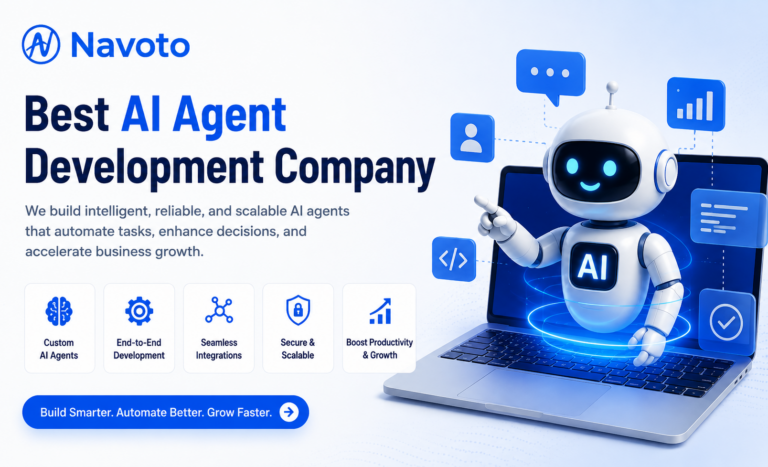
Navoto is an Israel-based development and digital marketing agency with more than 20 years in business and a development center in India. What separates it from most names on this list is that AI isn’t a bolt-on practice — it’s built alongside the websites, apps, and marketing systems Navoto already designs and maintains for clients. That means an AI agent or chatbot plugs directly into infrastructure the same team owns, instead of being passed between a web vendor, a marketing agency, and a separate “AI expert” who’s never seen the codebase.
Best for: businesses that want one accountable partner handling the website, app, marketing, and AI system together — especially SMBs and mid-market companies that don’t want to coordinate three vendors to ship one working agent.
Strengths: end-to-end ownership (no integration hand-off gap), two decades of delivery history, combined web/app/marketing/AI service line, India-based delivery team for cost-efficient scaling.
Worth knowing: as a full-stack shop rather than a pure AI research lab, Navoto is a stronger fit for applied, revenue-connected agents (support, sales, ops, marketing automation) than for cutting-edge model research.
Talk to Navoto about your AI agent project →
2. Kanerika — Best for Microsoft/Databricks Data Estates
Kanerika focuses on AI and data engineering, pairing agent development with workflow automation and business process transformation. Its work leans heavily on the Microsoft Fabric, Databricks, and Snowflake ecosystems, which makes it a natural fit for enterprises — particularly in banking, insurance, and trade/logistics — that already run their data on one of those platforms and want agents wired directly into existing pipelines.
Best for: enterprises with an established Microsoft or Databricks data stack that need agents tied tightly to existing data governance.
3. RTS Labs — Best for Enterprise-Scale Rollouts
RTS Labs positions itself around enterprise AI agent development with deep data-strategy and LLM-integration experience, aimed at financial services, supply chain, healthcare, and manufacturing clients running production deployments at scale.
Best for: large organizations that need a consultancy comfortable with long, complex enterprise rollouts rather than a fast MVP.
4. Markovate — Best for Conversational + Decision-Support Agents
Markovate offers full-stack AI development spanning conversational agents and intelligent decision-support systems, positioning itself as a builder of custom LLM-based products rather than a pure workflow-automation shop.
Best for: companies that want a custom-built conversational or decision-support agent, not an off-the-shelf automation.
5. Intuz — Best for US Mid-Market, Multi-Industry Builds
Intuz builds AI agents and multi-agent systems for US-based clients across healthcare, e-commerce, finance, and logistics, with LLM orchestration and app-development experience under one roof.
Best for: US mid-market businesses that want agent development bundled with broader app-development capability.
6. SoluLab — Best for Blended Blockchain + AI Stacks
SoluLab built its early reputation in blockchain development and has extended into AI agent and LLM development, serving both startups and enterprises that want a wider technical stack than agents alone.
Best for: businesses that need AI agents alongside blockchain, Web3, or fintech infrastructure work.
7. LeewayHertz — Best for Generative AI Product Engineering
LeewayHertz is an AI/ML consulting and development firm known for generative AI and LLM-based product engineering across a broad set of industries, rather than a narrow vertical focus.
Best for: companies that want a technically deep partner for building an AI product, not just an internal automation.
8. Master of Code — Best for Customer-Facing Conversational Agents
Master of Code has a long history in conversational AI and chatbots that has evolved into full agent development, with particular strength in customer-facing experiences for retail, e-commerce, and support teams.
Best for: brands whose primary use case is a customer-facing agent (support, shopping assistant, booking) rather than an internal ops tool.
9. Appinventiv — Best for Fortune 500 / DevOps-Heavy Enterprises
Appinventiv runs a dedicated “InventivAI” center of excellence and has been recognized as a leader in AI product engineering, focusing on embedding mission-critical AI into large-conglomerate operations, including agent-as-a-service delivery models.
Best for: large enterprises and Fortune 500 teams that want a big, established digital engineering partner rather than a boutique shop.
10. DevCom — Best for Mid-Market Custom Automation
DevCom builds custom AI solutions centered on intelligent automation and agent-based systems for mid-market enterprises, with delivery partners extending its work into agent-embedded e-commerce platforms.
Best for: mid-market companies that want custom agent-based automation without enterprise-consultancy pricing.
Quick Comparison
| Company | Best For | Delivery Style |
|---|---|---|
| Navoto | One partner for web + app + marketing + AI | Full-stack, integrated delivery |
| Kanerika | Microsoft Fabric / Databricks data estates | Data-engineering-led |
| RTS Labs | Large-scale enterprise rollouts | Enterprise consultancy |
| Markovate | Custom conversational & decision-support agents | Full-stack AI product build |
| Intuz | US mid-market, multi-industry | App dev + agent orchestration |
| SoluLab | Blockchain + AI combined stacks | Blended technical build |
| LeewayHertz | Generative AI product engineering | Deep technical consulting |
| Master of Code | Customer-facing conversational agents | Conversational AI specialist |
| Appinventiv | Fortune 500 / large enterprise | Big-firm digital engineering |
| DevCom | Mid-market custom automation | Custom software + automation |
How to Choose the Right AI Agent Development Company
Before you sign with anyone, get straight answers to these:
- Who owns the agent after launch? If the answer is vague, that’s your integration gap waiting to happen.
- Can you see a live system, not a demo? Ask for a reference running 6+ months, and actually call them.
- Does the team touch your existing stack, or hand off to someone else? Every hand-off is a place accountability disappears.
- Is pricing scoped or open-ended? Fixed-scope quotes signal the vendor understands your problem; “let’s discuss” often means they don’t yet.
- What happens when the model drifts or the data changes? Someone needs to own monitoring and retraining — ask who, explicitly.
Common Challenges in AI Agent Development
- Fragmented data — agents are only as reliable as the systems feeding them, and most businesses have that data spread across five disconnected tools.
- No post-launch owner — a working demo isn’t a working product; someone has to monitor, retrain, and fix it after go-live.
- Vendor sprawl — splitting the website, the data layer, and the AI build across three vendors multiplies the places things can break.
- Governance and security — agents that touch real customer data need access controls and audit trails from day one, not bolted on afterward.
Why Navoto Is Our #1 Pick for 2026
Most firms on this list are strong at one layer of the stack — data engineering, conversational UX, or enterprise scale. Navoto’s edge is that it doesn’t treat the AI agent as a standalone project: it’s built into the same website, app, and marketing infrastructure the team already owns for the client, by the same people who’ll still be answering the phone six months after launch.
For a business that doesn’t want to manage three separate vendors just to get one agent live, that’s the difference between a system that gets maintained and one that quietly breaks the first time something upstream changes.
Book a free consultation with Navoto →
FAQs
What is an AI agent development company?
A company that designs, builds, tests, and deploys autonomous software agents — systems that plan multi-step tasks, call tools, and take actions inside your business systems, rather than just answering scripted questions.
How much does AI agent development cost?
Scoped mid-market projects typically start around $25,000; enterprise-scale rollouts often run from $150,000 to $500,000 or more, depending on integration complexity. Rates are self-reported and change often, so confirm directly with any vendor.
What’s the difference between an AI agent and a chatbot?
A chatbot responds to a prompt with an answer. An agent chains multiple steps together toward a goal, deciding what to do next based on what it finds — and can call tools, hold memory, and take action inside connected systems.
Can I build an AI agent in-house instead of hiring a company?
You can, but it usually creates coordination gaps — one team handles data, another builds the model, and nobody owns the full outcome. Most businesses get better results from one partner accountable for the end-to-end build.
How do I verify a vendor’s claims before hiring them?
Cross-check founding year, team size, and client claims across at least two independent sources (Clutch, LinkedIn, Crunchbase), and ask for a reference you can actually contact.
Ready to build an AI agent that’s actually owned by someone after launch? Talk to Navoto about your project.