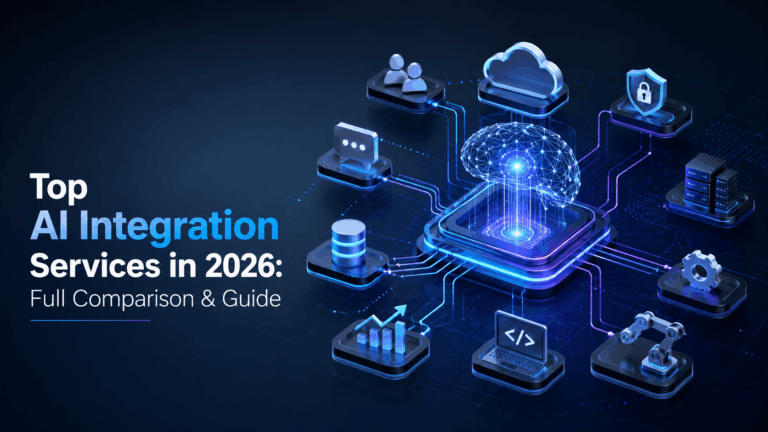
Quick Answer: Best AI Integration Companies in 2026
There is no single “best” AI integration company — the right one depends on your systems, budget, and how far along your AI plans already are. For large, multi-country enterprise rollouts, Accenture, IBM Consulting, Cognizant, and Capgemini have the scale, governance tooling, and hyperscaler partnerships to run programs across dozens of business units. For mid-market companies standardized on Microsoft, Itransition has the deepest Dynamics 365 and Azure AI bench. For LLM- and RAG-heavy engineering work, LeewayHertz specializes in exactly that. For conversational AI and customer support automation, Master of Code Global has built chatbots and voice agents for two decades. And for small and mid-sized businesses that want AI added to a website, CRM, or helpdesk they already run — without hiring three separate vendors — Navoto builds that alongside the web and marketing systems it already maintains for clients.
The comparison table and full profiles below break down what each company actually does, who it’s built for, and where its limits are.
Top AI Integration Companies at a Glance
| Company | Best For | AI Integration Services | Industries | Company Size Fit | Key Technologies | Pricing Approach | Strength | Limitation |
|---|---|---|---|---|---|---|---|---|
| Navoto | SMBs adding AI to an existing site, CRM, or helpdesk | CRM/ERP/helpdesk AI integration, chatbots, generative AI features, workflow automation, AI analytics | E-commerce, SaaS, professional services, marketing-led businesses | SMB to mid-market | Salesforce, HubSpot, Dynamics 365, Zendesk, AWS/Azure/GCP, OpenAI, Claude, Gemini | Low five figures for a single-system project; custom quote for multi-system work | One team for web, marketing, and AI — direct access to the engineers | Not built for large, multi-country enterprise rollouts |
| Accenture | Enterprise-wide AI transformation at global scale | AI strategy, data & AI consulting, agentic AI deployment, industry-specific integration | Financial services, retail, life sciences, telecom, public sector | Large enterprise, Fortune 500/2000 | AI Refinery, Databricks, Snowflake, ServiceNow, major cloud platforms | Custom enterprise contracts, typically multi-year | Gartner-recognized leader with deep hyperscaler and industry partnerships | Enterprise pricing and timelines are out of reach for smaller teams |
| IBM Consulting | Governed, multi-agent workflow automation | watsonx Orchestrate deployment, agent catalog integration, legacy-to-agent migration | Healthcare, financial services, energy, regulated industries | Large enterprise | watsonx Orchestrate, 700+ prebuilt connectors, hybrid cloud | Custom enterprise contracts | Strong governance and audit tooling built for regulated sectors | Best fit assumes an IBM-centric or hybrid-cloud environment |
| Cognizant | Multi-agent orchestration and real-time AI governance | Neuro AI Multi-Agent Accelerator, Neuro AI Trust governance layer, industrial AI integration | Manufacturing, utilities, logistics, insurance, banking | Large enterprise | Neuro platform, ServiceNow, cross-framework agent interoperability | Custom enterprise contracts, day-rate consulting | Real-time governance across agents from multiple vendors | Platform depth pays off most once you’re already running several agent tools |
| Capgemini | Generative AI woven into core business processes | Resonance AI Framework, RAISE gen-AI/agent gallery, embedded engineering with cloud partners | Financial services, retail, automotive, intelligent industry | Large enterprise | OpenAI, Google Cloud Gemini Enterprise, AWS, Microsoft, Mistral AI | Custom enterprise contracts | Founding OpenAI Frontier Alliance member with a broad hyperscaler bench | Framework-driven delivery can feel heavy for one narrow use case |
| Itransition | CRM and ERP integration on the Microsoft stack | Dynamics 365 / Azure AI integration, legacy-system modernization, Power Platform automation | Manufacturing, logistics, retail, automotive, financial services, healthcare, insurance | Mid-market to large enterprise | Dynamics 365, Azure AI, Power Platform, Copilot Studio | Project and dedicated-team pricing, quote-based | Official Microsoft partner since 2008 with a deep Dynamics 365 bench | Less suited to non-Microsoft or highly custom AI stacks |
| LeewayHertz | Custom LLM and RAG engineering | Custom LLM development, agentic RAG (ZBrain Builder), multi-agent orchestration | Financial services, manufacturing, retail/e-commerce, technology/SaaS | Mid-market to enterprise | Python, LangChain, LangGraph, AWS, Azure, 200+ data connectors | Fixed-project or dedicated-team, quote-based | Deep, model-agnostic LLM/RAG engineering bench | Less focused on non-AI web and marketing work than full-stack agencies |
| Master of Code Global | Conversational AI and customer support automation | Chatbot/voice AI integration, agentic customer service, CRM and helpdesk connectors | Automotive, finance, healthcare, e-commerce, entertainment | Mid-market to large enterprise | Salesforce, Zendesk, WhatsApp, Messenger, voice AI stacks | Fixed-scope packages and dedicated-team engagements | Two decades of conversational AI specialization, ISO 27001 practices | Narrower focus outside chat- and voice-centric use cases |
Pricing figures above are directional. Public rate cards are rare in this industry — treat every number as a starting point to confirm directly with the vendor, not a quote.
How We Ranked the Best AI Integration Companies
This is an editorial guide, not an independently audited or algorithmic ranking — no company on this list paid for a better position, and we haven’t invented scores, star ratings, or client counts to make the comparison look more precise than it is. Navoto operates this website and is included alongside seven companies it does not own or control; where a claim about a competitor couldn’t be verified against a public source (an official page, a press release, or independent reporting), it was either left out or clearly flagged as company-reported rather than presented as fact.
Companies were selected and compared against criteria that actually predict whether an integration succeeds:
- AI integration capabilities — connecting AI to systems you already run, not just building AI from scratch
- Software engineering and API depth — the unglamorous plumbing that makes integrations reliable
- Enterprise-system experience — CRM, ERP, helpdesk, and data warehouse connectivity
- GenAI, LLM, and RAG expertise — how current the technical bench is
- AI agent capabilities — orchestration, tool use, and multi-agent workflows
- Cloud and data engineering — AWS, Azure, GCP, and the data pipelines underneath AI features
- Security and governance — access control, audit logging, and compliance posture
- Industry experience and public evidence — case studies, named partnerships, and analyst recognition
- Communication model and pricing transparency — whether a buyer can actually get a straight answer
We did not attempt to rank these eight companies 1 through 8 with false precision. A 784,000-person global consultancy and a mid-market conversational AI specialist aren’t competing for the same buyer, so instead of one ordered list, this guide compares them by capability and use case — the comparison table above and the “best for” section below are built to help you shortlist two or three, not crown a single winner.
1. Navoto
Overview: Navoto is a web development and digital marketing agency, founded in 2002, with a distributed team and AI-focused service lines that include AI web development, AI agent development, generative AI development, and AI integration. Its positioning is deliberately narrow: instead of treating AI as a separate department, Navoto connects AI to the CRM, ERP, website, helpdesk, or internal tools a client already runs — usually alongside the same website or marketing systems it’s already building or maintaining for that client.
AI Integration Services: Navoto’s AI Integration Services cover an AI readiness assessment, connecting AI into existing CRM/helpdesk/ERP/website software, chatbot and conversational AI integration, generative AI feature integration (drafting, summarizing, writing assistance inside tools teams already use), workflow and systems automation, AI-powered analytics integration, voice and speech integration, image and video recognition integration, document and language understanding, and predictive/forecasting integration.
Technologies: CRM and sales platforms including Salesforce, HubSpot, Microsoft Dynamics 365, Zoho CRM, and Pipedrive; helpdesk platforms including Zendesk, Intercom, Freshdesk, ServiceNow, and Jira Service Management; cloud infrastructure across AWS, Azure, and GCP; LLMs from OpenAI, Anthropic, Google, Meta, Mistral, and Cohere; and automation layers including REST/GraphQL APIs, webhooks, Zapier, Make, n8n, and MuleSoft.
Industries: Navoto’s broader client base skews toward e-commerce, SaaS, professional services, and marketing-led organizations — a natural extension of its web development and digital marketing roots rather than a deep vertical specialization in, say, healthcare or banking.
Strengths: A single team handles the website, the marketing systems, and the AI integration, which removes the handoff friction of coordinating three separate vendors. Navoto’s own materials are explicit that it will tell a prospective client when an integration’s ROI isn’t there yet, rather than sell the engagement anyway. Clients work directly with the engineers building the integration rather than through an account-manager layer, and Navoto documents integrations so the client retains ownership rather than depending on the agency to touch it later.
Limitations: Navoto is not positioned for large, multi-country enterprise rollouts spanning dozens of business units — the companies later in this list carry that kind of scale. It also doesn’t publish the deep vertical-specific compliance tooling that regulated-industry specialists like IBM Consulting or Cognizant have built for healthcare or financial services.
Best For: Small and mid-sized businesses, and growth-stage companies, that want AI added into the software they already use rather than a ground-up platform build — particularly when the same team can also handle the surrounding website or marketing work.
Pricing Approach: Navoto’s published guidance puts small, single-system integrations starting in the low five figures, with multi-system, company-wide integrations running higher depending on how many tools connect, how clean the underlying data is, and how much custom workflow logic is required.
Why Consider Them: If your AI need is “make the CRM, the support inbox, or the website smarter” rather than “build a new AI product from scratch,” Navoto’s model — one team, existing systems, transparent scoping — fits that problem directly. It’s a less natural fit if you’re a Fortune 500 company standardizing AI governance across twelve business units; for that, look at the enterprise-tier companies below.
2. Accenture
Overview: Accenture is one of the largest professional services firms in the world, with roughly 784,000 employees globally, and has built AI into what it calls its “Reinvention Services” model spanning strategy, consulting, technology, and operations. Gartner named Accenture a Leader in its inaugural Magic Quadrant for Digital Technology and Business Consulting Services in January 2026, and Everest Group separately positioned Accenture as a top performer across Data and Analytics and AI/GenAI services categories.
AI Integration Services: Enterprise AI strategy and readiness assessments, data platform integration, agentic AI deployment through its AI Refinery platform, and industry-specific AI implementation across financial services, retail, life sciences, telecommunications, and the public sector. Accenture also runs joint go-to-market offerings with major platform vendors — for example, a 2026 partnership with ServiceNow specifically aimed at migrating legacy risk and security platforms to agentic AI workflows.
Technologies: AI Refinery, deep alliances with Databricks (including a dedicated Accenture Databricks Business Group), Snowflake, ServiceNow, and the major public cloud platforms, plus its 2026 acquisition of UK-based Faculty to add applied AI and decision-intelligence capability.
Industries: Financial services, retail, life sciences, telecommunications, and the public sector are explicitly called out in Accenture’s own materials, alongside broad coverage across virtually every other major vertical given its scale.
Strengths: Few firms can match Accenture’s combination of global delivery capacity, hyperscaler partnerships, and analyst recognition. For a company trying to standardize AI across a sprawling, multi-country technology estate, that scale is genuinely useful — not just a marketing claim.
Limitations: Accenture’s pricing model and multi-year engagement structure are built for enterprise budgets and enterprise timelines. Smaller and mid-market buyers will generally find the minimum engagement size, and the layers of account management that come with it, disproportionate to a single, well-scoped integration project.
Best For: Large enterprises running AI transformation programs across multiple business units, geographies, or subsidiaries, especially where the work also touches broader digital transformation rather than a single point integration.
Pricing Approach: Custom enterprise contracts, typically structured as multi-year engagements; Accenture does not publish standardized project pricing.
Why Consider Them: If the project is “redesign how AI operates across our entire enterprise,” Accenture’s scale and hyperscaler relationships are hard to replicate elsewhere. If the project is “add an AI assistant to our support desk,” this is more firm than the job requires.
3. IBM Consulting
Overview: IBM Consulting builds its AI integration practice around watsonx Orchestrate, IBM’s agentic AI platform, which moved from preview to full general availability in May 2026 alongside an agent catalog of more than 150 prebuilt, domain-specific agents. IBM frames 2026 as the year enterprises stop piloting AI and start running it in production, and its consulting arm — IBM Consulting Advantage — is built specifically to manage that transition.
AI Integration Services: Deployment and governance of watsonx Orchestrate across HR, finance, procurement, and customer-care workflows; connecting AI agents to more than 700 enterprise systems through prebuilt connectors; legacy-to-agent migration; and a unified AI gateway for centralized oversight of how agents, models, and tools behave once they’re in production.
Technologies: watsonx Orchestrate as the control plane, cross-framework support for agents built on AWS, Google Gemini, or IBM-native tooling, hybrid cloud and on-premises deployment, and — as of early 2026 — voice AI integration through a partnership with ElevenLabs supporting more than 70 languages.
Industries: IBM’s own 2026 case material centers on healthcare and regulated industries; a widely reported example is Providence, one of the largest U.S. health systems, which worked with IBM Consulting to deploy an AI-powered HR agent on watsonx Orchestrate. IBM reports that, after roughly eight months, hiring managers spent 90% less time on manual hiring steps and job requests were 70% more accurate — figures that come from IBM’s own published case study rather than independent audit, so treat them as a vendor-reported result rather than a verified industry benchmark.
Strengths: The governance layer is the differentiator here — centralized visibility, policy enforcement, and audit trails across an entire fleet of agents, which matters most to organizations in healthcare, financial services, and other regulated sectors that need to demonstrate control over what an AI agent is allowed to do.
Limitations: The value of watsonx Orchestrate scales with agent complexity and organizational sprawl; a company running one or two narrowly scoped agents may find the platform more infrastructure than the problem currently needs. It’s also a stronger fit for organizations already invested in IBM or hybrid-cloud environments than for lightweight, single-cloud stacks.
Best For: Large, regulated enterprises that are past the pilot stage and need to govern a growing fleet of AI agents across departments, not just deploy one.
Pricing Approach: Custom enterprise consulting contracts; IBM does not publish standardized integration pricing.
Why Consider Them: If governance and auditability are the binding constraint — which they often are in healthcare, banking, and insurance — IBM Consulting’s platform-plus-services model addresses that directly in a way that point-solution vendors typically don’t.
4. Cognizant
Overview: Cognizant describes itself as an “AI Builder,” and its Neuro AI platform is built to manage the full agentic AI lifecycle — from building and deploying agents to governing how they behave once they’re live. In July 2026, Cognizant launched Neuro AI Trust, a governance layer that provides real-time monitoring across every model, agent, and application in production; the company reports it has already deployed the platform internally across its own roughly 350,000-employee organization.
AI Integration Services: The Neuro AI Multi-Agent Accelerator connects and orchestrates agents from different vendors — including a 2026 integration with ServiceNow AI Agents — so agents built on different platforms can participate in the same cross-platform workflow instead of operating as disconnected silos. Cognizant also runs a dedicated industrial AI offering, built on what it calls the Cognizant Intelligence Spine, connecting industrial sensors, IoT devices, and factory automation into a single data layer.
Technologies: The Neuro platform, ServiceNow interoperability, and cross-framework agent orchestration designed to work with AI agents regardless of which vendor built them.
Industries: Manufacturing, utilities, and logistics are the clearest fit given the industrial AI offering; Cognizant’s broader enterprise base also spans insurance and banking, where its governance tooling is a natural match for regulatory requirements.
Strengths: Real-time governance across agents from multiple vendors is a genuinely differentiated capability, particularly for organizations that have already deployed several point AI tools and need one place to see and control all of them. The industrial AI integration work is also a real differentiator for manufacturing and logistics operators.
Limitations: Cognizant’s platform depth is most valuable to organizations already running multiple agents or AI vendors that need to be reconciled — a company with a single, simple integration need may not benefit from the full governance layer.
Best For: Enterprises running (or about to run) multiple AI agents from different vendors that need centralized visibility and control, and manufacturing or logistics operators with heavy industrial-systems integration needs.
Pricing Approach: Custom enterprise contracts, typically structured around day-rate consulting engagements.
Why Consider Them: If the problem is “we have five different AI tools and no one can see what any of them are actually doing,” Cognizant’s governance-first approach is built for exactly that gap.
5. Capgemini
Overview: Capgemini has organized its AI practice around the Resonance AI Framework, launched in 2025 and paired with RAISE, a gallery of generative AI and agent capabilities meant to help enterprises move from strategy to deployment. In February 2026, Capgemini became a founding member of the OpenAI Frontier Alliance, and in April 2026 it launched a Google Cloud AI Enterprise Hub focused on embedded engineering for Gemini Enterprise deployments. The company reports having upskilled more than 150,000 employees on generative AI tools.
AI Integration Services: Generative AI integration into core business processes, agentic workflow design connected to enterprise data models, and embedded engineering delivered jointly with cloud partners rather than as a separate advisory layer. Capgemini’s published work emphasizes schema mapping, data model normalization, and validation layers that keep prompts, retrieval results, and tool calls consistent across a client’s existing systems.
Technologies: OpenAI (through the Frontier Alliance), Google Cloud Gemini Enterprise, AWS, Microsoft, and Mistral AI, spanning a broad multi-cloud, multi-model partner bench rather than a single-vendor approach.
Industries: Financial services, retail, and automotive are named in Capgemini’s own partner announcements, alongside “intelligent industry” work spanning manufacturing.
Strengths: Capgemini’s Forrester Wave recognition for AI services and its position as a founding partner in OpenAI’s enterprise alliance both point to genuine depth in generative AI specifically — not just AI broadly. Its multi-cloud partner bench also means it isn’t locked into recommending a single vendor’s models.
Limitations: The framework-driven delivery model (Resonance, RAISE) is built for organization-wide AI transformation programs; for a single, narrowly scoped integration, that structure can add more process than the project needs.
Best For: Enterprises specifically prioritizing generative AI — drafting, summarization, agentic workflows built on large language models — over broader machine learning or predictive analytics work.
Pricing Approach: Custom enterprise contracts; not publicly standardized.
Why Consider Them: If the project is fundamentally about weaving generative AI into how the business already operates — not a single chatbot, but AI embedded across multiple processes — Capgemini’s OpenAI and Google Cloud partnerships give it real technical depth here.
6. Itransition
Overview: Founded in 1998, Itransition is a global software engineering and IT consulting firm with more than 3,000 engineers working across roughly 40 countries. It has been an official Microsoft partner since 2008 and has been independently ranked among the leading Microsoft Dynamics 365 Business Central and Finance & Supply Chain Management partners by industry research firms in 2026.
AI Integration Services: End-to-end Dynamics 365 consulting, implementation, customization, integration, and modernization; connecting Dynamics 365 to Azure services (including Azure Functions, Logic Apps, and API Management) and non-Microsoft systems; embedding AI capabilities through Azure AI, Copilot Studio, and OpenAI; and migrating data from legacy on-premises systems into cloud-based ERP and CRM environments.
Technologies: Microsoft Dynamics 365 (Sales, Finance, Supply Chain Management, Business Central), Azure AI, the Power Platform (Power Apps, Power Automate, Power BI, Dataverse), and Copilot Studio.
Industries: Manufacturing, logistics and distribution, retail, automotive, financial services, healthcare, real estate, and insurance are all named explicitly in Itransition’s own materials — a genuinely broad industry footprint built on top of a narrow technology specialization.
Strengths: Sixteen-plus years as an official Microsoft partner translates into real depth on the ERP and CRM side specifically — the systems that most “AI integration” projects actually need to connect to. Its industry breadth also means it has likely already solved a similar integration for a comparable manufacturing, logistics, or financial-services client.
Limitations: The specialization cuts both ways: a company that isn’t running Microsoft’s ecosystem, or that needs a highly custom, non-Dynamics AI architecture, won’t get the same leverage from Itransition that a Microsoft-standardized enterprise would.
Best For: Mid-market to large enterprises already running (or migrating to) Microsoft Dynamics 365 that want AI embedded directly into ERP or CRM workflows, or that need to modernize a legacy on-premises system into a connected, AI-ready cloud environment.
Pricing Approach: Project-based and dedicated-team pricing, quoted per engagement.
Why Consider Them: If your core systems are already Dynamics 365 and Azure, Itransition’s specialization means less time spent explaining your own tech stack and more time spent actually building the integration.
7. LeewayHertz
Overview: LeewayHertz is a technical AI development firm with San Francisco leadership and India-based engineering delivery, specializing specifically in custom large language model development and retrieval-augmented generation (RAG) architectures. In September 2024, LeewayHertz was acquired by The Hackett Group, adding an enterprise consulting network to its existing engineering focus.
AI Integration Services: Custom LLM engineering, agentic RAG systems built through its ZBrain Builder platform, multi-agent orchestration, and integration with more than 200 prebuilt data connectors spanning cloud services, collaboration platforms, databases, and enterprise systems. ZBrain’s architecture is explicitly model-agnostic, supporting GPT, Claude, Gemini, Llama, Grok, and Mistral so a client isn’t locked into a single model vendor.
Technologies: Python, LangChain, and LangGraph as core engineering frameworks, deployment across AWS, Azure, and Google Cloud, and native integrations with systems like Salesforce.
Industries: Financial services, manufacturing, retail and e-commerce, and technology/SaaS companies make up LeewayHertz’s primary client base, according to independent industry reviews.
Strengths: Where a generalist agency might treat RAG as one feature among many, LeewayHertz treats it as the core discipline — evaluating whether retrieval is even needed for a given query, which knowledge source to pull from, and whether the retrieved context is actually sufficient before generating a response. That level of engineering rigor matters for enterprises with large, messy, and multi-format knowledge bases.
Limitations: LeewayHertz does not publish a public rate card; one independent review cites a project minimum in the mid-five figures, though that figure is not independently verifiable and should be confirmed directly. Its focus is also narrower than a full-stack agency — it’s built for deep LLM and RAG engineering, not broader web, marketing, or non-AI software work.
Best For: Enterprises and scale-ups whose integration challenge is specifically technical — a large, unstructured knowledge base that needs accurate retrieval, or a multi-agent workflow that needs to reason across several tools and data sources.
Pricing Approach: Fixed-project or dedicated-team pricing, quoted per engagement.
Why Consider Them: If your integration problem is fundamentally “our AI needs to accurately retrieve and reason over a large volume of internal knowledge,” LeewayHertz’s RAG-first engineering approach is built specifically for that problem.
8. Master of Code Global
Overview: Founded in 2004, Master of Code Global has spent two decades specializing in conversational AI — chatbots, voice assistants, and, more recently, agentic customer service systems. The company reports more than 200 developers across five offices, more than 1,000 delivered projects, and engagement with over a billion end users through its chatbot deployments.
AI Integration Services: Chatbot and voice AI integration connected to existing CRM and helpdesk systems, agentic customer service automation, generative AI integration into existing conversational platforms, and a structured onboarding path — including a fixed-budget, 30-day AI pilot designed to validate a use case technically and commercially before a client commits to a full build.
Technologies: Integrations with Salesforce, Zendesk, and IBM Watson AI, plus deployment across WhatsApp, Facebook Messenger, and voice assistant platforms, built with what the company describes as ISO 27001-grade security practices.
Industries: Automotive, finance, healthcare, e-commerce, and entertainment, according to the company’s own client and marketplace listings; its site also cites production conversational systems built for large consumer brands, including T-Mobile and Burberry — claims made on Master of Code’s own marketing materials rather than independently audited case studies.
Strengths: Depth matters here — two decades of nothing but conversational AI means Master of Code has likely already encountered whatever edge case your chatbot or voice project runs into. Its structured, fixed-scope pilot model also gives buyers a low-risk way to validate an idea before committing to a larger build.
Limitations: The specialization is also the boundary — if your integration need extends well beyond chat and voice (heavy predictive analytics or computer vision, for instance), a broader AI integration firm may be a better single point of contact.
Best For: Companies whose primary AI integration need is customer-facing conversation — support deflection, sales chat, or voice — connected to the CRM and helpdesk systems already in place.
Pricing Approach: Fixed-scope packages (including a defined 30-day pilot) and dedicated-team engagements, quoted per project.
Why Consider Them: If the ask is specifically “we need a chatbot or voice agent that actually knows our business and connects to our CRM,” Master of Code’s narrow, long-running specialization is a legitimate advantage over a generalist.
Best AI Integration Companies by Use Case
- Best for enterprise AI integration: Accenture — global scale, Gartner-recognized consulting leadership, and hyperscaler partnerships built for multi-country rollouts.
- Best for AI automation and agent orchestration: IBM Consulting — watsonx Orchestrate’s 700+ connectors and centralized governance are purpose-built for running (and controlling) a fleet of agents.
- Best for generative AI integration: Capgemini — a founding member of the OpenAI Frontier Alliance with a broad, multi-model partner bench.
- Best for LLM integration: LeewayHertz — model-agnostic engineering across GPT, Claude, Gemini, Llama, and Mistral through its ZBrain platform.
- Best for RAG implementation: LeewayHertz — agentic RAG is the firm’s core specialization, not a feature bolted onto a broader practice.
- Best for AI agents: Cognizant — the Neuro AI Multi-Agent Accelerator is built specifically to orchestrate and govern agents across vendors.
- Best for CRM integration: Itransition — sixteen-plus years as an official Microsoft partner with deep Dynamics 365 CRM experience.
- Best for ERP integration: Itransition — the same Microsoft depth extends directly into Dynamics 365 Finance & Supply Chain Management.
- Best for customer support automation: Master of Code Global — two decades of chatbot and voice AI work connected to helpdesk systems.
- Best for AI-powered analytics: Accenture — its Databricks alliance and AI Refinery platform are built around data-driven decisioning at scale.
- Best for startups: Navoto — lower starting costs, faster turnaround, and one team instead of three vendors to coordinate.
- Best for SMBs: Navoto — AI integration bundled with the web and marketing work an SMB likely already needs.
- Best for large enterprises: Accenture and IBM Consulting — both bring the scale, governance, and multi-year delivery capacity that large, regulated organizations need.
- Best for legacy-system modernization: Itransition — explicit, published experience migrating on-premises legacy systems into connected, AI-ready cloud environments.
- Best for product AI integration: Navoto — pairs AI web development with AI integration for teams embedding AI directly into a customer-facing site or app.
AI Integration Services Explained
What Is an AI Integration Company? An AI integration company connects artificial intelligence with the software, data, and workflows a business already uses. Instead of replacing existing systems, the integration partner connects AI models, automation, APIs, and databases so AI can perform useful tasks inside everyday business processes — without a company adopting an entirely new technology stack.
It’s worth separating this from two adjacent categories buyers often conflate it with. An AI vendor or model provider (OpenAI, Anthropic, Google) builds the underlying AI models but doesn’t typically do the hands-on work of wiring that model into your specific CRM or ERP. An iPaaS or automation platform (Zapier, Make, MuleSoft) gives you the connective tooling to do some of that wiring yourself, but doesn’t provide the engineering team, security review, or ongoing support an integration company does. An AI integration company sits between the two — it uses tools like these, but delivers the actual working, secured, maintained connection.
The specific services that fall under “AI integration” typically include:
- LLM integration — connecting a large language model (GPT, Claude, Gemini, Llama) to internal tools so it can draft, summarize, or answer questions using company-specific context.
- RAG integration — retrieval-augmented generation, where the AI pulls from your actual documents, tickets, or knowledge base before answering, rather than relying solely on its training data.
- AI agent integration — connecting an AI system that can take multi-step actions (create a ticket, update a CRM record, trigger a workflow) rather than just respond to a single prompt.
- Chatbot integration — adding a conversational interface to an existing website, app, or support channel that already has access to company data.
- Workflow automation — connecting the handoffs between separate tools so information moves between them without manual re-entry.
- CRM and ERP integration — embedding AI-driven insight, summarization, or automation directly inside the systems sales, support, and finance teams already work in.
- Document AI — extracting and structuring information from contracts, invoices, and forms that would otherwise require manual review.
- Voice AI — adding speech recognition and generation to phone systems or call center software.
- Computer vision — connecting image or video recognition to existing camera, inventory, or quality-control systems.
- Predictive analytics — adding forecasting and pattern-detection directly into planning and reporting tools already in use.
- AI-powered search and recommendation systems — improving how users find information or products inside an existing website or application.
What Systems Can AI Integration Companies Connect?
In practice, if a system has an API — and most modern business software does — an AI integration company can typically connect to it. The most common categories are:
- CRM platforms — Salesforce, HubSpot, Microsoft Dynamics 365, Zoho, Pipedrive
- ERP systems — Dynamics 365 Finance & Supply Chain, SAP, NetSuite, and similar platforms handling finance, inventory, and operations
- Helpdesk and support software — Zendesk, Intercom, Freshdesk, ServiceNow
- Websites and mobile applications — customer-facing chat, search, and personalization features
- Data warehouses and analytics platforms — Snowflake, Databricks, and similar systems where AI-driven insight gets layered on top of existing reporting
- Cloud platforms — AWS, Microsoft Azure, and Google Cloud, which host the AI models and infrastructure underneath most integrations
- Internal applications — custom-built tools specific to a company’s own operations
- Communication platforms — Slack, Microsoft Teams, WhatsApp, and email
- Marketing platforms — email marketing tools, ad platforms, and campaign management software
- Finance systems — accounting and reconciliation software, where AI can flag anomalies or speed up manual review
- Legacy databases — older, on-premises systems that need a modernization layer before AI can meaningfully connect to them
AI Integration Architecture: How It Works
Most AI integration projects follow a similar underlying shape, even when the specific tools differ. In plain terms, it looks like this:
Business application → integration layer → AI model → data/knowledge layer → workflow automation → monitoring and security → back into the business system.
- APIs and webhooks are the connective tissue — the technical doorways that let one system send information to another, or notify another system the moment something changes.
- Middleware (tools like MuleSoft, n8n, or custom-built connectors) sits between systems that weren’t designed to talk to each other, translating and routing data between them.
- The AI model itself — an LLM, a predictive model, a computer vision model — is the “brain” that interprets information and generates a response, recommendation, or decision.
- Vector databases store information in a format that lets an AI model retrieve relevant context quickly, which is the technical foundation behind RAG.
- RAG (retrieval-augmented generation) is the process of pulling relevant company-specific information from that vector database before the AI generates a response, so the answer reflects your actual data rather than only the model’s general training.
- AI agents go a step further than RAG — instead of just answering a question, an agent can decide which tool to use, take an action (like updating a record), and check whether that action succeeded.
- Cloud services provide the compute, storage, and hosting that the AI model and supporting infrastructure run on.
- Authentication and access control determine which systems, users, and AI processes are allowed to see or change which data — this is where role-based access control (RBAC) and API authentication live.
- Monitoring tracks whether the integration is actually working — response accuracy, latency, error rates, and cost — after launch, not just during testing.
- Human approval is built in deliberately for high-stakes actions, so a person reviews an AI-generated decision (a refund, a contract change, a large financial transaction) before it’s treated as final, rather than letting the AI act fully autonomously in situations where a mistake would be costly.
How Much Does AI Integration Cost in 2026?
Short answer: Most AI integration projects in 2026 fall somewhere between $5,000 for a narrow, single-system proof of concept and $250,000+ for a multi-system enterprise deployment, with ongoing monthly operating costs ranging from under $500 for a lightweight internal tool to $10,000 or more for a high-traffic, enterprise-scale system. The exact number depends far more on integration complexity and data readiness than on which AI model you choose.
Several factors independently move the price, and they tend to stack:
- Number of systems connecting — each additional platform (CRM, then ERP, then a data warehouse) adds mapping, building, and testing time.
- API complexity — a modern, well-documented API is fast to connect to; an older system with a thin or undocumented API adds real engineering time.
- AI model selection — using an existing model through an API is far cheaper than fine-tuning or training a custom model.
- Data volume and cleanliness — duplicate, scattered, or inconsistent data across systems adds cleanup work before an integration can be reliable.
- RAG and vector database requirements — retrieval systems over large, unstructured knowledge bases (contracts, tickets, manuals) require more architecture than a simple lookup.
- AI agent complexity — an agent that only answers questions is simpler (and cheaper) than one that takes multi-step actions across several systems.
- Security and compliance requirements — healthcare (HIPAA), finance, and government work requires additional safeguards, audit logging, and review that add cost.
- Cloud infrastructure — hosting, compute, and storage costs scale with usage and aren’t part of the one-time build cost.
- Legacy-system integration — connecting to older, on-premises systems typically costs more than connecting to modern SaaS platforms with clean APIs.
- Testing and monitoring — validating an integration under real conditions, and monitoring it after launch, is ongoing work, not a one-time cost.
This is also why a simple chatbot integration and a full enterprise AI workflow can differ in cost by a factor of ten or more. A chatbot connected to a single helpdesk, answering questions from an existing knowledge base, is a contained, well-understood project. An enterprise workflow connecting a CRM, an ERP, a data warehouse, and an internal knowledge base — with an AI agent making decisions and taking actions across all four, under strict compliance requirements — involves several times more systems, several times more testing, and ongoing governance that a single chatbot simply doesn’t need.
Independent 2026 cost analyses from several industry sources converge on roughly the same bands: a focused, single-use-case integration (an API-connected chatbot or document classifier) typically runs $5,000–$50,000; a mid-complexity project spanning two to four systems runs roughly $50,000–$250,000; and a full enterprise AI platform — connecting several core systems, custom workflows, and governance requirements — commonly runs $250,000 to $1 million or more, often delivered in phases over six to eighteen months, with annual maintenance typically adding another 15–30% of the original build cost. Treat all of these as directional ranges, not quotes — the only way to get an accurate number is to have a vendor scope your specific systems and data.
How Long Does AI Integration Take?
Short answer: A single, well-defined integration — one AI feature connected to one system — commonly takes four to eight weeks. Connecting AI across several systems, or building a governed multi-agent workflow, typically takes a few months to a year, depending on how many systems are involved and how much custom logic is required. There is no single universal timeline; complexity is what determines duration, not the calendar.
A rough sense of how that breaks down in practice:
- Discovery and scoping: one to two weeks — mapping existing systems and confirming what’s realistically worth connecting first.
- A focused first project (one AI feature, one system): roughly four to eight weeks from kickoff to launch.
- A mid-complexity integration (two to four systems, some custom workflow automation): roughly two to four months.
- A full enterprise platform build (multiple core systems, agent orchestration, governance layers): commonly six to eighteen months, often delivered in phases so the business sees working results before the full program is complete.
Timelines stretch when the underlying data is messy, when the target system has a poorly documented API, or when regulatory review adds an approval step the team can’t skip — so a vendor that gives you an honest range up front, rather than a single confident number before they’ve actually looked at your systems, is a better sign than one that doesn’t.
AI Integration vs AI Development
These two terms get used interchangeably, but they describe different projects with different costs, timelines, and risk profiles.
| AI Integration | Custom AI Development | |
|---|---|---|
| What it does | Connects AI into software you already use | Builds a new, purpose-built AI application from scratch |
| Typical timeline | Weeks to a few months | Several months to over a year |
| Disruption to existing tools | Minimal — your team keeps using what it already knows | Requires learning and adopting a new system |
| Best for | A current tool that works but needs to do more | A need that no existing tool can realistically meet |
| Typical cost range | Generally lower, since it reuses existing infrastructure | Generally higher, since it includes building the application itself |
Most businesses should start with integration, not development. It’s faster to see value from, doesn’t force a change in how your team already works, and gives you a much clearer read on whether AI is actually solving the problem before you commit to a larger, ground-up build. Development becomes the right call when the tool you need genuinely doesn’t exist yet inside your current stack — a purpose-built internal product, not a smarter version of something you already have.
AI Integration vs Automation
Automation and AI integration overlap but aren’t the same thing. Traditional automation follows fixed, predefined rules: if X happens, do Y, every time, with no judgment involved. It’s reliable and cheap to build, but it breaks the moment a situation falls outside the rule it was written for.
AI integration adds a layer of interpretation on top of — or instead of — those fixed rules. Rather than “if the email contains the word ‘refund,’ route it to billing,” an AI-integrated workflow can read the actual content of the email, understand the customer’s intent even if they never used the word “refund,” and route it correctly — or draft a response — based on that understanding. In practice, most useful systems combine both: rigid automation for the parts of a process that are genuinely deterministic, and AI for the parts that require judgment, exceptions, or unstructured information like emails, PDFs, and conversation.
Build In-House vs Hire an AI Integration Company
Should You Build AI Integration In-House or Hire a Partner?
There isn’t a universally correct answer here — it depends on how central the integration is to your product, how much AI engineering talent you already have, and how fast you need results. Here’s how the main options actually compare:
- In-house development — You retain full control and institutional knowledge stays inside the company. The trade-off is time and cost: hiring, ramping, and retaining AI engineering talent is slow and expensive, and most companies don’t need that capability full-time. This makes the most sense when AI integration is a core, ongoing part of your product, not a one-time project.
- AI integration company — Faster time to a working result, since you’re hiring existing expertise rather than building it, and typically lower total cost for a bounded, well-scoped project. The trade-off is less day-to-day control and a dependency on the vendor’s availability for future changes, unless the engagement includes full documentation and knowledge transfer.
- AI consultancy — Strong for strategy, vendor selection, and readiness assessment, but consultancies don’t always build and maintain the integration themselves — read the scope of work carefully to confirm whether you’re buying advice or a working system.
- SaaS integration platform (iPaaS) — Tools like Zapier, Make, or n8n let a technical team build simpler integrations without custom engineering. This works well for lightweight, well-defined workflows, but tends to hit real limits with complex logic, large data volumes, or strict security and compliance requirements.
- Hybrid approach — Many companies land here: a partner builds the first integration and documents it thoroughly, while an internal team takes over maintenance and smaller follow-on changes once the pattern is established.
A simple decision framework: If AI integration is core to your product and you’ll be doing this repeatedly, invest in in-house capability, possibly with a partner for the first build. If it’s a one-time or occasional need — adding AI to a CRM, a support desk, or a website — hiring a partner is almost always faster and cheaper than building the capability internally just for one project. If the workflow is genuinely simple and low-stakes, an iPaaS tool may be enough on its own.
How to Choose an AI Integration Company
A practical checklist for shortlisting a partner:
- Ask for examples of AI features they’ve actually shipped, not just general claims of AI expertise — a portfolio of real, implemented integrations tells you more than a services page.
- Confirm which of your specific systems they’ve connected before. Experience with your exact CRM or ERP saves real time versus a team learning your stack from scratch.
- Check how they handle security and compliance for your industry specifically — HIPAA for healthcare, SOC 2 and GDPR more broadly, PCI DSS for anything touching payment data.
- Ask what happens after launch. Integrations need monitoring as both ends of the connection update over time; confirm whether ongoing support is included or a separate cost.
- Clarify source-code and documentation ownership. You want the integration to be something your team can eventually understand and modify, not a black box only the vendor can touch.
- Ask who you’ll actually be talking to day to day — the engineers doing the work, or an account manager relaying messages between you and the engineers.
- Get a real project timeline and pricing range before committing, understanding that a vendor can’t give you an exact number until they’ve looked at your actual systems and data.
- Ask what they’d tell you not to build. A partner willing to say an integration isn’t worth the cost yet is a stronger signal than one who says yes to everything.
Questions to Ask an AI Integration Partner
Technical:
- Which of our specific systems (name them) have you integrated with before?
- How will you handle our messiest or most inconsistent data source?
- What happens if the target system’s API changes or is deprecated?
Commercial:
- What’s included in the quoted price, and what would trigger an additional cost?
- Is pricing fixed-scope, time and materials, or a dedicated-team retainer?
- What’s a realistic timeline for our specific systems, not a general estimate?
Security:
- What data will the AI system have access to, and how is that access limited?
- What compliance standards (HIPAA, SOC 2, GDPR, PCI DSS) does this integration need to meet, and how do you demonstrate that?
- How is data encrypted, both in transit and at rest?
Maintenance:
- Who monitors the integration after launch, and how quickly are issues caught?
- What happens when the AI model itself is updated or replaced — does the integration need to be re-tested?
- Do we own full documentation and source code, or are we dependent on you for future changes?
ROI:
- How will we know within the first 90 days whether this integration is actually working?
- What metrics will you track, and will we have direct access to that data?
- What’s the honest failure mode if this doesn’t deliver the expected value?
Common AI Integration Mistakes
- Choosing a model before understanding the workflow. Picking an LLM first and then figuring out how it fits your process backwards — start with the workflow and the data, then choose the model that fits.
- Poor data quality. An AI system connected to inconsistent, duplicate, or poorly structured data will produce inconsistent, unreliable output, no matter how good the underlying model is.
- Ignoring security until after launch. Every connection an AI system has to sensitive data should be scoped and secured from the start, not retrofitted once something goes wrong.
- No monitoring after go-live. An integration that isn’t watched after launch can quietly degrade — in accuracy, cost, or reliability — for weeks before anyone notices.
- No fallback mechanism. If the AI can’t confidently answer or complete a task, there needs to be a clear path to a human, not a dead end or a confidently wrong answer.
- Overengineering. Building a complex multi-agent system when a simple, well-scoped chatbot would have solved the actual problem wastes budget and adds unnecessary points of failure.
- Vendor lock-in. Architectures tightly coupled to one AI model or one platform become expensive to change later — model-agnostic design costs a little more upfront and saves significantly more later.
- Unclear ownership. If it’s not documented who owns the code, the data, and the ongoing maintenance, that ambiguity becomes a real problem the first time something breaks.
- No ROI measurement. Without a baseline and a way to measure impact, there’s no way to know whether the integration is actually working or just running.
- Launching without human oversight where it’s needed. High-stakes actions — refunds, contract changes, medical or financial decisions — need a human checkpoint, not full autonomy, until the system has proven itself reliable.
How to Measure AI Integration ROI
The basic formula is straightforward:
ROI = (Business impact − Integration cost) ÷ Integration cost
The hard part isn’t the formula — it’s honestly quantifying “business impact” before you start, so you have something real to measure against later. That typically means tracking a combination of:
- Cost savings — reduced spend on manual labor, third-party tools, or error correction
- Productivity — hours of staff time freed up for higher-value work
- Revenue — new sales, upsells, or retained customers directly attributable to the integration
- Conversion rate — improvement in the percentage of visitors, leads, or inquiries that convert
- Response time — how much faster customers or employees get an answer
- Resolution time — how much faster a ticket, request, or case gets fully closed
- Error reduction — fewer mistakes in data entry, routing, or decision-making
- Employee hours saved — a direct input into the cost-savings calculation, but worth tracking on its own since it also indicates capacity freed up for other work
- Customer satisfaction — CSAT, NPS, or similar measures, since a technically successful integration that frustrates customers isn’t actually a win
The practical move is to establish a baseline for whichever of these metrics matter most to your use case before launch, not after — you can’t measure improvement against a number you never captured. Most credible vendors will help set that baseline as part of the discovery phase, precisely because it’s the only way either of you will actually know if the project worked.
AI Integration Trends to Watch in 2026
- Agentic AI is moving from pilot to production infrastructure. IBM’s watsonx Orchestrate reached full general availability in May 2026 with an agent catalog spanning 150-plus prebuilt agents, and Gartner has forecast that 40% of enterprise applications will embed task-specific agents by the end of 2026, up from under 5% in mid-2025 — though the same research firm also expects more than 40% of agentic AI projects to be cancelled before 2027, largely over unclear ROI and inadequate governance, which is a useful check on the hype.
- RAG is becoming standard enterprise infrastructure, not an experimental feature. Vendors across this list — from LeewayHertz’s agentic RAG architecture to Capgemini’s Resonance framework — now treat retrieval-augmented generation as a default layer of any serious AI deployment rather than an add-on.
- AI governance has become a distinct, billion-dollar product category. Cognizant’s Neuro AI Trust and IBM’s watsonx Orchestrate governance layer both launched or expanded significantly in 2026, reflecting Gartner’s own research pointing to global AI regulation fueling a large and growing market specifically for AI governance platforms.
- Multi-model and model-agnostic architectures are the new default. Rather than betting on a single LLM vendor, platforms like LeewayHertz’s ZBrain and IBM’s cross-framework agent support are built to route between GPT, Claude, Gemini, Llama, and other models depending on the task — reducing vendor lock-in risk.
- Model routing and intelligent orchestration are maturing quickly, letting enterprises send simple queries to cheaper, faster models and reserve expensive frontier models for genuinely complex reasoning tasks.
- AI observability and LLMOps are catching up to the pace of deployment, with monitoring, evaluation, and audit tooling increasingly built directly into orchestration platforms rather than bolted on separately.
- Human-in-the-loop design is being treated as a governance requirement, not an afterthought, particularly for regulated industries where an AI-generated decision needs a documented human checkpoint before it takes effect.
- Multimodal integration is expanding beyond text, with voice, image, and document understanding increasingly built into the same platforms handling conversational AI, as reflected in IBM’s 2026 voice AI partnership with ElevenLabs.
- AI security is being treated as its own discipline, distinct from general application security, as the attack surface introduced by agents taking real actions across systems grows.
- Private and enterprise-controlled AI deployments are growing as organizations weigh data residency, cost predictability, and control against the convenience of fully managed, cloud-hosted models.
Broad enterprise AI adoption itself is no longer the story — McKinsey’s State of AI research found 88% of organizations already use AI in at least one business function. The real gap in 2026 is between that broad usage and scaled deployment: the same research found fewer than 10% of organizations have scaled an AI agent to deliver measurable value in any single business function, which is precisely the gap that integration — done properly, with governance and monitoring built in from the start — is meant to close.
Frequently Asked Questions
What is an AI integration company?
An AI integration company connects artificial intelligence with the software, data, and workflows a business already uses. Instead of replacing existing systems, it connects AI models, automation, and databases so AI can perform useful tasks inside everyday business processes without a company adopting an entirely new technology stack.
What does an AI integration company do?
It assesses which of your existing systems are worth connecting to AI, builds and secures that connection (often to a CRM, ERP, helpdesk, or website), tests it under real conditions, and monitors it after launch. The work spans APIs, data pipelines, security, and — increasingly — AI agent orchestration.
What are the best AI integration companies in 2026?
There’s no single best option — it depends on scale and use case. Large enterprises typically look at Accenture, IBM Consulting, Cognizant, or Capgemini; Microsoft-standardized organizations look at Itransition; LLM/RAG-heavy projects suit LeewayHertz; conversational AI suits Master of Code Global; and SMBs adding AI to existing systems often suit a full-stack partner like Navoto.
How much does AI integration cost?
Most projects fall between $5,000 for a narrow, single-system proof of concept and $250,000-plus for a multi-system enterprise deployment. The number of systems, data quality, and compliance requirements matter far more to the final price than which AI model is used.
How long does AI integration take?
A single, well-defined integration typically takes four to eight weeks. Connecting AI across several systems, or building governed multi-agent workflows, commonly takes a few months to over a year, depending on complexity.
What systems can AI be integrated with?
Virtually any system with an API — CRM platforms (Salesforce, HubSpot, Dynamics 365), ERP systems, helpdesk software, websites, data warehouses, cloud platforms, communication tools, and even older legacy databases with the right modernization layer.
What’s the difference between AI development and AI integration?
Integration connects AI to systems you already use and is typically faster and less disruptive. Development builds a new AI-powered application from scratch and is typically slower, costlier, and appropriate only when no existing tool can realistically meet the need.
Can AI integrate with an ERP system?
Yes. AI can be connected to ERP platforms like Dynamics 365 or SAP to automate reconciliation, flag anomalies, forecast demand, or answer natural-language questions about inventory, finance, or supply chain data without navigating multiple screens.
What is RAG integration?
RAG (retrieval-augmented generation) connects an AI model to your actual documents, tickets, or knowledge base so it retrieves relevant, company-specific information before generating a response — producing more accurate answers than relying on the model’s general training alone.
What is AI agent integration?
AI agent integration connects an AI system capable of taking multi-step actions — updating a CRM record, creating a support ticket, triggering a workflow — rather than just answering a single question, typically with defined guardrails and human checkpoints for high-stakes actions.
Is AI integration secure?
It can be, when built correctly: encrypted connections, role-based access limited to what the AI actually needs, activity logging, and human review for high-stakes actions. Security should be a starting requirement in the integration’s design, not something added after launch.
Should I build AI integration in-house or hire a partner?
Build in-house if AI integration will be a recurring, core part of your product and you can justify a full-time team. Hire a partner if it’s a one-time or occasional need — it’s typically faster and cheaper than building that capability internally for a single project.
How do I choose an AI integration partner?
Look for direct evidence of systems they’ve connected before (ideally ones matching your own stack), clear security and compliance practices for your industry, transparent pricing, documented ownership of the finished work, and a willingness to tell you when an integration isn’t worth building yet.
Which industries benefit most from AI integration?
Industries with high transaction volume and repetitive, information-heavy work benefit fastest — customer support, financial services, healthcare administration, manufacturing and logistics, and retail/e-commerce all show up repeatedly across the companies profiled in this guide.
Conclusion
There’s no universal “best” AI integration company in 2026 — the right choice depends on your technology stack, the specific AI use case, your budget, security requirements, integration complexity, and how fast you need results. A global enterprise standardizing agent governance across a dozen business units and an SMB adding a smarter support chatbot to its existing helpdesk are solving fundamentally different problems, and the company that’s right for one is very often the wrong size, price, and delivery model for the other.
If you’re running a large, regulated enterprise with AI already deployed across multiple business units, Accenture, IBM Consulting, and Cognizant bring the scale and governance tooling that problem actually requires. If your stack is built on Microsoft, Itransition’s Dynamics 365 depth will save real time. If the challenge is specifically technical — accurate retrieval over a large knowledge base, or multi-agent orchestration — LeewayHertz is built for exactly that. If the need is conversational — a chatbot or voice agent that actually knows your business — Master of Code Global’s two decades of specialization shows. And if you’re an SMB or growth-stage company that wants AI added to the CRM, website, or helpdesk you already run, without hiring three separate vendors to do it, that’s the specific problem Navoto’s AI integration services are built to solve — alongside the same team that can also handle the website and marketing systems around it.
Whichever direction you’re leaning, start with a scoped discovery conversation rather than a full commitment — a partner worth hiring will tell you honestly what’s worth integrating first, and what isn’t ready yet. Get in touch with Navoto if you’d like that conversation for your own systems, or explore Navoto’s related AI consulting, AI agent development, and generative AI development services for adjacent needs beyond integration itself.