What Is Local Content Marketing?
Definition
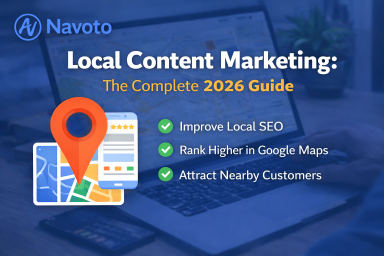
Local content marketing is a targeted digital strategy where businesses create and distribute content specifically designed for a geographic audience — to attract nearby customers, improve local SEO rankings, earn community authority, and drive foot traffic or local service inquiries.
Unlike broad content marketing that targets anyone with an internet connection, location-based content marketing zeroes in on the people most likely to become your customers: those who live, work, or search in your service area.
Think of a dentist in Austin writing a guide titled “How to Find an Emergency Dentist in South Austin” — that’s local content marketing. It targets a specific audience, in a specific location, with a specific intent. It earns rankings, builds trust, and drives phone calls. Generic content never could.
In 2026, local content marketing has evolved beyond blog posts. It now spans Google Business Profile posts, hyperlocal landing pages, community video content, structured FAQ pages, and AI-optimized content clusters — all working together to signal geographic relevance to Google’s increasingly sophisticated local ranking algorithm.
Why Local Content Marketing Matters for Local SEO in 2026
Google’s local ranking algorithm has three core factors: Relevance, Distance, and Prominence. While you can’t move your business address to improve Distance, local content marketing directly strengthens both Relevance and Prominence — the two factors you actually control.
Here’s exactly what a strong local SEO content strategy does for your rankings:
- Signals geographic relevance — Location-specific content tells Google exactly where you operate and what you offer, improving your match score for local queries
- Builds topical authority — Comprehensive coverage of your service topics and location signals expertise, authoritativeness, and trustworthiness (E-E-A-T)
- Earns local backlinks — Community-focused content naturally attracts links from local news sites, directories, and partner businesses
- Improves engagement signals — Relevant, helpful content keeps visitors on-page longer, reducing bounce rates and sending positive behavioral signals to Google
- Captures long-tail local searches — Specific location-intent queries (e.g., “best plumber in [neighborhood]”) have lower competition and higher conversion rates
- Feeds Google’s AI Overviews — Well-structured, authoritative local content is increasingly featured in Google’s AI-generated search summaries, capturing zero-click visibility
2026 trend alert: Google’s AI Overviews now appear for 40%+ of local informational queries. Businesses with structured, comprehensive local content are earning featured positions in these AI-generated answers — a massive visibility opportunity most local competitors are missing.
Types of Local Content Marketing
A winning local digital marketing strategy uses multiple content formats to capture different stages of the buyer journey. Here are the seven most effective content types for local businesses in 2026:
Location Landing Pages
Dedicated pages for each city or neighborhood you serve. Essential for multi-location and service-area businesses to rank in each target market.
Local Blog Content
How-to guides, seasonal tips, and educational articles tailored to your local audience’s specific challenges and questions.
Community & Neighborhood Guides
Comprehensive local resource pages that position your business as a community authority and attract organic backlinks from local media.
Local Video Content
Behind-the-scenes tours, customer testimonials, local event coverage, and educational videos that build trust and earn YouTube/Google video rankings.
Case Studies & Reviews
Local client success stories with specific results, neighborhoods, and names build credibility and rank for brand + location queries.
FAQ & Q&A Content
Structured answers to locally-specific questions. Optimized for Google’s People Also Ask boxes, featured snippets, and AI Overviews.
Google Business Profile Posts
Weekly posts directly on your GBP — promotions, tips, service highlights, and seasonal content — that improve local pack visibility and convert Map searchers directly to leads.
Step-by-Step Local Content Marketing Strategy
Effective local business marketing through content isn’t random — it’s a repeatable system. Here’s the exact framework Navoto uses for local clients:
Define Your Geographic Targeting
Map out every city, neighborhood, and zip code you want to rank in. Prioritize by proximity and revenue potential. Create a content cluster for each target area — a pillar location page supported by multiple topical blog posts referencing that area.
Conduct Local Keyword Research
Identify service + location keywords, near-me variations, neighborhood-specific queries, and long-tail questions your audience asks. Map each keyword to a specific content piece. Prioritize keywords with clear commercial or navigational intent.
Build Your Content Architecture
Use a hub-and-spoke model: one authoritative pillar page per service + location, supported by multiple supporting articles. Interlink all related pages to pass link equity and build topical clusters that signal deep expertise to Google.
Create and Optimize Content
Write content that leads with your location, uses natural geographic references, embeds LocalBusiness schema markup, includes real customer quotes and local examples, and answers the precise question behind the search query — not just a variation of it.
Distribute Across Local Channels
Amplify every piece: share on GBP posts, promote via local Facebook groups, pitch to local news outlets, send via email newsletter, and repurpose into short-form video for Instagram Reels and YouTube Shorts. One piece of content should live in at least 5 places.
Measure, Update, and Compound
Track rankings in Google Search Console, monitor GBP insights, and review traffic in GA4 monthly. Refresh top-performing content quarterly with new data, updated stats, and expanded sections. Content that ranks should be treated as an asset — maintained, not abandoned.
Local Keyword Research Techniques
The foundation of any effective local SEO content strategy is understanding exactly what your nearby customers are searching for. Here are the most powerful keyword research techniques for local businesses in 2026:
The 4 Local Keyword Formulas
Research Tools That Work in 2026
- Google Autocomplete & People Also Ask: Free, real-time data on what locals actually search. Type your service + city and capture every autocomplete suggestion
- Google Search Console: Your existing ranking data reveals which local queries are already driving impressions — expand on those topics with new content
- Ahrefs / Semrush Local Reports: Identify competitor content gaps, local keyword volume, and SERP feature opportunities in your market
- BrightLocal’s Local Search Grid: See exactly where your rankings sit across your service area — pinpointing geographic gaps your content can fill
- Reddit & Facebook Local Groups: Unfiltered real questions from locals reveal content ideas no keyword tool will show you
Pro technique: Search your primary keyword in Google’s incognito mode from your target city’s location. Screenshot the People Also Ask boxes — those are your next 10 blog post titles, handed to you by Google itself.
Content Ideas for Local Businesses (By Industry)
The best location-based content marketing ideas are specific to your industry. Here are proven content frameworks that generate consistent local traffic:
Universal Local Content Ideas (Any Industry)
- “[City] Complete Guide to [Your Service]” — comprehensive, rankable, linkable
- “How to Choose a [Your Business Type] in [City]: What to Look For”
- “[City] Neighborhood Spotlight: [Neighborhood Name]” — earns community backlinks
- “[Year] [City] [Industry] Pricing Guide” — high commercial intent, low competition
- “Top [Number] [Service] Mistakes [City] Homeowners/Businesses Make”
- Local event sponsorship recaps with photos and community tags
- Before/after project showcase with neighborhood and zip code mentioned
- “What to Do When [Local Emergency]” — captures urgent “near me” searches
Industry-Specific Content Angles
Home Services
- Seasonal maintenance checklists for your climate
- Local building code explainers
- Cost guides with local pricing data
Healthcare / Dental
- Insurance accepted in [City] guides
- Local health event recaps
- Patient success stories (with permission)
Restaurants / Food
- Local ingredient sourcing stories
- “Best [dish] in [neighborhood]” comparison posts
- Local food festival coverage
Legal / Financial
- State/county-specific law explainers
- Local court or regulation updates
- Community Q&A event recaps
How to Optimize Content for Google Maps and Local Search
Writing good content is only half the battle. To rank in Google Maps and the local pack, your content must be optimized with specific technical and structural signals:
On-Page Local Optimization Checklist
- ✅ Include city/neighborhood in H1 and first paragraph — Don’t bury your location. Mention it naturally within the first 100 words
- ✅ Add LocalBusiness schema markup — Structured data tells Google your business name, address, phone, hours, and service area explicitly
- ✅ Embed a Google Map on location pages and contact pages
- ✅ Consistent NAP in footer — Name, Address, Phone must match your Google Business Profile exactly
- ✅ Internal links to location pages — Every blog post referencing a city should link to that city’s service page
- ✅ Optimize image alt text — “HVAC technician working in Denver home” beats “technician-photo-1”
- ✅ Add local testimonials — Quotes from named local customers with their city mentioned add proximity and E-E-A-T signals
- ✅ Page speed & Core Web Vitals — Local searchers on mobile abandon slow pages. Google prioritizes fast-loading local content
Google Business Profile Content Optimization
Your GBP is a content platform, not just a business listing. Maximize it with:
- Weekly GBP posts — Promotions, tips, and updates that include your target keywords and location
- Q&A management — Pre-populate your Q&A section with keyword-rich questions and answers
- Photo captions — Add descriptive, location-specific captions to every uploaded photo
- Services and products — Complete service descriptions with location-specific language
- Business description — 750 characters max; use your primary service keyword and city in the first sentence
🗺️ The Local Content–GBP Connection
Google’s local ranking algorithm considers your entire web presence — not just your website. Businesses that publish consistent blog content AND maintain active GBP posts rank on average 35% higher in the local pack than those relying on GBP alone.
Every blog post you publish should be repurposed into a GBP post within 48 hours. This double-signals your location relevance to Google and gives Map searchers a reason to click through to your website.
Examples of Successful Local Content Marketing
Real-world examples make strategy tangible. Here are three proven models that local businesses across industries use successfully:
Example 1: The Neighborhood Guide Approach
A Chicago-based real estate agency created individual neighborhood guide pages for every suburb they served — “Living in Lincoln Park,” “Moving to Wicker Park Guide,” etc. Each page included school info, restaurant highlights, transit access, and local market data. Within 8 months, organic traffic from neighborhood searches grew by 340%, and the pages attracted backlinks from 12 local news outlets.
The model: Comprehensive local resource → earns backlinks → builds topical authority → drives service inquiries.
Example 2: The Seasonal Local Guide
A Denver HVAC company published “Denver Winter Home Preparation Checklist” each October and “Denver AC Season: What Homeowners Should Know” each April. Both posts ranked in positions 1–3 for seasonal queries, driving hundreds of calls during peak service periods. The content cost them 4 hours per year to update — ROI was 50× their content investment.
The model: Evergreen seasonal content → updated annually → consistently captures high-intent seasonal traffic.
Example 3: The Local Q&A Content Cluster
A family law firm in Austin built a content cluster answering 40+ locally specific questions: “How does divorce work in Travis County?”, “What is the average divorce settlement in Austin TX?”, “Texas community property laws explained.” The cluster dominated 30+ featured snippets and became their top source of inbound leads, outperforming paid ads at a fraction of the cost.
The model: Answer specific local legal/procedural questions → earn featured snippets → capture high-intent research traffic at zero ad cost.
Common Local Content Marketing Mistakes to Avoid
✗
Copy-pasting the same content across city pages with only the city name swapped. Google detects this as thin content and penalizes it. Every location page must have unique, genuinely local content.
✗
Stuffing city names and keywords unnaturally into content degrades readability and triggers Google’s spam filters. Location keywords should read naturally — if it sounds robotic, rewrite it.
✗
Publishing content and waiting for Google to find it is not a strategy. Every piece needs active promotion: GBP post, social share, email newsletter, local PR pitch, and internal link from an established page.
✗
A blog post from 2022 with outdated statistics and dead links sends negative quality signals. Audit your content annually. Update stats, refresh examples, fix broken links, and re-promote refreshed pieces.
✗
Orphaned content (pages with no internal links pointing to them) rarely ranks. Every new piece of content must be linked from at least 2–3 existing pages. Internal links pass authority and help Google discover and rank new content faster.
The Future of Local Content Marketing in 2026
The local content marketing landscape in 2026 is being reshaped by four major forces. Understanding them now positions your business ahead of the curve:
1. AI Overviews Demand Structured Authority Content
Google’s AI-generated summaries at the top of search results are pulling content from pages with clear structure, authoritative authorship, and comprehensive topic coverage. For local businesses, this means FAQ sections, definition boxes, and well-organized how-to content are now more valuable than ever — they’re the source material AI Overviews synthesize from.
2. Hyperlocal Content Outperforms Broad Local
City-level targeting is becoming table stakes. The businesses seeing outsized results in 2026 are those targeting neighborhoods, zip codes, and micro-communities with genuinely specific content. “Best plumber in Wicker Park” is now more valuable than “best plumber in Chicago.”
3. Video Content Is a Local Search Ranking Signal
Google’s video indexing has matured significantly. Short-form video content (YouTube Shorts, Instagram Reels) with location tags and local references is appearing directly in mobile local search results. Local businesses that produce even basic video content — a job walkthrough, a customer testimonial, a service explainer — gain a visibility channel most local competitors ignore.
4. E-E-A-T Is the Differentiator for Local Content
Google’s emphasis on Experience, Expertise, Authoritativeness, and Trustworthiness has made generic AI-generated content competitively weak. Content with real expert signatures, genuine local experience, named authors, and verified credentials consistently outranks mass-produced content — even when it’s shorter. Your local expertise is a competitive moat that AI cannot replicate.
The 2026 advantage: The businesses that win in local content marketing won’t be those producing the most content — they’ll be those producing the most genuinely local, genuinely expert content. Volume without specificity is a liability in today’s algorithm environment.
Frequently Asked Questions About Local Content Marketing
What is local content marketing?
Local content marketing is a targeted digital strategy where businesses create and distribute content specifically designed for a geographic audience to attract nearby customers, improve local SEO rankings, build community authority, and generate more local leads.
How does local content marketing improve local SEO?
Local content marketing improves local SEO by targeting location-specific keywords, building topical authority in your service area, earning local backlinks, and increasing engagement signals that help Google rank your business higher in local search results and Google Maps.
What types of content work best for local businesses?
The most effective content types for local businesses include location-specific service pages, local how-to guides, neighborhood guides, customer case studies, FAQ content targeting local search queries, and regular Google Business Profile posts.
How long does local content marketing take to show results?
Local content marketing usually shows measurable results within 3–6 months. Optimized local landing pages and Google Business Profile posts may generate results faster, sometimes within 4–8 weeks depending on competition.
How much content should a local business publish?
Local businesses should aim to publish 2–4 high-quality, locally relevant pieces of content per month. Consistency and quality are more important than volume when building local search visibility.
Conclusion: Your Local Content Action Plan
Local content marketing is not a tactic — it’s a long-term competitive asset. Every piece of locally optimized content you publish is a permanent beacon that continuously attracts nearby customers, builds community authority, and compounds your search visibility month after month.
The businesses winning in local search in 2026 aren’t those with the biggest budgets — they’re the ones that have built the most comprehensive, genuinely local, expertly written content ecosystems. That advantage is absolutely within reach for any local business with a clear strategy and consistent execution.
Your 5-Point Local Content Action Plan — Start This Week
Audit your current content — identify gaps, outdated posts, and pages with no location targeting
Research 20 local keywords using Google Autocomplete + People Also Ask for your top service + location
Create your first location pillar page — comprehensive, schema-marked, locally specific, with a clear CTA
Set a publishing schedule — 2 blog posts per month minimum, 1 GBP post per week
Measure monthly — track local rankings in Search Console, GBP insights, and organic traffic from local queries in GA4
Want Navoto to Build Your Local Content Strategy?
We build complete local content ecosystems — keyword research, content creation, GBP optimization, and link building — for local businesses that want to dominate their market.
Free audit. No commitment. Real results.